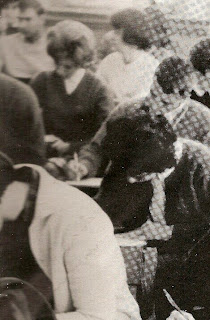
Loyola University (New Orleans) Philosophy students, ca. 1964. At that time incoming students chose majors according to interest and aptitude, not money making potential .
"Art history is the quintessence of the liberal arts, encompassing aesthetics, philosophy, political history, geography, even chemistry. That (Yale) introductory class gave such a sweeping, engaging, diversely relevant view of Western culture that it was frequented by budding physicists and engineers and actors as much as art historians.":- WSJ Letter writer, Feb. 5,, p. A17
In his recent essay, 'Civilization Is History At Yale', (WSJ, January 30, p. A17) Roger Kimball bemoans the retrenchment of Yale's famous 'Introduction to Art History' Course' which he describes as "a riveting introduction to the pulse of humanism." Adding:
"It is being cashiered for all the usual reasons. Its focus is "too white, too European, too male, too problematic" as Tim Barringer, chairman of the art history department put it. Mr. Barringer will substitute a course that challenges such Eurocentrism...and introduces a 'global perspective. Naturally, he says, the course will consider art in relation to gender, class and race."
Kimball adds that "it is also another sign that Yale has succumbed to a life -draining decadence. A decadent institution isn't necessarily impoverished or licentious. Rather it is dessicated because it has lost the live -giving pith of its purpose."
But I would submit what Kimball calls "dessication" is not simply reducible to one institution but to the entire field of study. In this case the humanities as an entire discipline has become infected with a 'disease' eroding its every facet and sub-discipline. In other words, the effect is not localized but throughout all institutions now offering the humanities in whatever form: art history, philosophy, literature.
Where once the concentration was on analyzing the works of Milton, Chaucer, Shakespeare, Shelley, Byron et al, the English (and Philosophy) major has now been "infected" by the works of Herbert Marcuse, or worse, Jacques Derrida. Derrida, for those unaware, was the creator of the nonsense called "deconstructionism" which encouraged assorted twerps in Ivy League (and other) universities to embrace full- on relativism in meaning and communication.
It can therefore be argued, as Professor Anthony T. Kronman has, that "post modernism" or "constructivism" or "antiessentialism" (crap by any other name) led to the downward arc of the humanities and of humanism in general. As he writes ('Education's End - Why Our Colleges and Universities Have Given Up On The Meaning Of Life'), p. 137:
"Loosely inspired by the work of philosophers as diverse as Marx, Nietzsche and Foucalt, constructivism affirmed the artificiality of all human values and the absence of any natural standards by which to judge them. It insisted, in particular, that the values of the West have no inherent superiority over those of other civilizatons and are merely instruments of power in disguise that must be unmasked and resisted as weapons of colonial oppression."
Therein lies the poison pill that - embedded within the humanities - contributing to its downward paths: "are those ideas that are the source of the culture of political correctness that has dominated the humanities for the past 40 years."
Prof. Kronman goes on to point out (ibid.) that these assorted constructivist ideas "helped to define a new and distinctive role for the humanities, organized around attractive moral and political values." Also that these "filled the void that opened up when teachers in these fields abandoned their role as guides to the question of life's purpose and value."
As Kronman notes this "appearance was a mirage" given the profs instead veered into a bogus research ideal that was often self-serving and inspired pushback from the hard sciences - which occurred with the Sokal hoax. (This was perpetrated by Alan Sokal in 1994, where he had a spurious paper published in the journal 'Social Text' that suckered all the Derridian twits into believing it was something serious. He succeeded by using the same fulsome language - albeit tying in elements of quantum theory- they did in their own empty research.)
How come this worked? Kronnman again (p. 139).
"Diversity, multiculturalism and constructivism are ideas that have failed to gain even a modest foothold in the natural sciences...That is because they are antithetical to the scientific ambitions to those disciplines and to their progams of research."
I would even go on to say the reason for exclusion of these flaky ideas and themes is similar to why we keep supernaturalism from infecting the scientific mode of research, see e.g.
Readers' thoughts on science and religion: Physics Today: Vol 71, No 6
Wherein I wrote:
"From a scientific and objective standpoint, there is simply no way that any purportedly supernatural entity or order can be demonstrated or proven. No scientific methodologies for such exist, nor any credible instruments or measuring techniques. ...One need not even deny its existence because to all intents the supernatural entity becomes logically unnecessary or redundant. It doesn't help us make scientific predictions or explain natural phenomena—say, coronal mass ejections or auroral substorms"
In much the same way constructivism and its derivatives offers nothing useful for hard science, and - like supernaturalist drivel - merely serves to impede progress. The exclusion of this dopey crap has helped to solidity and advance the position of the sciences, while - as Prof. Kronman notes (ibid.):
"Only in the humanities have these ideas attracted a significant following and been embraced as pedagogical values. The result has been to make the humanities appear even less respectable" say relative to the natural and hard social sciences (e.g. economics) - the real sources "of authority and prestige in American higher education today."
By contrast, "the humanities are not merely in a crisis they are in danger of becoming a laughing stock, both within the academy and outside it."
This is why I argue that Kimball's issues are not simply with Yale and its alleged "dessication", i.e. of the art history course, but rather of the humanities in general. At the same time, this is an unfortunate development because - taught the classical and proper way - the humanities have a crucial role in the development of the person.
By the latter I mean like the sort of (common core) English Lit course I took at Loyola in 1964- 65. The course consisted of a survey reading of Chaucer's 'Canterbury Tales' as well as Dryden's poetry and some Shakespeare ('King Lear', 'Hamlet') - with interpretations, discussions. In my (core) Philosophy course, the concentration was on Aristotle ('Politics', 'The Nicomachean Ethics') as well as Plato ('The Republic') . Philosophy majors (I was a chemistry major at the time) delved into much more classical philosophy (incl. Aquinas 'Summa Theologica') and no 20th century contributor was pursued. That's how it was and no surprise Loyola philosophy grads were able to write and think clearly - as opposed to emulating post-modernist clowns and poseurs.
As English Professor Paula Marantz Cohen put it in her 2018 WSJ essay: ('The Humanities' Decline Makes Us Morally Obtuse'):
"Science, engineering and finance may be hard but literature, history and philosophy are complex - impossible to resolve with a yes - or no, right or wrong answer. This is precisely what constitutes their importance as a tool for living. Metaphysics takes its name from the idea it goes beyond 'hard' science into the realm of moral and intellectual speculation, where no empirical proof is feasible."
This is a spot-on observation and also one that explains why most physicists, for example, would never write a book such as 'Beyond Atheism, Beyond God' - which I wrote seven years ago. Why not? Because in that book my Loyola Liberal Arts- Metaphysics- Ethics persona emerged, in particular in those chapters dealing with quantum mechanical conjectures, consciousness and how these affect human ethics and even religious propensities. (Explaining also why most physicists - though admitted atheists or agnostics - would never write any atheist or agnostic texts, as I did.)
In like manner, most physicists would not write a book such as 'The JFK Assassination - The Final Analysis'. Why not? Likely because most physicists either are not that invested in recent history, or not confident enough to write a 650-plus page book on one defining historical event (like the JFK assassination)
Beyond the two books cited above, I think of how much more restricted my writing would be without the exposure to the humanities I had at Loyola University, for example. Those years and courses - in everything from English lit, to metaphysics and ethics as well as comparative religion - set the stage for my much larger framework of experience and education. This was beyond the standard STEM subjects one takes in the course of specialization for one's chosen major. Were I to have been solely restricted to the STEM subjects, I'd never be writing about ethics, economics, religion, history now. This blog Brane Space would be vastly limited to just math and science topics.
Prof. Kronman's elaboration of a liberal arts education is one that ought to command attention for any graduate:
"All liberal arts education is defined in consciously non-vocational terms. It is not a preparation for this job or that, for one career rather than another. It is a preparation for the job of living, which of course is not a job at all. The variety of liberal arts education is enormous but all rest on the assumption that one important aim of undergraduate education is to afford the young who are its beneficiaries the opportunity to reflect on the curious and inspiring adventure of life before they have gone too far into it."
Secular humanism thereby enters (positively) as a philosophical template or infrastructure whereby "students and teachers pursue the perennial puzzle of human existence through the disciplined study of an interrelated series of works in which how a person ought to spend his or her life provides a connecting theme and organizing focus of inquiry."
The takeaway? Even if your college isn't in the habit of emphasizing reason and logic over "faith" in bunkum, you need to ensure you develop those attributes yourself. This should be irrespective of whatever the major chosen. That includes a much more generous appreciation of the (classical) humanities than standard (non-liberal arts inputs) STEM tracks - or dumbed down current humanities' allow.
See also:
