Showing posts with label deconstructionism. Show all posts

Tuesday, February 11, 2020

Collapse Of The Humanities Isn't Merely For Dept. Of Art History At Yale

Image result for brane space, Loyola
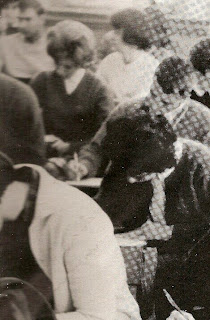
Loyola University (New Orleans) Philosophy students, ca. 1964. At that time incoming students chose majors according to interest and aptitude, not money making potential .

"Art history is the quintessence of the liberal arts, encompassing aesthetics, philosophy, political history, geography, even chemistry.  That (Yale) introductory class gave such a sweeping, engaging, diversely relevant view of Western culture that it was frequented by budding physicists and engineers and actors as much as art historians.":-  WSJ Letter writer, Feb. 5,, p. A17
 
In his recent essay, 'Civilization Is History At Yale', (WSJ,  January 30, p. A17) Roger Kimball  bemoans the  retrenchment of Yale's famous 'Introduction to Art History' Course'     which he describes as "a riveting introduction to the pulse of humanism."   Adding:

"
It is being cashiered for all the usual reasons. Its focus is "too white, too European, too male, too problematic"  as Tim Barringer, chairman of the art history department put it.  Mr. Barringer will substitute a course that challenges such Eurocentrism...and introduces a 'global perspective. Naturally, he says, the course will consider art in relation to gender, class and race."

Kimball  adds that "it is also another sign that Yale has succumbed to a life -draining decadence. A decadent institution isn't necessarily impoverished or licentious. Rather it is dessicated because it has lost the live -giving pith of its purpose."

But I would submit what Kimball calls "dessication"  is not simply reducible to one institution but to the entire field of study. In this case the humanities as an entire discipline has become infected with a 'disease'  eroding its every facet and sub-discipline. In other words, the effect is not localized but throughout all institutions now offering the humanities in whatever form:  art history, philosophy, literature. 

Where once the concentration was on  analyzing the works of Milton, Chaucer, Shakespeare, Shelley, Byron et al, the English (and Philosophy)  major has now been "infected" by the works of Herbert Marcuse, or worse, Jacques Derrida. Derrida, for those unaware, was the creator of the nonsense called "deconstructionism" which encouraged assorted twerps in Ivy League (and other) universities to embrace full- on relativism in meaning and communication.

It can therefore be argued,  as Professor Anthony T. Kronman has, that "post modernism" or "constructivism" or  "antiessentialism"  (crap by any other name)  led to the downward arc of the humanities and of humanism in general.  As he writes ('Education's End - Why Our Colleges and Universities Have Given Up On The Meaning Of Life'), p. 137:

"Loosely inspired by the work of philosophers as diverse as Marx, Nietzsche and Foucalt, constructivism affirmed the artificiality of all human values and the absence of any natural standards by which to judge them. It insisted, in particular, that the values of the West have no inherent superiority over those of other civilizatons  and are merely instruments of power in disguise that must be unmasked and resisted  as weapons of colonial oppression."

Therein lies the poison pill that - embedded within the humanities - contributing to its downward paths:  "are those ideas that are the source of the culture of political correctness that has dominated the humanities for the past 40 years."

Prof. Kronman goes on to point out (ibid.) that these assorted constructivist ideas "helped to define a new and distinctive role for the humanities, organized around attractive moral and political values." Also that these "filled the void that opened up when teachers in these fields abandoned their role as guides to the question of life's purpose and value."

As Kronman notes this "appearance was a mirage" given the profs instead veered into a bogus research ideal that was often self-serving and inspired pushback from the hard sciences - which occurred with the Sokal hoax.  (This was perpetrated by Alan Sokal in 1994, where he had a spurious paper published in the journal 'Social Text' that suckered all the Derridian twits into believing it was something serious.  He succeeded by using the same fulsome language - albeit tying in elements of quantum theory-  they did in their own empty research.)

How come this worked? Kronnman again (p. 139).

"Diversity, multiculturalism and constructivism are ideas that have failed to gain even a modest foothold in the natural sciences...That is because they are antithetical to the scientific ambitions to those disciplines and to their progams of research."


I would even go on to say the reason for exclusion of these flaky ideas and themes is similar to why we  keep supernaturalism from infecting the scientific mode of research, see e.g.  


Readers' thoughts on science and religion: Physics Today: Vol 71, No 6


Wherein I wrote:

"From a scientific and objective standpoint, there is simply no way that any purportedly supernatural entity or order can be demonstrated or proven. No scientific methodologies for such exist, nor any credible instruments or measuring techniques. ...One need not even deny its existence because to all intents the supernatural entity becomes logically unnecessary or redundant. It doesn't help us make scientific predictions or explain natural phenomena—say, coronal mass ejections or auroral substorms"

In much the same way constructivism and its derivatives offers nothing useful for hard science, and - like supernaturalist drivel - merely serves to impede progress.  The exclusion of this dopey crap has helped to solidity and advance the position of the sciences, while - as Prof. Kronman notes (ibid.):

"Only in the humanities have these ideas attracted a significant following and been embraced as pedagogical values.  The result has been to make the humanities appear even less respectable say relative to the natural and hard social sciences (e.g. economics)  - the real sources "of authority and prestige in American higher education today."

By contrast, "the humanities are not merely in a crisis they are in danger of becoming a laughing stock, both within the academy and outside it."

This is why I argue that Kimball's issues are not simply with Yale and its alleged "dessication", i.e. of the art history course, but rather of the humanities in general.  At the same time, this is an unfortunate development because -   taught the classical and proper way -   the humanities have a crucial role in the development of the person.   

By the latter I mean like the sort of (common core)  English Lit course I took at Loyola in 1964- 65.   The course consisted of a survey reading of Chaucer's 'Canterbury Tales' as well as Dryden's poetry and some Shakespeare ('King Lear',  'Hamlet') - with interpretations, discussions.  In my (core) Philosophy course, the concentration was on Aristotle ('Politics', 'The Nicomachean Ethics')  as well as Plato ('The Republic') .  Philosophy majors (I was a chemistry major at the time)  delved into much more classical philosophy (incl. Aquinas 'Summa Theologica')  and no 20th century contributor was pursued. That's how it was and no surprise Loyola philosophy grads were able to write and think clearly - as opposed to emulating  post-modernist clowns and poseurs.

As English Professor Paula  Marantz Cohen put it in her 2018 WSJ  essay: ('The Humanities' Decline Makes Us Morally Obtuse'):

 "Science, engineering and finance may be hard but literature, history and philosophy are complex - impossible to resolve with a yes - or no, right or wrong answer. This is precisely what constitutes their importance as a tool for living. Metaphysics takes its name from the idea it goes beyond 'hard' science into the realm of moral and intellectual speculation, where no empirical proof is feasible."

This is a spot-on observation and also one that explains why most physicists, for example, would never write a book such as 'Beyond Atheism, Beyond God' - which I wrote seven years ago.  Why not? Because in that book my Loyola Liberal Arts- Metaphysics- Ethics persona emerged, in particular in those chapters dealing with quantum  mechanical conjectures, consciousness and how these affect human ethics and even religious propensities. (Explaining also why most physicists - though admitted atheists or agnostics - would never write any atheist or agnostic texts, as I did.)

In like manner, most physicists would not write a book such as 'The JFK Assassination - The Final Analysis'.  Why not?   Likely because most physicists either are not that invested in recent history, or not confident enough to write a 650-plus page book on one defining historical  event (like the JFK assassination) 

Beyond the two books cited above, I think of how much more restricted my writing would be without the exposure to the humanities I had at Loyola University, for example. Those years and courses -  in everything from English lit, to metaphysics and ethics as well as comparative religion -  set the stage for my much larger framework of experience and education. This was beyond the standard STEM subjects one takes in the course of specialization for one's chosen major.  Were I to have been solely restricted to the STEM subjects, I'd never be writing about ethics, economics, religion, history now.  This blog Brane Space would be vastly limited to just math and science topics.


Prof. Kronman's elaboration of a liberal arts education is one that ought to command attention for any graduate:

"All liberal arts education is defined in consciously non-vocational terms.  It is not a preparation for this job or that, for one career rather than another.  It is a preparation for the job of living, which of course is not a job at all.   The variety of liberal arts education is enormous but all rest on the assumption that one important aim of undergraduate education is to afford the young who are its beneficiaries the opportunity to reflect on the curious and inspiring adventure of life before they have gone too far into it."


Secular humanism thereby enters (positively)  as a philosophical template or infrastructure whereby "students and teachers pursue the perennial puzzle of human existence through the disciplined study  of an interrelated series of works in which how a person ought to spend his or her life provides a connecting theme and organizing focus of inquiry."

The takeaway? Even if your college isn't in the habit of emphasizing reason and logic over "faith" in bunkum, you need to ensure you develop those attributes yourself.  This should be irrespective of whatever the major chosen. That includes a much more generous appreciation of the (classical)  humanities than standard (non-liberal arts inputs) STEM tracks -   or dumbed down current humanities' allow.

See also:


Monday, September 16, 2019

Are English & Fine Arts Majors "Worth It"? Yes, If Your Aptitude Is Confined To Those Areas

Image result for brane space, Loyola
Loyola University (New Orleans) Philosophy students, ca. 1964. At that time incoming students chose majors according to aptitude, not money making potential .


Once again we have another 'cart before the horse' op-ed column by William McGurn ('Is Majoring English Worth It?' WSJ, Sept. 10, p. A13)  where the Journal's resident curmudgeon scribbles:

"If you're a parent going into hock to pay for your son or daughter's degree in English you might be feeling a mite anxious about what you are getting for all those (tuition) dollars?"

He goes on to cite the not so great stats on such majors:

"A just-released Bankrate study won't make you feel any better.  In a ranking of 162 college majors by median income and unemployment rate, English majors landed among the bottom dwellers, at 132.  At $47, 800 in median income, they did better than those in drama ($35,500) or fine arts ($37,000), but they earned less than half as much as those who majored in electrical engineering ($99,000)"

Which totally misses the point because it assumes those English majors just selected their studies out of a whim. Not appreciating they may well have done so because they realized they didn't have the aptitude for electrical engineering (or any engineering).  A good indicator? They perhaps got a 700 in the English section of the SAT and only 490 in the math.  SO, to use an old cliche, why would you try to squeeze this round peg into a square hole?

Maybe what eludes McGurn is that those English (and Fine Arts) majors know in their heart of hearts if they selected the clearly more remunerative electrical engineering (or petroleum engineering) they'd just flunk out. Period.

Now it is true, as McGurn goes on to note, that the cachet of the major itself has taken a hit as it's been diluted and dumbed down. So where once the concentration was on  analyzing the works of Milton, Chaucer, Shakespeare, Shelley, Byron et al, the English (and Philosophy)  major has now been "infected" by the works of Herbert Marcuse, or worse, Jacques Derrida. Derrida, for those unaware, was the creator of the nonsense called "deconstructionism" which encouraged assorted twerps in Ivy League (and other) universities to embrace full- on relativism in meaning and communication to impart....well, balderdash. They even attempted to extend this gibberish to scientific areas.

Contrast that from when I took the perfunctory (common core)  English Lit course at Loyola in 1964- 65.   The course consisted of a survey reading of Chaucer's 'Canterbury Tales' as well as Dryden's poetry and some Shakespeare ('King Lear',  'Hamlet') - with interpretations, discussions.  In my (core) Philosophy course, the concentration was on Aristotle ('Politics', 'The Nicomachean Ethics')  as well as Plato ('The Republic') .  Philosophy majors (I was a chemistry major at the time)  delved into much more classical philosophy (incl. Aquinas 'Summa Theologica')  and no 20th century contributor was pursued. That's how it was and no surprise Loyola philosophy grads were able to write and think clearly - as opposed to emulating clowns and poseurs.

My personal introduction to Derridian madness was incepted by having to argue with his assorted deconstructionist disciples on the AOL forums , ca. 1993. They had  claimed "No REAL Humans were killed at Hiroshima and Nagasaki" only "mental constructions of humans, since the A-bomb was a mental construction of a real bomb". Of course, if NO real humans were killed and they view even an A-bomb as an abstraction, they'd have no qualms about carrying out any kind of killing themselves! Indeed, they'd regard any bombs or other weapons they use as "mental constructions"!

This sort of (literally) insane moral "argument" paves the way to moral chaos and insanity since it seeks to conflate  the objective realm with the internal, subjective one.  Thus, what is embedded in the (Derridian's) head  becomes conflated with the outside world- thereby trivializing the latter as mere "epiphenomena". People then cease to be authentic beings and emerge more as virtual-digital avatars - to be wiped out as if from a mouse click. At least one serial killer, I believe the "Green River killer", actually invoked Derridianism as an excuse for his crimes if memory serves.

So, to quote Jonathan Pidluzny - Director of Academic Affairs for the American Council of Trustees and Alumni (whom McBurn cites):

"The English major was once a guarantor of effective, formal , writing skills and the ability to comprehend and analyze the complex thoughts found within centuries of brilliant and challenging poetry and prose."

But now it's mainly dedicated to the subjective bollocks of Derrida and Marcuse, while exposure to the classic works - such as Milton's Paradise Lost-  is uh, lost.  As McGurn so colorfully puts it (ibid.):

"What''s on offer today isn't your father's English degree"

Or, his philosophy degree.   To McGurn's credit he makes clear that "it isn't that STEM subjects are the only subjects worth anything", but rather the humanities have been "infected" with too much ambiguous balderdash - from the likes of Marcuse, Derrida and company.

Pidluzny, for his part, reduces the problem mainly to one of lost rigor.  So a humanities major "still rooted in a rigorous core curriculum still provides value".  But when its core veers off into the nebulous realm of opinionating on the subjective meaning of language or relativism all bets are off. 

The question then emerges as to why the sciences have kept their integrity while the humanities (for the most part) haven't.  Well, in the words of Pidluzny:

"The costs of a dumbed down STEM degree can be more consequential"

Adding:

"The university can't get away without teaching engineering students differential equations because we'd have collapsing bridges all over the place".

(Side note: We do have collapsing bridges all over but that's not because of the lack of DEs being taught in engineering courses but because we have not reinvested in our existing infrastructure.)

Sounding his final note on the issue Pidluzny says:

"But for an English major who studies Harry Potter instead of Chaucer, or spends his time on gender theory instead of reading great literature, the costs aren't as obvious - except to the graduate who only later realizes he never developed the keen analytical mind and precise style of writing college was supposed to cultivate."


So true. But in an era in which universities are more invested in grabbing money by jazzing up enrollment - often by allowing rampant grade inflation - this is what it's come to: debased studies lacking any rigor and zero critical thinking. 

But, should the student stuck in a major (or course sequence) without rigor then opt to join the STEM curriculum?  Again, not unless that student has an aptitude for the subjects that curriculum entails, including: classical mechanics, dynamics,  calculus, linear algebra and likely differential equations and complex analysis.  Else, it is a route to frustration and failure, not enhanced earning power.

Finally, it is well to bear in mind the words Dr. Steve Mason wrote in an Integra article  ('The Myth of Higher Education') some years ago:

"The bottom line regarding a well -rounded education is that it has nothing to do with any kind of bottom line. Its value (non-monetary) is to be found in the quality it adds to one's life. It allows one to better appreciate music, art, history and literature. 

It contributes to a better understanding of language and culture, nature and philosophy. It expands rather than limits horizons and replaces faith and belief with reason and logic.
"

The takeaway? Even if your college isn't in the habit of emphasizing reason and logic over "faith" in bunkum, you need to ensure you develop those attributes yourself.  This should be irrespective of whatever the major chosen. That includes a much more generous appreciation of the (classical)  humanities than standard (non-liberal arts inputs) STEM tracks -   or dumbed down current humanities' courses-   allow.

Saturday, February 25, 2017

Bannon's "Deconstruction", Or Is It Destruction? - Of The Administrative State

No photo description available.
160304_donald_trump-cpac_gty_1160.jpg
24 Hours later: "And  the press is YOUR enemy! And we gonna build that wall"


For those who may have missed it, the slimy swine Steven K. Bannon emerged from his pig warren at the White House to appear at the CPAC confab this past week.  Ever arrogant in his supreme swinehood, and seated alongside Chief of Staff Reince Priebus, Bannon dismissed the idea that Trump might moderate his positions or seek consensus with political opponents. Rather, he said, the White House is digging in for a long period of conflict to transform Washington and upend the world order.

Good luck, Bannon! Others before you have tried and failed miserably. Seeking to energize the assembled knuckle draggers and lackeys, Bannon bellowed:

“If you think they’re going to give you your country back without a fight, you are sadly mistaken, “every day, it is going to be a fight.", referring to the media and opposition forces arrayed for truth and facts against these Nazi scheits.  And let's be clear Trump doesn't fart unless it has the approval of Bannon. He has a hand in nearly every scripted public Trump utterance, and had expressed  similar sentiments to what Trump spat out at the conference the day after..

The porcine slob continued, “And that is what I’m proudest about Donald Trump. All the opportunities he had to waver off this, all the people who have come to him and said, ‘Oh, you’ve got to moderate’ — every day in the Oval Office, he tells Reince and I, ‘I committed this to the American people."

Actually, Trump and his gang of hoodlums are committed only to the 40 % or so who voted for them, believing their lives would improve. The other 60 percent are solidly opposed and dedicated to total resistance and political warfare. That is until such day we can replace the current odious so-called government with one acting in the People's interests, as per the Constitution. As the Founders themselves wrote in the Declaration of Independence:

"Governments are instituted among Men, deriving their just powers from the consent of the governed, — That whenever any Form of Government becomes destructive of these ends, it is the Right of the People to alter or to abolish it, and to institute new Government"

Got that, Stevie boy?

To tell the truth, as I watched clips of Bannon and Priebus' buddy routine on CNN it triggered flashbacks of Oscar and Felix in “The Odd Couple” - with Reince in the role of Felix and Bannon as Oscar. (Though truth be told at times Priebus came over more like Pee Wee Herman with his squeaky voice.)

But the most show- stopping moment transpired when Bannon boldly announced the Trumpies were dedicated to the  “deconstruction of the administrative state,” meaning the system of taxes, regulations and agency oversight the current structure of government supports. In other words, presumably eradicating all those elements of the federal "bureaucracy" that ensure your milk is free of fecal matter, your burgers of E Coli., your drinking water of perchlorates and lead, and your canned tuna free of botulism. Oh, also that medical devices are properly manufactured and sterilized to acceptable standards (FDA regs), i.e. so when you get your colonoscopy the colonoscope didn't just come directly from insertion into another patient..

In other words, taken literally, Bannon was advocating nothing less than terrorism against the civil state, the effective working government that has the general welfare as a primary role.

But wait! Maybe I misconstrued Bannon's yapping to mean destruction of the administrative state, when he actually used the term "deconstruction".  Is there a difference? And if so, what is it? The meaning of destruction is clear to anyone with more than air between the ears. It would be the effective destruction (or gutting from the inside)  of the federal agencies to which Trump's band of despicables have taken up posts, including the EPA, Department. of Energy, Health and Human Services etc.

If those are destroyed and hence the ability of the government to ensure the general welfare - a form of national security (perhaps the most basic) - then we are indeed talking of a form of terrorism.

On the other hand, if Bannon really did mean deconstruction, one must question what exactly he's talking about.   To fix ideas, French philosopher Jacques Derrida is the founder of deconstructionism - a marginal area of modern philosophy that purports to "deconstruct" literary texts and specifically :

"a theory of literary criticism that questions traditional assumptions about certainty, identity, and truth; asserts that words can only refer to other words; and attempts to demonstrate how statements about any text subvert their own meanings."

Read that carefully and process it in strict terms of fidelity to the meaning of the term he used. If we take Bannon seriously what he really said is that he is committed to a literary or philosophical criticism of the administrative state - not that he actually intends to abolish it. THAT would be destruction, not deconstruction. Is Bannon not smart enough to discern the difference? Or did he just append the word to his babble to try and impress the gathering of conservative hacks, yes men, lackeys and nitwits?

So, if we take Bannon literally it means his (and Trump's agenda) is not to destroy the federal agencies that protect our land, air, food and water but rather to challenge their underlying assumptions regarding "certainty, identity and truth" by a kind of literary criticism method.

This would entail questions posed to the agency heads and rank and file workers like:

1) Do we really need to check restaurants for sanitary standards? Can't we tolerate a little bit of roach feces and fly larvae in the pantries and on the foods, and some norovirus in the salads? Can we not allow just a bit more food poisoning - like at Chipotle  - to get higher profits?  If all restaurants have the same lower standards we all win, no?

2) Do we really need to regulate the amount of agricultural fertilizer runoff into lakes and streams giving rise to cryptosporidium,? (The parasite that made 440,000 Milwaukeeans sick in 1994)

3) Do we really need to inspect meat packing plants for E. coli. and whether the automated butchering process splatters it  into burgers?

You get the point. Each of these questions seeks to probe for degree of certainty, something any genuine Derridian who invokes deconstruction should appreciate.

Then there is identity. Is meat really meat?  Is there really such an entity as 100 % pure meat? (Meaning animal flesh). Isn't it okay to count pink slime as meat or at least as 50 percent filler? How about a teeny weeny bit - maybe a half ounce - of misplaced cow turd or floor shavings to pass as "meat" filler? Say if it gets caught in the grinder in the meat plant.  When is ice cream ice cream? How about a definition permitting a bit of errant drip off the roof - some of it carrying squirrel urine - to pass as ice cream if it accidentally ends up in the mixer below? Must the company really re-outfit the plant at great expense to avoid that?

And finally, there is truth. Rhetorically again - following Bannon's train of deconstruction:  Are we really expected to go after a company when its ground beef is claimed to be 100 percent beef but it's really 70 percent pink slime?  Isn't pink slime edible? Of course!  Or say a company advertises tuna as 100% wild caught when it is all farmed? Or a dairy claims its milk is pasteurized when it isn't? What's the big deal? It  takes a lot more money to regulate all these items when we could just take the word of advertisers or companies that make the products.

So the question then is whether Bannon's agenda means merely using questions like the preceding to push a Derridian deconstruction of the administrative state - OR - does he out and out mean destruction of that state?  The difference is critical because on the one hand we contend with mere words, and on the other hand,  actual actions which can impact one's health and security.

Of course, assorted nitwits. pundits and op-ed dunderheads see no problem. Like one moron (Patrick Armstead) writing in The Denver Post op-ed pages last Sunday who wrote (p. 6D):

"Obama's EPA became the primary vehicle for implementing regulations like the Clean Power Plan without asking Congress  for a vote",

Well, uh yeah, Sparky....because "congress" - meaning the Repukes, were mainly taking every other day off or doing nothing but obstruction while millions across the nation (including here in COS) were being poisoned by the mercury spewed out from coal -fired power plants.

Of course, this is the same turkey who also wrote: "Instead of giving the man voters elected a chance to govern they have written him off as an authoritarian and opted for total resistance."

Well, first it appears more and more this traitor was actually more elected by the Russians. As the intel agencies and FBI coalesce findings in their investigations this appears more and more likely.

 As for being called an "authoritarian", it doesn't take a Mensa level I.Q. to figure out that if a guy insists the "press is the enemy of the people"- like Hitler did ca. 1933, that he's an authoritarian. And also  if a guy dispatches ICE agents to break down immigrants' doors and haul them away, he is an authoritarian. And if he threatens violations of the Posse Comitatus Act  i.e. by sending federal troops to Chicago-  he is also one. This stuff isn't rocket science. And as one former Harvard professor of psychiatry (Lance M. Dodes) has noted: "If I see a guy yelling on the street about unseen enemies and flicking a switchblade - I don't need a DSM V manual to determine that he's mentally unbalanced."

So no, we don't have to give the Swine- in- chief (who suckles on the Sow Nazi in residence) any more chances than we have to understand he's a Hitler in the making and full on resistance is the order of the day.

Opposing our efforts there will always be the soft soaping media enablers such as Sabrina Tavernise ('Are Liberals Helping Trump?', Feb. 18) and WaPo hack Marc A. Thiessen ('The Left's Hypocrisy On Trump's 'Enemy of the American People Comment').At least Tavernise tried to show some balance in her coddling of the Trumpies, while Thiessen showed little or none. He hyped the "venom spewed by the left at anti-Trump rallies" but said nothing of the venom spewed by Trump - which as we've seen has now given rise to hundreds of hate crimes. That includes the murder of an Indian techie in Olathe, KS by a hard core Trump supporter babbling his same rhetoric. Can this fuckup hack Thiessen point to ONE incident where the "hateful Left" has vandalized one Jewish gravestone (far less 68 like the Trump Nazis), or burned a Mosque (as in Tampa last week) or shot an Indian student dead (mistaken for a middle Eastern immigrant)?  No? Then don't even attempt to inject false equivalence!

So he needs to shut the fuck up and train his sights on the real enemy here. The pretender passing for a president who doesn't know the first thing about the job and treats the truth with utter contempt. Meanwhile, the rest of us - not into giving the Trump Nazis a pass - must continue our resistance and keep doubling down until we oust this whole set of assholes and hurl them into history's dumpster. Most of humanity believed we'd seen the last of Hitler wannabes after 1945, but evidently not. There's now an authoritarian narcissist psychopath who wants to duplicate the Fuhrer's stunts and wreckage of a nation. We cannot let him.


See also:

http://smirkingchimp.com/thread/george-lakoff/71462/the-public-s-viewpoint-regulations-are-protections


And:

http://smirkingchimp.com/thread/p-m-carpenter/71367/trumps-oddly-exhausted-cpac-speech


Sunday, June 7, 2015

Insanity, Irrationality and the Inability of People to Reason: The Legacy of Jacques Derrida

Few people outside of academia have probably ever heard of philosopher Jacques Derrida. This is a pity, because apart from the PR-infested media- perhaps no other agent has been more responsible for the gutting of minds. Derrida is the founder of deconstructionism - a marginal area of modern philosophy that purports to "deconstruct" literary texts and specifically :

"a theory of literary criticism that questions traditional assumptions about certainty, identity, and truth; asserts that words can only refer to other words; and attempts to demonstrate how statements about any text subvert their own meanings."

My personal introduction to Derridian madness was incepted and initiated via exchanges with deconstructionists - on the AOL forums , ca. 1993- who claimed "No REAL Humans were killed at Hiroshima and Nagasaki" only "mental constructions of humans, since the A-bomb was a mental construction of a real bomb". Of course, if NO real humans were killed and they view even an A-bomb as an abstraction, they'd have no qualms about carrying out any kind of killing themselves! Indeed, they'd regard any bombs or other weapons they use as "mental constructions"!

This sort of (literally) insane intellectual and moral "argument" paves the way to moral chaos and insanity since it seeks to conflate automatically what is in the (Derridian's) head with the outside world- thereby trivializing any external, or objective reality as non-existent - reducing it to what can be immediately sensed by the person.

Flash forward to two days ago - when I made a comment on the Financial Times website, after an article about "mathiness" in finance and the reasonableness of mathematics in financial analysis and models. My comment reflected earlier points I've made in previous blog posts that: a) the only math actually justified in finance involves basic statistics, i.e. such as applied to job numbers, GDP, interest rates, inflation etc. and no advanced maths can be applied to models since b) financial and economic models are purely confections of an artificial universe and have no genuine objects of inquiry. 

For example, in devising economic models all "externalities" are ignored. This would be analogous to physicists ignoring the role of energy in assorted models, say of stars. In an April 26, 2010 letter of mine published in The Financial Times,  I drew attention to the abysmal failure of modern macro-economics (touted as a “science”) to predict the 2008 market meltdown and financial crisis. I pointedly noted that economics ignored too many externalities which included aspects like environmental costs and resources that were omitted from its models, as well as lacking any consistent empirical basis analogous to physics.

Illustration of  the Gaussian Copula Formula used by economists to justify credit default swaps.

In the particular case of the failure in predicting the credit crisis and meltdown, academic economics erred by assuming a putatively poorly regulated system was capable of sustaining massive risk entrenched in obscure, poorly understood credit derivatives created by Wall Street “quants” , most of whom had forsaken bright careers in science or mathematics to invent these devious financial instruments for investment banks. The assumption saw all the hinges come loose when the credit default swaps were immersed in securities purported to be safe, since they were given AAA ratings by credit agencies like Moody’s and Standard and Poor’s.

Thus, the  forecast failure was predicated on a three-way collapse of the paradigm: 1) commercial banks taking on the risk of investment banks by leveraging their assets to preposterous ratios (sometimes as high as 33:1), 2) credit derivatives designed using the Gaussian Copula Formula which enabled them to be sliced, and spread throughout ordinary securities such as collateralized mortgage obligations, and 3) a failure of the credit rating agencies to take proper note of (2) and in effect, be blinded while assigning bond ratings the securities didn’t deserve.

Since then, it’s become ever more evident why economics is a failure and can’t even be regarded as a science like Physics,


In the case of the Gaussian copula, invented by David X. Li while working at JP Morgan Chase and articulated in his (2000) paper: ‘On Default Correlation: A Copula Function Approach”  it isn't a true mathematically sound equation analogous to those used in physics or celestial mechanics.. It is more an intellectual Frankenstein monster that never should have seen the light of day any more than a four-headed baby with a pointed tail. For example, Li's misuse of the distribution functions (FA(1)) and (FB(1)) would appall any genuine mathematician or physicist. Each is actually based upon significant uncertainties via survival law distributions which can vary enormously. There is no way to normalize any probability based on (TA, TB so there is no way to equate Pr[TA, TB] to anything on the left side. The equal sign is dangerous recklessness masquerading as math. Were economists or "quants" know any of this when they cranked out credit default swaps? The evidence of failure to predict the 2008 credit crash shows they didn't.

Getting back to my recent FT website comment, one poster using the monicker "camus_deferral" didn't take kindly to it, basically arguing astrophysics had no "real" objects of inquiry either, since after all black holes couldn't be observed, and how did we know anything about the universe since the distances weren't even "graspable".  Besides, he insisted, "all your parameters can change on a dime" - such as the current fact that the expansion of the cosmos is undergoing acceleration.

After patiently trying to explain astrophysics basics, including that black holes  - while not directly observable - were nevertheless detectable (i.e. via their x-ray signatures as part of binary systems) we came to an impasse based on what exactly defined a "real object" - assuming any such entity actually existed.

I tried to explain that in empirical science we define a real object as any for which definable properties could be exposed, say following observational or other analysis. This would also enable classification of such objects, for example stars into spectral classes O, B, A, F, G, K, M based on measured temperatures and spectroscopic analysis.  Thus, stars were certainly real objects, as were planets which could be grouped into "gas giants" (Saturn, Jupiter, Uranus, Neptune) and "terrestrial type" planets with hard surfaces. Also, we know planets are real objects by the fact space craft have actually landed on a number of them, i.e. Russia's Venera Probe on Venus, Viking and Rover on Mars, etc.

None of this mattered to "camus" who denied any such examples constituted real objects and they could as well all be merely in an astrophysicist's mind. To him it was only real if he could "hold it and touch it". Ironically, he was awarding himself reality perception on the basis of proximity to the senses, but dismissing it for astrophysics - for which he allowed only a Derridian facsimile. 

Interestingly, he failed to appreciate his definition would apply even more cogently to entities  fabricated in financial models, i.e. using the Gaussian Copula Formula which mixes functions from human actuarial tables, generic survival distribution laws, and a “probability” function based on coupling two financial entities in an actuarial table – then tossing in a correlation coefficient. 

Imagine a quantum physicist performing an analogous desecration of his probability density equation, e.g.
by incorporating standard Gaussian distributions (not normalized) and mixing electrons with macroscopic entities like marbles – then deeming the wave function is capable of capturing the survival probabilities of both marbles and electrons? And – to add injury to insult, fabricating a “correlation coefficient” to relate (couple) survivable marbles to electrons?

Any such quantum physicist would be rapidly deemed insane and trotted off for some needed intervention, including ECT treatments.

I was tempted to suggest as much for "camus". However, I decided to simply end the exchange by observing it wasn't possible to have a constructive debate with anyone incapable of distinguishing reality from unreality - or who didn't even understand basic astrophysics.

Alas, this interlude shows the malformed, deconstructionist legacy of Jacques Derrida remains alive and well.  You will even find it in more sophisticated enclaves of the web, such as the Financial Times site.

See also:

http://brane-space.blogspot.com/2010/04/no-maths-was-not-responsible.html

And:

http://www.smirkingchimp.com/thread/jaime-oneill/62564/the-dumbfuckification-of-damn-near-everything