Showing posts with label Dr. Steve Mason. Show all posts

Monday, September 16, 2019

Are English & Fine Arts Majors "Worth It"? Yes, If Your Aptitude Is Confined To Those Areas

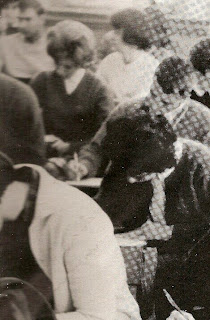
Image result for brane space, Loyola
Loyola University (New Orleans) Philosophy students, ca. 1964. At that time incoming students chose majors according to aptitude, not money making potential .


Once again we have another 'cart before the horse' op-ed column by William McGurn ('Is Majoring English Worth It?' WSJ, Sept. 10, p. A13)  where the Journal's resident curmudgeon scribbles:

"If you're a parent going into hock to pay for your son or daughter's degree in English you might be feeling a mite anxious about what you are getting for all those (tuition) dollars?"

He goes on to cite the not so great stats on such majors:

"A just-released Bankrate study won't make you feel any better.  In a ranking of 162 college majors by median income and unemployment rate, English majors landed among the bottom dwellers, at 132.  At $47, 800 in median income, they did better than those in drama ($35,500) or fine arts ($37,000), but they earned less than half as much as those who majored in electrical engineering ($99,000)"

Which totally misses the point because it assumes those English majors just selected their studies out of a whim. Not appreciating they may well have done so because they realized they didn't have the aptitude for electrical engineering (or any engineering).  A good indicator? They perhaps got a 700 in the English section of the SAT and only 490 in the math.  SO, to use an old cliche, why would you try to squeeze this round peg into a square hole?

Maybe what eludes McGurn is that those English (and Fine Arts) majors know in their heart of hearts if they selected the clearly more remunerative electrical engineering (or petroleum engineering) they'd just flunk out. Period.

Now it is true, as McGurn goes on to note, that the cachet of the major itself has taken a hit as it's been diluted and dumbed down. So where once the concentration was on  analyzing the works of Milton, Chaucer, Shakespeare, Shelley, Byron et al, the English (and Philosophy)  major has now been "infected" by the works of Herbert Marcuse, or worse, Jacques Derrida. Derrida, for those unaware, was the creator of the nonsense called "deconstructionism" which encouraged assorted twerps in Ivy League (and other) universities to embrace full- on relativism in meaning and communication to impart....well, balderdash. They even attempted to extend this gibberish to scientific areas.

Contrast that from when I took the perfunctory (common core)  English Lit course at Loyola in 1964- 65.   The course consisted of a survey reading of Chaucer's 'Canterbury Tales' as well as Dryden's poetry and some Shakespeare ('King Lear',  'Hamlet') - with interpretations, discussions.  In my (core) Philosophy course, the concentration was on Aristotle ('Politics', 'The Nicomachean Ethics')  as well as Plato ('The Republic') .  Philosophy majors (I was a chemistry major at the time)  delved into much more classical philosophy (incl. Aquinas 'Summa Theologica')  and no 20th century contributor was pursued. That's how it was and no surprise Loyola philosophy grads were able to write and think clearly - as opposed to emulating clowns and poseurs.

My personal introduction to Derridian madness was incepted by having to argue with his assorted deconstructionist disciples on the AOL forums , ca. 1993. They had  claimed "No REAL Humans were killed at Hiroshima and Nagasaki" only "mental constructions of humans, since the A-bomb was a mental construction of a real bomb". Of course, if NO real humans were killed and they view even an A-bomb as an abstraction, they'd have no qualms about carrying out any kind of killing themselves! Indeed, they'd regard any bombs or other weapons they use as "mental constructions"!

This sort of (literally) insane moral "argument" paves the way to moral chaos and insanity since it seeks to conflate  the objective realm with the internal, subjective one.  Thus, what is embedded in the (Derridian's) head  becomes conflated with the outside world- thereby trivializing the latter as mere "epiphenomena". People then cease to be authentic beings and emerge more as virtual-digital avatars - to be wiped out as if from a mouse click. At least one serial killer, I believe the "Green River killer", actually invoked Derridianism as an excuse for his crimes if memory serves.

So, to quote Jonathan Pidluzny - Director of Academic Affairs for the American Council of Trustees and Alumni (whom McBurn cites):

"The English major was once a guarantor of effective, formal , writing skills and the ability to comprehend and analyze the complex thoughts found within centuries of brilliant and challenging poetry and prose."

But now it's mainly dedicated to the subjective bollocks of Derrida and Marcuse, while exposure to the classic works - such as Milton's Paradise Lost-  is uh, lost.  As McGurn so colorfully puts it (ibid.):

"What''s on offer today isn't your father's English degree"

Or, his philosophy degree.   To McGurn's credit he makes clear that "it isn't that STEM subjects are the only subjects worth anything", but rather the humanities have been "infected" with too much ambiguous balderdash - from the likes of Marcuse, Derrida and company.

Pidluzny, for his part, reduces the problem mainly to one of lost rigor.  So a humanities major "still rooted in a rigorous core curriculum still provides value".  But when its core veers off into the nebulous realm of opinionating on the subjective meaning of language or relativism all bets are off. 

The question then emerges as to why the sciences have kept their integrity while the humanities (for the most part) haven't.  Well, in the words of Pidluzny:

"The costs of a dumbed down STEM degree can be more consequential"

Adding:

"The university can't get away without teaching engineering students differential equations because we'd have collapsing bridges all over the place".

(Side note: We do have collapsing bridges all over but that's not because of the lack of DEs being taught in engineering courses but because we have not reinvested in our existing infrastructure.)

Sounding his final note on the issue Pidluzny says:

"But for an English major who studies Harry Potter instead of Chaucer, or spends his time on gender theory instead of reading great literature, the costs aren't as obvious - except to the graduate who only later realizes he never developed the keen analytical mind and precise style of writing college was supposed to cultivate."


So true. But in an era in which universities are more invested in grabbing money by jazzing up enrollment - often by allowing rampant grade inflation - this is what it's come to: debased studies lacking any rigor and zero critical thinking. 

But, should the student stuck in a major (or course sequence) without rigor then opt to join the STEM curriculum?  Again, not unless that student has an aptitude for the subjects that curriculum entails, including: classical mechanics, dynamics,  calculus, linear algebra and likely differential equations and complex analysis.  Else, it is a route to frustration and failure, not enhanced earning power.

Finally, it is well to bear in mind the words Dr. Steve Mason wrote in an Integra article  ('The Myth of Higher Education') some years ago:

"The bottom line regarding a well -rounded education is that it has nothing to do with any kind of bottom line. Its value (non-monetary) is to be found in the quality it adds to one's life. It allows one to better appreciate music, art, history and literature. 

It contributes to a better understanding of language and culture, nature and philosophy. It expands rather than limits horizons and replaces faith and belief with reason and logic.
"

The takeaway? Even if your college isn't in the habit of emphasizing reason and logic over "faith" in bunkum, you need to ensure you develop those attributes yourself.  This should be irrespective of whatever the major chosen. That includes a much more generous appreciation of the (classical)  humanities than standard (non-liberal arts inputs) STEM tracks -   or dumbed down current humanities' courses-   allow.

Thursday, July 14, 2016

Available Job vs. Degree Mismatches Leave Too Many Grads Sitting In Their Parents' Basements


Molly could be in a high paying job paying off her college debts, instead of daydreaming in her childhood bedroom, had she just taken a logistics degree - as opposed to psychology - according to the Denver Post.

According to a piece in the new AARP Bulletin ('More Adult Kids Living With Their Parents', July-August, p. 6) a survey by Redfin Real Estate Brokerage finds that one fifth of homeowners age 55 to 64 have adult children at home causing them to remain in larger homes.  The same piece notes that "nearly one-third of millennials, or 32, 1 percent" now lie with their parents, the largest percentage in 130 years.

Meanwhile, a Denver Post story ('Postgrad Dismay', July 12, p. 9A) observes that a large part of this arises from recent college grads not having the right degrees. Hence, there is a mismatch between the actual jobs available and the skill set (or talent) offered by the new grads looking for jobs. It speculates that this is one major reason why so many young grads are holed up in their parents' basements.

Just how bad is the jobs-degree mismatch? According to the Post, "the state graduates 15 times more students with physical science degrees than there are actually open positions to absorb them".. In other words, these students end up working at jobs - if they work at all - that represent significant underemployment, say like Starbucks baristas.

The situation isn't much better for life science major who graduate in numbers nearly 13 times greater than the available open positions in the state.

But Business majors of all types need to take a deep breath before they get too smug. According to the Post's statistics there were 28,837 graduates this year with management degrees while there were only 5, 756 job openings for those with such degrees. By contrast, there were 15, 359 office support positions open but only 2,020 with degrees in that area. A vast mismatch.

The same Post study found no less than 4,417 more job openings for logistics majors than there were actually grads available to fill them. Logistics? What the hell kind of major is that? For sure it wasn't anywhere around 40 years ago! Anyway, by googling "logistics major" one learns:

 "A program that prepares individuals to manage and coordinate all logistical functions in an enterprise, ranging from acquisitions to receiving and handling, through internal allocation of resources to operations units, to the handling and delivery of output. Includes instruction in acquisitions and purchasing, inventory control, storage and handling, just-in-time manufacturing, logistics planning, shipping and delivery management, transportation, quality control, resource estimation and allocation, and budgeting."

The depth of these mismatches discloses something seriously amiss with our corporate employment system. In particular, it has become infested by a business culture too obsessed with specific training and degree skills, rather than imparting these skills in on the job training as used to be the case. Case in point: why is it not possible for a sizeable proportion of the business management grads to take logistics major jobs? I mean, the latter is just a synergistic extension of general management, right?  Or am I being too naïve for the new Neolib system?

When I took my first job in 1967 as a geologist's assistant for an Oil corporation, I had no training in petroleum geology nor had I even taken a single course in geology. Under today's peddled malarkey, I'd therefore merit being jobless for not possessing the correct and specific skill set. But in truth, the company understood that 99% of all applicants would lack such prerequisites, so had developed a training program where one learned on the fly.
 
 
With this job, I was able to establish my independence at age 20, and get my own apartment on Canal St. in New Orleans. Meanwhile, today's debt-slave kids are seeing hell, and 5.9 million between 21 and 34 have had to move back in with their PARENTS! But what else can they do when the jobs that are available (mainly desk clerks, telemarketers and retail) are unable to deliver that independence, far less pay off monstrous college loans?
 
So the additional question arises: why couldn't those companies with 15, 359 office support positions open at least train some of the 23,000 - odd business management degree majors who didn't find specific management jobs?  (Or perhaps jobs in logistics) Are the job duties that different, to the extent the talents of the management majors sit idle and waste away in parent's basements? Please. "Office support? Are you nuts? I'm in management!"  Fair enough, so would you rather be a barista until a management position opens up?

In similar vein, why couldn't a psych major like "Molly"-  shown above-  be trained in logistics? Isn't there a basic level to which she could contribute to be able to get out on her own and pay off some of her college debt?  I mean for her to get a B.A. or B.Sc. in psychology she can't be a dummy, after all.

My point also is that jobs can be organized to be done successfully even if a candidate doesn't have exactly the skills needed. Related to what I noted in my own case, only about 10% of the IT workers in Silicon Valley (during the tech boom of the 90s) actually had IT degrees. Technically, based on today's BS, they were no more qualified to do IT work than I was petroleum geology!   But what the IT companies then understood is that while it might be nifty to have an IT Ph.D. checking your network connections, it didn't really require that level of expertise and training could compensate for lack of skills.

But what do we find? American companies are no longer featuring or sponsoring training programs! Even basic apprenticeship programs have largely vanished along with management training programs.

Why? It appears a major reason is that companies feel they can now get the expertise they need without training, by setting up shops with lower cost Indian or other labor overseas. This saves them lots of money, but at the cost of leaving too many grad in the U.S. jobless. For the Neoliberal corporate CEO it's much better just to call on some Indian techie to get assistance with an American network problem than hire Americans to do it.  Or hire a temp techie out of the ubiquitous 'gig economy' since too many IT companies no longer value job security or benefits. (One big exception: Redfin out of Seattle, according to a Sunday NY Times Review piece.)

Of course, this deplorable situation also explains why so many out of work folks, especially recent college grads, are lining up to do unpaid internships - to acquire the skills they ordinarily would have with company training! But how long can they do that route when their college loan grace period expires after 6 months?


The same Post study offers no real solutions or much consolation, only to suggest that young people need to be much more judicious and selective about which degree majors they choose. But that's often easier said than done given that the Neoliberal economy is constantly changing with more and more 'gig' jobs being infused to replace permanent ones. In fact, the trend of Neoliberal job creation is only to have basically a top tier of relatively steady employment mainly in IT, engineering and some business areas.

More to the point, the forecast is for ever more jobs to be transient only, meaning there is no long term assurance a grad - even if she gets a great job - can keep it. The goal of the Neoliberal economy, after all, is first and foremost to expunge all citizen economic security.

The result is that for the foreseeable future young people, college grads, will have to deal with an unsettled and mismatched employment situation. Now, more than ever, the words of Intertel member and psychologist Steve Mason make sense as published in Integra (No. 9, Oct.  2010):

"The bottom line regarding a well -rounded education is that it has nothing to do with any kind of bottom line. Its value (non-monetary) is to be found in the quality it adds to one's life. It allows one to better appreciate music, art, history and literature. It contributes to a better understanding of language and culture, nature and philosophy. It expands rather than limits horizons and replaces faith and belief with reason and logic"

Thursday, October 9, 2014

On Space Aliens, Scientology, Yeti - the JFK Assassination – And ‘Teaching Pigs to Whistle’


Should the Kennedy assassination and UFOs even be discussed in the same critical piece?

In an intriguing article (‘Black and White and Gray’) in the October/November issue of ‘Port of Call’ (Region VII Newsletter for Intertel) Dr. Steve Mason proposes the question:


“How do you determine if an individual has a reasonable grasp on reality?”

But, of course, many would opine it’s a loaded question and automatically respond: Well WHO is doing the testing? Does the person – in the matter of the question at hand – have his own grasp of reality  (especially knowledge) on the subject, or is he just fooling himself?  Is he merely a therp or psychologist, lacking knowledge or expertise on the specific matter? Then his assessment can’t be worth much. (Mason himself observes that “between Relativity and Quantum Physics there is a lot of gray”. Indeed! Particles behaving as waves, one electron passing through two diffraction holes at the same time, etc.)

In many matters, such as the belief in things like the Loch Ness monster, UFOs (as actual alien craft monitoring us 24/7), Scientology’s clearing of “engrams” and Abominable Snowmen (Yeti), it isn’t a matter so much of grasp of reality as distorted reality. Somehow the people invested in these beliefs (which mean, btw, accepting something as factual without evidence) have allowed their overall grasp of integrated reality to be distorted by an emphasis on a “one trick pony” (e.g. UFOs as alien craft) which robs their ability to profoundly grasp the rest of what’s going on in our world.  But I assign the same sort of distortion to those who never read books and only get their ‘news’ from comedy shows, or who have their nose stuck in smart phones tweeting nonsense all day long.


 The issue of who assigns “reality” is also key. And also, just what constitutes it?  Is it based on one type of perception, or multiple ones as well as reasoning in terms of those. Well, I have what I call an ‘integrated reality’ test which I will post next so people can see how they do. It isn’t predicated on asking nonsense questions for way out beliefs (whether in Yeti or 4” high fairies that speak Gaelic) but rather real world attention and response to real world issues – whether in economics, politics or basic science.


 In his article Dr. Steve notes that “for many years” it was his job to “judge the sanity of others”. He wrote that “if they said I was the one who was crazy then I knew for sure they were nutters” – which is a fair response. But then again, it depends on the issues being discussed. And rather than calling someone “crazy” a better question is: How well informed is the person regarding the issue under debate?


 Is what is referenced as a “nutball” issue really that, or is it purely a product of inattentive orthodoxy which – as author Curtis White noted in his book, The Middle Mind- is all about preserving a politically vanilla landscape which doesn’t tolerate challenges to the order paradigm. White's contention, well supported in his book, is that an entire government -corporate PR - academic specialist structure “exists to manage the public mind.” This is to ensure its collective thoughts don't veer too far off the orthodox path, or into realms that seriously question or challenge the powers-that -be. As he puts it (p.12):

"We have the lovely pretense of serious inquiry: no one gets hurt and no one has to worry that something undesirable might come of it. Like a demand for real thought. We are free to say anything we like so long as what we say does not suggest...that the ruling order has no right to rule"

     IF one then asserted JFK was murdered as part of a coup d'etat, to enable  a national security state elite takeover of the government, then this comes close to saying the same thing. 


Psychologists, as author Chris Hedges has warned ('Empire of Illusion', p. 129), bear particular scrutiny. As Hedges observes:


"Psychologists, in and out of government, have learned how to manipulate social behavior. "


He goes on to note that such manipulation has as its primary objective an adherence to conformity, especially of thought. (The cult of "positive psychology" is particularly involved in this, but psychologists are also part of the CIA's ongoing psych agenda, as first demonstrated in "Operation Mockingbird")

 
The dispassionate observer and especially those of us trained in deep politics also need to be wary of the conflation bogey which even Dr. Mason manifested in his Port of Call piece.. For example, while trotting out the clearly whacky beliefs such as Raelism,  Scientology and Yeti, he also drags in the JFK assassination while observing:

“There are those who believe the JFK assassination was a conspiracy involving LBJ, the CIA, the FBI and maybe even Lee Harvey Oswald – but the jury is out on the last one,.”

But it is exactly here where he crosses the line from a logical assessment of extreme fringe beliefs to a real world political case and for which an actual conspiracy has more than ample evidence to support it (based on files released since 1993). This also leads one to ask if he is really qualified to say anything about the event even peripherally or via invoking sarcasm. For example, I don’t take seriously anyone’s opinion if s/he can’t first pass a basic test to do with the actual constellation of accepted facts in the case, e.g.


 The aim of the test is to expose the lack of actual knowledge concerning a real historical event, say as opposed to mere anecdotes or rumors concerning a mythical entity like the Yeti, Loch Ness monster or “Big foot”.  If then a person can’t even get at least 18 correct then he isn’t qualified to discuss the assassination – or even offer quips. And if he isn’t qualified to discuss the event then he’s not qualified to discuss a conspiracy pertaining to it.

 For example, Dr. Mason - as is usually the wont of JFK conspiracy skeptics or phobics (like Marilyn Elias of the SPLC)  indiscriminately bundles possible components together without any explanation or clarification.  Thus, when the untutored reader reads the passage highlighted above – with seemingly unrelated components (FBI, LBJ, CIA) muddied together, it appears that the whole conception of conspiracy is absurd. But that has been the intent of the 'Mockingbird' media for as long as I can recall.  (Google: “Operation Mockingbird”). Is Dr. Steve part of the Operation Mockingbird axis? Hardly. He’s just a specialist – like many others – probably unaware of it, because he hasn’t done enough investigation and research on his own. But this is precisely why HE is the one responsible here for distorting others’ perceptions regarding the JFK case.

If one intelligently grasps that the ones who actually carried out  the deed are separate from the architects, then he also sees it's egregious to conflate actors as if they are all distinct possible conspirators to the same degree and with the same objectives.  But had Steve Mason really done his  preliminary work (after deciding he’d interject a few lines on the JFK conspiracy) using texts such as Donald Gibson's 'Battling Wall Street - The Kennedy Presidency',   he'd have seen how the CIA, Oil, Banking, and the Military-Industrial Complex have been in bed together for decades.  He’d also have seen how close LBJ and Hoover (not the WHOLE FBI) were, and both had much to lose if JFK was re-elected. LBJ for his role in the Bobby Baker scandal and Hoover for his role in covering up the earlier (1962) assassination threats directed at JFK from Carlos Marcello (see Mark North’s excellent book, ‘Act of Treason’)


 As for LBJ,  no one - including me-  has said he was an active participant. But no one other than a dunderhead (like Vince Bugliosi) would deny he stood to gain immensely if JFK was knocked off - since Kennedy planned to dump him from the 1964 ticket on account of the political damage from the Bobby Baker scandal.  Knowing this, and there's little doubt he did, all LBJ had to do is nominally assent to an existing plan, probably made aware of it by Allen Dulles or Hoover. NO documents need have been signed, or actual vocal indications given.  What is the evidence? Look no further then all the material evidence (the limo with bullet-marked windshield, actually taken apart re-assembled, the suit coat, and a curb stone near where James Tague was struck)  “lost” or destroyed in the immediate aftermath – following Johnson’s swearing in and being in control of the Secret Service, the autopsy team at Bethesda (where JFK's brain oddly "disappeared")  etc.

 Mason next tries to skirt all these issues – after he’s basically knocked all  past and recent JFK researchers – by appealing to an old and tired meme: that all of us humans are “pre-disposed as hard-wired pattern seekers”. So the evolutionary instincts that served us long ago, i.e. seeing patterns in the bush betraying evidence for the presence of tigers or snakes, are now re-directed to searching for patterns of conspiracy or some form of outer control.

Of course this is bollocks. First, just because pattern perception was valuable once doesn’t mean it has ceased to be in certain cases (e.g. disturbed articles in rooms of one's home betraying an intruder's presence). And second, the assessing of a real conspiracy entails far more than perceiving a pattern. It also entails examination of hard evidence – such as the Warren fraud generated – and analyzing it using physics and human anatomy, see e.g. the approach used herein:


 As I carefully showed in the above link, the uncovering of the fraudulent nature of the Warren Commission Report is step one in uncovering one branch  (the cover up) of the three-pronged conspiracy.. This was perhaps most crucial because it meant bending the minds – or trying to – of millions of Americans to the false conclusions of the Warren Commission, and that was ultimately Johnson’s creation. The two other prongs – as noted by deep politics researcher Peter Dale Scott were: 1) the framing of Lee Oswald, see e.g. the clear role of the CIA in laying the groundwork for Oswald to be the patsy:

http://brane-space.blogspot.com/2013/10/the-pre-assassination-framing-of-lee.html

http://brane-space.blogspot.com/2013/10/the-pre-assassination-framing-of-lee_1807.html


And the actual assassination itself – carried out by at least three teams in a triangulation of cross fire. (As evidenced by the bullet numbers, trajectories and directions) That Oswald himself couldn’t have been involved has been demonstrated by the fact that his alleged rifle couldn’t even be operated  – couldn’t be tested properly in the aftermath, e.g.

 Again, the above  rifle test trials aren’t based on simple “patterns” or perceptions of such, but actual physical tests of the purported rifle used, and carried out by a team of experts. No one who has thoroughly understood the consequences of the tests would remotely believe Lee Oswald was involved in the assassination, other than as a patsy. As for Peter Dale Scott, he's repeatedly warned of the media's role in conflating all three conspiracy legs when discussing the assassination, But this could likely be part of the Mockingbird disinformation plan.

 Mason ends his piece by somewhat lamenting the hyper-speculative, 'belief in anything' state of affairs, in terms of those who propose “fringe” entities and  conspiracies, but also likely those who've researched the JFK conspiracy, i.e. with LBJ, the CIA and Hoover involved at some level (clearly Steve has not):

“So what do you say to someone who tries to fill you in….Absolutely nothing. It’s like trying to teach a pig to whistle. It wastes your time and it annoys the hell out of the pig.”


Teaching pigs to whistle? (Bad analogy, Steve!) What Mason is getting at is that it’s futile to attempt to stop people from searching for patterns and applying them to real life, but often coming up with “unseen” jabberwocky like Alien anti-grav craft monitoring humans 24/7, or discharging engrams through Scientology or tracking Yeti in the Himalayas. 

 But what it doesn’t address is the uncovering (often by diligent work-research) of hard evidence in actual historical events such as the JFK assassination. What about confirmation bias? As a scientist I’m trained to always examine assumptions and facts brought to bear to ensure I am not merely confirming what I already suspect, or selectively extracting only evidence that comports with a hypothesis. I’ve faithfully practiced that not only in my past research into solar flares and sunspot morphology, but also in the JFK case. By such assiduous practice, as I noted in my recent book ‘The JFK Assassination – The Final Analysis’ ,  I have been able to eliminate the hypothesis that “Oswald dunnit” otherwise known as the “lone nut” hypothesis. It fails on so many counts that it doesn't even make the serious threshold and only a naïve or untutored person would accept it.


 Would that others (e.g. Marilyn Elias, Glen Garvin, Steve Mason etc)  could summon the same energy before commenting on a case they know little or nothing about – and especially conflating it with truly marginal or fringe beliefs, examples.  This  tactic confers little benefit in helping people distinguish ideas-beliefs- theories  of merit from those without, while also calling into question their own credibility.

See also:

http://brane-space.blogspot.com/2011/09/conspiracies-and-belief-separating.html

http://brane-space.blogspot.com/2012/11/cam-americans-distinguish-conspiracy.html

and:

http://brane-space.blogspot.com/2013/11/even-liberals-can-be-victims-of.html

http://brane-space.blogspot.com/2014/06/the-southern-poverty-law-center-still.html