Showing posts with label George P. Brockway. Show all posts

Tuesday, July 11, 2017

"Now is the time to sell your stock" - According to WSJ Columnist


Is the great 2017 stock rush propelled by the "Trump effect" about to come to perdition? Is it time to sell your stocks, assuming you've elected to be part of the current mania? (Ok, it still hasn't been decided by the market gurus whether the current 'ride' is mania or bubble driven by irrational exuberance).  But WSJ columnist James Mackintosh ('Everything Is Awesome! Now Is The Time To Sell Your Stock', July 3, p. B1) seems to have some insight.

Mackintosh begins by citing the usual upside indices (e.g. low inflation, low interest rates,  low bond yields, low volatility  etc.) as to why markets are flush with new money and "celebrating" but why some nevertheless believe "everything is just too perfect".    Mackintosh refers to this as the "Goldilocks economy". Like the "Goldilocks zone" around certain class G and F stars with planets, the conditions are "not too hot and not too cold".

Mackintosh goes on to point out (ibid.):

"Explanation is not the same as justification. The fact that everything has been awesome recently is little guide to the future of the economy or inflation - and the rise of stocks makes it less likely the general awesomeness will continue."


So, in a sense, investors' belief that things will continue "awesome"  because they have been awesome the past year or so,  is a twist on the classical logical fallacy known as Post hoc ergo propter hoc   which - as I noted in a previous post -  basically means a person has connected some event in a causal fashion with an event that has gone before – though there is no proof whatever of causal nexus.  Thus, a guy goes to a fortune teller, demands his money back for not getting the reading he wants, after which she curses him. Three days later he gets the Swine flu and nearly dies. He blames the curse of the fortune teller.

In the current instance, stocks (most) are going great guns and everyone in the market feels like  a world beater. So, if this has already gone on so long, why not longer ....into the near future?

But as Mackintosh points out there are as  many reasons to dismiss this belief as much as the earlier example, i.e. with the fortune teller.  He puts it in terms of an old market adage:

"The markets climb a wall of worry and slide down a slope of hope."

Adding:

"Worry has all but disappeared this year."

Then quoting Simon Smiles, chief investment officer for UBS Wealth Management, that "if  the only thing to worry about is North Korea then there really isn't anything serious to worry about."

Well, ah, not quite.  If the U.S. were to mount a pre-emptive strike  on North Korea the response would be absolute carnage via retaliation on South Korea and Japan, with perhaps 1 million dead in the first nuclear strikes since the end of World War II. The S & P 500 as well as DOW would plausibly collapse by as much as 80-90 percent. Thinking 21,000 DOW now? Think 1, 500 after a North Korean nuclear retaliation strike on Seoul and Tokyo.

But let's assume that in the constellation of possibles, Smiles believes (or at least hopes) the North Korean scenario is the least likely to occur. Maybe he thinks Trump is another JFK in the midst of the Cuban Missile Crisis. Who knows?

But Mackintosh is thinking beyond current geopolitics or threats arising therefrom, e.g.

"The trouble is it is almost by definition the unexpected events that hit markets, and the calm has left investors less prepared for bad news than usual. As investors step further outside their comfort zone in the pursuit of gains, their resilience to bad news is reduced. The frothier the market the less bad an unexpected event has to be to shake confidence."

In other words, as the market rise goes on, it will take a much less devastating event to shake it. Again, note that the "pursuit of gains' doesn't mean just buying more stocks in this "froth" environment, but remaining in the stocks you have longer to reap continued gains. If I were in stocks, and I am not - preferring the route to immediate annuities - I'd be bailing out about now. (Mainly because of the North Korean specter.)

The following parting words of Mackintosh ought to be a warning to current stock holders:

"Investors believe that bear markets only come with recessions, and so reassure themselves that there is no sign a recession is imminent, repeating the mantra that 'economic cycles don't die of old age'. Unfortunately, this is both wrong and useless.

First, 20 percent drops happen outside recessions, as in 1987 and 1966. Second, economic cycles can be killed by a financial crash, and as the late Hyman Minsky pointed out, the longer a financial cycle goes on, the more likely it is to turn to excess and end badly. Worse, there is no reliable method of forecasting a recession, so even if it were true that only a recession can end a bull market, that isn't a lot of use to investors."

Mackintosh correctly notes no one really "knows when the next dip will come" which is small consolation to those invested 60 percent or more in stocks. However, George P. Brockway ('The End Of Economic Man'), has pointedly noted that all bull markets end in veritable crashes, the purpose of which is a massive transfer of wealth to the upper crust (with most disposable income) from those who can least afford it.

Maybe something to think about. Or perhaps seriously consider the final advice of Mackintosh:

"When everything is awesome it is best to prepare for things being a little less awesome in the future, even at the cost of missing out on some of the gains."

So, a rational response now may be to consolidate gains and sell- redeem what you have - as opposed to waiting until the inevitable panic strikes (at the last  minute) and the wealthy hotshots beat you to the exits with their flash trading systems.

Wednesday, March 15, 2017

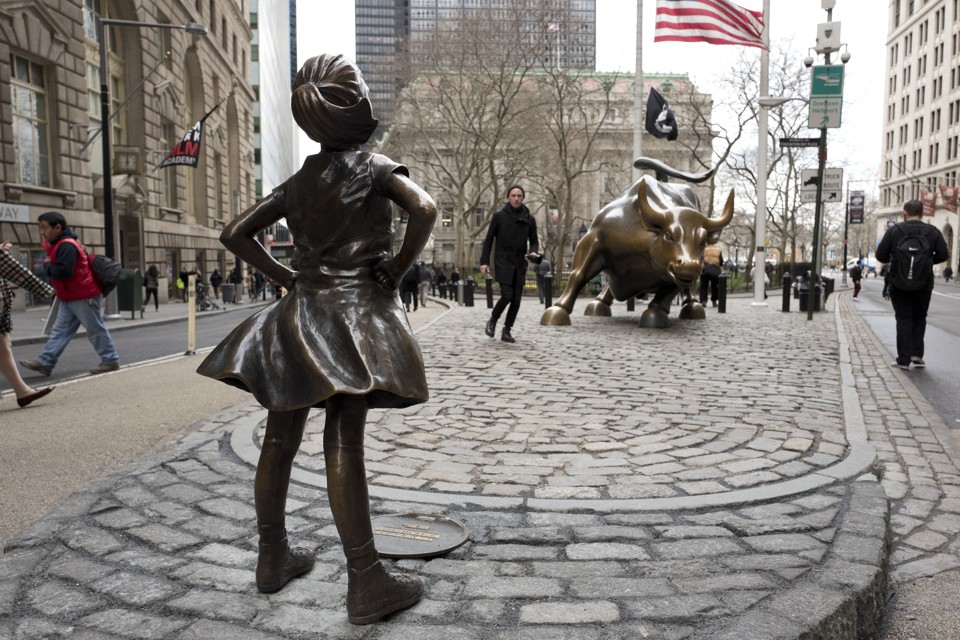
"Fearless Girl": An Empty Symbol For Misplacing Girls' Aspirations

The "Fearless Girl" statue faces down Wall Street's famous Charging Bull.

"That we Americans allot the richest rewards of our economy to speculators, is a question of mores; that we allow one-sixth of our fellow citizens to be ill-housed, ill-clad, and ill-nourished is a question of morals. That we shrink from our problems instead of attacking them with eagerness, generosity and hope is a question of morale. The questions are obviously interrelated." - George P. Brockway, in 'The End of Economic Man - Principles of Any Future Economics', p. 86.

The statue 'Fearless Girl' became an instant icon of women's liberation and strength just hours after  it had been placed in front of the famous Wall Street bull in celebration of International Women's Day. The statue is meant to honor women, specifically those in finance who are "historically forgotten". The problem is that high finance, not only in the U.S. but around the world, has made a veritable mess not only of women's lives but men's as well, namely on "Main Street" and for Main Street priorities. Hence, the statue is really an empty symbol paying homage to a system that has more exploited than helped average Americans.  It may make some little girls feel "fearless" for a bit - staring down that bull  - but in the end Wall Street will have its way and grind everyone under unless it is tamed, regulated.

With the Trumpies ready to water down the fiduciary rule - the one that requires financial advisors to disclose any conflicts of interest - things are not going to change for the better any time soon.

It was George P. Brockway in his 'End of Economic Man' who noted that  ultimately our choice as a society is to reward either markets and speculators or the commonweal based on "Main Street". So far, we've made mainly the wrong choices and allowed the market to dictate our future and quality of life.  This has been from its domination over our health care via shares purchased for various insurance companies, to its yen to replace workers with automation to jack up share price for the benefit of speculators.

And let's also be aware that it is Wall Street that has been pushing incessantly for the privatization of Social Security. One big reason the Street desperately wants Social Security monies in its insatiable maw is that it it's pretty well exhausted the largest (boomer) 401k market - and they'll soon be cashing out, along with their IRAs.

Nowhere is the distortion more evident than in the 401k and investments made there, which puts the ordinary person at great financial risk.  Perhaps the best financial education I ever received, was thanks to William Wolman and Anne Colamosca in their book 'The Great 401k Hoax', (2002), which offered the best advice for recognizing real returns as opposed to the bubble variety. With their solid arguments they showed, for any given fiscal environment, what a realist investor could expect to make. As they noted, one needed to look carefully at the percentage profits returned by X, Y or Z company. If it is averaging 1.3% a year, then that is the real return you can expect.  The stock hawkers bejabber of 10% annualized returns, or more often, 7 percent, is purely designed to lure the unwary into stock investment.

The authors' arguments were further reinforced about 6 years later in a Financial Times article (‘A Metaphorical Proposal’, Mar. 13, p. 11A, 2008) by Michael Skapinker. He cited remarks by Joseph Berardino – chief exec of Arthur Andersen- who noted how the existing reporting system “fails to communicate essential information about the real risks facing companies” to the small investor.  If the small investor doesn't know these risks, how can he make judicious choices? He can't.

Skapinker quoted Berardino as noting how accountants can only issue generic ‘pass’ or ‘fail’ judgments on companies – but never disclose the red ink being bled by a company that’s been passed. (What's referred to as a “bleeding edge” company wherein auditors are actually resigning). As the author notes, to do so would precipitate a collapse in share prices. Duh! (But, tough luck!)


Wolman and Colamosca, meanwhile, paid great attention to how the 401k has been abused and misused, usually by financial shysters - often in workers' companies, but also on the "Street".  Their primary beef? The 401k was never designed as an "investment" vehicle but as a purely savings medium! It was meant to salt your money away in safe, low risk abodes - while being matched by your company to some degree- and all the while not having to pay taxes on it. But almost from the start of the plan, named after the section in the tax code, people -workers were driven to put money into stocks, mainly equities, and other high risk instruments.  Little wonder, that small fry investors in 401ks have been fried and refried, over and over again.

They will be again, as sure as the Sun rises in the morning, once the new stock bubble bursts, as it will. As George Brockway has observed: the purpose of every Bull market is to take back all the gains made, mainly from small investors.  So, why would any little girl want to be part of this system? Why not instead be inspired to be a "fearless climate scientist" or astrophysicist?

As Cara Sheffler of The Guardian recently put it:

"State Street Global Advisors, the investment firm behind the ‘Fearless Girl’ sculpture temporarily placed in front of the famous Wall Street bull, pulled off a formidable marketing coup when they placed the statue there on Women’s Day. But let’s not kid ourselves into thinking that it is a brave feminist statement. It is not.  Fearless Girl doesn’t have to worry about affording college – she’s owned by an investment firm! No one can shut her out of the economy, as so many of her flesh-and-blood sisters have been: she owns Manhattan real estate. In the financial district, no less! No wonder she’s so fearless."

Indeed. And another reason she's so fearless is that she isn't subject to Pareto economics the way the rest of us mortals are. (Nor would any females ensconced in the towers of high finance.)  So it is a fact that with few exceptions, modern economics has dictated we are all subject to the Pareto utility function, to Pareto efficiency:


Basically, we are graphing "utils" or nominal units of "utility" on the vertical axis, vs. value of dollars used or consumed along the horizontal. The curves are displayed for two populations, one "rich" (say earning in the top 1% or $340,000/yr.) and the other "poor" (earning about $14,000/yr.). The key aspect to note is the width corresponding to the "delta x" portion of the gradient (delta U over delta x) which translates into the net dollar's worth for each population. As readers can see from inspection, the width of $1 for the rich is significantly longer than the one for the poor. This translates into the argument that the buck is worth more to the rich man, and hence, any transfer from the rich to the poor hurts the rich more than it helps the poor .

Thus, by Pareto's original example (in quotes): Allowing the wolf in the wolf-sheep combo to EAT the sheep expresses less overall "hurt" or pain on it than permitting the sheep to remain unscathed, thereby merrily prancing away eating its grass while the poor wolf starves. "The wolf" let us again bear in mind in concert with George Brockway's thesis, is the Wall Street paradigm.

The Pareto utility also explains why former Fed Chairman Alan Greenspan went on record in an appearance before congress (in 2003) to assert that "Social Security benefits need to be cut to pay for Bush’s tax cuts."  What on Earth was the man thinking? Well, he's thinking on the basis of Pareto efficiency!    Social Security payments, especially with COLAs, do everything the Fed Chairman didn’t want. They pour more money into the economy, but not via productive labor or market indices, returns. People receive their checks merely by existing and breathing day to day, and having paid into the system with FICA deductions. Even then, they receive far more in benefits than actually paid in, making a total mess of "utils" earned.

"The Street" isn't happy with this set up because it is cut out of the Social security income stream especially via potential juicy fees, commissions.  For example, if these expenses and commissions total 3.5% per annum, half of a 7% return is wiped out, leaving our exuberant investor with only 3.5% takings. If the particular privatized account is "churned" - meaning subjected to lots of internal exchanges and activity - that fee/commission factor could easily become 8%, 10% or more. The person left with virtually NO gain. In a down market this would amount to a nightmare.

What about health care? How does it work under a Pareto system? The clue was revealed by Academic Economist (and former Reagan Advisor) Martin Feldstein, after being awarded the presidency of the American Economic Association in 2004. A large part of his address was devoted to the issue of health insurance. Feldstein made the case that health care is in trouble in this country because deductibles and co-payments are too low, and as a result people (mainly the non-wealthy partially subsidized by health insurance) over use the system and go to the doctor too many times.


Hence, it more redounds to the benefit of shareholders (of stocks in health insurance companies) if a sick person is paid something like $134 not to see a doctor, given each doctor visit (then) costs on average $150. In like manner, the Repuke health plan is designed to benefit stock shareholders by containing and minimizing care rather than expanding it. Hence, the $800 b in cuts to Medicaid by 2020 will achieve Ryan's Randian goal of capping health costs as it "de-federalizes" care.


So why erect a "fearless girl" statue facing the notorious Wall Street Bull and encourage women and girls to entertain becoming fellow shysters to the sharks already there? It makes little sense, not that many of them would anyway. (Hopefully!) I can't imagine thousands of women leaving noble professions like nursing or teaching to become cutthroat shylocks on Maul Street. Or, perhaps I have too much of a 60s perspective.

Cara Sheffler again:

"Having it all” for most women won’t mean being Marissa Mayer or Sheryl Sandberg. The women’s movement, the marches for equality, are not about making every little girl a CEO, but rather about rendering the national dialogue more inclusive. Ironically, womensmarch.com has launched a campaign to convince Americans to divest from banks that support the Dakota pipeline.

Not every person has the option to do so, but women need to divest at a deeper level: we need to divest our values of social equality from Wall Street success. We need to understand that economic justice is not the plot of Working Girl; economic empowerment is not taking a helicopter to East Hampton every weekend during the summer season."

Exactly so. But how many  will process that?  How many women and girls mesmerized by that statue facing the bull will grasp that it likely has little to do with establishing economic justice? How many others will realize that just becoming a broker on Wall Street, where you might try to make a mint or earn vacays to the Hamptons, is not exactly economic empowerment for the many?


Most spot on, she writes:

"Feminism is about human decency, not molding young girls in the image of a banking industry that bets against us, shorts us, and then receives government bailout money.

It’s an industry that always has enough in its coffers to bet on both horses. America has companies on both coasts – on Wall Street and in Silicon Valley – that need to be shamed into civic responsibility, yet demand equal protection before the law. They restructure, outsource and demand tax breaks as job creators. Yet the cities in which they are located squeeze out the middle class and become bedroom communities for their very wealthy employees and clients. "

I could not have put it better, and Ms. Sheffler hits several notes to do with the Pareto model that are important, especially shorting the public then getting bailouts and the gentrification aspect noted at the end. Lastly:

"We need women who will realize new possibilities for companies to work toward the common good, to use capitalism to extend the promises of our founding documents to all, rather than serving as a pernicious, perfectly legal tool of oppression. We need female lawmakers to do that, too.

We need to remember these ladies, and we need symbols that will help us to do so. Some, of course, interpret a little girl staring down the mean, old bull of Wall Street as doing precisely that. But it’s really hard to take on Wall Street when you’re funded by Wall Street. That’s something Fearless Girl is sure to find out ."


Again, why not more inspiration for little girls to become scientists?  There was a lame effort back in 2012 called Science: It’s a Girl Thing!” . The letter I in “science,”  once one accesses the site,  is a tube of lipstick.   The defense for this vacuous nonsense? Máire Geoghegan-Quinn of the European Commission explained that the campaign was trying to “overturn clichés and show women and girls (and boys too!) that science is not about old men in white coats.”    But that is not the way to do it.

Meanwhile, spokesman Michael Jennings added that the clip was “intended to catch the attention of the target audience – 13-to-17-year-old girls,” in a “fun, catchy” attempt to “speak their language to get their attention.”

Errrr.......you really want to know the best way to get their attention? You detach them from their ipads, iphones, cell phones, and Facebook obsessions then let some intellectual light in. You try to stimulate the radiance of that "light" by encouraging independent inquiry. You don't feed their culturally-biased fantasies with superficial baloney and bunkum.

Nature editor Helen Pearson called it “packed with painful patronizing cliché,” while Victoria Herridge, a paleontologist at Britain’s Natural History Museum, declared it “beyond parody… all the things we worry about with gender stereotyping and body image these days.” Meanwhile, University College London social psychologist Petra Boynton succinctly asked, “For the love of all things holy, what is this crap?

What is it indeed? Basically, as most of us see it, a case of the "tail wagging the dog". The demeaning, superficial and lowest common denominator culture attempting to entice young females into the rarefied realm of rigorous science....by appealing to lowest common denominator social or personal appearance obsessions.

To me, the "fearless girl" attempt to get more girls into Wall Street finance is no different.  What we need is not more traders,  brokers or hedge funders ensconced on Wall Street but a lot more female scientists, and physicians. Especially with the looming shortage of the latter. And the way to encourage them isn't with tubes of lipstick and vacuous 'fun' themes but getting them excited with the subjects by inspired teaching, or well thought out appeals to girls' intelligence.

Above all, as George Brockway argued in his book, we need to restore the balance between Main Street and Wall Street, not distort it further.


Monday, August 17, 2015

An Aging Bull Market Headed For The Dumpster - Are You Ready?


A subset of the 23 Bull Markets and their durations in days. The longer the Bull Market the closer it gets to its expiration date.

Jason Zweig, he of the "Intelligent Investor" column of The Wall Street Journal, had some excellent advice for those still in the stock market: buckle up and hold on. Zweig begins by asking if people recall that between October, 2007 and March, 2009, the U.S. stock market dropped in price by 57 percent. It was a time of angst as 401ks were wiped out left and right and victims had to either notch down their retirement plans, or plan for longer working years.

Zweig then adds, with little consolation:

"If you think stocks can't fall by at least 50 percent again you are wrong. ...And if you think you won't over react when it does you had better test that belief now before it's too late to find out you were kidding yourself".


This isn't just blowing smoke or sparking reckless jitters. Anyone who knows anything about markets knows the existing Bull is already breeding a monster asset bubble just right for the bursting. And let's not forget it was George P. Brockway in his 'End of Economic Man' who noted that all Bull markets end and most do it in spectacular crash fashion with ordinary investors the ones most often left without the shirts on their backs. The more inflated the asset bubble underling the Bull, in this case fed by QE 'crack', the bigger the crash. Nate Silver in fact already pointed out two years ago how this one is in dangerous territory given the 21 % increase at that time.

Now, new research, based on Bull lifetimes, shows they can be seen in terms of comparative human life spans. And we know the older a human gets the closer he is to croaking time.  According to Michael Ball of Weatherstone Capital Management (Denver Post Business, Aug. 12,  p. 13A), the current bull market run (in days) is equivalent to an 88.3 year old person.  Let's face it, that's pretty close to 'kick the bucket' time.

As he put it (ibid.):

"We are very late into a normal bull market life span. Problems will come up sooner rather than later."

As may be seen from the attached graphic, this bull market at 2,262 days already ranks as the fourth longest in modern history.  By comparison, the bull that led to the stock market crash of 1929 lasted for 2,932 days (equal to 94.4 human years). On the more encouraging side, that bull saw a 497 percent gain in 8 years, while the current one has seen a 180 percent gain in 6 years. Maybe, indeed, we should hope for a correction soon - which could come as soon as the first Fed interest rate increase.

But other factors are also weighing on the stock market including slowing global growth, declining corporate  earnings and rising bond yields.  Stock valuations, as gauge by the P/E or price to earnings ratio are also way too "rich", having already crossed into the top 10 percent of bulls.

Who are the most likely to 'take a bath' when crunch time hits? Ball points out a certain subset of baby boomers who haven't been content with the low yields from pedestrian savings instruments like money market funds and have exposed themselves much more in risky equities. Of course, indexed funds (like those of Vanguard) are always a safer bet than managed funds, but in a major correction or crash of 50 percent or more, no one's money will be safe.  If you have a half mil tied up in the markets can you afford to lose $250,000?

Ball also notes that those investors who've already been mauled by two bear markets in 15 years won't easily be able to wait out this bull to see if it turns into a bear. They may have to redeem early, take their money and run as it were. Probably a better choice than having to eat cat food and kibbles the rest of your days.

Ball's final parting words for anyone who wants to hear them?

"It's a prudent time to take some money out of stocks."

Amen.

Tuesday, July 14, 2015

Split Inflation: Does the Fed Care?


The news in yesterday's Wall Street Journal (p. A2) that consumers are being "pinched" by a split inflation was unsettling to say the least. On the one hand, the Federal Reserve has kept interest rates near zero because the "overall inflation rate has been well below 2 percent a year" - never mind the Fed excludes a number of items including food prices and cost of fuel.

From the time of Greenspan and Bernanke all such costs as food, housing - even exploding rent, as well as meds - have been referred to as "shelter costs" -  or  "essentially made up numbers" to quote Mr. Bernanke from a 2012 remark. Well, here's an easy question: if all those shelter costs including groceries are "made up" numbers, how about we pay the costs of them in "made up money"?

Anyway, left unsaid is that while this one form of inflation is deemed "low" another form  - based on services - has increased.  To be specific (ibid.):

"Over the 12 months ending in May while goods prices fell 0.3 percent services prices were up 12 percent."

According to the piece:

"The upward trend might signal the domestic economy has less excess capacity and labor market slack than is commonly assumed. When the economy has a lot of unused capacity, business have less ability to raise their selling prices."

This is enlightening but even moreso is the example given on the inflation split between goods and services, i.e.:

"Buy a bottle of wine and uncork it at home and you are paying less than you did five years ago, according to Labor Department data. If the same wine is served by a sommelier at a restaurant you will shell out 12 percent more."

Another example, while the price of a new TV has fallen 58 percent from five years ago. the cable service (or satellite service) to deliver it has increased by 13. 7 percent.

So why do we feel we are getting the 'thick end of the stick' overall as far as prices? Well, because we "pay service bills more often than we buy most goods other than food and gasoline" (Which are left out of Fed inflation indices anyway).

Is the Fed paying attention? Hardly. According to the minutes of the Fed's June policy meeting because of "slack in the labor and resource markets" inflation will continue to run low until the end of 2017 - which means there is little incentive to raise interest rates. In fact, the dollar's increasing strength against other currencies like the euro has given the Fed yet another reason to keep them near zero.

Is this wise? I don't believe so and neither does the author of the WSJ article who notes the "economy might have less unused domestic capacity than the Fed thinks."

It warns:

"If so policy makers may find themselves in an inflation bind in the next two years."

But that may well be the least of our worries. More vexing is the asset bubble being inflated because of Yellen and the Fed's cheap money policies. Originally, I was foursquare for Janet Yellen's ascension to Fed Chairman, but sadly it appears she's merely continued Bernanke's blinkered QE strategy,  under the delusion that feeding Wall Street cheap money 'crack' helps the whole economy. NO it does not, it only aids and abets Wall Street and the speculator economy.

 George P. Brockway, author of  The End of Economic Man’‘ has written that any given Bull market's purpose is to suck the savings and nest eggs from the ordinary investor and transfer it into the hands of the richest speculators who know the small fry will never be able to resist rapidly rising share prices.  The longer the Fed feeds the stock market to the exclusion of helping income-based people the closer we come to yet another re-enactment of the collapsing Bull.  The collapse will be even worse next time around because of the extent to which income inequality has increased since 2008.  And those whose 401ks are savaged will have even less time to recover, say from a 50% meltdown, and likely have to work past 80.

For those of us who are traditional savers, still waiting for higher interest rates, we're not going to 'hold our breath' nor will we chase yield in a risky stock market. Let others celebrate as the DOW climbs toward 18,000 - we will recall what transpired in 2008.

Tuesday, July 15, 2014

What Part of 'Inflation is Here!' Doesn't the Fed Understand?


The Federal Reserve has been playing games with our money for years now, using the bogus,  speculator -appeasing device of quantitative easing (QE I and II). Their motive has been explained as trying to "stimulate" the economy and sadly even liberal economists (like Paul Krugman) have bought into this jabberwocky. The fact is that the only economy the Fed's QE tactic is stimulating is the one for speculators - the "asset rich" economy based in Wall Street.

According to the article The Asset Rich, Income Poor Economy' (WSJ, June 20, p. A13):

 "Asset wealth is sustainable only when it comes from earned success, not fiat. Wealth comes from strong, sustainable growth that turns a proper mix of labor, capital and know how into productivity..."

Here, "asset rich" means bountiful in terms of stock or mutual fund ownership, including dividends and capital gains arising therefrom. It also includes real estate, for example owned and then flipped, or owned for later profit at re-sale.  "Income" means basically what it implies, any and all income - say from labor (where wages have stagnated since 1973) or from bank savings interest. Since the Fed has kept interest rates near zero, the latter group has had to not only suck salt but sand as well.  Thus, "income poor".

Meanwhile, the stock owners are doing well, thanks to the Fed - including under Janet Yellin now - continuing the misplaced quantitative easing program. According to the article cited above:

"The Fed assures us that long term rates need not move higher - even with improving inflation dynamics, credit markets priced for perfection and stock prices at record levels."

Indeed, the stock market (DOW, specifically) is in serious bubble territory and having surpassed  17,000, it is just a matter of time before that bubble pops  - and blood is all over the 'Street'.

Sadly, the Fed from the epoch of Greenspan and Bernanke believes it is doing "God's service" keeping the interest rates at zero. Even Paul Krugman has taken umbrage at "inflation truthers" who he believes are trying to mislead the hoi polloi, but in this case Paul is wrong and he needs to take a few trips to the super market.

Pork chops now $4.95 a pound? The cheapest ground beef at $5.50/ lb.?  Chicken shooting up past $4 a pound owing to a problem with roosters! Even orange and apple prices going up through the roof! According to 'The Aggregator' (Denver Post, WSJ 2, Sunday, July 13):

"The consumer price of ground beef in May rose 10.4% from a year earlier while pork chop prices climbed 12.7% . The price of fresh fruit rose 7.3% and oranges rose 17.1%."

The piece goes on to observe that the above have created much increased pressure on the Fed to "separate food inflation signals from noise" (i.e. emanating from broad inflation measures.)


But do the nosebleed Elites and their academic pretenders who do selective  'system analysis' have any care? Not  bloody likely!  These outliers -  inhabiting such a rarefied financial ozone that such things as exploding food prices have no meaning other than "made up numbers" and "statistics" - see no problem. As long as the DOW is rising, never mind Main Street, everything is cool.

 From the time of Greenspan and Bernanke all such costs as food, housing - even exploding rent, as well as meds - referred to as "shelter costs" -  are  "essentially made up numbers" to quote Mr. Bernanke from a 2012 remark. Well, here's an easy question: if all those shelter costs including groceries are "made up" numbers, how about we pay the costs of them in "made up money"? Maybe I will just present an ideational, invisible "made up" $50 bill next time I go to the check out counter. "Here, Mr. Clerk, see this fifty ....no, no you CAN see it if you try! It's not just in my head! But see, I am using this made up entity to purchase goods which have prices that - according to our Federal Reserve Chairman, constitute "made up numbers"!

The fact the Fed refuses to see the inflation ramping up doesn't mean it doesn't exist, only that it doesn't exist in their Elite world of financial illusion. To the average man (or woman) on the street it's abundantly evident.  But see, the average person is asset poor, unlike the Wall Street lot who are in a feeding frenzy thanks to the Fed.

Originally, I was foursquare for Janet Yellen's ascension to Fed Chairman, but sadly it appears she's merely continued Bernanke's blinkered QE strategy,  under the delusion that feeding Wall Street cheap money 'crack' helps the whole economy. NO it does not, it only aids and abets Wall Street and the speculator economy. Main Street, meanwhile, is on life support and the massive decline continues with mostly stagnant wages.

George P. Brockway, author of  The End of Economic Man’‘ has written that any given Bull market's purpose is to suck the savings and nest eggs from the ordinary investor and transfer it into the hands of the richest speculators who know the small fry will never be able to resist rapidly rising share prices.  The longer the Fed feeds the stock market to the exclusion of helping income-based people the closer we come to yet another re-enactment of the collapsing Bull.  The collapse will be even worse next time around because of the extent to which income inequality has increased since 2008.  And those whose 401ks are savaged will have even less time to recover, say from a 50% meltdown, and likely have to work past 80.

This is not merely blowing smoke or spouting scare stories. We have past history to refer to by which an alarm ought to be sounded - certainly enough for the Fed to back off.  A critical tipping point has already been identified by none other than stats guru Nate Silver.   In his book, The Signal and the Noise- Why So Many Predictions Fail But Some Don’t , he writes (p. 347):

"Of the eight times in which the S&P 500 has increased at a rate much faster than its historical average over a 5-year period , five cases were followed by a severe and notorious crash, such as the Great Depression and the Black Monday crash of 1987”.

Already we are well into this treacherous territory yet Yellen and the Fed keep feeding the maw of Maul Street. The clear danger of feeding already bloated  asset wealth ($26 trillion added last year alone)  to the exclusion of income is that the speculative economy then makes the whole economy unstable.

Sadly, when the next financial meltdown occurs it likely won't trigger another "Great Recession" but a full blown Depression that'll make the one in the 1930s look like a walk in the park.

Wednesday, June 25, 2014

$26 Trillion In Wealth Added - But Almost All To The One Percent


The article 'The Asset Rich, Income Poor Economy' (WSJ, June 20, p. A13) was a shock and wake up call for any ordinary citizen hoping the economy will favor them at some point. The evidence, instead, is that the richest have continued to make out like bandidos while the rest of us suck salt.

Let's again get our terms straight here: "asset rich" means bountiful in terms of stock or mutual fund ownership, including dividends and capital gains arising therefrom. It also includes real estate, for example owned and then flipped, or owned for later profit at re-sale.  "Income" means basically what it implies, any and all income - say from labor (where wages have stagnated since 1973) or from bank savings interest. Since the Fed has kept interest rates near zero, the latter group has had to not only suck salt but sand as well.  Thus, "income poor".

Meanwhile, the stock owners are doing well, thanks to the Fed - including under Janet Yellin now - continuing the misplaced quantitative easing program. According to the article cited above:

"The Fed assures us that long term rates need not move higher - even with improving inflation dynamics, credit markets priced for perfection and stock prices at record levels."

Indeed, the stock market (DOW, specifically) is in serious bubble territory and I personally would take every last cent out if I saw it hit or surpass 17,000. It is just a matter of time before that bubble pops  from some external shock (e.g. oil prices skyrocket over Iraq) even if the Fed keeps up its QE crack infusions. Meanwhile, as the authors (Kevin Warsh and Stanley Druckenmiller) observe:

"The aggregate wealth of U.S. households, including stocks and real estate holdings, just hit a new high of $81.8 trillion. That's more than $26 trillion in wealth added since 2009. No wonder most on Wall Street applaud the Fed's balance sheet recovery strategy. It's great news for those households and businesses with large asset holdings, risk tolerances and easy access to credit."

And that group is precisely the 1 percent, against which Occupy Wall Street so vigorously protested a mere three years before. It is this group that is benefiting from the Federal Reserve's QE crack infusions, and which also has the "risk tolerance" by virtue of having the disposable income to sustain sudden market dives (and losses) which most of us lack. They also have the easy access to credit and often hold real estate as well as stocks. In addition, they are often the beneficiaries of flash trading so can buy and sell before the hoi polloi can even pick up a phone. Hence, they will make more money on any redemptions, even as they will be able to pick up cheaper stocks before the ordinary bloke can say 'buy'.

As the authors note the current conditions "provide little solace for families and small businesses that must rely on their income statements to pay the bills."

They also point out that "about half of American households don't own any stocks" -  but I'd say the aggregate stats are even less asset -based. That is,  perhaps 75 percent of the half that DO own stocks (as mutual funds) don't have the disposable income to cover losses. We saw that play out back in 2008 with the crash incepted by the housing meltdown and credit crisis.

The bottom line is the Fed is not stimulating the real economy but the speculative one. It is playing a dangerous game of feeding a giant asset bubble via cheap money that will also hurt the real, Main St. economy if and when it bursts. (The Bank of England has already recognized the danger which is why they plan to raise interest rates.)

The authors are thus correct when they state: "Asset wealth is sustainable only when it comes from earned success, not fiat. Wealth comes from strong, sustainable growth that turns a proper mix of labor, capital and know how into productivity..."

The danger of feeding asset wealth to the exclusion of income is that the speculative economy then makes the whole economy unstable. A critical tipping point has already been identified by none other than stats guru Nate Silver.   In his book, his book, The Signal and the Noise- Why So Many Predictions Fail But Some Don’t , he writes (p. 347):

"Of the eight times in which the S&P 500 has increased at a rate much faster than its historical average over a 5-year period , five cases were followed by a severe and notorious crash, such as the Great Depression and the Black Monday crash of 1987”.

Already we are well into this treacherous territory.

George P. Brockway, author of  The End of Economic Man’‘ has written that any given Bull market's purpose is to suck the savings and nest eggs from the ordinary investor and transfer it into the hands of the richest speculators who know the small fry will never be able to resist rapidly rising share prices.  The longer the Fed feeds the stock market to the exclusion of helping income-based people the closer we come to yet another re-enactment of the collapsing Bull.

Tuesday, March 19, 2013

Why The Next Stock Market Crash is Merely A Matter of Time

Several reports coming to my attention the past two weeks all but scream “ALARM!” in terms of the DOW and the stock market. While millions of small fry have rushed back into the stock game to try to make up for 401k losses, they are doing so in a perilous bubble environment not based on sound economic markers. If stock investors, especially the small fry –small scale investors, fail to grasp the underlying dynamic of what’s driving the DOW to absurd heights (that belie the real indices) then they’re putting themselves in line to lose most of their nest eggs.


First, there is the recent ‘Kiplinger Letter’ noting (p. 2) that “healthy gains in output won’t bring an equal gain in employment”. The reason? Corporate employers’ continued yen to “squeeze more from less” (i.e. get fewer workers to do more work) and increasing automation. The subtext is that corporate employers remain averse to hiring real flesh and blood humans because of having to pay wages and benefits, thereby lowering their profit margins. Worse, (p. 1), corporate America has no intention of plowing its $1.7 trillion cache into new jobs for at least another year, and maybe more.

These tendencies are amplified by other unmentioned ones (in the KL) which were exposed in a recent piece (‘The Barbarians are Back’, TIME, March 25, p. 16) by Rana Forhoohar. For example, “just in time manufacturing” allows companies to hold less inventory and be more nimble but also requires more cash in reserve to support quick start ups. In other words, as Forhoohar explains, “companies are becoming their own banks.” This also gives them more latitude to invest outside the U.S. and with that expanded choice, 99 times out of 100 they will do so. Damned the need for new jobs in the U.S.

As another case in point, she cites Apple, which keeps funds abroad in part for tax avoidance. i.e. “to skirt U.S. taxes on foreign earnings.” She goes on to note that “this technique is particularly common among cash rich technology companies and investment firms because of laws that make it relatively easy to move intangible assets abroad.”


Wonder why so many new college grads are sitting around in parents' basements at home playing SIMS online or waiting tables for $2.13/hr plus tips while they face enormous college debts? Well there it is! The U.S. techie companies, enabled by legislation compliments of our political whores (who make it easy for the companies to hoard cash abroad), aren’t doing squat to help Junior or Missy start earning real money!

Meanwhile, as Forhoohar observes, the big CEOS are more worried about their personal balance sheets than shareholder value, especially that of small fry (the flash traders can take care of themselves using algorithms for the computer flash trade and fractional share trading.) As she adds, with this “short termism” - this blinkered profiteering for the short term practiced by CEOs, “we all have something to lose”.


In the meantime, this short term virus of obsessive capital hoarding risks further infusions by the Federal Reserve in the form of quantitative easing that will further inflate the existing stock bubble. Much of the current rise in stock prices is due to a Fed buying spree. The past 4 years Bernanke’s Fed has pumped out billions to buy bonds and mortgage –backed securities. This tactic helped to fuel stock prices by forcing investors (mainly small fry) to chase yield and return in the equity markets. As Forhoohar has observed (TIME, March 18, p. 18) Bernanke intends to keep the spigots flowing through next year – which means we could be seeing the biggest stock bubble in history.

How to recognize a bubble that could lead to a massive correction? Arch-forecaster Nate Silver, in his book, The Signal and the Noise- Why So Many Predictions Fail But Some Don’t   has the answer (p. 347):

"Of the eight times in which the S&P 500 has increased at a rate much faster than its historical average over a 5-year period , five cases were followed by a severe and notorious crash, such as the Great Depression and the Black Monday crash of 1987”.


Now, add to this the risk-taking biology of traders and you have a recipe for a disaster. Jim Coates, of the University of Cambridge, and a former Goldman Sachs trader, recently reported on a series of experiments conducted by himself and colleagues at Cambridge on the London trading floors. He found that during “winning streaks” such as now beheld with the soaring DOW, the biology of typical traders “over reacts” and “risk taking become pathological”.


For male traders, particularly affected, “testosterone levels surge, hemoglobin increases and oxygen levels in the blood – which increases the brain’s appetite for risk and feeds over-confidence. Such a combination was likely responsible for the creation of the credit default swaps back in 2007-08 which nearly took the entire economy down. Coates’ conclusion is that at some point in the upward spiral of testosterone-fueled confidence, judgment becomes impaired. It is this impairment  (known as "irrational exuberance" about 10 yrs. ago) that's sowing the seeds for the next crash. As he puts it (TIME – Business Report, July 9, 2012, p. 18):


“Effective risk taking morphs into over confidence and traders on a winning streak may take on positions of increasing size with ever worsening risk-reward trade offs”


How will the latest overt risk taking manifest in the markets? What new confections will the quants who devise financial instruments come up with? We don’t know. But that is the worry! What we can be sure of is that every Bull market has one function and one only – according to George P. Brockway, author of  The End of Economic Man’‘. That is, any given Bull's purpose is to suck the savings and nest eggs from the ordinary investor and transfer it into the hands of the richest speculators who know the small fry will never be able to resist rapidly rising share prices.

But maybe they will next time!

--------------------
Addendum: Billionaires Now DUMPING STOCKS!

According to this new item from Money News: http://www.moneynews.com/MKTNews/billionaires-dump-economist-stock/2012/08/29/id/450265?PROMO_CODE=110D8-1&utm_source=taboola

Billionaries are dumping stocks BIG time.   Acording to the piece:

"In the latest filing for Buffett’s holding company Berkshire Hathaway, Buffett has been drastically reducing his exposure to stocks that depend on consumer purchasing habits. Berkshire sold roughly 19 million shares of Johnson & Johnson, and reduced his overall stake in “consumer product stocks” by 21%. Berkshire Hathaway also sold its entire stake in California-based computer parts supplier Intel.


With 70% of the U.S. economy dependent on consumer spending, Buffett’s apparent lack of faith in these companies’ future prospects is worrisome. Unfortunately Buffett isn’t alone.

Fellow billionaire John Paulson, who made a fortune betting on the subprime mortgage meltdown, is clearing out of U.S. stocks too. During the second quarter of the year, Paulson’s hedge fund, Paulson & Co., dumped 14 million shares of JPMorgan Chase. The fund also dumped its entire position in discount retailer Family Dollar and consumer-goods maker Sara Lee.

Finally, billionaire George Soros recently sold nearly all of his bank stocks, including shares of JPMorgan Chase, Citigroup, and Goldman Sachs. Between the three banks, Soros sold more than a million shares."

WHY is this happening? According to the MONEY News author:


"It’s very likely that these professional investors are aware of specific research that points toward a massive market correction, as much as 90%."

Do you know what a 90% correction will do to your 401K? Let me summarize it with one sentence:

"Cat food + working til you're 90!"

Wednesday, January 30, 2013

Excited About the Roaring DOW? Better Take a Chill Pill!

The DOW broke all records since 1989 yesterday, and everyone is stoked! Their 401ks are replenishing and things are looking terrific. DOW 14,000 and over here we come!


The DOW ramp up was only mildly curbed on Friday after the Commerce Department reported the nation’s sales of new homes fell by 7.3% in December. (Shares in the home building sector traded higher, however).

Meanwhile, large institutional investors and others are looking at growth in emerging markets as a way to sustain gains. As one observer put it (‘Stocks Continue Winning Streak- May Draw in Investors’, Denver Post, Jan. 22, p. 13K): “Emerging markets should be a positive factor for many U.S. multinationals.”

The observer then went on to warn:

“That said, I think the market is a little ahead of itself, and I would like to see it go sideways in coming weeks to take some of the adrenaline out of the market.”

Bingo! Does this maven know something the stock-owning jocks and DOW groupies don’t? I believe he does and it’s spelled: B-U-B-B-L-E.

Combine Bernanke’s free money to banks policy (with effective interest rates near zero), with a speculative culture embedded in the markets and indeed, engrained in institutions across the country and you have an ominous formula.  Former Wall Street player Greg Smith already sounded the warning two months ago in an excellent essay, How Wall Street Is Still Rigging the Game’ (TIME, Nov. 5, 2012). As he observes:

“There is a misconception that Wall Street is composed of rich people gambling with other rich people’s money. This couldn’t be further from the truth. The secret that Wall Street doesn’t want anyone to know is that hedge funds comprise less than 5% of assets in the stock market. The real big players in the stock market are individual households and the pension funds, mutual funds, endowments, charities and foundations that are entrusted with your savings, donations, retirement funds and 401ks- trillions and trillions of dollars that are invested with Wall Street banks.”

In other words, Wall Street has the country by the proverbial balls, and has subverted “Main Street” by getting it to sell its assets or “invest” them in phantom money vehicles - many of them too complex to comprehend even for most financial advisors. It has thereby effectively converted a productive economy into a speculator economy. This was also predicted in the book ‘ ‘The End of Economic Man: An Introduction to Humanistic Economics’  by George P. Brockway.


Brockway noted that before about thirty years ago one had a 'productive' economy and a 'speculative' economy (based in Wall Street). There was more or less a balance between them, and the nation as whole benefited as a result. Real productivity kept growing because real investment was made in hands-on materials, plant, research and labor. Most everyone benefited, including workers - via real (defined benefits) pensions (not '401ks') as well as higher wages, and companies that produced REAL goods.

Sometime after Reagan was canonized, in the 1980s, the speculative economy - which up until then had been kept in the background- began to take control. A number of steps instituted by Reagan led to the Michael Milkens, Ivan Boeskys and that lot. This also probably laid the fertile soil for our own WorldComs, Enrons, and Arthur Andersen- type funny accounting.


One step was the Bank Holding (De-regulation) Act of 1984, which sped the way to speculative excesses resulting in travesties such as the S&L scandal in the late '80s.  One would have seriously thought the legislative infrastructure would have learned from that - but oh no, they didn't. In 1995, congress repealed the right of investors, shareholders to sue companies. That essentially removed the last private solution that would've kept the criminal speculators (like those who peddled credit default swaps to cause the 2008 credit meltdown) at bay. Too much big money from the corporate campaign contributors iced it.

Just as their money has been desperately trying to cook up a perfidy of a bankruptcy law- and has left a corporate "reform" law that isn't worth much more than the paper it's printed on. (Since it excluded independent audit provisions, and refused to count stock options for CEOs as expenses). This point was driven home in a  2009 London Financial Times article (‘A Metaphorical Proposal’, Mar. 13, p. 11A) by Michael Skapinker. He cited remarks by Joseph Berardino – chief exec of Arthur Andersen- who noted how the existing reporting system “fails to communicate essential information about the real risks facing companies” to the small investor.  If you don't KNOW what you're getting into, how the hell can you have any confidence that you will get anything back? You can't!

Skapinker quoted Berardino as noting how accountants could only issue ‘pass’ or ‘fail’ judgments on companies – but not disclose the red ink being bled by a company that’s been passed. (What's referred to as a “bleeding edge” company wherein auditors are actually resigning). As the author notes, to do so would precipitate a collapse in share prices.

Before all this, there was the  October,1987 Market crash,when  the speculative economy had sucked nearly $1 trillion from people who had invested, and could least afford to lose money. However, they were constantly besieged with the 'buy and hold' mantra to ready them for the next plucking. Meanwhile, a host of ancillary political-economic policy factors contributed to the ongoing speculative frenzy (culminating in the 2008 crash and the loss of over $8 trillion) and fed it such as:- the passage of the 401k as a substitute 'pension' plan which would replace defined benefits (in real money) that had been received until then.

Workers were now expected to place their savings - whatever they could muster given wage stagnation since 1973 - at the mercy of a market that was anything but merciful. Basing future retirements on 'phantom money' and the shenanigans of shysters on Wall Street (see e.g. 'License to Steal: The Secret World of Wall Street Brokers and the Systematic Plundering of the American Investor', 1999).


Then add to this morass the constant shrinkage of bank (pass book) interest rates, as well as CDs - forcing vulnerable people to chase yield in risky vehicles for which they were never prepared. These items drove millions of average Janes and Joes into the 'market' who otherwise may never have ventured there. Just as, before 1929, millions of ordinary folk were driven into the infamous 'investment trusts' that caused them to lose everything.  (These 'investment trusts' were the forerunners of today's mutual funds) and then - as now - touted as "the little guy's way to enter the stock market".)

The more recentt piling into the market with 401ks, IRAs, etc, resulted in a never-before -seen phenomenon. What mass speculation did was to drive P/E ratios (the price to earnings of stocks, and averaged out, for mutual funds) to incredible overpriced magnitudes. Some stocks and funds were trading at over 30 times earnings just before the '87 crash, and all during the 90s the average was at 45 times earnings. This was nuts, disclosing grossly overvalued stocks- and (as we now know) a speculative bubble..

“Bubble” economics therefore has a nasty past history. So why do people forget it so readily? Well, because hope springs eternal in the human breast and most brains are infected by a persistent false optimism. They inherently believe things will get better, their 401ks will get back to where they were, and their homes’ values will be what they were before the credit meltdown in 2008.

Or as Greg Smith puts it so bluntly:

“In effect YOU are the big player in the market, and when a bank overcharges a teacher’s retirement fund or a charity or a complex product, or misprices a Facebook IPO – causing billions of dollars of wealth destruction, or rigs interest rates affecting trillions of dollars of loans, it comes out of your pocket. “


So how does Wall Street make so much money while so many small fry lose theirs? Smith attributes this to “asymmetrical information”.  Basically, because Wall Street expedites business for all players (hedge funds, mutual funds, pension funds etc.) :

“It knows who is on every side of a trade.”

Therefore, Wall Street can always bet smarter with its own money. Add in fractional value trades (where the Street denotes the whole number values of stocks, mutual funds, but keeps the fractions in any and all transactions) and its money, money, money. We win, you lose! Worse, as Smith observes, given the lax regulation “there is maximum temptation to try to exploit unsophisticated investors or conflicts of interest.”

It brings to mind the banking creeps during World War II, who – according to Clive Ponting’s book ‘Armageddon’ were on each side of every loan, whether to the Third Reich or the Allies, and hence could not lose money. What they lost with the Germans, they gained via much higher loan interest rates with the Allies.

The bottom line: This chasing of phantom gains by speculation in the stock market - in fact – has caused the underfunding, under-investment in the REAL economy. This is why labor is in a precarious position now, as are all those who seek to earn money through hard work, as opposed to easy money by betting in the market. The whole Wall Street edifice has so captured most Americans’ brains that if the meme is challenged people look at you as if you are mad if you challenge them on where they keep their money.

But as long as people are hostage to the speculator culture of Maul Street they will be accomplices in the undermining of any real productive economy and contributing to higher and higher structural unemployment – or cutting the noses of their offspring trying to find decent remunerative work on leaving college.

Enjoy the DOW while you can, just bear in mind who is really prospering and who won’t lose even if there’s another stock market crash. (The 'Street' collects commissions and fees from both winners and losers.) Meanwhile, good luck if that 401k you need for retirement is stuffed with your hard earned money. You just better hope the GOP and wussified Dems don't cut your future benefits too!