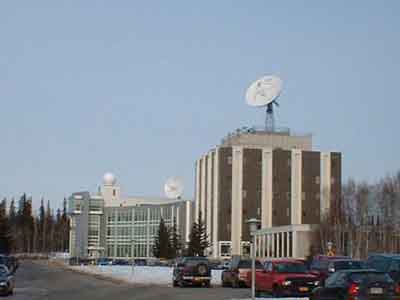
The Geophysical Institute at the University of Alaska -Fairbanks. UAF isn't listed in U.S. News & World Report's Annual College ranking but that doesn't mean it's not a great university
"Getting an A in biology — and being awakened, in the process, to the wonders of the natural world — doesn’t matter if a committee of strangers at Stanford isn’t sufficiently impressed?
Being student body president — and reaping valuable lessons in leadership and teamwork — is a waste if it can’t be translated into a ticket to Cambridge, Mass.?
For these kids, education isn’t an opportunity to wring more meaning from life and make a more constructive impact on the world. It’s transactional. It’s a performance. If the right audience doesn’t clap, there was no point in even taking the stage. This is what the modern madness of attributing magical, make-or-break powers to a school with an acceptance rate of 15 percent or 10 percent or even 5 has wrought." Frank Bruni, 'The Moral wages Of The College Admissions Mania', NY Times, Sunday
"Tennessee Tech is an amazing school. And no one breaks the law to get admitted." - Peggy Noonan, 'Kids, Don't Be Success Robots', WSJ March 16-17, p. A13)
"Tennessee Tech is an amazing school. And no one breaks the law to get admitted." - Peggy Noonan, 'Kids, Don't Be Success Robots', WSJ March 16-17, p. A13)
That the Varsity Blues scandal was an atrocity that saw wealthy cheaters screw decent, hardworking families and kids out of their own (presumed) slots at elite schools is something we can basically agree on. We've since seen the DOJ indict 50 people, including 33 parents, a college administrator, college athletic coaches, test proctors - and mastermind Rick Singer- in the odious scam. But there's another aspect that requires attention: Why this yen of so many- whether upper middle class or working class - to get a slot in the Ivies anyway? Why is it so damned important, including that some (often wealthier) parents are willing to cough up $1,000 an hour for LEGAL coaching to help their charges get into Harvard, or Yale or Stanford?
The real question, however, is how so many could go so nuts- to the point of lawbreaking - just to try to get kids into a big name school. Well, there are various theories for this annual elite school feeding frenzy.
One is parental "projection" : pressuring their kids to go all out in applications to the so-called top schools, to go to a place that is status for them - but not necessarily the kid. These parents, often sensing themselves as "losers" or second rate because they didn't get into an Ivy, push their kids to ridiculous lengths to attain the status they couldn't. According tot a 2013 study appearing in the journal PlOS One, this behavior is peculiar to parents whose identities are too closely intertwined with their kids'.
These parents seem not to process that it's much more important for the student to be involved in his or her school - and feel at home on arriving - than to be seen "making it" at a highly selective place like Harvard. As one parent discovered when she dragged her kid to a potential Ivy (WSJ March 18, p. A13) and asked if these were people he might like to hang out with. She was dumbfounded when her kid said 'No' he'd "rather hang with kids who wore Nikes and not Doc Martens."
Moral of the story? Parents need to keep their own neurotic needs and snobby impulses concerning college out of their kids' decisions and lives. Parents also need to lay off the hyper-excellence("perfection") syndrome and let their progeny achieve at the level they're able - even if it means not getting into a "select" school.
Psychologist Erica Komisar, for example (WSJ, 'The Sickness Behind the College Scandal', p. A17) cites the case of a decent HS student who "only" got 29 out of 36 on the ACT, and whose parents wanted more. Well, because they wanted him in an Ivy. The pushy, pressuring parents asked about medication but were informed: "The problem wasn't his performance. His panic attacks were a response to intense pressure". From his parents.
Again, it turns out when one beholds parents like this - using money, influence, neurotic pressure to get a kid into an Ivy "without considering whether it's the right academic environment for the child" it's more about their own status. They're insecure and upset if little Annie of A.J. doesn't get ace the SAT (or ACT) because they're convinced it reflects on them. This is indeed a sickness, a pathology, which needs addressing.
Mr. Bruni even points out correctly the Varsity cheating scandal is just an outlier - an extreme, illegal example - of lesser scheming on a broader scale. As he writes:
One of the best takes is from WSJ op-ed columnist Peggy Noonan ('Kids, Don't Be Success Robots', March 16-17, p. A13) , who sometimes manages to get to the core of an issue, scandal or problem. In this case, the advice she gives is fairly well grounded:
But this is also somewhat oversimplified. The problem, really, is too many kids (and parents) today have tunnel vision in terms of academia. They focus in the most high profile, most selective "elite" universities, while forgetting that the genuine match is between a student and the specific area of endeavor, or specialty.
A case in point was the University of South Florida ca. 1968-75 featuring the best quality work in astrometry in the nation, thanks to its Chairman, Prof. Heinrich Eichhorn. (Astrometry is that branch of astronomy that deals with accurate determination of stellar positions, i.e. for the purpose of creating reliable star catalogues.) This work is crucial for broad astrophysics research as well as astrodynamics, celestial mechanics.
Flash forward to the present: If one searches the annual U.S. News & World Report rankings for the University of Alaska-Fairbanks, the chances are it will not be found. The lame conclusion based on the ranking elite bias will then be it is not a place worth attending, but this would be a gross error. In terms of specific fields, atmospheric science and space physics, there is perhaps none better. We are talking here not only about the quality of the staff but the resources, e.g. available at the Geophysical Institute.
UAF, for example, has been at the forefront of Arctic atmospheric research - much of which is conducted at the Climate Research Center, e.g.
There is also Poker Flat, the world's only scientific rocket launching facility, e.g.
The rockets launched from here enable more detailed studies of the aurora, magnetic substorms. For space physics in general, including the study of the aurora, substorms, and solar-terrestrial dynamics it has all the resources the dedicated researcher needs, see e.g.
Given UAF's location and its facilities you won't find a better place for studies in ionospheric, infrasound and magnetospheric physics, as well as space weather. Harvard certainly can't compete in these specialized fields, nor does it have comparable resources, such as a rocket range.
All of this underscores points I made three years ago concerning a fact too many wannabe collegians and their parents overlook: it makes very little difference which university you attend (assuming it isn’t a ‘for profit’ or online version). It is more the cachet and reputation of the specific department.
This take was amply supported in a WSJ report from 3 years ago
(February 1, 2016 p. R1) is that the extent to which one benefits from university really depends on one's major - and whether the chosen school matches up well in staff, resources. The Journal looked at about 7,300 college grads ten years after their graduation and divided their major into several categories: business, engineering, social sciences, humanities, education and 'other'. They also cross-referenced three categories for college type: "selective" (covering elite schools), midtier, and "less selective" (covering schools with open enrollment - e.g. like the University of South Florida, my Alma Mater).
As the Journal authors (Eric R. Eide and Michael J. Hilmer) put it:
"What we found startled us. For STEM-related majors, average earnings don't vary much among the college categories. For example, we found no statistically significant differences in average earnings for science majors between selective schools and either midtier or less selective schools."
This is truly amazing and also important. It means, basically, that one will not be significantly better off with earnings in the physics field - for example - graduating from Harvard than the University of South Florida. He or she may actually be worse off graduating from Harvard if one has only minimal financial help (other than loans) to pay back the hefty debt incurred from the purchase of all that name prestige.
As the authors write (p. R2):
"Our findings are crucial for families to understand because chasing a prestigious STEM degree can leave students burdened with huge amounts of unnecessary debt."
This also conforms to a May, 2011 MONEY magazine investigation which found it is more the name and reputation of the specific department that conferred benefits than the school itself. As the MONEY authors put it:
"Don't assume an Ivy League education is better than one from a public or state university."
MONEY found that 'bang for the buck' included college graduation rates and post-college success rates - which compared favorably to - or exceeded - what one obtained from the hallowed Ivies. Alas, this has still not trickled down into the mainstream media where we still find "Best Colleges" lists spread around with the Ivy Leagues on top - then all the rest. So no wonder students and their parents are neurotically driven to believe the Ivies are the only route to success.
Meanwhile, Frank Bruni, in his recent piece, cites a Harvard Graduate School of Education’s Making Caring Common Project which points out:
"The biggest problem in college admissions is that huge numbers of young people, especially low-income and first-generation students, struggle to access or simply can’t afford college, or land in colleges that aren’t committed to their success.”
In fact, about two-thirds of Americans over 24 never started or completed a four-year college. Technically, that ought to put ANY graduate of a decent 4-year public university in a driver's seat for future success. So why the mad rush to pile into only a few schools perceived as "exceptional" ? Basically, it's all branding and PR, spread by inflated rankings given excessive prominence in the media. See, e.g.
Let's get back to Peggy Noonan's claim of the elite universities more often being "indoctrination mills". Reinforcing this is Chris Hedges' Ch. 3 in his remarkable book, 'The Empire of Illusion' where in he observes the "Ivies" (Harvard, Yale, Brown etc.) are often the source of regimented thinking elites dropping questionable tropes, theories and memes into the national narrative - on politics, economics and business. (Recall it was Glenn Hubbard, a prof from the Columbia Business School, who dreamed up Bush's destructive supply side tax cuts.) Then there is Martin Feldstein of Harvard - whose extreme monetarist stance I've criticized numerous times already. See e.g.
http://brane-space.blogspot.com/2018/03/americas-debt-disease-prof-marty.html
The effect has been to reinforce the hegemony of the financial elites and their stranglehold on the country, as well as fueling the ongoing inequality.
Can the nation afford even more of these delusional, entitled twits? I doubt it. (Thankfully, the STEM areas of these schools remain relatively uncontaminated of elitist manipulation and PR. Unless they're in areas which receive corporate grants to support oil shale drilling, or promoting GMOs.)
Hedges sums up the total negative impact of the indoctrinated thinking in the elite schools on page 89 of his key chapter (3), 'The Illusion of Wisdom', e.g.
These along with most elite secondary schools, do only a mediocre job of teaching students to question and think. "
Adding:
“Response for the collapse of the global economy runs in a direct line from the manicured quadrangles and academic halls in
These are breathtaking accusations but Hedges can fully back them up with his examples and citations. Nor is this simply a matter of “sour grapes from a loser” since Hedges did in fact lecture at
I think this gets to the heart of Ms. Noonan's argument on indoctrination. It also interjects the weakness of the incoming students themselves, when she writes, for example:
"An irony is that the success robots once wound up and pushed forward, often struggle. The president of an elite college told me recently the most surprising thing about recent classes is the number of students that ask for an need psychological services. They seem said the president, unusually dependent on their parents."
Which may not be altogether surprising if these coddled kids were aware of the money spent by their parents (often up to $1,000 an hour) to coach them into elite entry fold. They'd feel beholden, both materially and psychologically. Alas, they'd likely also feel that they'd need permission from Mom and Dad on when to even take a dump.
Contrast this situation with Noonan's example of Tennessee Technological University, which no one is beating down the doors for entry. But the school's effects on the students are vast and positive, i.e. when Noonan visited three years ago and found: "They are often the first of their families to go to college. They are so mature, gracious, welcoming, quick with smart questions"
And no dependency issues, or need for psychological counseling, wonder of wonders.
Meanwhile, Denver Post columnist Krista Kafer ('Overcharging for prestigious degree is also a scam', Mar. 14, p. 13A) makes the point that (regarding the gung- ho parents who tried to cheat to get their kids into elite schools):
"My first thought about the Varsity Blue scandal is that the parents overpaid: Their children would have had the same success if they had enrolled at a decent public university, worked hard and persevered. .. Research published in The Quarterly Journal of Economics (2002) found that expected salary gains from attending a very selective school were 'generally indistinguishable from zero" when taking into account other student characteristics."
What lesson can we take away, if any, from the Varsity Blues scandal and the larger societal obsession with "elite" universities, to the exclusion of looking at any others? I would say that one must conclude the myopic pursuit of an elite college entry and degree is misplaced and over inflates its importance, including to learned values - moral and academic. It is also toxic, given it contributes to academic (as well as moral) tunnel vision. With such tunnel vision, transgressions inevitably with be large, even if the consequences may not be immediate.
A recent iteration of this distorted thinking appeared in a "debate" format in Journal Report (WSJ, p. R4, March 18, 'Should All College Admissions Be Need Blind?') delivered in the 'Yes' corner by Catharine Bond Hill. According to this president emeritus of Vassar College, the 'yes' is obvious because, well, so many will be pounding at the doors to get into the Selects. In her skewed perception:
"The benefits of attending a selective college are vast as these schools often have the greatest resources to devote to students, faculty, staff and amenities."
To which my response would be 'fiddlesticks and twaddle'. The benefits, such as they are, are more in the realm of PR branding and status perceptions. In the latter case, unhealthy one-upmanship games likely emerge, and then who gets to decide "which elite schools carry the most social cachet?" From this specious nonsense a whole spectrum of idiotic parlor games can be played by the fatuous and insecure.
But for every Ivy that Ms. Bond Hill can name with ample resources, I can name twenty public universities with vastly more to devote to their students, faculty. USF, for example, is now a multidisciplinary top international research university- in areas from biomedical and business to ocean resources, climate climate change. Those interested (especially parents!) can check out its academic resources here:
https://www.usf.edu/academics/academic-resources.aspx
Getting such information out into the public domain is crucial, in my opinion, to breaking the stranglehold and fixation on the Ivy League schools as the sole repositories of educational quality.
It is clear that to break from that pathological tunnel vision, Americans who value college education need to also break their addiction to the perception (and PR branding) that only elite universities with high name recognition (or reputation) matter. Given the corollary is that all others are "dumpster" schools.
This sort of skewed thinking leads to a toxic nation with toxic values...and toxic thinking. It leads to the perverse drive to get an "edge", and even cheat to get one's progeny into schools believed to have the only value for success. But as Krista Kafer put it:
"Their children would have had the same success if they had enrolled at a decent public university, worked hard and persevered."
Besides, there is absolutely no assurance once a kid gets into Harvard, Brown or Yale he or she will be taught by the best profs anyway. More likely it will be a (graduate student) teaching assistant, or adjunct prof. $80 grand a year to be taught by a TA.
Think of that!
