Friday, January 26, 2018

"Trump Derangement Syndrome"? The Right Should Be Terrified


One of the supposed  trigger images for "Trump Derangement Syndrome".

Image may contain: 1 person, text

One of the tropes circulating amongst the Trumpkins is that the Left is hysterical and over-reacting to the former's beloved, brain dead buffoon - manifesting in TDS or "Trump Derangement Syndrome".  In the fantasies of these Right wing knuckle draggers, most of the Left is either seeking therapy or crouched into fetal positions on cots in their basements, crying at every Trump news flash as they reach for their Zoloft.

The Right should be so lucky, even as we learned last night Dotard was intent on firing Special Prosecutor Robert Mueller last June, but held back when his lawyer (Don McGahn) threatened to quit.

In fact, the Left has been massively organizing by the millions  - especially the women who backed Hillary Clinton- and are now enraged a pussy grabber stole (with Russian help)  her job of destiny. Not only organizing but fielding candidates and winning in state elections.  As a recent TIME article on 'The Avengers' pointed out (Jan. 29, pp. 27-33):

"Progressive women described undergoing a metamorphosis. In 2016 they were ordinary voters . In 2017, they became activists, spurred by the bitter defeat of the first female presidential candidate at the hands of a self-described pussy grabber. Now, in 2018, these doctors and mothers and teachers are jumping into the arena and bringing new energy to a Democratic Party sorely in need of fresh faces."

Adding:

"Call it payback, call it a revolution, call it the Pink Wave inspired by marchers in their magenta pussy hats and the activism that followed. There is an unprecedented surge of first time female candidates....running for offices big and small - from the U.S. Senate to local school boards."

This ought to worry the Repukes and their groupies given "women candidates energize women voters". This, combined with potential depressed turnout on the Right,  holds the potential for a 'blue tsunami" not just a blue wave in November.

Other signs of what's to come:

- Female donors have helped raise $523 million for candidates over the past year, including for organizations like ActBlue

- Support from female voters helped lift Dem Ralph Northam to victory in the Virginia governor's race. (Northam won women by 22 points, which provided the winning margin overall)

- The Ds also picked up 15 seats in the VA House of Delegates of which 11 were won by women.

- The Resistance organization 'Indivisible' now has at least two local chapters in every congressional district and more than 6,000 groups nationwide.

In respect to the last, Professor  of Government and Sociology Theda Skocpol of Harvard "says the anti-Trump progressive uprising already has more local groups than the Tea Party did at its height."  We now also know many of the women who built this new progressive infrastructure are the same ones who spent 2016 trying to stop Trump. Yes, they failed and they were in a world of emotional hurt in the aftermath, maybe even suffering from TDS. But now, they're angry, they're motivated, they're organizing and running for office themselves to bring the Repukes down. They are not going to take it any more.

"Trump Derangement Syndrome"? If that's what it takes to propel electoral organization to topple the Trumpkins and their GOP lapdogs, bring it on.

But it doesn't stop there. There is also the potential for the entire Republican Party to go the way of the Whigs based on their irrational anti-immigration stance. That's not my take but that of Daniel Henninger, conservative columnist of The Wall Street Journal in his article ('Republicans and Dreamers') yesterday. Henninger argues that while the Reeps are "taking a victory lap" after the Dems blinked last week on the shutdown, they shouldn't count their winning chits too soon.  It may be instead that:

"The Republican Party has a last chance not to consign itself to the dustbin of history over the infernal immigration issue."

He is referring to the enormous public support for DACA and the Dreamers as disclosed in polls As he continues:

"DACA has become a household word, meaning that most people who vote have developed an informed opinion about the 800,000 or so Dreamers ...Public support for letting the Dreamers off the deportation hook sits between 70 percent and 80 percent. When polling numbers hit that level the politics of an issue is usually over.

Except - as always for Republicans- if the subject is immigration. Rarely has a political party fallen so deeply in love with a ball and chain."

A 'ball and chain' which Henninger believes will take this party down to the level of irrelevance.  Why? Look at the stats as Henninger does here and consider the consequences if the 'pukes vote down any DACA deal:

"For the purposes of the imminent  Washington battle over the Dreamers, Mr. Trump carried Florida and its 29 electoral votes by 1.2 % of the nine million votes cast. He won Texas' 38 electoral votes with only a 52.4% majority. No Republican since Bob Dole has won Texas with a smaller margin."

He goes on to elaborate how these margins are critically important given we are talking about a total of 67 electoral votes for the two states. In the case of Texas "the Hispanic population has increased in all but 11 of its 254 counties."   Republicans typically win "40 to 45 percent of the Hispanic vote". So any change in the proportions could toss the state into the blue column. Such a change could occur when  agonizing TV scenes showing the deportation of Dreamers play across the country.

The same trigger applies in Florida, with the added electoral specter being the nearly 300,000 Puerto Ricans (voting U.S. citizens) who have migrated there because Dotard allowed the island territory to sink after Hurricane Maria rather than provide timely and sufficient assistance. Even now, barely 50% of the island has its power back. This is disgusting. And the import isn't lost on Henninger, because these dissed Puerto Ricans - while they may be suffering from some TDS - will be up and ready to vote in November. As Henninger notes:

"The state estimates that nearly 300,000 U.S. citizens from Puerto Rico fled to Florida after Hurricane Maria. Some will stay, register and vote.  You cannot, like King Canute, simply order this wave back to Puerto Rico,"

No, indeed, you cannot. And further,  I somehow suspect given the scenes (still fresh in mind)  of Dotard tossing kitchen napkins to their families, there will be many more than "some" casting votes- against Trump and the pukes.

Heninger observes (ibid.):

"If Florida turns as reliably blue as California and New York, Republicans - starting with Donald Trump - may never win another presidential election. A Republican candidate would have to run the electoral table across the Midwest."

Yes, the wonders of Trump Derangement Syndrome. In this case now fueling a profound passion in alarmed citizens to take back their country from the traitors, troglodytes and proTrump turds.

Thursday, January 25, 2018

The Doomsday Clock: Now Moved To Two Minutes To Midnight

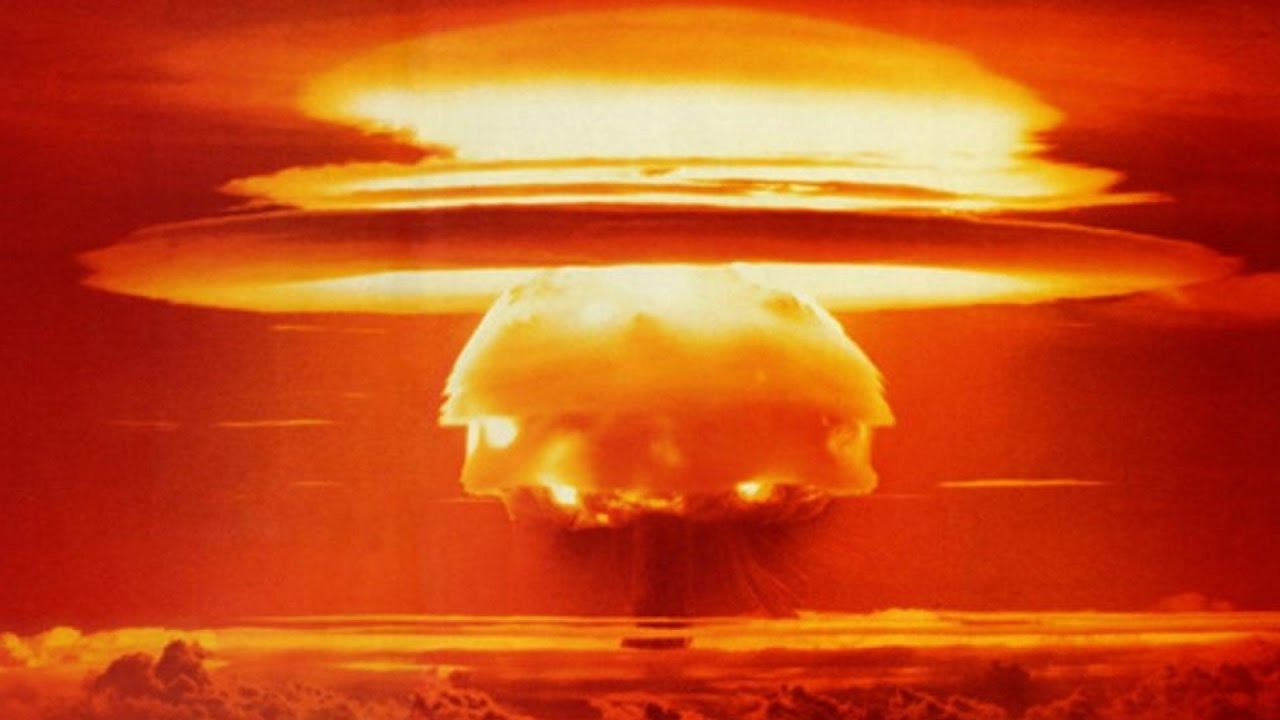
Image result for H-bomb blast images

Today The Bulletin of the Atomic Scientists moved the "Doomsday Clock" 30 seconds closer to midnight then it had been one year ago.   As I noted at that time (Jan.. 26 blog post):

This morning at 10:00 Eastern time, in news that ought to send chills down ever citizen's spine, The Bulletin of the Atomic Scientists moved the second hand of the Doomsday Clock another half minute closer to midnight. Hitherto it had been set at 3 minutes to midnight, since 2015.  The new setting marks metaphorically the acknowledgement of the highest danger facing the planet since 1953, when the U.S. and U.S.S.R. conducted multiple H-bomb tests in the atmosphere.
A global failure to fight climate change and concern over Donald Trump’s cabinet picks were cited as reasons for the increased threat to the planet.

For background reference, the group was founded in 1945 by University of Chicago scientists who helped develop the first atomic weapons as  commissioned by the Manhattan Project.  Two years later the "Doomsday clock" was created using the imagery of a clock striking midnight (translated into apocalypse) and the contemporary idiom of a nuclear explosion to convey threats to humanity and the planet.   The decision to move (or to leave in place) the minute hand of the Doomsday Clock is made every year by the Bulletin’s Science and Security Board in consultation with its Board of Sponsors, which includes 15 Nobel laureates. The Clock has become a universally recognized indicator of the world’s vulnerability to catastrophe from nuclear weapons, climate change, and new technologies emerging in other domains.

Each year the basis for moving the minute hand is given in an accompanying statement. This year's statement is given below:


To: Leaders and citizens of the world Re: Two minutes to midnight Date: January 25, 2018:

In 2017, world leaders failed to respond effectively to the looming threats of nuclear war and climate change, making the world security situation more dangerous than it was a year ago—and as dangerous as it has been since World War II.

The greatest risks last year arose in the nuclear realm. North Korea’s nuclear weapons program made remarkable progress in 2017, increasing risks to North Korea itself, other countries in the region, and the United States.  Hyperbolic rhetoric and provocative actions by both sides have increased the possibility of nuclear war by accident or miscalculation.

But the dangers brewing on the Korean Peninsula were not the only nuclear risks evident in 2017: The United States and Russia remained at odds, continuing military exercises along the borders of NATO, undermining the Intermediate-Range Nuclear Forces Treaty (INF), upgrading their nuclear arsenals, and eschewing arms control negotiations.

In the Asia-Pacific region, tensions over the South China Sea have increased, with relations between the United States and China insufficient to re-establish a stable security situation.  In South Asia, Pakistan and India have continued to build ever-larger arsenals of nuclear weapons.

And in the Middle East, uncertainty about continued US support for the landmark Iranian nuclear deal adds to a bleak overall picture.

To call the world nuclear situation dire is to understate the danger—and its immediacy.

On the climate change front, the danger may seem less immediate, but avoiding catastrophic temperature increases in the long run requires urgent attention now. Global carbon dioxide emissions have not yet shown the beginnings of the sustained decline towards zero that must occur if ever-greater warming is to be avoided. The nations of the world will have to significantly decrease their greenhouse gas emissions to keep climate risks manageable, and so far, the global response has fallen far short of meeting this challenge.

Beyond the nuclear and climate domains, technological change is disrupting democracies around the world as states seek and exploit opportunities to use information technologies as weapons, among them internet-based deception campaigns aimed at undermining elections and popular confidence in institutions essential to free thought and global security.

--------------------------\
The Bulletin of the Atomic Scientists Science and Security Board believes the perilous world security situation just described would, in itself, justify moving the minute hand of the Doomsday Clock closer to midnight.
But there has also been a breakdown in the international order that has been dangerously exacerbated by recent US actions. In 2017, the United States backed away from its long-standing leadership role in the world, reducing its commitment to seek common ground and undermining the overall effort toward solving pressing global governance challenges. Neither allies nor adversaries have been able to reliably predict US actions—or understand when US pronouncements are real, and when they are mere rhetoric. International diplomacy has been reduced to name-calling, giving it a surreal sense of unreality that makes the world security situation ever more threatening.

Because of the extraordinary danger of the current moment, the Science and Security Board today moves the minute hand of the Doomsday Clock 30 seconds closer to catastrophe. It is now two minutes to midnight—the closest the Clock has ever been to Doomsday, and as close as it was in 1953, at the height of the Cold War.

The Science and Security Board hopes this resetting of the Clock will be interpreted exactly as it is meant—as an urgent warning of global danger. The time for world leaders to address looming nuclear danger and the continuing march of climate change is long past. The time for the citizens of the world to demand such action is now:  #rewindtheDoomsdayClock.

The untenable nuclear threat. The risk that nuclear weapons may be used—intentionally or because of miscalculation—grew last year around the globe.

North Korea has long defied UN Security Council resolutions to cease its nuclear and ballistic missile tests, but the acceleration of its tests in 2017 reflects new resolve to acquire sophisticated nuclear weapons. North Korea has or soon will have capabilities to match its verbal threats—specifically, a thermonuclear warhead and a ballistic missile that can carry it to the US mainland. In September, North Korea tested what experts assess to be a true two-stage thermonuclear device, and in November, it tested the Hwasong-15 missile, which experts believe has a range of over 8,000 kilometers. The United States and its allies, Japan and South Korea, responded with more frequent and larger military exercises, while China and Russia proposed a freeze by North Korea of nuclear and missile tests in exchange for a freeze in US exercises.
The failure to secure a temporary freeze in 2017 was unsurprising to observers of the downward spiral of nuclear rhetoric between US President Donald Trump and North Korean leader Kim Jong-un. The failure to rein in North Korea’s nuclear program will reverberate not just in the Asia-Pacific, as neighboring countries review their security options, but more widely, as all countries consider the costs and benefits of the international framework of nonproliferation treaties and agreements.

Nuclear risks have been compounded by US-Russia relations that now feature more conflict than cooperation. Coordination on nuclear risk reduction is all but dead, and no solution to disputes over the INF Treaty—a landmark agreement to rid Europe of medium-range nuclear missiles—is readily apparent. Both sides allege violations, but Russia’s deployment of a new ground-launched cruise missile, if not addressed, could trigger a collapse of the treaty. Such a collapse would make what should have been a relatively easy five-years ago unimaginably more intractable.
------------------------------------

Let's hope that all citizens and leaders pay attention to these threats and seek to turn the hands of this clock backward instead of forward.  But we'll have to strive for a rewind despite the news of a leaked Pentagon draft describing additions to the U.S.  nuclear arsenal including: 'low yield' (tactical) nukes that can be mounted to Trident submarines and a new submarine launched cruise missile (SLCM).  These new weapons are estimated to cost $1.2 trillion over the next 30 years to build and maintain according to the Congressional Budget Office.


The Biggest Stock Market Crash "In Our Lifetime"? The Indicators Are All Blinking Red


Image may contain: text that says 'YUTILITY FORECASTER Growth Safety Income Reliability Since 1989 Ari Charney, Chief Inrestmen Strategist You need to rely Why (Regular) Stocks Could on yourself. Drop 50% in the Next 12 Months'
Look, I get that the species of investor governed by irrational exuberance  doesn't want to hear it, but the sky high gains of the DOW aren't going to continue. There will be no DOW 30,000, the market will crash first.  Already the rampaging Bull has lasted longer than all but one other, and in the midst of the gains too many are checking their brains and critical thinking at the assorted investment house doors.  The smart ones understand inflated Bulls always take a dive and the current iteration - with its stratospheric P/E ratios- is already in dangerous bubble territory based on Nate Silver's stats on what precedes crashes.

Silver, in his book, The Signal and the Noise- Why So Many Predictions Fail But Some Don’t  warned (p. 347):

"Of the eight times in which the S&P 500 has increased at a rate much faster than its historical average over a 5-year period , five cases were followed by a severe and notorious crash, such as the Great Depression and the Black Monday crash of 1987”.

Interestingly, two of the largest stock market dives have followed two of the biggest bubbles: the first of 37.85 percent and on the heels of the bubble that formed from Jan. 14, 2000 to Oct. 9, 2002, and the second of 58.78 percent that formed (mainly due to the housing bubble) from Oct. 9, 2007 to March 9, 2009.

More recently, Charlie Farrell, the CEO of Northstar Investment Advisors LLC, wrote a year ago in The Denver Post Business pages  ('Do You Have The Stomach For The Next Stock Crash?') :

"For the past eight years, investors have enjoyed a steadily increasing stock market. Memories of the 2008 crisis have largely faded and many investors have forgotten that sinking feeling. But if you want to avoid the mistakes investors made during the last crisis, you should start thinking bad thoughts. Yes., bad thoughts. Start training your brain and your guts for the next stock market decline. Why? Because big stock market crashes and declines happen and they pose a big threat to your wealth."


One indicator of a bubble is the rate of stock share increase. But another is the rate of inflation related to the trailing P/E ratio.  This is the classic price to earnings which looks at the current price divided by the company's total earnings the past 12 months. .  This is perhaps the most common metric used by investors to value publicly traded companies. While it does not account for growth rates by default, it represents a simple metric that can be compared over long periods of time. 

The  most recent issue of The Utility Forecaster  has tracked this metric up to now and for good reason expresses alarm. We see that the immediate factors have also appeared in 'the biggest dips in recent years" including the 2008 crash. These contributing factors include the Fed policy of cheap money infusion (via low interest rates coupled with quantitative easing or "QE"), along with the Fed subsequently halting QE by no longer buying bonds (from Oct. 29, 2014.) Add to that the Trump- GOP tax cuts which will create enormous deficits and debt and you have the makings of a large potential crash.

For reference, three years ago (in September)  the P/E ratio was about 18.5. Today the P/E for stock in the S& P 500 index is just over 25.  That is, investors are paying $25 for each $1 in corporate earnings. Just before the 2008 crash and 2009 financial meltdown it hit 27. 

What gives?   What gives is that there is no genuine support for the share increases or higher P/E ratio.  In other words, people are basically being hosed. Let's also note the long term average P/E ratio is about 16 and markets tend to revert to that average at some point.

The Utility Forecaster points out that only one other developed  economy adopted a stimulus plan like  ours, and that met with disaster. This was Japan between 2001 and 2006. After the Bank of Japan pulled the plug Japanese stocks fell by 50 percent. What is preventing the current market from crashing now? Mainly corporate stock buybacks which are providing a false cushion.  As long as these corporations keep sustaining their buybacks the DOW (as well as S & P) will continue upward, but there is a limit. Once the debt impact is felt - and it will be, when investors see they are only playing with "Monopoly money", then the roof caves in.

As The Forecaster puts it:

"As reported by Business Insider, a report from the global head of Société Générale's asset allocation team projected that the unwinding of easy money policies and broken politics in Washington will cause  today's market to unravel."

The 'broken politics' refers to an inability to resolve issues like the debt ceiling and out of control spending, especially with inadequate revenue coming in.  The next debt ceiling increase is likely to exceed $21 trillion, and the money still to be unwound from the Fed's QE program is nearly $4 trillion. Put the two together and you are looking at a major catastrophe ready to happen, never mind the current irrational exuberance.

The Utility Forecaster goes on to note that other sources forecast an even more dire end to this Bull, viz.:

"Legendary investor Jim Rogers says we're about to suffer the biggest stock market crash in our lifetime. And he believes it could happen later this year."

The UF goes on:

" Why should we listen to him?  The 74 year old not only helped found one of the most successful hedge funds of all time, he's made a number of market calls including the last housing crash. As Rogers observed, the debt that fueled the last downturn is nothing compared to the debt we've piled up since then. Over the last 10 years our national debt has more than doubled. His advice, 'Be worried!'

He cites a debt of $19.8 trillion but that is before the Republicans effectively added at least another $1.5 trillion with their idiotic tax cuts - the last thing we need now as even Rogers agrees. The most proximate warning metric we have right now? It is the Shiller P/E ratio, which uses inflation adjusted earnings over a trailing 10-year period.

This is "now at its highest level since the dot.com bust and even higher than before Black Monday in October, 1987".  We're now at 31.1  by this measure or 85 percent higher than the historical mean of 16.8.  Further, as the Utility Forecaster points out, "the  current total market cap is about 138.2% of the last reported GDP implying that the market is significantly overvalued."

Seth Klarman of the Baupost Group adds this attention getter (ibid.):

"The U.S. financial system is poised to collapse at any time."

In so far as any sensible person knows the national debt doubling in ten years portends a "Potemkin" market,  Klarman is correct.   But I am convinced that "any time" will be this fall, most likely in October, or about 3 weeks before the midterm elections. By then the total uselessness of the GOP tax cuts and their addition to the debt should be realized, and investors will finally see - as the UT puts it -  that their wondrous DOW is based on a straw foundation - now ready to go up in flames.


See also:

http://brane-space.blogspot.com/2017/11/has-stock-market-dodged-bullet-in.html


Take note, you've been warned.

Wednesday, January 24, 2018

Selected Questions - Answers From All Experts Astronomy Forum (Celestial Mechanics)

Question -

How do they find the positions of planets  (mathematically)?


Answer:

Determining the position of any planet in the orbital plane is not trivial
at all, nor can it be answered in a simple response format. The reason is
that whole courses in what is called celestial mechanics are devoted to
it.

Students cannot take this course without first having studied (or taken
courses in) calculus, advanced calculus and differential equations, as
well as advanced computer programming. Hence, if you haven't taken or been
exposed to such - it is impossible to convey what is necessary to compute
orbit positions!

Basically, position determination entails identifying - calculating the
seven elements that make up a given planetary orbit, including: the
eccentricity of orbit (how much it deviates from circularity); the
semi-major axes (or mean distance from the Sun); the longitude of the
ascending node, the inclination (i) of the orbit, the true anomaly, and
the mean anomaly, and the time of perihelion passage (T) or alternately
the 'mean motion' n = M/ (t - T).


Getting more specific, the diagram  below shows assorted orbital elements
for a planet of mass m2 (the Sun is m1) .


In the diagram, w   is the argument of the perihelion, W is the
longitude of the ascending node, f is the true anomaly and i is the
inclination of the orbit. The critical or key parameter
here is h, the angular momentum vector for the orbiting system. 

The true anomaly is perhaps most difficult to obtain since it requires one
take a Fourier expansion (again, this is taught in advanced calculus!) of
the difference (w - M), e.g. the mean anomaly (M) from the true anomaly.

The student must be  able to ascertain that  W  = M - w  (difference
between mean anomaly and argument of the perihelion) where M can
be obtained from a table based on observations, and w can be obtained
using a Fourier expansion of the mean anomaly, M:

w  = M + (2e – e3 / 4) sin M + 5 e2/4 sin 2M + ... etc.

One then needs to obtain the energy constants C1, C2, C3.
Where:

C1/ h = sin W sin (i)
C2/ h = - cos W sin (i)
C3/h = cos(i)

The magnitude h, of the angular momentum vector is:

h = r x r’ =

(y z’ - z y’)

(z x’ - x z’) = (C1 C2 C3)

(x y’ - y z’)

so (r x r’) = (C1/ h, C2/ h, C3/h)

Since the inclination of Earth's orbit to the ecliptic  (i) is known
(23.5 deg) and therefore cos(i) can be determined, then sin(i) can be
found as well.  Also h can be determined, since: h = C3 / cos(i) =
(GMm a (1 – e2)12 where all the constants are known (a = semi-major axis
of orbit, e = eccentricity of orbit)


(The energy equation is: ½V 2 - u/r = C, and the C's - energy integration
constants- are  found from this.)

Once W is known, C1 and C2 and C3 are known, and the student can
compute the position of a planet, say Jupiter, forty or so years in the future.

If you would like to find out more details of planetary position computation
and exactly how it's done - there is an excellent and detailed site (with tutorials)