Showing posts with label nuclear fusion. Show all posts

Sunday, April 3, 2016

Fusion Power Within Ten Years? Basically A Pipe Dream


In a TIME magazine issue from some months ago, an article ('A Star Is Born'. Nov. 2, 2015, p. 31) appeared which offered the hope that nuclear fusion will soon be available as a viable energy source. One which "would mean the end of fossil fuels and the greatest antidote to climate change the world could ever ask for".  Adding "saving the world, that is the endgame".   These are heady words and we're also informed that in the past ten years a new front has "opened up" to make fusion a more plausible reality than once believed.

Already, the author notes, there exists a "prototype fusion reactor" which is the product of a secretive company called TriAlphaEnergy. (The name is derived from the triple alpha fusion process in stellar interiors by which three helium nuclei combine to form one carbon nucleus, e.g. He4 + He 4 + He4 -> C12.

The article also points out that communicating these discoveries is still troublesome because too many confuse nuclear fission with nuclear fusion. In the former, massive atoms like uranium 235 (U 235) are split apart into smaller, less massive atoms.  This process releases a good deal of energy and hence is used in our current nuclear power plants but there are drawbacks.  For one thing, uranium is a scarce and finite course, and secondly fission plants are expensive to maintain and regulate. They also generate enormous quantities of toxic waste that remain hazardous for centuries.

By contrast, in nuclear fusion, rather than splitting atoms they are fused together into larger, more massive ones.  Thereby, a fraction of the mass of the particle involved gets converted into energy via the famous Einstein mass-energy equation: E = M c2   .   This enables the typical fusion reaction to produce 3 to 4 times as much energy as nuclear fission.

There are also huge advantages including that fusion reactors use an abundant element, hydrogen (the most plentiful in the universe), and fusion reactors don't melt down, they just stop. Little or no radioactive waste is produced and no hazardous pollution is generated as with fission. For example, the main byproduct used in hydrogen fusion is helium - the element used in balloons.

Most modern fusion research and work is based on the Russian-designed tokamak, a toroidal system by which the super heated plasma is magnetically contained and compressed (by magnetic fields) inside a toroidal-shaped device, e.g.

.The design makes use of the fact that plasma is extremely sensitive to electromagnetic fields. Interestingly, the analogous behavior is observed in coronal loop structures on the Sun, e.g.


The TIME article noted that the "colossus of all tokamaks" is currently being constructed in a small town in France, outside Marseilles. The so-called ITER (International Thermonuclear Experimental Reactor) will be 30 m high and weigh in at 23,000 tons.  Its staff will "number in the thousands"  and it will hold 840 liters of plasma. The containing magnets alone will require some 100,000 km of niobium tin wire. The stupendous cost - in the tens of billions estimated now - is being paid by a global consortium that includes the U.S., Russia, the EU, China, Japan, South Korea and India.

It is currently expected to come to full power operation by the year 2027. (Originally it was projected to be in operation this year.)

The goal is the same for all similar machines that preceded it: to pass the breakeven point where the reactor generates more energy than it takes to run it.  Some big tokamaks cam close in the 1990s but were always hamstrung by the fact the magnetic containment broke down, and in most cases it barely lasted for a second.

Enter now TriAlpha's fusion reactor which is quite different from the ITER and other tokamaks.  As the TIME author put it, "you can think of it as a massive cannon for firing smoke rings except the smoke rings are actually hot plasma and the gunpowder is a sequence of 400 electric circuits timed down to 10 billionths of a second that accelerate the plasma ring to just under a million kilometers per hour".

We're then informed that in fact "there are actually two cannons, arranged nose to nose, firing plasmas at each other which merge in a central chamber and the combined plasma heats up to 10 million degrees Celsius.".

The mammoth machine that orchestrates all this "sits outside a gigantic warehouse section of TriAlpha's Orange County Office Building surrounded by racks of computers that control it and more racks of computers that process the information that pours out of it". In other words, another huge project. (Every five millionths of a second operation generates a gigabyte of data)

All of this sounds and reads in the realm of the "imminent" which is how many sources interviewed in the TIME piece portray it. But is it really?  Some speak of reaching commercial fusion in "ten years" but this is probably bollocks. There are simply too many formidable barriers a few of which I will touch on below. More likely as the head of the Princeton fusion lab put it: "I think we'll have commercial fusion on the grid in the 2040s."

But there are significant hurdles to overcome and I will focus on those for tokamaks because: a) these devices have been around much longer and afforded the most opportunity for in depth research, and b) most of the money on the planet is tied up with the ITER not its newfangled commercial fusion cousins. (Which I tend to view in the same manner as the commercial space ventures. Lots of pizzazz but little real value to deliver over time)

The most important consideration in respect of wave-particle energy loss has to do with the wave-particle resonance in plasmas. Recall before we looked at inverse Landau damping in the context of collisionless coronal shocks and specifically the two -stream instability, e.g
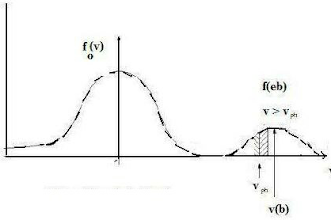


In the region where the slope is positive (f(v)  / v > 0) there is a greater number of faster than slower particles so a greater amount of energy is transferred from particles to associated (e.g. Alfven) waves.  Since f eb contains more fast than slow particles a wave is excited, and there is inverse Landau damping such that plasma oscillations with vph in the positive gradient region are unstable

In the original case of Landau damping, with the slope negative (f(v)  / v < 0) the number of particles slower than the waves phase velocity exceeds the number of those that are faster. Thus, more particles gain energy from the wave than lose energy to it.

In the case of tokamak fusion reactors the loss of particle (ion) energy is critical. Why? Well, if fusion products, say deuterium (D2) reach the plasma-facing tokamak wall at full energy there will be two adverse consequences: 1) they will have lost energy via the interaction so can no longer contribute to heating the background plasma, and 2) they may damage the wall itself. A lot of difficulty here will be obviated with ITER, for which the orbits of generated ions will be small relative to the device size. Given ions will have much farther to travel to escape the plasma we don't expect major losses through single wave -particle interactions.

Chaotic ion orbits associated with multiple resonances from a single Alfven mode is another story. Simulations of this behavior (see Physics Today, October, 2015, p. 34) shows a rapid dispersal of energy for individual ions. As the authors note: "Even if the ions are not ejected from the plasma, their loss from the central core region leads to reduced temperatures and fusion yield."

Without any doubt, given the results of simulations thus far, it may be well into the middle of the century before there is even a faint hint of workable fusion, i.e. that exceeds the 'breakeven' point. As for actual fusion energy meeting even 50 percent of our needs, in terms of exajoules delivered - which would have to rival our current coal power and nuclear (fission) output, I don't expect that until the end of the century, if then.

Looking realistically at the exajoule delivery capabilities of different energy sources, it is evident that fossil fuels will play a major part barring: a) a sudden decrease in population, or b) a sudden decrease in energy demand, i.e. to run our energy insatiable civilization. Global energy consumption rose from barely 21 EJ (exajoules)  in 1900, to 318 EJ in 1988, and is at about 400 EJ today. Solar, geothermal + wind by the end of this year will total 10 EJ at most,  and will therefore have contributed only:

(10/ 400) x 100% = 2.5% of the total global demand by the end of next year.

The key question is where will the energy come from to support an energy intense and consumptive civilization? You can’t just say “new alternative sources” and leave it at that. What new, alternative sources? Where? As Jay Hanson (www.dieoff.org) pointedly notes:

“The fact that our society can‘t survive on alternative energy should come as no surprise, because only an idiot would believe that windmills and solar panels can run bulldozers, elevators, steel mills, glass factories, electric heat, air conditioning, aircraft, automobiles, etc., AND still have enough energy left over to support a corrupt political system, armies, etc."

According to The Physicist's Desk Reference oil, gas and coal remain the primary energy components (at roughly 83% total)  of the current energy  mix in terms of EJ delivered. That won't change unless fusion power comes in much earlier and delivers up to 30 EJ a year in a practical form. I simply can't see that happening anytime soon!


Friday, October 24, 2014

Introduction to Nuclear Physics (3): Nuclear Fusion and Deuteron Potential

Continued from previous installment:

4. Nuclear Fusion Reactions:

In general a nuclear fusion reaction is one in which two light nuclei combine (fuse) to form a heavier nucleus with positive energy given off (the Q of the reaction).  Nuclear fusion is demonstrated in its most compelling form in the case of stellar energy. Exhaustive investigations in this regard, eventually led to the realization that fusion was the only practical energy by which stars could be sustained over long periods of time, such as billions of years.

In the Sun, for example, two distinct nuclear fusion processes occur: 1) the proton-proton cycle, and 2) the carbon-nitrogen cycle.

 In the first of these (the easier one because it has fewer reactions):
                                                                                                                       
1H + 1H + e- ®  2 H   + n + 1.44 MeV

2 D   + 1H ®  3 He + g + 5.49 MeV

3 He + 3 He ®  4 He + 1H + 1H  + 12.85 MeV

The top line shows two protons fusing to yield deuterium (heavy hydrogen) with a positron and neutrino (n) emitted, along with 1.44 MeV of energy. Empirical evidence of this reaction is obtained from gallium detectors, of the neutrinos given off, which are within 1-2% of what theoretical models predict.[1] In the second fusion reaction, the deuterium combines with a proton to give the isotope helium 3, along with a gamma ray (g) and 5.49 MeV energy. In the final fusion, two helium-3 nuclei combine to yield one helium-4 nucleus, along with two protons, and 12. 85 MeV energy. Note that the two ending product protons commence the cycle anew, so that the generation of nuclear energy is ongoing.  

The ending quantities on the right sides of each part of the cycle denote the Q of the reaction for that part.  Let us check the Q for the first and simplest part. We know the hydrogen mass = 1.007825 u and for deuterium we have (from atomic tables): : 2 D  =  = 2.01410 u. Then:

Q = [ 2(1.007825 u) – 2.01410 u] c2

Q = [ 2.01565  u – 2.015941u] c2

Q = [2.01565 – 2.01410] 931.5 MeV/u

Q = [0.00155] 931.5 MeV/u = 1.44 MeV

The effect of ongoing fusion reactions such as this,  means that the central core of the Sun becomes heavier and heavier, as more and more helium is produced. This despite the fact that the Sun as a whole is losing an amount of mass of roughly 4 x 10⁶ metric tones per second

Insight Problem:

If the atomic mass for helium 3 (3 He) is equal to 3.01603 u, then verify the other Q-values for the last two parts of the proton-proton cycle. A  simplified, compressed “net reaction”:

 1H + 1H +1H + 1H ®  4 He + Energy

Is sometimes used to evaluate the total energy released in the proton-proton cycle. Compute this energy and compare to the value obtained for the total energy released in the earlier example. Can you account for the difference?

Nuclear Fusion Reactions in the Aging Sun:

     At some stage, when nearly the entire solar core is helium a new helium fusion phase will be ushered in (at higher temperature), such that the following reaction series, known as the ‘triple alpha’ process, kicks in:

4He + 4He ®  8Be + g  (- 95 keV)

8Be + 4He  ®  12C + g  + 7.4 MeV

     Here, the two alpha particles (helium nuclei) first fuse to give unstable beryllium and a gamma ray (g), with 95 keV energy absorbed. Then the beryllium fuses with a helium-4 to give carbon–12 plus a gamma ray and 7.4 MeV energy given off.

     In this way a new cycle commences, leading to a heavier molecular weight core. Each successive burning phase, however, is less efficient than its predecessor, as can be seen by comparing the energy given off in the triple alpha process to the energy given off in the proton-proton cycle. The key thing to bear in mind in terms of a stable phase (i.e. ‘Main sequence’) star like the Sun is that it is in pressure-gravity balance. The outer gas pressure balances the weight of its overlying layers. Any condition likely to disrupt this balance is therefore of paramount interest.

The stable lifetime of the Sun depends on how long before it consumes ninety percent of the hydrogen in its core. Theoretical investigations using data from nuclear reaction rates and cross sections suggest the Sun’s Main Sequence lifetime at 8-10 billion years. Since it already has spent 4.5 billion of those years, there are anywhere from 3.5 to 5.5 billion years remaining. 

Once the triple-alpha process gets underway and the energy balance declines, the Sun will have to compensate for the lost energy to sustain any kind of balance. Thus, the Sun’s core must contract and convert gravitational potential energy into thermal energy.  Meanwhile, ignition of hydrogen burning in the Sun’s outer layers will create radiation pressure that forces the outer layers to expands. The Sun will then become a “Red Giant” and its new larger surface will be expected to engulf all the planets up to and including Mars.

Example Problem:

If the atomic mass of beryllium 8 (8Be) = 8.00531 u, verify that the first part of the triple-alpha fusion process is endothermic and has the value given.

Solution:

We have:

Q = [ 2(4.00260 u) –  8.00531 u] c2

Q = [ - 0.00011] 931.5 MeV = 0.102465 MeV = - 102.4 keV

Of course, not taken into account here is the gamma ray (g) which also comes off. Hence we will have:

(-102.4 keV) + (E (g)) = -95.7 keV

So that:

E (g) =   hc/ l = 6.7 keV

Is the missing energy of the gamma ray photon, with the difference factored in yielding 95.7 keV.


Aside: The Problem of the Coulomb Barrier in Solar Fusion

 The problem of the Coulomb repulsive barrier to solar nuclear fusion was first highlighted and explored by Prof. Martin Schwarschild in his excellent monograph 'The Structure and Evolution' of the Stars’  (Dover, 1958).

     Schwarzschild once calculated that the probability of any one proton fusion in the Sun’s core would ordinarily be  about once every 14 billion (14 x 109) years. Since the universe itself is only 13.8 billion years old this means it could never occur unless another factor was present to enable it.

     The reason for this has to do with the Coulomb (electrostatic) repulsion between the potentially fusing H-nuclei. Thus, each proton, having (+) charge tends to repel any other proton within a discrete sphere or distance around it. (Recall from your basic physics, like charges repel, unlike attract - and that's what essentially obtains here)

     In order for thermonuclear fusion to be realized, the Coulomb barrier must be overcome. Fortunately quantum mechanics allows for a certain non-vanishing probability that a particle (say proton) of kinetic energy K, can overcome a barrier of energy V ("barrier potential"), via the process of "quantum tunneling".

Note that tunneling is a general feature of low mass systems, such as single proton (H) states.

Consider a deBroglie (matter) wave arising from a single proton (p+) of form:

U(x) ~ sin(kx)

Where x is the particle's linear displacement (e.g. in 1-D) and k, the wave number vector(k= 2π/
l), where l  denotes the wavelength.

    Though the associated kinetic energy K < V (the barrier "height") the wavefunction is *non-zero* within the barrier, e.g.

U(xb)~ exp(- cx)

So, visualizing this behavior as shown below: 

Image result for brane space, deuteron
Fig. 4: Tunneling through Coulomb barrier potential  to allow nuclear fusion

with the "barrier" at height V, so we can visualize the particle of lesser energy K, moving from the left side of the E-axis "tunneling" through to the right side where it may have wave function, U(x) ~sin (kx + φ), where φ denotes a phase angle.

    Note that if the barrier is not too much higher than the incident particle energy, and if the mass is small, then tunneling is significant.

    It's important here to point out that the penetration of the barrier is a direct result of the wave nature of matter. In effect, this wave nature - which is uniquely quantum mechanical in origin- allows a higher energy barrier to be penetrated by a lower energy particle, something totally without parallel in classical, Newtonian physics!

    Even given tunneling, an "offset" is required to reduce the low penetration probability , since clearly the Sun and other stars are shining by fusion.

     This 'offset' arrives via enormously high density of protons, e.g. in the core, which: i) increases the probability enormously, since so many more protons are in extremely close proximity, and (ii)enhances temperatures to the point they can be sustained, and continue - thereby building up other fusion reactions to finish the initial one.

   The idea here being that a particle of relatively low incident energy (of kinetic energy K, say) can actually penetrate a higher potential energy barrier, say of energy V(x) > K. Note that the penetration of the barrier is a direct result of the wave nature of matter! (The matter wave form changes in the process of transmission through the barrier, say from an exp(-ikx) function to a sin (kx + f) where f denotes phase angle). In effect, this wave nature - which is uniquely quantum mechanical in origin- allows a higher energy barrier to be penetrated by a lower energy particle, something totally without parallel in classical, Newtonian physics! Note that if the barrier is not too much higher than the incident energy, and if the mass is small, then tunneling is significant.   It was insights such as this that paved the way to apprehending how much subtler nature was than hitherto realized, and how many more technological advances could be achieved when the wave nature of matter was factored into designs. 


5. The Quantum Treatment of the Deuteron.

The deuteron is perhaps the most basic nuclear system to confront. As we know the deuteron consists of one proton, one neutron and the electron – with the first two comprising the nucleons.

To proceed, we write the usual Schrodinger equation for the hydrogen atom but let F and Q = const. so that their derivatives are zero. Then, substitute in the reduced mass:

m’=   m n m p/ (m n + m p)

So we obtain the new form of the Schrodinger equation:

1/r2 d/dr (r2 dR/dr)  + 2m’/ ħ[E – V] R = 0

This can be further simplified by letting:

U(r)  = rR(r)    which results in the equation:

d2U/dr2  +  2m’/ ħ[E – V] U = 0


In this equation we find that V, the potential, has two values:

V = - Vo and  V = 0 outside the well. The diagram below shows how we are treating the deuteron in terms of the function V(r).
Image result for brane space, deuteron
Fig. 1: The potential well associated with deuteron

There are then two solutions we can designate:

i) u I for r   <   r o and 

ii) u II for r   >   r o

Inside the potential well:

d2 u I /dr2  +  2m’/ ħ[E + Vo] u I = 0

and we let:   a2  = 2m’/ ħ[E + Vo]

so that: 

d2 u I /dr2  +  au I = 0


For which we can show:

u   = A cos (ar)  + B sin(ar)

Since R = u/ r  the cosine solution must be discarded, lest we get an unwanted infinity. This leaves:

u   =   B sin(ar)

Outside the potential well  V = 0 so that:

d2 u II  /dr2  +  2m’/ ħ[E]  u II = 0

Let:

b2  = 2m’/ ħ[- E ]


Since the total energy of the neutron is negative, i.e. being bound to the proton.  Then:

d2 u II  /dr2  -  b2 u II = 0

Which can be shown to have the solution:

u II   = C exp (-br) + D (exp(br))

For consistency we demand u ® 0 as r ®¥, so D = 0 and:

u II   = C exp (-br)

For continuity at r  =   r o  and  u I  =  u II  :

B sin(ar)  =  C exp (-br)

Thence:

du I /dr = d u II  /dr Þ  aB cos (a r o) = -bC e-b r o

Now, divide the solution on the left side by the one on the right side, e.g.:

a B cos (a r o) /   -b C e-b r o

so:

tan (a r o)  = -  a/b

In effect, the deuteron problem cannot be solved analytically, only graphically.


Quantum Numbers for Deuteron:

Since there are two particles, each with intrinsic spin ½   in the deuteron, the total intrinsic spin angular momentum can only have the values: S = s1 + s2 = 0 or 1.   The orbital angular momentum quantum number, L (describing the motion in space of the proton and neutron relative to each other) can assume the values L= 0, 1, 2 (i.e. S, P, and D states).

The total angular momentum of the deuteron has been measured and the total angular momentum quantum number J has been found to be 1. This must be the vector sum of the orbital angular momentum (L) and the total spin momentum (S).


Problems:

1) Calculate the wavelength of the gamma ray photon (in nm) which would be needed to balance the endothermic part of the triple –alpha fusion equation. (Recall here that 1 eV = 1.6 x 10 -19 J)

2) Verify the second part of the triple-alpha fusion reaction, especially the Q-value. Account for any differences in energy released by reference to the gamma ray photon coming off and specifically, give the wavelength of this photon required to validate the Q.

3) The luminosity or power of the Sun is measured to be L = 3.9 x 1026 watts.  Use this to estimate the mass (in kilograms) of the Sun that is converted into energy every second. State any assumptions made and reasoning.


4) In a diffusion cloud chamber experiment, it is found that alpha particles issuing from decay of U238 ionize the gas inside the chamber such that 5 x 10 3 ion pairs are produced per millimeter and on average each alpha particle traverses 25 mm. Estimate the energy associated with each detected vapor trail in the chamber  if each ion pair generates 5.2 x 10⁻¹⁸  J.

5) When 118 Sn 50 is bombarded with a proton the main fission fragments are: 

24 Na 11   and  94 Zr 40  

The excitation energy necessary for passage over the potential barrier is:

e  >   3 ke2 Z2/ 5

Where the right hand side denotes the height of the Coulomb barrier.

a) What must this value be?
(Take   ke2  = 1.44 MeV/ fm)

b) Find the energy difference between the reactants and the products. (Take c2  = 931.5 MeV/ u)

6)  a) Show that u   = A cos (ar)  + B sin(ar)

In  a solution of the reduced Schrodinger equation for the deuteron:

   d2 u I /dr2  +  au I = 0.

Show why the cosine solution needs to be discarded.

 
b) Show that u II   = C exp (-br)

Is a solution of the other reduced Schrodinger equation for the deuteron:

   d2 u II /dr2  +  bu II = 0? 

Explain.


[1] See, e.g. Physics Today: Reports, April, 1995, p. 19.

Tuesday, January 14, 2014

Once Again: Jason Lisle is NO Astrophysicist


Pseudo-scientist Jason Lisle: His groupies still believe he's an "astrophysicist" - so cite him often to bolster their Biblical bollocks, 'creation science' and other baloney.

Let's clear the air once more that Jason Lisle, despite his attempted "resurrection"  by some deluded fundies, is NO astrophysicist. One cannot be an astrophysicist if he doesn't adhere to basic principles of astrophysics!  One really has to wonder what intellectually deformed sort of nitwit – who calls himself an “astrophysicist”- can forego all the major postulates and principles (NOT beliefs!) of physics and astrophysics and subscribe to patently obvious bunkum like a young Earth, "young Sun" or young cosmos.

In the case of Jason Lisle, he's reputed to be an astrophysicist based on one Ph.D. doctoral thesis in which – perhaps for the first time in his academic life - he came close to doing real science. But even that had numerous holes, e.g. http://brane-space.blogspot.com/2011/06/why-jason-lisle-is-wrong-in-his-solar.html                         

And: 

http://brane-space.blogspot.com/2011/07/jason-lisle-astrophysicist-dont-make-me.html
and  http://brane-space.blogspot.com/2011/07/jason-lisle-faux-astrophysicist.html


Among the powerful arguments I made to show Lisle’s young Earth-young Sun etc. claims are bollocks (and automatically disqualify him from being any "real astrophysicist") is the fact he  rejects nuclear fusion in the Sun as the primary energy source.  Any first year astrophysics student knows that given accepted-known  nuclear fusion reactions the time taken to steer a spectral class G star through the Main Sequence- goes on for millions of years. Thus Lisle adheres to nonsense (for a thousands of years old Sun)  that NO REAL astrophysicist would hold! For example, Lisle in one dvd on “The Young Sun” attempts to convince gullible fundies and other viewers that he can show the Sun is “young” so fits in with the Genesis fairy tale that the Sun can be no more than 6,000 years old (since in Genesis the Earth was made before the Sun, an impossibility anyway as I’ve shown in a number of blogs).

Lisle's claim, supposedly made by a "real" (sic) astrophysicist, is absolutely astounding in context (especially for a "Ph.D.") - given that it stands all of stellar evolution, astrophysics and thermodynamics, statistical mechanics on its head, especially nuclear fusion: the basis for the Sun's energy! These are things EVERY budding astrophysicist is taught in his first graduate course in stellar astrophysics or stellar evolution. Thus, there are differing nuclear cross sections for differing fusion reactions and also differing time scales.

More to the point, the same arguments that torpedo Lisle’s claims for a young Earth, young Sun also torpedo D. Russell Humphreys' (another make believe "astrophysicist), e.g.
Russell Humphreys


 for a young Earth and young cosmos. The reason? To embrace such codswallop would require rejecting most of modern stellar physics predicated on nuclear fusion. A key quantity in obtaining these time scales is the energy liberated per (nuclear fusion) chain defined as:

W(r) = rE, or W = (rE)/ r


which is in ergs/gram for example. (I.e. the total ergs of stellar energy given off per gram of stellar matter available for reaction.)
 
E is found from specific nuclear fusion reactions, such as p + p -> D2 +e(+) +v, where two protons fuse to yield deuterium, a positron and a neutrino(v). The key quantity is r, defined as the reactions/cm3. Obviously, the greater this value the shorter the energy generation time scale and the smaller the value the longer it will take. It is defined (see, e.g. Astrophysical Concepts, p. 331), by Martin Harwitt:
 
r = B (r)2  X1X2/ T1.5 * exp^-3[2π^4e^4mH (Z12)(Z22)A'/ h^2kT]1/3
 
where B is a proportionality constant, r is the density, h is Planck's constant (e.g. h = 6.62 x 10⁻²⁷  erg-sec), k is Boltzmann's constant = 1.38 x 10⁻¹⁶ erg/K), T is absolute temperature of the reaction, i.e. in K deg, and X1 and X2 are the concentrations associated with atomic numbers Z1, Z2 while A' is the reduced atomic mass, i.e. A' = (A1 A2)/ (A1 + A2).

 Then working out 'r' for the proton-proton fusion cycle one can (after a lot of work) obtain the time scales for each chain part and the energy yielded for each, viz. (cf. Harwit, op. cit., p. 336):


p + p -> D2 +e(+) +v (1.44 MeV, Time = 14 x 10  yrs.)
 
D2 + p -> He3 + y(gamma ray) [5.49 MeV, time = 6 secs)

He3 + He3 -> He4 + 2H1 [12.85 MeV, Time - 6 million years]
 
Note that the last branch of the cycle already takes 6 million years, i.e. for each fusion to furnish 12.85 Mev (millions of electron volts of energy, were 1 eV = 1.6 x 10⁻¹⁹   J). Thus, this cycle alone takes almost 1,000 times longer than Lisle's time of 6,000 years, as the supposed maximum age of the Sun.
 
The only mildly problematical time frame in the p-p cycle is for the initial fusion, which yields 14 billion years or about three times the age of the current Sun. Thus, at face value, this translates into only about one fusion every 14 billion years for the first branch of the proton-proton reaction. While that is extremely long, the Sun fortunately has a vast number of protons available in its core, so that – at a temperature of 10 million Celsius, enough can fuse to initiate helium production and energy given off. Moreover, the key "catalyst" speeding the reaction time up is the phenomenon of "quantum tunneling" whereby a lower energy particle can surmount a higher energy barrier (what we call the "Coulomb barrier") by virtue of its wave-like properties.
 
To fix ideas, let us say a particle (say proton) of kinetic energy K, must overcome a barrier of energy V ("barrier potential"), via the process of "tunnelling". Consider a deBroglie wave of wavelength lD =  h/p  or lD =  h/ mv  where lD is the de Broglie wavelength) arising from (p+) of form: U(x) ~ sin(kx) where x is the linear dimension along displacement and k, the wave number vector (k= 2π/ lD).
 
 
Now, though the associated energy K < V (the barrier "height"), the wavefunction is non-zero within the barrier, e.g.

U(x_b)~ exp(-cx)

So, sketching axes for this:

E
!
!---------V------
!   *p
!
!
!------!-------------> x
 
with the potential (Coulomb) "barrier" at height V, for which we visualize the particle p(*) on the left side having "tunneled" over to the right side where it may have wave function, U(x) ~sin (kx + φ), where φ denotes a phase angle.  Note that if the barrier is not too much higher than the incident energy, and if the mass is small, then tunneling is significant.

Note also that the penetration of the barrier is a direct result of the wave nature of matter! In effect, this wave nature - which is uniquely quantum mechanical in origin- allows a higher energy barrier to be penetrated by a lower energy particle, something totally without parallel in classical, Newtonian physics.

In other words, without the benefit of quantum tunneling, the first reaction time in the p-p cycle would be inordinately long and have to be disallowed as unphysical.
 
Beyond this we know the photon diffusion time (the time to make it from the edge of the solar core to the Sun's surface or photosphere) is calculated to be nearly 1 million years. This takes into account all the changed random directions the released photons undergo as a result of absorption and re-emission by particles along the way out. No core photon makes it directly through, but instead undergoes millions of interactions en route resulting in collisions. Again, 1 million years for a photon's diffusion time belies Lisle's young Sun argument! It also belies Humphreys' own young Earth- young cosmos claims. (Since even the brightest O and B spectral class stars have lifetimes on the Main Sequence, much longer than this photon diffusion time)
 
In the case of  Jason Lisle, here’s another conundrum for his assorted worshippers to ponder: Lisle himself contradicts his 'Young Sun' assertion in his Ph.D.! (Introduction). Therein he concedes to the above dynamics for nuclear fusion occurring in the Sun! So one is forced to ask if he really believes that or if he LIED in his dissertation? If he lied then his Ph.D. isn’t worth an ounce of doggie lickspittle I don’t care which institution awarded it.
 
Let’s now return to Humphreys.  Let us grant, according to assorted online Wiki entries, that he is a physicist at the Institute for Creation Research (ICR), like Duane Gish. He is best known for his creationist views and his attempts to reconcile reality with the notions of young Earth creationism. As in the case of Lisle  before him, this reconciliation process entails standing long confirmed physics and astrophysics on its head, and dreaming up improbable assumptions to make the reconciliation work.  It would be roughly analogous to me using an array of misplaced physics and whacky assumptions to show an elephant could be suspended from a string and the spring’s tension would support it.


While one of Humphreys favorite sayings (cited on many fundie blogs)  is evidently that scientists –astrophysicists don’t have their own evidence but just  “believe what other scientists believe” we must take care to point out he is certainly not in the same league as many pseudoscientists.  Indeed, he appears to have far more truly scientific distinctions than Lisle.   For example, his biography at Creation Ministries International lists many commendable achievements and awards, but none of his awards appear related to his young Earth-cosmos research.


This shows two things: 1) The discontinuity in awards discloses the actual scientific establishment places no value on creationism or any of its offshoot “theories” including young cosmos, and 2) Though Humphreys cites these mainstream awards for his ICR bona fides, he technically rejects their basis since he rejects the science behind them!

This is important to note because it elicits the question of why he’d cite any mainstream awards at all. If it is to show his professional scientific acumen or capabilities then it’s mostly useless because by embracing young Earth, young cosmos bollocks he’s squandered all his scientific capital. So the awards only show a once prominent physicist who has now “gone off the rails” and in many ways has lost all credibility. In many respects this parallels what happened to the once great Nobel-winning chemist Linus Pauling who tried to parlay his many scientific awards into credibility for his whackadoodle megadose vitamin C conjectures. It didn’t work. People saw through it and concluded that a once great scientist had either become senile or that he betrayed his background to enter a fringe field.


Sadly, both Jason Lisle and  D. Russell Humphreys will continue to attract their respective, assorted acolytes and groupies - mainly anti-science fundagelicals - because the Bible isn't enough for the backward, uneducated  fundie  populace to confer gravitas on their religious bunkum. No, they all (or mostly) understand they need the patina of science - or at least scientific -sounding names, terms,  jabberwocky etc. to confer some scintilla of objective authority on their bollocks beliefs. Because that is what they are. Pure belies, based on no evidence, and no repeatable observations.

As I've noted many times before, the biggest indicator that what they're doing isn't science is the absence of any falsification tests. That is, testing their hypotheses, i.e. Young Sun, with the aim to falsify it. This is totally beyond them, but until they do it - as opposed to invoking the backward baggage of cherry-picked pseudo-scientists, they simply confirm they are all about promoting religious beliefs - not any scientific theories.