Showing posts with label Runaway Greenhouse effect. Show all posts

Tuesday, August 27, 2019

Rapid Melting Of Greenland Ice Sheet : Will Our Favorite Barbados Beach Still Be There Next Time We Arrive?


It's been known for at least 38 years, that South Florida will be 'ground zero' when the rising seas from climate change begin to have their most serious impact. Indeed, the image of  projected sea reclamation by 2035  for Florida - in a U.S. Geological survey map -  was actually published first in a (World Book) Science Encyclopedia article from 1981.   

Meanwhile, sea rise prognostications had forecast a 20- 25 ft. increase by 2070 owing to the melting of Greenland' enormous ice sheet.  But frankly, that's all gone by the backboards as we now have direct evidence the melting of the Greenland ice sheet has accelerated and dramatically.  

How much are we talking about?  According to the latest reports (cf. The Denver Post, Aug. 25, p. 1A, 'Greater Mass Loss Going Forward'):

"By the end of the summer about 440 million tons of ice wil have melted or calved off Greenland's giant ice sheet. "

Adding:

"In the span of July 31 to August 3, more than 58 billion tons melted from the surface. This is more than 40 billion tons more than the average for this time of year."

Which elicits the question of what transpires if this rate of melt is sustained or even accelerates? It seems clear that in such a case the forecast that "Greenland alone would cause 3-4 feet of sea level rise" must be advanced, possibly to 2040 or even earlier.  Indeed, Greenland accelerated melting is  now evident given (ibid.):

"A NASA satellite found that Greenland's ice sheet lost about 255 billion metric tons of ice a year between 2003  and 2016, with the loss rate generally getting worse over that period."

Add that to the melting of the Arctic ice caps and Antarctic ice shelf as well and one can imagine a scenario for a 20-25 ' sea level rise by mid century.   We also now have to factor in the effects of the burning Amazon rain - forest - likely to add 2- 5 gigatons of carbon to the already CO2 sodden atmosphere.  This is no longer in the realm of science fiction such as portrayed in flicks like 'Waterworld'.  

Just look at the projected map of sea reclamation projected by the U.S. Geological survey for Florida by 2035. Now imagine a sea level rise instead of 3 m and five times the number of Florida residents affected. Yes, it is quite within the realm of plausibility now.  Hell, we've even seen how Miami itself is now subject to flooding.  The map below of the Miami area shows effect of elevation on rate of property price appreciation:

No photo description available.
Where the more contrast colored purple section refers to greater effect on rate of appreciation.  The incredible conclusion of Harvard real estate professor (and author of the paper) Jesse Keenan, is that ordinary home owners are already factoring future sea level rise into their calculations.

What about the island nation of Barbados, where I lived with wifey for 20 plus years?  It won't be any better for Bim's residents - unless they are living toward the higher elevations as indicated in the topographical  map below


Here the green coded area is greatest in elevation over sea level - from 194m to 338 m. To spare Bim's populace from the ravages of sea level rise on the same scale we expect for South Florida, they'd have to move to this area.  The most populated areas near the south coast (1- 3 m elevation) would be totally reclaimed by the ocean. Already as I posted previously, sea level rise has claimed large chunks of the beaches in and around Christchurch and St. Michael parishes.  On several visits to Bim over the past several years we've seen the encroachment of the sea first hand.

The future for Barbados and other island states does not look promising as an article in the UK Independent  notes:
"With a sea-level rise of one metre, which is now regarded as highly likely by the end of the century, the Caribbean would see "at least 149 multi-million dollar tourism resorts damaged or lost" and would also see loss or damage of 21 of the Caricom airports, and the inundation of land surrounding 35 of the region's 44 portsmage leapt upwards, as one metre of sea level.  

With a two-metre sea-level rise, by no means impossible, there would be "at least 233 multi-million dollar tourism resorts lost" plus damage or loss of nine power plants, 31 airports, and the loss of 710km of roads. However, when a more sophisticated analysis was done on the impacts of erosion caused by rising seas, it was found that the damage leapt upwards, as one metre of sea level rise on low-lying coasts gives between 50 and 100 metres of erosion. A one-metre rise with erosion factored in would result in "at least 307 multi-million dollar tourism resorts damaged or lost," the report says."

So we are talking calamitous economic and topographical changes here. Almost certainly permanent and indeed - with increased warming - the forecast can only get worse.  Indeed, we are speculating that at the current rapid Greenland ice sheet melt rate our favorite Bajan beach (below)  may no longer even exist by the time we next visit. 
Lastly, let's bear in mind that sea level rise is only one aspect of the ongoing climate catastrophe.  The other is the increased frequency of extraordinarily hot days -  spiking heat indices to unheard of levels (110 F and above) as lives and livelihoods are put at risk.

To fix ideas, the Union of Concerned Scientists 'Killer Heat' team recently compared historic averages over the period 1971- 2000 with projected heat indices for the middle to the end of this century. Their finding? 

"The team's projections bumped up against the limits of the NWS heat index formula, which is capable of calculating a value for 99 percent of summertime conditions. The analysis found that as climate change intensifies extreme heat, the numbers will often rise beyond the calculable range."

In other words, we are taking of conditions at the cusp of the runaway Greenhouse effect. Conditions so radically divergent from those today that current heat index models are unable to calculate the temperature (or thermature) limits.

One thing for certain, with the incineration of the Amazon rain forest  all our futures - especially for the younger generation - suddenly got much,  much worse.

See also:

https://www.independent.co.uk/environment/climate-change/rising-sea-level-threatens-hundreds-of-caribbean-resorts-says-un-report-2148034.html


And:

Friday, January 11, 2019

"The World Is Quietly Getting Better"? The Facts & Evidence Don't Support That Meme


Conflicts over roughly the last 65 years and the casualties estimate for each. World quietly getting "better"? Judge for yourself!

Once more we behold the meme of humanity "getting better", this time trotted out by Greg Ip, e.g.


Of course this is codswallop, but ironically - if facts are only in the background and dire events kept "quietly" on the backburner - or on page 23 - then yes,  it is possible to accept it.  But any study of events over the past century or so belies the claim and the incipient basis for this fantasy.    As Exhibit A readers are directed to the graphic above showing just the conflicts that have gone on for the past fifty years or so- and the numbers of dead  estimated for each.  And this doesn't even take into account the ongoing Syrian Civil war, the numbers of dead there (est. over 1 million) and the vast number of fleeing refugees.

Ip is correct that "for most of recorded history humanity lived on the brink of starvation"  and "as recently as 1980 half of the world lived in extreme poverty", i.e. consuming less than the basic necessities - valued at $1.90 a day.  Meaning that since then the lot of global humanity has improved. No argument there, but at what cost as Neoliberalism has dominated global economics?    Well, the answer appeared in the Market Outlook section of the same day's WSJ  (p. R1) exploring 'The World's Growing Debt".  That debt, as the article notes, now stands at "$250 TRILLION" - and as the author puts it, "the world has never had so much debt".  But "growing debt goes hand in hand with growing economies" . Why? Because in the Neoliberal model growth is predicated on expectation of return in the future and leverage. Hence, Neoliberal investors are prepared to use leverage to buy stocks in companies just as companies are prepared to use leverage, i.e. go into debt, to expand. 

Why is this a negative? Because growing debt cannot be sustained. It portends a depression of extreme proportions and a return to the unthinkable poverty Ip claims is a thing of the past. Think of twenty years in a Great Depression,  few or no jobs, no capital  (far less credit) to form businesses or income for citizens. Think, in other words, of the current government shutdown and no pay, zilch, but for everyone! Well, everyone except the über wealthy like Jeff Bezos',  worth $130 b.

The fact is that even now - before a calamitous trigger brings the "house" down, Neoliberal economics has been shown to be a failure. As reported in The Denver Post last Sunday ('High Number Of Americans Getting Absolutely No Raises', p. 5K):

"Nine years into what is currently the second longest recovery in U.S. history  an unusually large number of workers is still stuck with frozen paychecks."

And corroborating this, in an article in The Washington Post today about how displaced federal workers are having to sell precious belongings to make ends meet in this Trump shutdown, we read:

"In the United States, living paycheck to paycheck is disturbingly common, regardless of profession or location. A recent report from the Federal Reserve revealed how little cushion most Americans have in their budgets: Four in 10 adults say they couldn’t produce $400 in an emergency without sliding into debt or selling something, according to the figures that surveyed households in 2017, a relatively prosperous year for the American economy."

A "relatively prosperous year" but for whom?  Not for millions of middle or working class stiffs, or the federal employees caught in this shutdown atrocity spawned by the Right's blowhards - and Dotard Donnie acting as their slave.  This is all despite the fact that the GOP and Trump promised workers better wages with the massive tax cut passed in 2017.  Now, however, we see there are no real wage gains - plus we are saddled with an addition of $1.5 trillion to the national debt, now expected to top $22.5 trillion this year.  And to add insult to injury, the demented Trump vermin now talk of raiding the disaster relief funds (for Puerto Rico, Texas, California etc.) to pay for Trump's  - or rather Limbaugh's and Ann Coulter's ...Wall.

How long can the party go on? That is the question of the moment. The answer is that the payment will come due when the first major crisis erupts and the system finds itself unable to continue without the essential resources to sustain the population.  What might that be? An immediate trigger would be a devastating nuclear war  in which nearly all of ten thousand megaton warheads currently  in nuclear powers' arsenals are detonated within a day or less.  Then civilization as we know it ends, especially with nuclear winter. 

Or, it could be a global event that cripples economies across the planet such as a pandemic of Avian Flu or even a re-assorted H1N1 virus - the same which spawned the 1918 pandemic that killed 100 million. (I will have a post about this pandemic next week).  Less  likely would be a monster solar  flare hurling a super stream of charged particles in a coronal mass ejection (CME)  with the potential to knock out all our power grids and GPS satellites . Bear in mind that GPS, besides providing directions for road users, allows synchronized cell phone conversations, as well as orchestrates air traffic not to mention 'date stamping' on most financial transactions and guiding the dynamic positioning of the majority of deep sea oil drilling and gas operations. 

Don't believe the power grid is that vulnerable? Then you're living in fantasy land. The map below shows the extent of Russian hacking efforts into the power grids of at least 24 states (cf. WSJ today, 'Russia Hacked U.S. Grid', p. A9):

Map showing at least 24 states where Russian hacked into the power grid. (From WSJ, p. A9)

Then how successful were they? According to a cyber security chief (Jonathan Homer) cited in the article,  referring to a utility company briefing paper : "The Russians had penetrated the control system area of utilities through poorly protected jump boxes".  The latter are really computers that enable technicians to move between two systems: the internet and critical control networks (walled off from the web for security purposes.) 


But consider this: if the Russians could so easily create havoc - admittedly with the help of malicious or spoofed emails- imagine what a well-placed CME could do. Many experts agree a simple solution would be to install large enough resistor -capacitor systems at critical locations (e.g. near power plants or major cities)  in order to sever any CME-driven upward field aligned current connection to the grid. The problem? Major U.S. power companies don't want to assume the cost for any voluntary installations, which could run $100,000 per transformer. Hence, the grid remains unprotected against the rare - but potentially calamitous - Carrington event CME.


My point? The Neoliberal capitalist system, built as it is on fossil fuel consumption and competitive individualism, would not be resilient enough to survive such an event. Further, the debt amassed already would ensure returning to our present civilization unlikely if not impossible.  Hence, a dystopic future awaits  humanity  (maybe a rung or so above Dark Ages' level) though the Neoliberals can't seem to see it.

 Ip brags that "as of September half the world - 3,8 billion people - are middle class or rich" - but that is not a permanent attribute or constant. Those numbers can be wiped out in an instant by one catastrophic event - OR by an encroaching cataclysm such as extreme climate change, i.e. the onset of the runaway greenhouse.

And what of climate change? Is it even on Ip's radar? Well yes to the extent he writes:

"The warming climate is a consequence of all those new middle class entrants burning fossil fuels. Yet obsessing over such perils is how we'll likely solve them. Take global warming: Public concern over climate change is rising in the wake of wildfires and floods."

Well, if that was really true how account for the fact carbon emissions actually rose 3.4 percent the past year, e.g.

It appears to me the public is not as invested in controlling climate change as he claims, which in the first instance would mean accepting a significant fuel tax. But look how that worked out in Macron's France with all the Yellow vest riots.

This  Neoliberal blind spot, which also entails forecasting outrageously high economic growth  despite the ravages of climate change (Ip predicts GDP 400 % bigger by 2100) is more or less the same idiocy adopted by WSJ resident denier Holman Jenkins   Jenkins,  recall, insisted ('Climate Change Is Affordable', p. A15, Nov. 28) that the latest IPCC climate assessment allows us to "arrive at a manageable $510 billion in estimated climate-related costs by 2090"

 But as I noted in my post of October 10th, after the original IPCC report came out:

"The cost of doing nothing until 2040 and allowing the now forecast 4C rise (more likely 6C) by 2100 will be well over $100 trillion in worldwide costs - from the mega-disasters including massive flooding, fires, to loss of jobs, homes, infrastructure - including power stations."

And let's note that one of Jenkins' standard ploys is to whine constantly about  "doom mongers", i.e. those of us seeking to control fossil fuel consumption.  But look,  if people were rational beings, as opposed to pawns and zombies manipulated by the media pundits and BS'ers like Jenkins and his WSJ op-ed cohort, fear would not be necessary . Able -minded citizens could examine the climate news and data dispassionately e.g.   Climate report understates threat

And arrive at the same conclusion as climate scientists like Myles Allen.  Prof. Allen,  an Oxford University climate scientist and an author of the IPCC report. was quoted in one NY  Times piece after the release of the UN report:

"It’s telling us we need to reverse emissions trends and turn the world economy on a dime,”


This is, of course, why in my first post this year I predicted climate change would become unstoppable, e.g.

2019 Forecasts: Climate Change Becomes Unstoppable...

The very fact we in the U.S.  were unable to limit our carbon emissions -  even as coal plants closed - -  supports this. Totally.  I hate to puncture Greg  Ip's little pink balloon of false hope, but there it is. Sometimes you have to put on your 'big boy' pants and face cold, hard facts.

The latest news that the oceans are now 40 percent warmer ought to also strike  fear (or at least a dose of reality)  into the hearts of those like Jenkins, as well as puncture the presumptuous optimism of those like Greg Ip (and Steven Pinker).  See e.g.


Ocean heat is climbing 40% faster than thought - Axios


Hitherto, let us note, the world's oceans have provided a buffer to moderate the warming by absorbing excess CO2 in the atmosphere.  But when the seas absorb CO2 from the atmosphere carbonic acid is formed - and the oceans become acidic. The particular chemical reaction is:

H2O + CO2 -> H2 CO3

The lower the pH level in the seas ('7' is neutral pH), the more acidic they are. This is also worrisome because mass extinctions of marine creatures in the past have been linked to instances of ocean acidification.  But now with oceans much warmer it is clear we are approaching another tipping point where the limits of  the oceans' CO2 absorption may have been reached and now we may well be in for the worst.  

 Indeed, since the Industrial Revolution the acidity of the oceans has jumped 25 % from a pH of 8.2 to 8,.1 according to the U.S.  Global Change Research Program;s 2014 National Climate Change assessment. If current trends continue unchecked the acidity would increase 100-150 percent above pre-industrial levels by the end of the century, according to Carol Turley of the Plymouth Marine Laboratory in the UK. 

 But it seems now that with the oceans much warmer the carbonic acid concentrations may have peaked but the outgassing of CO2 may be not far away. If so, we may have passed the point of no return. In an article appearing  in Eos Transactions of the AGU (Vol. 83, No. 34), from August 20, 2002, ‘Progress Made in Study of Ocean’s Calcium Carbonate Budget’, we are alerted that sedimentary carbonates represent the largest reservoir of carbon on Earth. The author also notes that “a third of the anthropogenic CO2 that has been added to the atmosphere since the middle of the 18th century has been absorbed by the oceans”. This means that the oceans, acting as CO2 reservoirs, have actually masked the worst effects of global warming and that when their saturation point is reached, the spillover effect will be rapid and calamitous indeed.

The oceans now being 40 percent warmer means that saturation point is quite near. If so, the tipping point that sends our civilization crashing is also not far away, all Greg Ip's assurances notwithstanding. 

World getting quietly, relentlessly better?  Sure, from the perspective of an ostrich! 

Tuesday, August 1, 2017

'Climate Change Isn't The End Of The World' - Total, Absolute Bollocks!


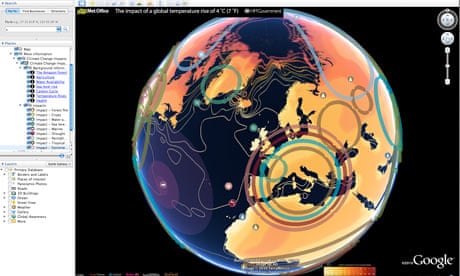
A new interactive Google Earth map showing the impacts of a 4°C world
In a WSJ article yesterday (p. A17) by David R. Henderson and John M. Cochrane ('Climate Change Isn't the End of the World') it is claimed that climate change is really no biggie.  After all the "costs of moving and adapting are not as imposing as they seem", and besides "carbon dioxide hurts nobody's health" and it's "good for plants"..   In fact, it is incredible that such recycled rubbish could even appear in a serious newspaper, but there it is.  Climate codswallop is indeed fertile soil for the denizens of the Hoover Institution. They earn their living hawking it.

The formidable problems of trying to adapt I've already dealt with here:

http://brane-space.blogspot.com/2017/01/climate-change-adaptation-will-be.html

Really choice is the authors' remark:

"It follows that if the future of civilization is really at stake adaptation or geo-engineering should not be unmentionable"

True, which is why I did discuss them in the post associated with the preceding link, especially the latter.  I also showed why the various geo-engineering solutions are totally impractical!

None of the problems I examined are in the distant future as the authors seem to believe, but basically right around the corner. For example, the projection by the U.S. Geological Survey for the loss of Florida land owing to sea rise by 2035 - or barely 18 years from now. (This is depicted below.)Estimated economic cost to Florida's economy? Well over $10 billion, and factoring in inflation  - probably closer to $20 billion.


As for the claim CO2 "hurts nobody" I wonder where these two Hoover Institution bozos who wrote the piece got that idea or if they ever lived in a dense urban center with thousands of vehicles outgassing CO2 (as well a CO) for hours on the day.    But more important and deadly is the cumulative indirect effect of CO2 being added by the gigatons each year to our atmosphere.   To put it into quantitative terms, the temperature of the planet is currently out of balance by 0.6W/ m2  and this is almost entirely due to the annual rate of CO2 concentrations increasing. Further,  every increase in CO2 concentration by 2 ppm increases the radiative heating effect by 2 W/ m2.

Prof. Gunter Weller (formerly of the Univ. of Alaska Geophysical Institute)  estimated the runaway greenhouse effect would kick in when the CO2 concentration level of 600 ppm is surpassed-  which seems reasonable. If it is just over 400 ppm now - by many conservative measures -  then doing the math (adding 2 ppm  per year and 2 W/ m2     puts us in jeopardy by 2100.

The authors claim "typical costs are well blow 10 percent if gross domestic product  in the year 2100 and beyond".   But they are basing this on way too conservative models that have already been shown not to have reckoned in the expected much more rapid increases. In fact, by 2100,  if nothing is done much earlier, economic costs could well exceed 50 percent of GDP for most nations of the planet.  These costs will be engendered by:

- Collapse of power grids and energy infrastructure, i.e. from being unable to meet demand in a climate where 130- 140 F is hit in most cities around the world daily.

- Associated collapse of utility electrical pumping stations, i.e. to provide enough water for a much larger population. (because electric power is needed to pump water for use)

- Spread of tropical diseases including cholera, dengue fever and worm parasite infestations, e.g.


Millions more tapeworm cyst infections of human brains in affected areas - perhaps four fifths of our planet's land surface.

Also filiarisis worm infections - as shown on the left. Estimated cost to treat victims, including in North America: over $100 billion per year.

Adapting to worm infestations may be the most straightforward process for some kind of adaptation but require enormous supplies of anti-worm serums, meds such as Ketrax. I recall here my own worm infestation while in Peace Corps - noticed only after being awakened one night by intense itching of my skin, mainly on the inner thighs. As I switched the night light on and spotted definite wriggling movement of the skin, I realized the worms would spread if I didn't act. The cure? Ketrax, prescribed by the spoonful (by a dermatologist) three times a day. After a few bouts of vomiting the vermin out (visible wriggling in the vomit), all had been eliminated. I don't know that people will even be properly diagnosed as multiple worm infestations spread on approaching the cusp of the runaway greenhouse.

We will also have to expect long before the runaway greenhouse kicks in, the spread of antibiotic resistant diseases which will add even more enormous medical costs - and indeed, there may be no way to stem such infections once temperature averages are beyond a certain limit.

Left unsaid, is how increasing CO2 is also altering the composition of our oceans to render them less supportive of life.   As recently as 2012 scientists from Columbia University, which led  much of the research,  have found surging levels of carbon dioxide in the atmosphere that forced down the pH of the ocean by overall 0.1 mean unit in the last century. This is 10 times faster than the closest historical comparison from 56 million years ago. It's deadly serious because - like the margins for ushering in a runaway greenhouse effect, the margins of safety for acidic oceans are extremely low. Hence, one can't tell by the small magnitude of numerical pH that the increment change is nothing to fret over.

As noted in earlier blog posts: the seas absorb CO2 from the atmosphere, forming carbonic acid. The particular chemical reaction is:

H2O + CO2 -> H2 CO3

The lower the pH level of the seawater ('7' is neutral pH), the more acidic. This is also worrisome because mass extinctions of marine creatures in the past have been linked to instances of increased ocean acidification. Thus,  the current incremental change could also threaten important species. This according to Baerbel Hoenisch, the paleoceanographer at Columbia who was lead author of a  2012  paper that appeared in the journal Science. As he noted:

“If industrial carbon emissions continue at the current pace, we may lose organisms we care about — coral reefs, oysters, salmon,”

By one estimate, at the rate of acidification, the only marine life that will still survive by 2050 will be jellyfish.

As for the authors' claim that "CO2 is good for plants", the response is yes, but WHAT kind? Seven years earlier we learned in The Wall Street Journal (June 4, p A16, 'Superweeds Trigger New Arms Race'; June 21, 2010, p. D1 that at least 40% of U.S. corn and soybean crops will "harbor Roundup resistant super weeds."  Indeed, CO2 spiking concentrations have already led to "super weeds" such as a pig weed variant capable of releasing an irritant chemical known as  urushiol and resistant to the most toxic weedicides, excepting perhaps the highly  carcinogenic agents known as: 2, 4- D, dicamba and paraquat.


Yes, the plants just love the CO2, but not the kind of plants we want!

The two Hoover -based morons who wrote the piece also insist on the ease of moving, but how will they reckon such climate change flight (say away from an area laden with brain -infesting worms) when it is set against similar migrations occurring simultaneously worldwide?

They ought to consult the 'Defense, National Security And Climate Change Symposium' , held in Washington, D.C.  At the Symposium,  Brigadier General Stephen Cheney stepped up to the podium to discuss 'Conflict and Climate Change'. Cheney, like some other speakers- zeroed in on climate-driven migration, asserting:

"We know for a fact that climate change is already driving internal and cross border migration"

Referencing here, for example, that in Bangladesh - the 'ground zero' of global warming- rising sea levels could displace 15 million by 2050. Oxford University's Norman Myers has projected there could be as many as 200 million climate refugees by mid-century.  Cheney's presentation tagged a number of conflicts that climate change triggers, including the desertification in the borderlands between Chad and Nigeria which "has caused a lot of migration". He also indicated that the terror organization Boko Haram "is simply taking advantage of that".

Other aspects of Cheney's talk cited beefing up military infrastructure at home and abroad to be resistant to harsher climate. The army, in fact, has adopted a 'Net Zero' initiative to make its U.S. bases water and energy independent.  Supporting the national defense position, nearly all the reinsurance companies (like Munich Re) have climate change factored into their tables, costs, plans.

A vastly more serious voice than the two Hoover Institution  clowns is economics and psychology expert George Loewenstein.  His take was typical of the risk assessment experts consulted in a recent AP study. He called climate change "a problem that threatens the very existence of the human race and is already having devastating consequences around the world".

Indeed, extreme weather events derived from climate change have killed more than twice as many people in the U.S. as terror attacks in the past 15 years - including the carnage on September 11, 2001.   In fact, the slow rolling disaster of ever intensifying climate change can be thought of as a mode of natural terror which we dismiss or diminish at our peril.   New research also discloses that the runaway greenhouse isn't as far off or unlikely as some might wish to believe. See, e.g.

https://www.sciencedaily.com/releases/2013/07/130730163146.htm

But a word of caution: the astronomers who did the research show again why they also need to communicate with climate scientists  That is, an increasing solar constant is not required to trigger the runaway, only increasing radiative heating of the atmosphere via added CO2.  For every 2 ppm higher CO2 concentration we are registering increases in the radiative heating effect by 2 W/ m2.


Here's a timely heads up when one might encounter articles such as the one from the WSJ yesterday: If it's written by authors based at the Hoover Institution don't trust a word of what is put forward. (And look at the end of such op-ed pieces to see where the tract originated. As we know the Hoover Institution is one of the primary enclaves for climate deniers and skeptics.)

Wednesday, October 26, 2016

Yes, Ocean Life Is Headed To Extinction - Perhaps Even In Millennials' Life Time

Image may contain: plant, sky, outdoor, nature and water

Image may contain: ocean, sky, plant, outdoor, nature and water
Top: Healthy tropical coral reef supporting tabletop and staghorn corals. Bottom: A degraded tropical coral reef, affected by ocean acidification and higher ocean temperatures from global warming.

In a previous post (October 3rd) skewering the cockeyed global warming narrative of a putative high IQ member of Intertel, I noted how Janice and I had taken a tourist cruise sub across Carlisle Bay in Barbados e.g.
Image may contain: ocean, sky, outdoor, water and nature

This tour sub enabled us to see not only healthy coral reefs but also decimated ones, bleached out from higher water temperatures. These degraded reefs very much resembled those shown in the graphic above. It is now clear that this phenomenon is not localized by any means, but occurring worldwide, from the Caribbean to the Pacific to the Indian Ocean.

As recently as 2012 scientists from Columbia University, which led the research. have found surging levels of carbon dioxide in the atmosphere that forced down the pH of the ocean by overall 0.1 mean unit in the last century. This is 10 times faster than the closest historical comparison from 56 million years ago. It's deadly serious because - like the margins for ushering in a runaway greenhouse effect, the margins of safety for acidic oceans are extremely low. Hence, one can't tell by the small magnitude of numerical pH that the increment change is nothing to fret over.

As noted in earlier blogs: the seas absorb CO2 from the atmosphere, forming carbonic acid. The particular chemical reaction is:

H2O + CO2 -> H2 CO3

The lower the pH level of the seawater ('7' is neutral pH), the more acidic. This is also worrisome because mass extinctions of marine creatures in the past have been linked to instances of increased ocean acidification. Thus,  the current incremental change could also threaten important species. This according to Baerbel Hoenisch, the paleoceanographer at Columbia who was lead author of a  2012  paper that appeared in the journal Science. As he noted:

“If industrial carbon emissions continue at the current pace, we may lose organisms we care about — coral reefs, oysters, salmon,”


Meanwhile, the UN’s Intergovernmental Panel on Climate Change has said ocean pH may fall another 0.3 units this century. Even before the dawning of the year 2100 that means the generation of millennials could behold an ocean devoid of accessible sea life, leaving only jellyfish.  Anyone think or believe we'd see surfing contests in such waters?

According to ocean research scientist Carles Pelejero, depending on how we humans respond - whether we take action or continue fouling our waters- the pH could reach a low of 7.7 by 2100.  (Note that while technically not in the "acid scale"  i.e. pH  less than 7, we are talking about the direction of the pH change, toward higher acidity.) For reference, Pelejro leads a section of the Institut di Ciencies del Mar but his specific field is marine paleo reconstruction. Some have called it "seabed archaeology - as it uses drills to take samples from deep in the sediment at the bottom of the oceans. Using such samples, marine scientists can assess how the geochemistry of sea creatures has altered.

One of the most horrific findings was associated with the     PETM or Palo-Eocene Thermal Maximum, 55 million years ago. Over a 100ky period the evidence of samples showed a massive die off of shell -based life. If projections hold the same will occur by the end of this century.

An associated worry is that a stable, solid form of methane (clathrates) may be disrupted by current ocean chemical changes in what is called the "clathrate gun hypothesis". Should disruption occur, by changes in the ocean water chemistry and higher temperatures, it would mean the release of a greenhouse gas vastly more damaging than CO2.

For comparison, in the PETM phase referenced above, - which conditions we may now be headed for again  -  sea levels were as much as 330 feet higher than they are today.  Such a rise in sea levels would be enough to obliterate Europe, Florida and the northeast U.S. as well as Argentina.

Pelejero, for his part, is most concerned about the rapidity of the changes taking place now. He has noted that the same shifts that happened over the course of a few thousand years during the PETM era are now due to happen over a few centuries. - counting from the onset of the Industrial Revolution. That means their culmination by the year 2100, barely 83 years away.

Already a number of precursor effects have been observed, including:

- Around the world the shells of some animals are thinner than they were 300 years ago.

- An acidification spike off the coast of British Columbia in February, 2014 wiped out 10 million scallops.

- Foraminfera, the tiniest shelled plankton in the ocean are having trouble growing as they did in the PETM era

Could the seas of the world be filled with only jellyfish within 50 to 100 years? There is every possibility, indeed probability, if we continue our deplorable ways, pumping out ever more CO2 and turning the oceans into a giant waste pit.

Will the climate deniers finally come to their senses when they or their families are no longer able to get fresh fish to eat?   One assumes with all the marine resources, food potential devastated they will finally see the folly of upholding a world view based on Neoliberal, capitalist economics. But I wouldn't put money on it!

See also:

http://projectcensored.org/3-rising-carbon-dioxide-levels-threaten-permanently-disrupt-vital-ocean-bacteria/

And:

http://projectcensored.org/3-rising-carbon-dioxide-levels-threaten-permanently-disrupt-vital-ocean-bacteria/


http://projectcensored.org/12-lives-depend-keeping-80-percent-fossil-fuels-ground/