Wednesday, February 7, 2018

This H3 N2 Flu Season Could Be The Worst For U.S. Since 1968 Hong Kong Flu Pandemic

475158127.jpg
Electron micrograph of the H3 N2  influenza virus, largely responsible for most deaths and hospitalizations this flu season.

As the tally of pediatric deaths reaches a high not seen for nearly a decade, and flu is now wreaking medical havoc in all of the contiguouos states, one wonders if this scourge could rival the Hong Kong flu pandemic of 1968-69.

As I wrote earlier (December 11, 'The H3N2 Flu  - Are We Ready For The Onslaught?')  citing a Wikipedia reference:

"The Hong Kong Flu was a category 2 flu pandemic caused by a strain of H3N2 descended from H2N2 by antigenic shift, in which genes from multiple subtypes reassorted to form a new virus. This pandemic of 1968 and 1969 killed an estimated one million people worldwide"

But could this flu season be as bad? What we do know is what began as "the Aussie flu" last summer (the Australian winter)  has now metastasized to cause over 14, 000 hospitalizations and nearly 60 pediatric deaths. The hospitalization rate, according to one WSJ article ('Flu Hospitalizations Highest Since 2010' ) has now reached 51.4 per 100,000 or the highest since the  2009 H1N1 pandemic flu. That  strain "led to more than 60 million flu cases in the U.S".

Less noted is that the current hospitalization rate now compares to that (43.5 per 100,000) in the 2014-15 flu season - also dominated by H3 N2. Less known is that flu season saw 56,000 die from flu or even more than the Hong Kong flu killed in the U.S. (34,000).  In a blog post I wrote on Dec. 22, 2014, it was interesting to read how I suddenly came down with that flu while watching a football game. (My wife got it 3 days earlier).  That holiday season turned out to be a total wipe out but we were both glad we got our flu shots!

I also got the Hong Kong flu - the first  known appearance of H3 N2  -  so why didn't I have any immunity when the 2014 H3 N2 flu struck?  Well, likely because that was actually a variant strain, e.g. H3 N2v - where more Avian or swine contributions factored in.  It elicits the question of whether the current ferocious flu season is dominated by a similar H3 N2 variant, and in fact whether it could be as bad as the 1968 pandemic.

Soon after the Aussie flu struck the UK,  Professor Robert Dingwall, a public health expert at Nottingham Trent University, told the UK Daily Express  the oncoming H3 N2 season is expected to be the most serious flu outbreak since the 1968 pandemic that started in Hong Kong and killed more than a million people world wide. 

In a number of respects he's correct as this flu season further plays out, and it is clear we haven't even hit the peak yet.  See e.g.

No automatic alt text available.

There is also the chance this flu season could go on much longer than the (normally)  expected end in May. The Hong Kong flu swept the world infecting hundreds of millions for almost 2 years. Such freak pandemics seem to occur every 50 years, with the 1968 pandemic striking 50 years after the deadly Spanish flu - which killed up to 100 million - arguably a worse  human health catastrophe than  the Black Death. See also:

https://www.cnn.com/2017/04/07/health/flu-pandemic-sanjay-gupta/index.html

In their book, 'The End of Epidemics', authors Jonathan D. Quick and Bronwyn Fryer argue that the most frightening future risk is the potential for a new, highly contagious and deadly flu to arise from a "viral stirring pot".  Such a pot would include avian, animal (e.g. swine) and human-infecting viruses.  They also note the opportunity for such mixing abounds as beasts, birds and humans rub shoulders in places like factory farms.  Like Sanjay Gupta (earlier link) Dr. Quick's take is this is not a matter of if but "when".

My bet, as I've written before, is the new deadly pandemic will be a hitherto unseen form of Avian flu.   Cue then the date September 29, 2005, when David Nabarro, the newly appointed Senior United Nations System Coordinator for Avian and Human Influenza, warned the world that an outbreak of avian influenza could kill anywhere between 5 million and 150 million people. The reported mortality rate of highly pathogenic H5N1 avian influenza in a human is high; WHO data indicate 60% of cases classified as H5N1 resulted in death. My take, given the H5N1 would incept a "cytokine storm"  similar to what the H1N1 Spanish Flu did, is that at least 500 million would perish, and possibly as many as 1 billion.

So, we infer that what kills most humans - apart from the secondary infections, e.g. pneumonia  - is the immune system's hyper response to the virus invasion of our lung cells. This hyper reaction is what induces the cytokine storm.   Research into the Spanish flu victims discloses that death likely arrived via a cytokine storm, i.e. the victim basically "drowning" in their own lung fluids. The alveoli or air sacs of the lungs become basically incapable of gas exchange, e.g. between oxygen and CO2 and the victim suffocates as the cells burst - responsible for many of the victims having blood spurting from eyes, ears, nose etc.  Also, the effort to summon oxygen from elsewhere leaves the victims with a bluish or cyanotic facial appearance.

Contrast this with a number of  documented Asian cases,  where victims with H5N1 experienced diarrhea followed rapidly by a coma without developing respiratory or flu-like symptom. This shows that one can perish that suddenly, and with no evident breathing problems. 

More distressing, genetic sequencing of avian influenza A (H5N1) viruses from human cases in Vietnam, Thailand, and Indonesia shows resistance to the antiviral medications amantadine and rimantadine, two of the medications commonly used for treatment of influenza. This leaves only two remaining antiviral medications (oseltamivir and zanamivir) that should still be effective against currently circulating strains of H5N1 viruses.

If and when the next influenza pandemic strikes we better have our anti-viral weapons ready along with every available resource to care for the millions of victims. The current scenes, with hospitals having to set up triage  tents outside of main facilities and ERs flooded, shows we are nowhere near ready when the "big one" strikes. Which could, I say could...be at the tail end of this current H3 N2 season.

We will also have to drop the obsession with "diminished hospital profit margins" during flu outbreaks. That should be the least concern if millions of our fellow citizens are infected by a killer flu variant or totally new strain.

Tuesday, February 6, 2018

Baby Dotard Barks "Treason!" As Stocks Dive - What You Should Know About This Market Volatility

Image result for Trump screaming baby images
"WAAAAAH! Those Dems Is Treasonous For Not Clapping At My Speech!"

Even as the overgrown thug baby occupying the White House pissed his Depends at a speech at a company in Cincinnati (Sheffer Corporation)  yesterday he continued to bluster and bawl about the Democrats committing "treason". This because they refused to clap at the pathetic excuse for a State of the Union speech last Tuesday - when he barely managed to sound sane for an hour and twenty minutes.    At the Ohio company the fat con man and snake oil salesman yelped:

“Can we call that treason?  Why not? I mean, they certainly didn’t seem to love our country very much.”

Confusing love of country with ass kissing  this sleazy real estate criminal and Russian -backed stooge.. Of course, this fat turd is mad because one can't be guilty of treason for merely failing to applaud a farrago of lies.

But the interesting thing is that while this blubbering buttbrain was going on  about Dem "treason" the stock market plummeted by more than 1,000 points.  Even more interesting, as Diaper Donnie ranted, TV networks broadcast a jarring split screen. As Dotard  boasted of companies bringing billions of dollars back to America, the Dow Jones industrial average was shedding billions more. At one point, the rout became so drastic that CNN and MSNBC switched from the speech to report exclusively on the market gyrations.

Trump's delirious spiel about "treason" and inflating his effect on national economics coincided with the largest one day point drop in history.

This is where we get very serious and try to note the underlying reasons for what's going on. Higher wages threatening inflation and higher interest rates from the Fed has been one reason, and it is legit. While fatter paychecks are a welcome sight to workers (wages climbed 2.9 percent last month) they usually signal inflation for stock investors That in turn signals to them a Federal Reserve move to increase interest rates, meaning an end to the cheap money that's been fueling the stock bubble.

Right now the market is floating on trillions ($4 trillion to be exact)  of cheap money thanks to the generous Federal Reserve quantitative easing program. But the underpinning of this is really massive debt which hasn't been helped by the GOP tax cuts. These are projected to add nearly $1.5 trillion in deficits.

As yesterday's WSJ 'Business and Finance' headline blurted: Investors Fear Broader Asset Fall. Therein noting that over the past year stocks, emerging market currencies, commodities (like copper and gold) and high yield bond prices, have all risen in lock step.  However, this flashes red warning signs to global investors who (ibid.):

"had grown uneasy about various assets moving in lockstep -  especially because trading in many of these market isn't typically tied to share prices Such closely correlated movements are often associated with turning points in the markets."

Further, and most important:

"A sharp rise in asset prices can lead to an increase in leverage, or the use of borrowed money,before a turn in sentiment prompts a decline in prices that spurs forced selling as borrowers scramble to repay debt obligations..   That has some investors worried that even if some sort of market correction is inevitable, the number of markets that are moving in tandem raises the prospect of a more severe selloff than what the still positive fundamentals would warrant."

In other words, the lockstep asset prices could lead to a "mulltiplier" sell-off effect that would overshadow a normal correction, So if 10 percent is a normal correction and the DOW was initially at 25,000 or so, that would mean a loss (total) of 2500 points.  If this is a multiplier effect at work, we could instead be looking at a  20 percent correction, or a 5000 point drop  Do the math and you will infer the selloff isn't over, not by a long shot.  That doesn't mean it will dive today (though the DOW Futures indicates that) but we can expect weeks of gyration leading up to the debt ceiling increase. (Or what should be a debt ceiling increase!)

Let us note that debt:  municipal, corporate or (federal) governmental, is financed via bonds.  Investors purchase bonds at a certain rate and then see their yield increase or decrease. Generally, bond yields have now increased which explains why many foreign investors are bailing out of our stock market to buy bonds instead. They feel bonds are a safer bet and they're probably correct.

Just so you know, companies comprising the Standard & Poor's 500 index got 43 percent of all their sales from outside the country in 2016 - the last full year for which the S&P DOW Jones Indices has statistics. Indeed, the biggest U.S. company - Apple - got 63 percent of its investment sales from abroad in the most recent year for which stats were available.

As can be seen, our stock market stability is currently built upon the purchase power and holdings of foreign investors. If these investors bail, as in sell - then flee to bonds and sell them too - that means a "multipleir"sell off must ensue and that's what we're seeing now- as in yesterday's nearly 1200 point drop of the DOW.  The Financial Times, by the way, is already referring to what we've been in as a "bond bear market", meaning crashing prices, rising yields.

As per an article appearing in the Sunday Denver Post (p. 11A):

"The stock market finally got spooked by an ongoing sell-off in bonds.  As bond prices fall their yields go up, a sigaal of rising interest rates. Low interest rates have been an underpinning of the current bull market in stocks now for the ninth year."

Now, go to the WSJ headline on Feb. 2nd ('Deficits Shake Up Treasury Bond  Issuance'), in which article we learned the Trumptard- GOP tax cuts boosted borrowing needs at a time of shifting demand for debt. Just as regular bond yields are rising, we learn that Treasury bond yields are as well. (The yield on the 10-year Treasury climbed to 2.84 per cent Friday  from 2.79 percent Thursday.  That may not sound like much difference, but over a 1-day  interval it's colossal.

 This is not a good thing because  "investors think the supply of government bonds hitting financial markets is rising as budget deficits grow as a result of the Trump administration's recent $1.5 trillion tax cut."

As a result, the Treasury Borrowing Advisory Committee (TABC) has estimated the Treasury will need to borrow a net $955 billion for the fiscal year that ends Sept. 30th.  For reference, this is up from $519 b the previous year and discloses a radical increase in debt (and deficits) traced to the recent tax cuts. Worse, the TBAC has estimated borrowing costs will be even greater in subsequent years, e.g. $1. 083 trillion in 2019,  and $1.128 trillion in 2020.  This marks the first sustained acceleration in Treasury borrowing since the 2007-09 recession and also comes within weeks of the looming debt ceiling increase.

A warning heard from Eric Winograd, senior  U.S. economist at AllianceBernstein, ought to send chills down the spine of every equity investor, e.g.(D. Post, ibid.)

"We are rapidly approaching the point at which low rates will no longer provide support to the equity market."

What could go very wrong and send the current correction into a crash? Failure to raise the debt ceiling whereby we (as a nation) signal to creditors we don't plan to pay off what we already owe. U.S. debt is considered the safest of safe assets, which is why lots of other financial products are benchmarked to U.S. Treasury yields. If our creditors doubt they’ll receive full and timely payments, Treasury yields will rise, setting off a chain reaction of chaos and panic in markets throughout the world.

Note that technically  we  reached our borrowing limit in early December. Since then, the Treasury has been resorting to “extraordinary measures” to prevent default. This essentially means moving money around so we can meet our obligations without issuing new debt. At some point, though, those measures will get exhausted. And that some point is coming sooner than previously expected. In November, the Congressional Budget Office projected that Treasury would run through those extraordinary measures around late March or early April. But then Republicans passed their absurd tax bill.

The potentially most dire aspect is that the debt ceiling won't be increased.   If not, well ...look for lots of roiling market upheaval and volatility and a possible further correction or even crash. (Though I don't foresee the big one until October)..  Re: volatility, it should be noted that the Vix volatility index, Wall Street's  "fear gauge", shot to its highest level yesterday since the Chinese currency devaluation in 2015.

FT columnist Gillian Tett also has referenced other serious issues, including: too low interest rates have "fostered financial engineering", i.e. structuring ETNs (exchange traded notes) to make bets on volatility  - similar to how credit default swaps were used prior to the credit crisis in 2008. Also, Tett warns "regulators are finding it hard to keep track of the risks" because they are now so fragmented.

Among her other depressing observations: "the global debt to gross domestic product is now 40 percent higher than it was ten years ago."  In addition, "leverage has crept unnoticed into the corporate world".   How many corporations are now surviving on billions of borrowed money, risky loans, we have no idea. But when these debts come due the party could well end in a thudding crash.

While finance pundits - like Melanie Hobson on CBS this morning - talk soothingly of the "fundamentals" being fine and to "stay the course", they avoid mention of the enormous debt and leverage this market is based upon.   Also unmentioned amidst all the tax cut cheerleading is how previous cuts have spawned stock market crashes. See e.g.

http://brane-space.blogspot.com/2017/11/has-stock-market-dodged-bullet-in.html

 All this is unfolding as Americans, flush with their  growing 401(k) balances,  are increasingly tapping them - whether for dream vacations or home remodeling projects. (Denver Post,  Business, p. 1K, Feb. 4th).   This is despite the money being taxed or even being hit with a 50 percent early withdrawal penalty. Quoting one of these irrationally exuberant folks in the piece:

"It is a hard decision but I think I will make more money in the stock market."

Of course, that is assuming no crash, which event  - if she's near retirement - would ensure her having to work 10 or 15 more years to make up the losses. No stock market rise goes on forever, all end in crashes and that's when the hoi polloi who can least afford it are parted with their cash  - with the richest investors (or those using flash trading) picking up the pieces.

The best advice one can offer in a volatile market environment is to not even think of withdrawing any 401(k) money no matter how "rich" you might feel. Remember it's only phantom money - on paper - until shares actually are redeemed.

Monday, February 5, 2018

Why Labor Productivity Needs To Be Redefined And GDP Eliminated


Once more labor productivity is being criticized as too low (e.g. Worker Productivity Remained Sluggish in 2017, WSJ,  Feb. 2, p A2).  Using the graph and other stats, the WSJ author (Eric Morath) is led to write:

"Soft productivity gains is an impediment to stronger wage gains and ultimately better economic growth".


Which in itself is a rather strange comment given it has been precisely "stronger wage gains" in concert with higher bond yields - that has spooked the stock market causing it to dump nearly 2.7 % of gains. (The worry being the higher wages will lead to inflation and the Federal Reserve raising interest rates - which means the cost for business borrowing and credit increases.)

He also writes (ibid.):


"When workers don't become more productive, it may be difficult for business to justify larger raises for workers. Firms may instead opt to add more employees rather than increase pay for current staff."

Which is more patent codswallop, given I earlier (Jan. 10) quoted Paula Harvey, VP of Human Resources at Schulte Building Systems in Houston:

"Companies are really hesitant to give raises. When you give a raise, it's stuck in the pay system. It is something you're guaranteeing: it's becoming a fixed cost. "

In other words, companies don't wish to give raises on account of being stuck with a fixed wage rate for their employees, not because they aren't working productively or hard enough. Today's workers are producing every bit as much as they were in early years - it's just that the metric is no longer capturing the work!

Before commencing my argument that labor productivity as currently defined is archaic, let's provide a definition:

Labor productivity is a measure of economic growth within a country. Labor productivity measures the amount of goods and services produced by one hour of labor; specifically, labor productivity measures the amount of real gross domestic product (GDP) produced by an hour of labor.

What could be wrong with that? Well, plenty! Namely, if the GDP is in error or doesn't measure what is really needed, then the labor productivity will be off too. Hence, the WSJ's (and other) sources criticism of this productivity will be baseless.   As  Financial Times contributor David Pilling writes in a recent  TIME Viewpoint article ('Why GDP Is A Faulty Measure Of Success',  Feb. 5, p. 41):

"Invented in the 1930s, the figure is a child of the manufacturing age - good at measuring physical production but not the services that dominate modern economies. How would GDP measure the quality of mental health care or the availability of day care centers and parks in your area?  Even Simon Kuznets, the Belarussian economist who practically invented GDP, had doubts about his creation."

This has import for the other claims made about falling productivity in the WSJ piece, i.e.:

"Nonfarm, business sector productivity, measured as the goods and services produced per hour worked, advanced 1.2 percent last year from 2016...That matched the average rate recorded from 2007 through 2017 and is well below the 2.1 % annual rate averaged since 1947."

Says who?  GDP is supposed to measure the total production and consumption of goods and services in the United States. But the numbers that make up the Gross Domestic Product by and large only capture the monetary transactions we can put a dollar value on. Almost everything else is left out: old growth forests that maintain cooling and act as CO2 repositories, watersheds, animal habitats, e.g. the Everglades, and costs of infrastructure maintenance. But ALL of these count toward  the physical security and welfare of a society. If bridges collapse owing to maintenance failure and hundreds or thousands of drivers are inconvenienced, delayed  - then that has an economic impact!

In addition, there are hundreds of other contributions not registered that arguably have  major economic impacts. For example, a 2015 Forbes article highlighted how 40 million family caregivers in the U.S. are putting their own careers on hold to provide unpaid care — sometimes for decades.   The estimated  total value of the care has been put at nearly $1 trillion. This isn't reckoned into the GDP but IF it were,  the labor productivity cited in the WSJ would surely be much higher in the years since 2007 - maybe even double or (1.2%) x 2  2.4 %. Which would then exceed the rate cited since 1947.

Just saying!

What to use in place of GDP? The Index of Sustainable Economic Welfare which was first proposed by Eco-economist Herman Daly of the University of Maryland. is a prime alternative  Daly's point was that the GDP was too artificial and narrow an indicator of economic health. He argued that if one incorporated all the "externalities" usually dismissed or ignored by standard economic models, people would be more parsimonious in how they consume which would yield a better world.

Ignoring these externalities leads us into a fool's paradise where we come to believe things are much better than the GDP numbers show. Similarly with energy, conveniently ignoring externalities of cost and demand leads too many to envisage a pie-eyed future of never-ending growth (based on producing material output)  and ever more intense energy consumption.

All this translates inexorably into “growth” and woe betide you if you dare intimate (as Prof. Daly has done) that a zero or negative growth index may be a lot better for humans, if they hope not to outstrip their resource support base. Right now, indeed, we already know that humans are consuming the equivalent of 1.5 Earths every year. See, e.g.

http://www.footprintnetwork.org/

This is obviously unsustainable, which means we desperately need to replace the industrial age GDP and sooner rather than later.

No surprise that a decade ago a panel headed by Nobel Prize winning economist Joseph Stiglitz concluded we are  "mismeasuring our lives" using GDP.

If indeed it is true (and it is) that the millions of man-hours that go into Wikipedia  (which brings human knowledge to  virtually everyone) "adds not a cent to GDP" then something is seriously amiss. Because if that's so then it also doesn't add a single extra unit to labor productivity. Hence, those millions of man hours of research, writing, editing go unrecorded in our grand economic metric.  This is absurd.

We can't keep using this antiquated metric which is totally detached from reality.  "Production" simply cannot be measured in output of material units of slim Jims, Barbie dolls, Legos, Ipads, Ipods or X Boxes alone. Apart from being skewed toward one type of production it omits an entire other universe that now needs to be reckoned in - including for things like Wikipedia, unpaid care giving and generation of art or music, as well as abstract research/

See also:

http://www.smirkingchimp.com/thread/dean-baker/77576/three-percent-gdp-growth-and-democrats-irresponsible-opposition-to-trump-tax-cuts

Saturday, February 3, 2018

Non-Patsy Fans Need The Eagles To Thrash The $#%@&#* Patriots Tomorrow

Image result for I hate Patriots images

"I just want somebody to beat the goddamned Patriots!"  - Bill Maher "New Rules" on Real Time

Ho hum. Another year, another appearance of the $#%@&#%  Patriots in the Super Bowl, the nation's largest sports stage. Never mind the rest of us - who'd like to see a different AFC opponent in the big game -  have to put up with this repeat BS (with the Patsies managing to hog the stage most years.)  And their delirious pain in the ass fans would be happy to have this monopoly extend the next 50 years, or longer.

Jacksonville came close to taking out Brady, Belichick and crew, leading 20 - 10 late in the game, but couldn't seal the deal . This was mainly because they didn't have the answers for the Patriots' D changes (or Offensive tricks) in the 2nd half. Here's hoping the Eagles do, and that maybe this post with a few pointers (which granted, they may already know) helps. Neither Janice (a Ravens' fan) or myself (Packers' fan) can tolerate another Patsy win, Lombardi trophy award etc.

 It's not a top secret security matter that 99 percent of NFL fans not from New England hate the Cheatriots with a passion. Last year we came close to seeing a third Super bowl defeat handed to these insufferable mutts  but the Atlanta Falcons blew it by failing to just kick a FG instead of going for an attempted TD pass from Matty Ice.  The FG would have given the Falcons a two score lead  late in the 4th quarter that would have been difficult to surmount. But Dan Quinn, the greedy Falcons' coach,  blew it along with his offensive coordinator.  The latter actually thought the yardage needed to make the FG was longer than it was.  Go figure.

Now the Philadelphia Eagles have a chance to put the kibosh on these entitled bastards, for whom an entire (younger) generation sincerely believes they're owed a Duck boat parade every February.  Nothing  could be worse for most SB fans than another Patsy win, so I am here to provide some insights to the Eagles to ensure a 'W' and make this Super Bowl Sunday the best since the NY Giants last beat Brady's gang in Superbowl XLVI.

Steve  Spagnuolo,  the D -coordinator who helped the NY Giants to two SB wins over NE,   delivered some terrific defensive advice to the Eagles players last week on the NFL channel show 'Good Morning Football'.

Summarizing:

- Brady likes to use a lot of clock, often taking it down below 10 seconds. The secondary has to be patient and do likewise so as not to give away its look, coverage.

-  The D line has to get in Brady baby's face even it doesn't sack him. Hit him and hurry him over and over again to make him as uncomfortable as possible. (According to Stats LLC, the Giants - the only team to conquer Brady twice on the SB stage - hurried him a combined 28 %  of the time in their Superbowl XLII and XLVI wins.)

-  Do NOT under any circumstances allow Brady to throw for more than 20 yards a play. Spagnuolo was very clear on that, emphasizing no completions over 20 yards.  The mistake the Jags made in the AFC championship was allowing the Patsies and Brady to first burn them with trick plays - then entice them to go to zone coverage (instead of man) in the 4th, leaving wide open spaces for Amendola.

- Brady and the Pats possess an almost preternatural knack for scoring before the end of the half, as they did in the Jags' game. Do NOT let them do it!  That effort made it a 14-10  score after the 1st half and much easier to come from behind and best Jacksonville in the 2nd half. (The Jags' O also didn't help by having 56 secs left and doing nothing with it, not even a FG effort.)

- Be sure to hit Gronk early as he comes off the line to disrupt his timing.

As for the Eagles' offense, Spagnuolo likes the idea of using lots of varied RPOs (run -pass options). The Jags used these too but alas, could not execute effectively after Bellichick and Co. made adjustments at the half.  Four three and outs basically sealed the Jags' fate.

It need not be so with the Eagles given they have the weapon to stop the Pats cold. As WSJ writer Jared Diamond  put it ('Eagles Like The Jags - But Better'):

"The Eagles have the personnel to combat the problems that plagued the Falcons and Jaguars.. In addition to a dynamic first unit led by Fletcher Cox and Brandon Graham they boast a group of backups who likely could start anywhere."

This is important given you have to be able to blitz and put pressure on Bratsky Brady but at the same time not get so fatigued that you're running on fumes by the 4th quarter - enabling him and his Patsies to make a possible comeback.

My main worry is the game being played in a domed environment, which will have a temperature of 72F - way too hot for defensive "big boys" especially late in the game.

If the Eagles can surmount the overheated environment - thermal or otherwise- I am confident they can send the Patsies' fans home crying with only their $5,000 ticket stubs.

Prediction: Eagles 27  Patriots 10

So it will be the Eagles fans - nominal "underdogs" - who go home happy:


Friday, February 2, 2018

If Pluto Has Clouds Can It Still Be A "Dwarf Planet"?

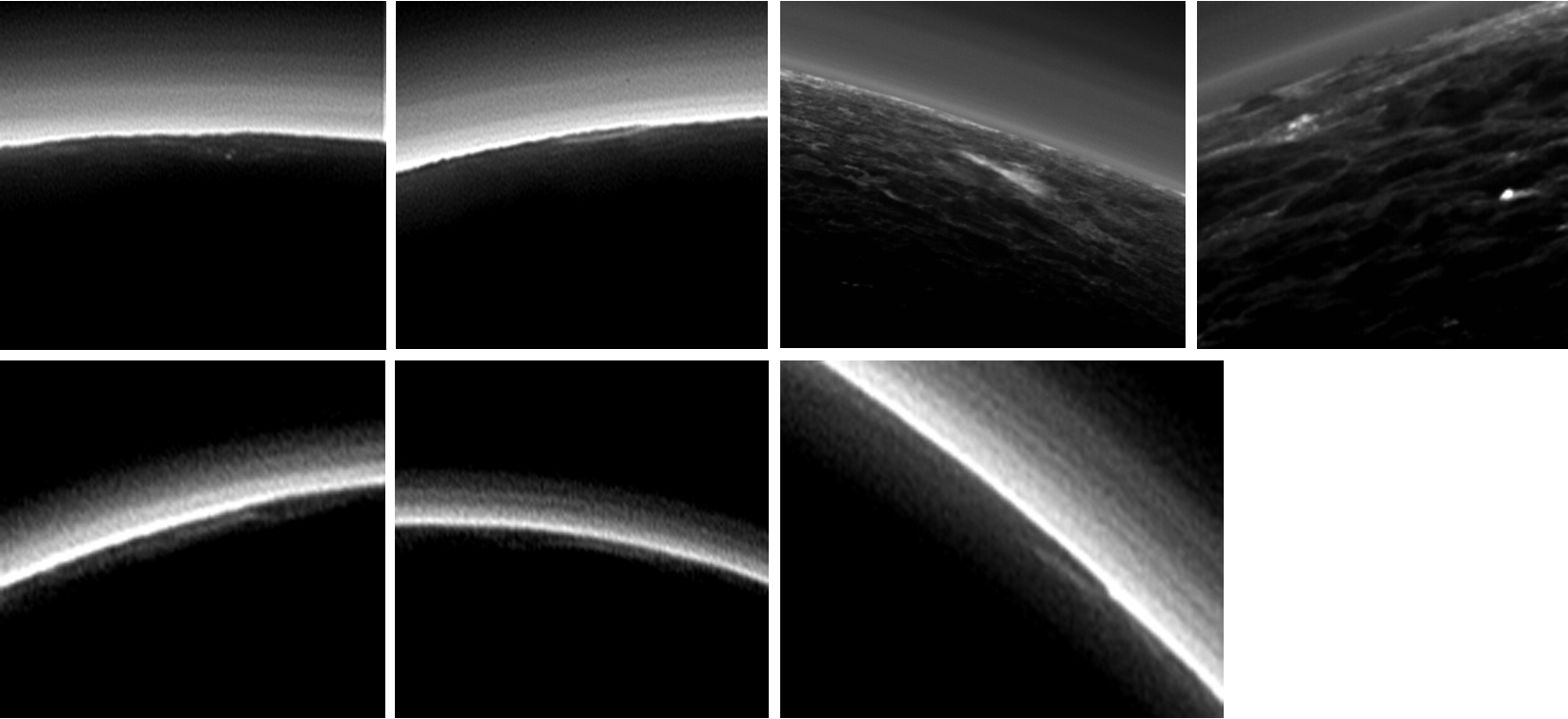
Pluto-clouds
A sequence of images taken by the Long Range Reconnaissance Imager and Multispectral Visible Imaging Camera from the New Horizons spacecraft Pluto flyby  in July, 2015. The images show possible evidence for clouds on Pluto but altitude data are needed to confirm this.

Alan Stern, New Horizons principal investigator,  gave a terrific analogy to the demotion of Pluto to a 'dwarf planet' in the NOVA special  'Chasing Pluto'.  He compared the ridiculous IAU vote (to decide Pluto was a "dwarf" as opposed to "real" planet)  to a similar vote by canine specialists to vote all small dogs, i.e. pugs, Chihuahuas etc. to 'dwarf dogs' while all larger dogs are 'real dogs'.   

Stern has been consistent in his position that Pluto is emphatically a genuine planet , never mind the contrived definition offered by some (e.g. Michael Brown).  Stern maintains Pluto is a planet simply because it is massive enough that gravity has forced it into a spherical shape.

Now it appears there is even further physical evidence -  from the New Horizons mission - that this dwarf planet nonsense might finally be put to rest. And who might we thank other than the same Alan Stern who has described several lines of evidence that Pluto may exhibit partly cloudy skies.  Can such clouds be an attribute of a dwarf planet? I doubt it, for the same reason that it is unlikely a genuine dwarf world would have adequate gravity to force it into a spherical shape.  Bottom line:  a dwarf world wouldn't have the gravity to retain any kind of atmosphere, it would be outgassed.  We can use:

v =  Ö( (3 k T/m)

where k is Boltzmann's constant (1.38 x 10 -23   J/K), T is the absolute temperature applicable in degrees K, and m is the mass of the most prominent, constituent single gas  molecule . We then compare this value to the escape velocity of the object.

Anyway, Stern's new findings were presented on October 18 last year to a joint meeting of the American Astronomical Society Division for Planetary Sciences and European Planetary Sciences Congress.  This took place in Pasadena, California and interested readers can find more details at:   

http://bit.ly/aas-dps

Let's note that previous observations have shown that Pluto does have a hazy atmosphere. This arises as a result of a process involving sunlight (even at that great distance) and hydrocarbons present. In particular, when sunlight strikes the planet it triggers formation of the haze composed of hydrocarbons like acetylene and ethane.  These chemicals then coagulate into small particles that scatter sunlight - visible as a blue mist captured in the images captured by the instruments aboard the New Horizon.

This haze, to be sure, is extremely thin whereas the particles of vapor that meteorologists would classify as clouds must be discrete, optically thick objects that block the surface.. So again, we have to deal with some scientific semantics here.

How to reconcile the Earth meteorologists' definition with what Stern's New Horizons team found? Well, the latter actually spotted - using the instruments cited- several bright smudges at apparently low altitudes that blocked Pluto's surface. (Refer to the last two images on the right of the top panel). These appeared at Pluto's dawn and dusk when lower temperatures would allow condensed clouds to form.

Moreover, the Stern team spotted these features at low altitudes which totally conforms with what a planetary atmospheric model of cloud formation would expect to yield.

The bugbear or the primary obstacle preventing a definite confirmation?  Because the Stern team lacks altitude data they can't yet confirm whether the features detected optically hang above Pluto's surface  or lie atop it. Once we get that resolved then a more unambiguous conclusion is possible.

For my part - and Stern's (who's articulated this before) we don't need the cloud confirmation to ascertain Pluto is definitely a planet - and not a mere "dwarf" planet.

In Stern's Wall Street Journal interview (July 18-19, 2015 p. A9) he addressed the admission of one IAU voter to vote for Pluto being a dwarf planet. To wit,  "We're not so keen to have Pluto and all his friends in the club because it gets crowded. By the end of the decade we would have had 100 planets.."

Hmmm...can't have too many planets, eh?, Otherwise they'd all have to be named and the poor little school kids wouldn't be able to remember them all.  Stern's response (ibid.):

"That's a very 20th century view. Our technology used to be very limited, so we could only see a few planets, and we could memorize the list because we thought we knew them all. Arbitrarily limiting the number of planets to a familiar few is like deciding to name only seven mountains on Earth,"

Of course, one response of the pro-dwarfers would be that gazillions of people are more interested in space and the planets rather than all the terrestrial mountains. But in fact that planet -space prejudice is immaterial to Stern's basic point. In another parallel universe, many more might be interested in mountains... but planets -  not so much.


Another type of objector who might brainlessly ask: "Why does it matter if we call Pluto a planet?  Only a bean counter might care"

However, we do care because scientific terminology has consequences. It's not a mere casual parlor game of semantics. It matters because scientific methods and processes are important, not because "a name by any other name" means anything....to anyone.  If people (laymen) perceive that planetary status (which ought to be an OBJECTIVE finding) is accomplished by subjective vote, then you really can't blame them for buying into the agnotology message- i.e. hat consensus, i.e. in the anthropogenic warming setting, means science is decided by popularity.

And more importantly, if scientific words and terms meaning nothing and are all relative, that opens the door to direct exploitation by ideology and  authoritarians who'd like to play upon the fake news idiom. This we cannot afford.   As one blog commenter Laurel  Kornfield put it:

"Clearly, more than "a few bean counters" care about what we call Pluto, and this is a good thing. It means they are paying attention to astronomy and have the discretion to distinguish a poor definition from a good one. "


Would it be nice and seal the deal to learn Pluto has a bona fide atmosphere? Sure, but in the end it is not necessary for regarding Pluto as a bona fide planet - as opposed to a dwarf planet.

See also Laurel's blog at:

http://laurele.livejournal.com


Thursday, February 1, 2018

Now It's Electric Vehicles Driving Out Jobs

When Alan Emtage, the father of the modern search engine ("Archie") told me during a conversation in Barbados in April, 2017 that most jobs that required driving would be gone by 2025, I didn't believe him.

"How is this going to happen?" I asked. Of course, I knew about the advent of self-driven vehicles but truth be told, these were nowhere near ready to be taking the highways en masse anytime soon. There were still too many technical details to work out.

But he didn't budge.

"Those issues will all mostly be solved by 2020. Then that will pave the way for long haul self-driven trucks carrying cargo, so humans won't be needed on such drives any longer. Also, bus drivers as well as taxi drivers stand to be replaced. Already, Uber is considering self-driving vehicles, removing most of the problems they've had with driver - passenger negative interactions."

He also assured me that was the tip of the proverbial iceberg, and very soon electric vehicles would be rendering redundant most jobs that depend on maintaining internal combustion engines.  I knew Emtage was also something of a futurist, but believed at the time even this might be too big a stretch even for his seer powers.

That was before I read the December 17, 2017 Denver Post article, 'Electric Vehicles Driving Jobs Out',  by Peter Holley.  We learn therein:

"As a wave of electric vehicles quickly approaches, experts say, it could wash away a large portion of a skilled labor group that has been around for decades: the automobile mechanic."

And why?

"The reason is simple: Unlike gas-powered engines, electric engines don't require oil changes, have far fewer moving parts and rarely break down, eliminating much of the maintenance repair shops rely on. The latest electric vehicles can be services using parts purchased online or fixed remotely through over-the -air updates."

That has serious implications when one considers the U.S. auto repair industry currently employs some 750,000 workers - or almost four times the number employed in the coal industry.   The worst aspect? None of these workers is remotely prepared for the end of the era of gas powered transportation.  Thus, they will likely remain on their soon to be extinct jobs until informed they aren't needed any longer.

According to one long time auto mechanic, Craig Van Batenburg, quoted in the piece:

"People are freaking out. Ninety percent of our industry has done nothing - absolutely nothing - to prepare. They just turn the hybrids and EVs away and say 'We don't work on those cars, take them back  to Ford or Toyota."

This is a sad commentary given there are 160,000 independent auto shops in the U.S. which may all be going out of business very soon.  They are literal dinosaurs given that EVs - unlike gas powered cars- require no traditional oil changes, fuel filters, spark plug replacement or emission checks.  You can also basically say goodbye to changing timing belts, differential and transmission fluid.

This elicits the question of what all these auto mechanics will do once displaced?  Well, it seems clear the same provision of UBI (universal basic income) as needed by the other 300 million in the world about to be displaced by automation. According to one recent WSJ  report ('Firms Leave The Bean Counting To The Robots') in the Business and Investing section (p, B5, Oct. 23) .AI -based robots will soon be taking over CFO and accounting work across the land.  And this is but a fraction of all the workers that will be displaced globally.

The same applies to the realm of manual labor, and  in an October column Jim Hightower cites the example of "SAM" a robotic bricklayer that "lays three times as many bricks in a day as a human can". Hence, it has the potential to displace three times the number of human workers.

Hightower then sizes things up with crystal clarity:

"It's not robots that are taking our jobs, but corporate profiteers. They're creating a robot economy in order to displace you and me with inexpensive machines that don't demand higher wages or health care, don't take sick days or vacations and don't organize unions, file lawsuits or vote for pro-worker politicians. It's to be a plutocratic utopia designed by and for the corporate elite "

His words ought to sound resonant chords in any sentient worker, especially if your job is of a repetitive nature even if not manual labor.   As Hightower notes:

"Also, the jobs of librarians, pharmacists, lawyers, air traffic controllers, doctors, teachers, hospital administrators, bartenders — and so many more — are targeted for massive displacement."

As I warned in earlier posts, now is the time for our vaunted leaders to get serious about implementing the UBI solution.  The alternative is not something any of us will wish to see.

Selected Questions -Answers From All Experts Astronomy Forum (Tidal locking, resonance)

Question:

I don't quite understand how even if the moon is spinning, why is it not
subject to tidal braking? And what is different about Mercury that causes
its spin rate to be locked differently from the moon's?


Answer -

The basis of your question resides in the principle of conservation of
angular momentum. To put it in simple terms, two bodies in a joint system
cannot both 'spin up' at the same time, when tidal forces act. One will
slow (in this case, the Earth), the other (Moon) will acquire its 'lost'
angular momentum. Ignoring external effects, you can summarize the
transaction as a "zero sum" game.

Let's now fix ideas within the Earth-Moon system: The Earth rotates faster
than the Moon moves in its orbit. Because the tides are linked to the more
slowly moving Moon, they act by friction as a brake on Earth's rotation,
gradually slowing it down.

The angular momentum lost by the rotating Earth in this process is
transferred to the Moon's angular momentum. Thus, the Moon is accelerated
in its orbit, causing it to slowly spiral outwards, away from Earth. The
day and month are thus lengthening at different rates.

Calculations have actually been retro-worked to show how the length of
month differed when the Moon was much closer to Earth in the past. For
example, when the Moon was only 16,000 km away (10,000 miles) the month
was approximately seven mean solar days long.

Similar calculations based on the conservation of angular momentum also
allow us to project into the future. Thus, about three billion years
hence, the day and month will be equal - about 47 of our present days
long -  and the Earth will always turn the same face towards the Moon.

In the case of Mercury a number of reasons explain why its spin rate
is locked differently.

One is that its resonance period is simply different. Thus, 59 days
rotation period for Mercury equals roughly two-thirds of its period of
revolution (88 days). This suggests a resonance effect with the tidal
forces of the Sun. (Resonance effects always mean the rotation, for
example, is a whole number or integer multiple of the revolution(s). In
this case: 3 rotation periods » 2 revolution periods).

Clearly, since Mercury is much closer to the Sun than the Moon is,
the role of the Sun would figure much more prominently in such 'resonance
periods' for Mercury than for the Moon. This would surely lead to the locking
In of a different spin rate .

Another factor that may play a role is the particular shape of the Moon,
which is a tri-axial ellipsoid, not a perfect sphere. In this case, its
longer axis is always pointing more or less towards the Earth's center.
Thus, the Moon's shape may well contribute to some degree to its differing
'lockage' of spin rate.