Showing posts with label Alan stern. Show all posts

Monday, December 31, 2018

New Horizons Craft Reaches Dwarf Planet Ultima Thule Later Today


Artist's depiction of Ultima Thule - next target for the New Horizons spacecraft.


At roughly 10:33 p.m.  MST today (05h 33m  GMT, Jan. 1st), the New Horizons craft, the same one that brought us close ups of Pluto, will fly even closer to the outermost dwarf world named Ultima Thule (meaning "beyond the know world").   Assuming one single world, it is estimated to be 30 km (20 mi.) in diameter, close to absolute zero temperature, and with an orbit that takes it once around the Sun every 300 years.

On the other hand, the light curve suggests  planetary "doublet" such as depicted in the accompanying artist's conception, In this case, the distant (4 bn miles)  world looks somewhat like a misshapen dumbbell. How is this depiction justified?   Earlier images of Ultima Thule revealed that it’s actually two objects that are either joined via geo-morphology or very closely orbiting one another. Given such a dual pair of objects reflects sunlight, one would expect light to pulsate as the strangely shaped object rotates and the light varies according to a designated light curve. The trouble is, Ultima Thule’s light curve doesn't show it  getting brighter or dimmer as it rotates.

Alan Stern, the principal investigator of New Horizons, writes in a blog post.:

"We expect that Ultima is the most well-preserved sample of a planetary building block ever explored.  What will Ultima reveal? No one knows. To me, that is what’s most exciting — this is pure exploration and fundamental science!” 

The "building block" aspect is easily the most important for planetary astronomers given this distant world was likely formed at the very birth of the solar system. So it will hold key clues to the formation of the other larger planets as well.   To Alan Stern the flyby of this odd -shaped world by the New Horizons, and the images that accompany it, will be akin to the now famous "Earthrise" photo taken by the Apollo 8 astronauts 50 years ago.   This famous photo, for those who need a reference marker, is shown below:

No automatic alt text available.
Alas, I was unable to fully partake of the illustrious moment - including astronaut Gordon Lovell reading from Genesis -  because I had been laid low by the Hong Kong flu.  It kept me down for the entire two week period from roughly Dec. 18- Dec. 31st, 1968. 

This time around, to be sure, I plan to be following every minute of the flyby to the best  I can given the limits imposed, e.g. on NASA, by the Trump shutdown.


See also:

https://www.theplanetstoday.com/new_horizons_flight_path.html

And:

https://www.space.com/42860-new-horizons-beyond-pluto-ultima-thule.html

Friday, February 2, 2018

If Pluto Has Clouds Can It Still Be A "Dwarf Planet"?

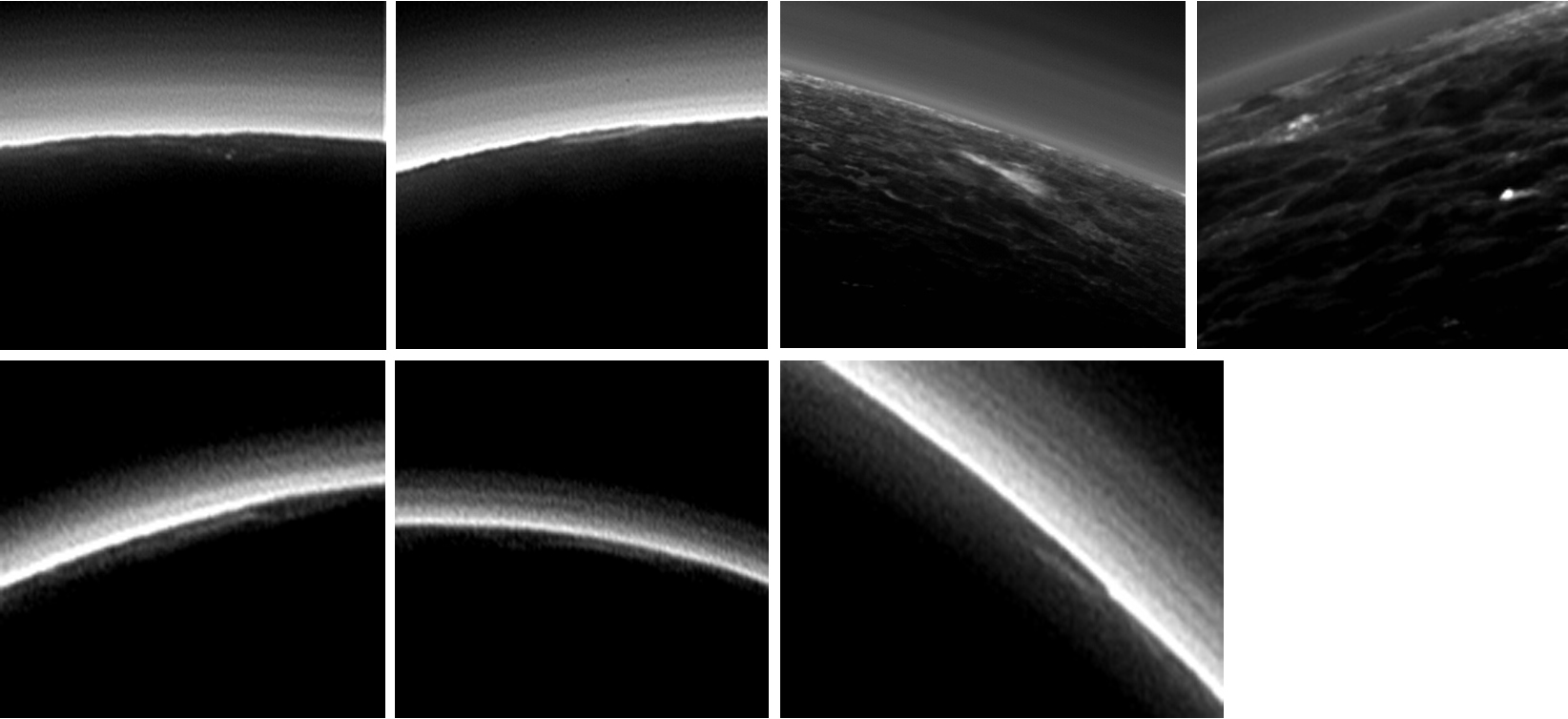
Pluto-clouds
A sequence of images taken by the Long Range Reconnaissance Imager and Multispectral Visible Imaging Camera from the New Horizons spacecraft Pluto flyby  in July, 2015. The images show possible evidence for clouds on Pluto but altitude data are needed to confirm this.

Alan Stern, New Horizons principal investigator,  gave a terrific analogy to the demotion of Pluto to a 'dwarf planet' in the NOVA special  'Chasing Pluto'.  He compared the ridiculous IAU vote (to decide Pluto was a "dwarf" as opposed to "real" planet)  to a similar vote by canine specialists to vote all small dogs, i.e. pugs, Chihuahuas etc. to 'dwarf dogs' while all larger dogs are 'real dogs'.   

Stern has been consistent in his position that Pluto is emphatically a genuine planet , never mind the contrived definition offered by some (e.g. Michael Brown).  Stern maintains Pluto is a planet simply because it is massive enough that gravity has forced it into a spherical shape.

Now it appears there is even further physical evidence -  from the New Horizons mission - that this dwarf planet nonsense might finally be put to rest. And who might we thank other than the same Alan Stern who has described several lines of evidence that Pluto may exhibit partly cloudy skies.  Can such clouds be an attribute of a dwarf planet? I doubt it, for the same reason that it is unlikely a genuine dwarf world would have adequate gravity to force it into a spherical shape.  Bottom line:  a dwarf world wouldn't have the gravity to retain any kind of atmosphere, it would be outgassed.  We can use:

v =  Ö( (3 k T/m)

where k is Boltzmann's constant (1.38 x 10 -23   J/K), T is the absolute temperature applicable in degrees K, and m is the mass of the most prominent, constituent single gas  molecule . We then compare this value to the escape velocity of the object.

Anyway, Stern's new findings were presented on October 18 last year to a joint meeting of the American Astronomical Society Division for Planetary Sciences and European Planetary Sciences Congress.  This took place in Pasadena, California and interested readers can find more details at:   

http://bit.ly/aas-dps

Let's note that previous observations have shown that Pluto does have a hazy atmosphere. This arises as a result of a process involving sunlight (even at that great distance) and hydrocarbons present. In particular, when sunlight strikes the planet it triggers formation of the haze composed of hydrocarbons like acetylene and ethane.  These chemicals then coagulate into small particles that scatter sunlight - visible as a blue mist captured in the images captured by the instruments aboard the New Horizon.

This haze, to be sure, is extremely thin whereas the particles of vapor that meteorologists would classify as clouds must be discrete, optically thick objects that block the surface.. So again, we have to deal with some scientific semantics here.

How to reconcile the Earth meteorologists' definition with what Stern's New Horizons team found? Well, the latter actually spotted - using the instruments cited- several bright smudges at apparently low altitudes that blocked Pluto's surface. (Refer to the last two images on the right of the top panel). These appeared at Pluto's dawn and dusk when lower temperatures would allow condensed clouds to form.

Moreover, the Stern team spotted these features at low altitudes which totally conforms with what a planetary atmospheric model of cloud formation would expect to yield.

The bugbear or the primary obstacle preventing a definite confirmation?  Because the Stern team lacks altitude data they can't yet confirm whether the features detected optically hang above Pluto's surface  or lie atop it. Once we get that resolved then a more unambiguous conclusion is possible.

For my part - and Stern's (who's articulated this before) we don't need the cloud confirmation to ascertain Pluto is definitely a planet - and not a mere "dwarf" planet.

In Stern's Wall Street Journal interview (July 18-19, 2015 p. A9) he addressed the admission of one IAU voter to vote for Pluto being a dwarf planet. To wit,  "We're not so keen to have Pluto and all his friends in the club because it gets crowded. By the end of the decade we would have had 100 planets.."

Hmmm...can't have too many planets, eh?, Otherwise they'd all have to be named and the poor little school kids wouldn't be able to remember them all.  Stern's response (ibid.):

"That's a very 20th century view. Our technology used to be very limited, so we could only see a few planets, and we could memorize the list because we thought we knew them all. Arbitrarily limiting the number of planets to a familiar few is like deciding to name only seven mountains on Earth,"

Of course, one response of the pro-dwarfers would be that gazillions of people are more interested in space and the planets rather than all the terrestrial mountains. But in fact that planet -space prejudice is immaterial to Stern's basic point. In another parallel universe, many more might be interested in mountains... but planets -  not so much.


Another type of objector who might brainlessly ask: "Why does it matter if we call Pluto a planet?  Only a bean counter might care"

However, we do care because scientific terminology has consequences. It's not a mere casual parlor game of semantics. It matters because scientific methods and processes are important, not because "a name by any other name" means anything....to anyone.  If people (laymen) perceive that planetary status (which ought to be an OBJECTIVE finding) is accomplished by subjective vote, then you really can't blame them for buying into the agnotology message- i.e. hat consensus, i.e. in the anthropogenic warming setting, means science is decided by popularity.

And more importantly, if scientific words and terms meaning nothing and are all relative, that opens the door to direct exploitation by ideology and  authoritarians who'd like to play upon the fake news idiom. This we cannot afford.   As one blog commenter Laurel  Kornfield put it:

"Clearly, more than "a few bean counters" care about what we call Pluto, and this is a good thing. It means they are paying attention to astronomy and have the discretion to distinguish a poor definition from a good one. "


Would it be nice and seal the deal to learn Pluto has a bona fide atmosphere? Sure, but in the end it is not necessary for regarding Pluto as a bona fide planet - as opposed to a dwarf planet.

See also Laurel's blog at:

http://laurele.livejournal.com


Saturday, November 26, 2016

A Welcome Addition To Basic Astrophysical Literature: "Welcome To The Universe"

Image result for Welcome to the UniverseImage for the news result

As Black Friday dawned yesterday it was almost a certainty that 99 percent of people would be flooding big box stores to snatch up the latest electronic wonders including the new 55"  "Ultra HD" TV sets to make their debuts as Walmart and Best Buy. But a much more sensible option,  as opposed to more electronic titillation,  would have been to invest in Neil De Grasse Tyson's new book, Welcome to the Universe: An Astrophysical Tour.'

The book, a breathtaking overview of astrophysics and especially how we obtain the knowledge we do, is indispensable to getting to know the universe as science knows it   It is distinct from most other basic texts because most of those - as De Grasse Tyson noted on a recent CBS Early Show appearance -  are "a mile wide and an inch deep".  By contrast, this 472 -page book is a "mile wide and a mile deep."  Well, not quite but pretty close and hey, it even includes algebraic equations where necessary - so ignores the old rule that each equation given "decreases sales by one percent" - or some such jabberwocky.

Some of the topics covered include: stellar evolution (the lives and deaths of stars), the search for life in the galaxy, the interstellar medium, the Milky Way, the expansion of the universe, the early universe, quasars and Einstein's special and general theories of relativity. Also: black holes, cosmic strings, inflation and the shape of the universe.

The content actually represents a division of labor between Neil De Grasse Tyson, Michael A. Strauss and J. Richard Gott. For example, the three chapters on special and general relativity were very ably done by Gott.  If you truly wish to get a handle on these abstruse theories there is perhaps no place better then Gott's trio of chapters, so long as you're ok with some intermediate algebra to assist in the task.

Tyson himself is responsible for chapters:  1, 2, 4, 5, 6, 7, 9 and 10. The only one I really had issues with was Chapter 9, 'Why Pluto Is Not A Planet'.   For one thing, Pluto is not specifically an object for astrophysical inquiry but rather planetary astronomy. Hence, the chapter's inclusion can only be attributed to Tyson having already spent a lot of ink on the subject, so why not include it (since it's firmly in his academic 'wheelhouse') in a new book?

But as I noted in previous posts the arguments given don't make any physical sense. For example, Alan Stern, executive director of the Space Science & Engineering Division of the Southwest Research Institute – and Principal Investigator for NASA’s New Horizons mission to Pluto- observed that the new planet definition was “sadly flawed, particularly due to the vagueness of the third condition- clearing the neighborhood around its orbit - which might also disqualify Earth”.

He added: “A lot of people are going to ignore the (new) definition because it doesn’t make sense.” (Source: Eos Transactions of the American Geophysical Union, Vol. 87, 29 August, p. 350). The other aspect is that Pluto’s dethroning was done by a subjective vote at an IAU meeting, not by any objective measures or consistency. The problem is the IAU definition overlooks the neighborhood of the object.  Pluto just happens to be in the Edgeworth –Kuiper belt with thousands of other objects. This is a condition of happenstance, not of actual intrinsic property.

If Earth were to interchange its position with Pluto it would also be in the same belt, and because other substantial objects (e.g. Neptune) crossed its path, it would have to be demoted – by De Grasse Tyson and the IAU's definition. So what to call it, a “demi-Earth”? A jumbo dwarf planet or jumbo shrimp planet? Give me a break!

Tyson is on much firmer ground - as well within the proper astrophysical sphere -  when he explores the lives and deaths of stars, as well as the scale of the cosmos, how stars radiate energy and stellar spectra. The last two are especially important cornerstones of astrophysics, and Tyson does a stand up job. One also hopes that when curious readers finish his chapters they will move on to Lawrence Aller's  (and now also Leo Goldberg's) 'Atoms, Stars and Nebulae' - which remains the standard for elementary astrophysics in terms of deciphering the nature of stars.

But Tyson and company excel in their own approach presenting the (usual) less advanced reader with numerous examples borne out by superb diagrams such as Fig. 2.4 showing Kepler's laws, and Fig. 6.2 showing the energy levels and associated spectral line series for hydrogen. I also liked how Tyson delved into the historical background, e.g. for the Balmer series, discovered in 1885.

The H-R diagram (Fig. 7.1) is also one of the best, most beautiful I've seen in any astrophysics text, with the relative sizes of specific stars - like Betelgeuse and Aldebaran - in color and projected against their evolutionary tracks. It's also interesting just how the famous diagram was composed: "From a catalog of stellar luminosities and temperatures Hertzsprung and Russell started filling in the diagram and discovered stars did not occupy just any place". Well, no, because it plots the stellar spectra (or surface temperature) vs luminosity so because each stars has distinct pairs of these, it will have differing positions on the H-R grid.

One warning here: Tyson uses an unorthodox form for describing nuclear fusion reactions in stars. For example (p. 101):

ppn + ppn  =  ppnn + p + p

As opposed to say,

3 He + 3 He ®  4 He + 1H + 1H  + 12.85 MeV

with the energy given off.    But truth be told, this notation of his would probably only irritate purists or pedants

What really sets the text apart is all the calculations shown, all very basic, such as the total energy a star will generate over its lifetime by multiplying the star's luminosity L by the lifetime. T. In fact, all the math used which leads to so many fascinating insights, is fairly basic. None of it ought to be beyond a person who has taken at least first year algebra though the derivation of  E = m c2       in Appendix I will likely require at least an intermediate algebra background to follow. .

What makes this book so special is that it offers the reader so many more useful insights and "tidbits" - for lack of a better word- than most astrophysics texts would at this level. One learns, for example (p. 51) "Superman can indeed throw an object 5 miles per second . The object will also fall under the influence of gravity but its curved trajectory now matches the curvature of the Earth such that it never hits the surface and ends up in a circular orbit."

De Grasse Tyson's conversational style, which served him so well in his  2014 reprise of 'COSMOS'  e.g.

http://brane-space.blogspot.com/2014/03/new-cosmos-series-is-well-worth-look.html


is apparent throughout his chapters in the current work. For example, on p. 88, we read:

"You can think of the outermost layer of a star as a tree. Do you know what is coming toward the tree (from inside the star)?  Mixed nuts. We have a mixed nut cannon (the interior of the star) firing mixed nuts (photons at different frequencies) into the tree, and in the tree we have squirrels. My squirrels like acorns (the photons) - these are acorn squirrels. They see all these mixed nuts coming through but they are grabbing only the nuts they like, the acorns, on the other side. (outside the star) come mixed nuts minus the acorns (the thermal radiation minus the H-alpha  photons)"

The reader has to understand that this sort of description is uniquely Tyson's, You won't find it in the chapters by Gott or Strauss, though theirs do remain in a colloquial mode.

The takeaway here is that if you enjoyed the COSMOS series you should find a lot  to enhance your reading in this book. There is all one could ask for to gain a foothold in grasping the basic principles of astrophysics - as well as other topics not specifically related to it, such as how the zodiacal constellations came to be (including why astrology is off) and, of course, why Tyson doesn't regard Pluto as a planet.

Wednesday, July 22, 2015

Alan Stern On Why Pluto Is Still A Bona Fide Planet

Pluto

View Of Pluto from the Long Range Reconnaissance Imager  Aboard New Horizons spacecraft then half way to its minimum distance of 7700 miles.

Alan Stern, New Horizons principal investigator,  gave a terrific analogy to the demotion of Pluto to a 'dwarf planet' in the NOVA special  'Chasing Pluto'.  He compared the ridiculous IAU vote to a similar vote by canine specialists to vote all small dogs, i.e. pugs, Chihuahuas etc. to 'dwarf dogs' while all larger dogs are 'real dogs'.

Of course, to make the analogy much better,  one would postulate a scenario in which people go crazy about breeding and owning small dogs which soon outnumber large breeds by 10:1 or more. Worrying about a proliferation of small dogs, the specialist canine community makes the decision to vote on redefining them as 'dwarf dogs' to try to discourage ownership and breeding.

In Stern's Wall Street Journal interview (July 18-19, p. A9) he is even more specific, after referencing what led to the IAU vote, i.e. when scientists began finding worlds even  farther away and one (Eris) nearly the same size as Pluto. This led certain investigators (e.g. Michael Brown) to propose a special class for the proliferating small planets, calling them all 'dwarf planets'.

So rather than have public confusion about hundreds of planets, it made sense to them to separate eight regular planets from the multitude of dwarf planets.

As one IAU voter put it (ibid.):

"We're not so keen to have Pluto and all his friends in the club because it gets crowded. By the end of the decade we would have had 100 planets.."

But Stern objected:

"That's a very 20th century view. Our technology used to be very limited, so we could only see a few planets, and we could memorize the list because we thought we knew them all. Arbitrarily limiting the number of planets to a familiar few is like deciding to name only seven mountains on Earth,"

Of course, the response of the pro-dwarfers would be that gazillions more people are interested in space and the planets rather than all the terrestrial mountains. But in fact that planet prejudice is immaterial to Stern's basic point. In another parallel universe, many more might be interested in mountains... but planets -  not so much.

Stern also dissents on more technical grounds given the IAU insists a bone fide planet must have gravitationally swept its neighborhood clear of other objects which Pluto hasn't done. But as Stern observes, a body big enough to clear a small orbit and qualify as a planet might fail to make the cut for a larger orbit (as Pluto has).

In other words, when is a planet not a planet? Well, when it is somewhere else!

Stern goes on to maintain Pluto is a planet simply because it is massive enough that gravity has forced it into a spherical shape. (A sphere - for technical reasons - is the maximum volume shape arrived at from g-forces) By this definition, Ceres also qualifies as a planet.

In one of the most incisive points, Stern acknowledges that planetary scientists regularly define objects this way. Which is why it was wrong to bring the planetary definitional vote before the entire International Astronomical Union - because you're mixing planetary astronomers, with stellar astrophysicists, solar physicists, cosmologists, space physicists, astro-geologists, astro-biologists, astrometry specialists (astrometrists), celestial mehanicians and so forth.

As Stern aptly puts it:

"I know the public thinks we're all the same because we study things in space. So my analogy is doctors. Would you let a podiatrist do brain surgery on you. Wrong specialty! So don't let an astrometrist classify planets."

A point well taken which is why many of us ignore the  supercilious IAU vote and continue to regard Pluto as a planet.

See also:

http://www.smirkingchimp.com/thread/ed-tant/63181/new-horizons-provides-up-close-look-at-faraway-pluto

Wednesday, July 15, 2015

New Horizons Arrives At Pluto - Showing Again Why Gov't Is Superior To Commercial Space Enterprises

Pluto
View Of Pluto from the Long Range Reconnaissance Imager  Aboard New Horizons spacecraft then half way to its minimum distance of 7700 miles.

The spectacular views of the most distant planet, Pluto, coming in from the New Horizons spacecraft have been are more than enough to stir wonder and awe.  What used to be visible in our telescopes only as a fuzzy disk or blob is now seen to have distinct features, with different coloration. This successful 9 1/2 year long, 3 billion mile voyage ( to many of us),  has also revealed the enormous advantage that government -enabled missions have over commercial space endeavors.

By "government -enabled" I mean that a government agency, NASA, coordinated and supported all the detailed technical and engineering inputs - while ensuring that the disparate institutional contributors (e.g. Southwest Research Inst.) all delivered this end point, as if from a single "conductor" directing a symphony. I argue that no commercial enterprise such as exists now - including Space-X -  could have done the same, and probably couldn't even in the near future. They simply don't command the resources.

Officially, NASA's New Horizons whizzed past the planet Pluto about 5:49 a.m. Tuesday, traveling at more than 30,000 miles per hour. The reason the close-up, detailed photos weren't available at the time is because of the fact that light only travels at 300,000 km/sec so it would take over 4 hours to transmit each photo (at closest pass) back to Earth. The electronic signals which embody the images then must be deconvolved,  processed - which takes time.

The spacecraft last communicated with mission control at 9:17 p.m. Monday night. The craft, which has now gone radio silent, is using its energy for science — pointing its instruments at Pluto and its moon Charon to collect data on its one-time trip. Mission Control, based at the Johns Hopkins University Applied Science Lab, didn't hear from New Horizons again until about 6:50 p.m. Tuesday, when a signal sent from the spacecraft to Earth about four hours earlier reached  mission control.

New Horizons principal investigator Alan Stern said Monday that dynamic  models indicate a low probability that New Horizons will suffer damage on its journey through Pluto's system.

"I don't think that we're going to lose the spacecraft," Stern said. "We've been furiously transmitting data to the ground over the last few days ... but it would be gilding the lily a little bit if I didn't tell you 99 percent of the data is still on the spacecraft."

Although Stern remains hopeful, he said the science team has already downlinked "fail-safe data sets" from each area of the spacecraft's study as a contingency plan. The spacecraft will collect about 100 times more data on close approach to the planet than it can send home before the entire fly-by is over, according to NASA.

About 1 percent of the data collected during the approach and fly-by will be immediately sent back to Earth. This will include some images that the New Horizons team will share with the public as soon as they are processed.

Most of the data will be stored on board and downlinked to Earth beginning in September, providing scientists what Stern calls a "16-month data waterfall," bringing scientists new and exciting discoveries over the next year.

In what is possibly the most fascinating aspect of the 9½ -year-long wait, the data the team receives tomorrow will make Tuesday's data obsolete, said Southwest Research Institute's John Spencer, who heads up the mission's geology and geophysics areas.

"Tomorrow's pictures will be nearly 10 times better than today's," Spencer said. "We also get our first decent views of the small moons, Nix and Hydra, which up to now have been little more than just points of light ... There's stuff coming thick and fast from now on."

So we need to be patient and hold strain as the ever more highly resolved imagery comes in.

In the meantime, it's a good opportunity to revisit Pluto's identity: Is it a dwarf planet or a bona fide proper planet? I take the latter position as does Stern, who three years ago noted that the new "dwarf" planet definition was “sadly flawed, particularly due to the vagueness of the third condition”, e.g. clearing the neighborhood around its orbit – which might also disqualify Earth!)

He added: “A lot of people are going to ignore the (new) definition because it doesn’t make sense.” (Source: Eos, Vol. 87, 29 August, 2012,  p. 350)

Let us recall here that the Pluto re-definition as a "dwarf planet" was entirely the result of a subjective vote taken at a meeting of the International Astronomical Union (IAU).  So while one might sympathize with author Mike Brown ( 'How I Killed Pluto and Why It had It Coming') over the "hate mail from school children" at his role in Pluto's demise, the fact is it was likely spurred as much by the irrational basis.

Meanwhile, another proper planet antagonist, Neil DeGrasse Tyson, has argued in an interview this evening "how can Pluto be a regular  planet when it crosses the orbit of Neptune's for 20 years" - which is one of the most inane excuses for degrading its status I ever heard.

 The tragedy of the 2006 Pluto vote is that it has not only set back planetary astronomy – showing the preponderance of ego and pseudo-science over genuine scientific inquiry – but also eroded public confidence in science, extrapolated to areas like anthropogenic global warming.

But perhaps after this important flyby, and seeing Pluto's moon system up close as well - all that will change.

Stay tuned!


A comparative view of Pluto, Earth and Pluto's moon Charon is shown below:
Earth comparison with Pluto and Charon

Thursday, July 12, 2012

Return Pluto to the Pantheon Of Planets!

The recent discovery (made via the Hubble Space Telescope) that Pluto has not one, not two but five moons to call its own, reminds me of the words of  former Hayden Planetarium Director Kenneth Franklin - when he visited Barbados nearly 40 years ago. He warned (in a guest lecture) that Pluto - based on its relatively small size - might at some time in the future be demoted from full planetary status. However, he warned that if Pluto had any moons, this would amount to a serious error of judgment and perhaps be a result more of subjective preference than scientific determination. 

I have come to believe that as well, despite ridiculous books such as Mike Brown's 'How I Killed Pluto and Why It had It Coming'. The fact is "it" didn't "have it coming" - it was entirely the result of a subjective vote taken at a meeting of the International Astronomical Union (IAU).  So while one might sympathize with author Brown over the "hate mail from school children" at his role in Pluto's demise, the fact is it was likely spurred as much by the irrational basis for the election to downgrade Pluto to "dwarf planet" status.

By contrast, the modern consensus on evolution was achieved by a body of empirical evidence, including from the fossil record, microbiology and genetics. For example, one of the most powerful lines of evidence has shown that the human chromosome designated '2' was the result of the telomeric fusion of the two ape chromosomes, 2p and 2q. The effect also saw the reduction from 24 chromosome pairs in apes, to 23 pairs in humans. (Source: Yunis and Prakash, 1982, Science, Vol. 215, p. 1525, 'The Origin of Man: A Chromosomal Pictorial Legacy')

Mathematical precision also consolidates scientific discovery in quantitative fields, making them less likely to be overturned. Particle physics is one such example, wherein the original three sub-atomic particles (proton, neutron, electron) have become a veritable “zoo” numbering in the hundreds – including up, down, top and bottom quarks, W and Z bosons, electron, mu and tau neutrinos and many others too numerous to mention. This panoply of particles didn’t just manifest because the respective particle physicists intended to be “mean” to school children or regular mortals. It emerged out of more refined and detailed experiments that exposed each of the particles. (The same set of parameter confirmations and empirical cross-checks will have applied if the Higgs boson is confirmed.)

The same applies to the current consensus on global warming, only arrived at after years of computer analysis of ice cores, changing CO2 concentrations therein, satellite imagery disclosing retreat of polar ice and data from over 1300 temperature sensing bouys in the oceans. Not to mention data we now possess that the glaciers in Greenland are melting 32 times faster than they were 10 years ago. No one took a vote to attain the consensus on anthropogenic warming, it was the culmination of over 1500 papers published over 20 years in peer-reviewed climate journals. Doesn't Pluto's demotion warrant at least half as much effort?

In the end, the error of the  IAU planetary astronomers was to cave in to public pressure to avoid “complexity”, e.g. in adding numerous additional planets like Charon, Xena, Ceres etc. This, despite the fact the original IAU definition was perfectly rational in its criteria for a planet.

Alan Stern, executive director of the Space Science & Engineering Division of the Southwest Research Institute – and Principal Investigator for NASA’s New Horizons mission to Pluto- observed that the new planet definition was “sadly flawed, particularly due to the vagueness of the third condition”, e.g. clearing the neighborhood around its orbit – which might also disqualify Earth!)

He added: “A lot of people are going to ignore the (new) definition because it doesn’t make sense.” (Source: Eos, Vol. 87, 29 August, p. 350)

The tragedy of the Pluto vote is that it has not only set back planetary astronomy – showing the preponderance of ego over scientific inquiry – but also eroded public confidence in science, which extrapolates to areas like anthropogenic global warming. (Which polls disclose only 46% of Americans now accept as arising from human-engendered greenhouse gases, as opposed to 59% in 2000.)

Anyway, the newfound fifth moon, designated P5, is estimated to be between 6 and 15 miles across. Pluto's largest Moon, Charon - at 650 miles across, was discovered in 1978 - three years after Prof. Franklin's lecture and warning about a possible Pluto downgrade.

Right now, I imagine Dr. Franklin turning over in his grave about how his forecast was ignored and the demotion of Pluto overall.  And.....I suspect he'd have some words to share with Brown, Neil Degrasse Tyson and others of the 'Anti-Pluto as full Planet' ilk.