Showing posts with label mountain pine beetle. Show all posts

Thursday, February 23, 2017

70 Degree February Days As We Head Toward The First 'Year Of No Seasons'


David Suzuki - above- who predicted the first 'Year of No seasons' by 2040.

weather1
Scene in Chicago February 27, as temperature hits a record high of 75 F.

Let us admit that a 75 degree day in Tampa, Florida in February is not unusual, and in fact normal. Let us also admit a 75 degree high day in Chicago is not. When the high temperatures also hit 77 F here in Colorado Springs, I noted to Janice that this is a reminders that within 20-25 years such days will be the norm, not just in February. Imagine then 65-75 degree highs from December through February, for most of the nation, and 75 to 90 degree highs from March through May, then 95 to 105 degree days from June through October. Unreal? No, very real, and well on the way as humans continue to by and large disregard the harbingers of massive global warming, acting like nothing strange is going on.

Just imagine now, if you can, weird warm days in northern cities ALL the time, not just a few instances or one offs.  Picture in your mind no more autumns with brilliant leaf colors such as Vermonters currently enjoy, and no more adequate snow pack to accommodate skiers at Vail or any other place. Impossible? You wish.

Researcher and author David Suzuki, in his book It's A Matter of Survival (Harvard University Press, 1991) co-authored with Anita Gordon, believes we are well on our way there and will reach that stage by the year 2040. The first 'Year of No Seasons' (I happen to believe we will reach this stage a lot sooner, perhaps by 2020.) Bear in mind Suzuki based his projections on 1991 data and the hope we'd be able to keep the warming increment to less than 2C by 2100. According to data compiled from the National Climate Data Center, IPCC, the Hadley UK Center and other sources, all bets are off for achieving this based on their recent reports and the maximum increase now is projected to be from 3.6 C to 4.0 C.

Suzuki and Gordon wasted no time bitch-slapping the complacent reader from the first words of Chapter One: Beyond Your Worst Nightmare:

"A.D. 2040- If we were to give this year a name it would be Despair. This is the hopeless world we have left our children and grand children. Where once our lives were measured and enriched by the cycle of the seasons, there is now only searing heat and the certainty it will get hotter. Seasons exist only in the nostalgic longing of those of us old enough to remember the richness of life......

Daily, experts try to play God, desperate to determine what each new ecosystem will be, before it too is lost. This is the nightmare world of 2040 on this sad excuse for the planet we once called home."

On p. 8 of the same chapter, Suzuki and Gordon go on to link the total disappearance of the seasons worldwide to global mean temperatures 5 C (9F) above what they were in 1991. Given that Carl Sagan once forecast an increment of 6C as adequate to trigger the runaway Greenhouse, Suzuki's numbers would put us right on the cusp. Once that begins, and the methane is also released from melting permafrost and later CO2 is released from all the carbonate rocks in the world, we are for the high jump.

Of course, the cessation of seasonal changes is only one aspect of ongoing climate change. Already here in Colorado we are seeing a continued and relentless dying of the trees. One in 14 trees is now dead in Colorado forests and the number of gray-brown standing-dead trees has increased 30 percent since 2010 to 834 million, the state’s annual survey has found.    The dying trees are  largely the result of insect infestations —which  can lead to large intense wildfires, such as the Beaver Creek fire in 2016 that burned 38,000 acres northwest of Walden, This is according to  Colorado State Forest Service officials in a report released 2 weeks ago.
Standing-dead trees are shown on Wolf Creek Pass in Mineral County. One in 14 trees are dead in Colorado forests and over the past seven years, the number of gray-brown standing-dead trees increased 30 percent to about 834 million, according to the state's annual forest survey.
Still standing dead trees on Wolf Creek Pass in Colorado.

Recall the insect infestation is traced to the mountain pine beetle which population has exploded directly as a result of warming temperatures. Those readers interested in a detailed account of the trepidations spawned by this pest can get hold of the superb book: The Dying of the Trees.  You can read a shorter account here:

http://www.nytimes.com/2008/11/18/science/18trees.html?pagewanted=all

The point is the beetle is a major catalyst for all the ongoing and uncontained Colorado wild fires

With the release of the report, given we now know there are at least 800 million dead trees in the state, greater attention is being focused on conserving what we have left. State forest service director Mike Lester quoted in The Denver Post stated:

"When so many trees die and large wildfires follow, our forests quickly turn from a carbon sink into a carbon source. Beyond the implications for our atmosphere, forests in poor health have implications for our water supplies, public safety, wildlife and recreation opportunities.”

Other key findings:

• Colorado’s mountain pine beetle epidemic killed trees across 3.4 million acres
• The continuing spruce beetle epidemic has killed trees across 1.7 million acres
• About 80 percent of Colorado residents rely on forest watersheds for their municipal water supplies
• Climate models projecting statewide average temperature increases by 2.5 to 6.5 degrees before 2050 mean the risks of severe wildfires, insect infestations and droughts will worsen

More sobering yet, a University of Colorado -Boulder study is questioning whether burned forests on the Front Range in Colorado will ever return to normal. Given the predations of the mountain pine beetle in concert with the forest fires, it may be wishful thinking to believe so.

Note also the older trees that burned in fires were seedlings 50-100 years ago and we know the climate was different then.. The 2014 Climate Change in Colorado  report for the Colorado Water Conservation Board found that statewide temperatures have increased 2 F over the past 30 years.  This may sound insignificant but simulations of differing conditions on ponderosa pine and Douglas fir seedlings- in a 2015 published Canadian study (Canadian Journal of Forest Research) -  found that those growing in a post-burn areas had less chance of survival when subjected to even small increases in temperature. Or when subjected to less water.

One more takeaway: A recent study by scientists working as part of a group called World Weather Attribution, looked at the influence of climate change on the seasonal variation of temperatures, using models of the atmosphere as it exists and of a hypothetical atmosphere with no greenhouse gas emissions and thus no human-driven climate change. They found that a warm February like the one just experienced is now about four times more likely in the current climate than it would have been in 1900, before significant CO2 emissions began to change the climate.

How will all this play out as our own EPA, and indeed government, has been captured by climate change deniers and anti-science knuckle draggers? That will be the subject of an upcoming post.

Saturday, September 24, 2016

Colorado Climate Change Future: Grim - According to New Report

A house is fully engulfed by the Black Forest Fire.
Fires like this will be common in Colorado in 25-30 years.

A newly released report (on Thursday) commissioned by three Front Range cities forecasts grim climate conditions for Colorado - certainly for the Front Range, and likely the entire state. This according to the Louisville, CO-based Rocky Mountain Climate Organization.. The forecast includes an increase in the average number of days with temperatures over 100 F, as well as increased precipitation for other areas, i.e. featuring severe winter or summer storms. Already, here in the Springs - two months ago- we were lashed with the worst hail storm in memory with hail stones up to the size of softballs.

We just had our entire roof repaired following hail strikes with pits, holes that one roofer compared to "meteorites" - an exaggeration but he got the point over to us. Now, we are awaiting one entire south side of the siding to be replaced after it was literally ripped into multiple holes by the hail. According to the insurance company (Hartford) hundreds of homes have been affected putting enormous pressure on roofers and others in the area, now forcing wait times of many weeks to complete repairs.  This is only a taste of what's to come if the RMCO projections turn out to be even 50% correct, and there's more reason to believe the probability will be a lot higher.

Much of this isn't surprising in that NOAA (National Oceanic and Atmospheric Administration) made similar predictions, including for the entire Rocky Mountain  West, some six years ago. They projected hotter, drier conditions with extended droughts and enhanced fire danger especially as the forests ravaged by the mountain pine beetle spread. See, e.g. this report on the pest.

http://extension.colostate.edu/docs/pubs/insect/05528.pdf

What this pest does is nothing short of horrendous, in converting living plant tissue into highly flammable dead bark for which the slightest spark can start a conflagration. Those readers interested in a detailed account of the trepidations of this pest can get hold of the superb book: The Dying of the Trees.  You can read a shorter account here:

http://www.nytimes.com/2008/11/18/science/18trees.html?pagewanted=all

The point is the beetle is a major catalyst for all the ongoing and uncontained Colorado wild fires, including the nearby Waldo Canyon fire  four years ago.  At the time I posted that thermal currents and winds also dispersed parts of the fire's burgeoning smoke plumes eastward, toward the east side of Colorado Springs where we live. 
Basically, if heat-trapping emissions into the atmosphere keep increasing, the northern Front Range climate by 2050 will be fundamentally different. According to lead  researcher Stephen Saunders, director of RMCO,:

“By the middle of the century, summers here will be as hot as summers have been recently in El Paso.  Half the houses in Denver today do not have air conditioning. We’re going to be facing serious threats to people’s health because of these temperature increases,”

Adding:

“Temperature increases also will drive wildfires, increased evaporation from reservoirs, changes in snowpack, and enormous increases in energy use for air conditioning. These temperature changes will affect every aspect of our life.”

Already, Denver's average summer temperature has increased. This year, the average temperature in Denver for June, July and August was 72.7 degrees — 1.5 degrees higher than the annual average of 71.2 dating to 1872, said Kyle Fredin, meteorologist for the National Weather Service in Boulder. If current trends in heat-trapping emissions continue, Denver residents by 2050 will face an average of 35 days a year where temperatures hit 95 degrees or hotter, the study found. Right now, the average is five days a year.

Boulder by 2050 will have an average 38 days a year with temperatures exceeding 95 degrees and, by the end of the century, an average of 75 such days a year. The studies found Fort Collins by 2050 will have an average 24 days with temperatures exceeding 95 degrees and 58 days on average by the end of the century.

These numbers may not significantly impress many people, but they should given they mean vastly more demands on the power grid, already stretched energy sources. Currently, half the houses in Denver lack air conditioning as noted above by RMCO Director Stephen Saunders. The proportion is even greater here in Colorado Springs (65%). That means more health problems for those who don't install it, but it also implies the probability of more power outs if all those people do. This is something the deniers need to register as they keep pooh-poohing consequences of a rapidly changing climate.

According to a Denver Post account (Sept. 23, p 1A) the RMCO report was commissioned for the purpose of:

"helping Colorado prepare and are based on government temperature data and university consortium climate models. RMCO does advocacy work in favor of limiting greenhouse gas emissions in addition to climate research. Denver environmental health officials commissioned the Denver climate analysis. Boulder and Fort Collins analyses were done as part of a $57,300 project run by the Colorado Department of Local Affairs.

Denver officials commissioned this study for $9,000 “as a way to frame our actions on climate, both for the mitigation of climate altering greenhouse gas emissions and the adaptation to a warming, altered climate,” city spokeswoman Kerra Jones said. “This study was intended to bring real data into models that could project what that might specifically mean for Denver and the metro area.”


Officials in the three cities that commissioned the study are also painfully aware of the role of increased CO2 emissions. (An appreciation that's been slow to emerge in the right wing City Council members here in the Springs). Prompted to act,  Denver officials last year issued a Climate Action Plan calling for citywide cutting of emissions by 80 percent, below 2005 levels, by 2050.

 Unfortunately, as the Post notes, "local efforts to reduce emissions from vehicles, factories, the oil and gas industry and other sources in Colorado likely would make a small difference because climate change is driven by global-scale increases in heat-trapping gases." So unless thousands of other municipalities around the planet  take action, the difference in conditions will hardly be noticeable. It is a global problem.  According to Saunders, quoted in the Post:

“All this depends on global emissions. However, people around the world will be looking to see what we do here in response.”

Indeed. A prime reason we moved to Colorado 16 years ago was because we believed it to be one of the few places - given its mean altitude - that might weather the worst excesses of climate change. It now appears we were wrong, but when we look around and see the likely impacts on other areas -including Barbados - we still realize we probably have been relatively lucky. Besides, neither of us are likely to still be around when the worst arrives!


Tuesday, May 24, 2016

John Denver's 'Rocky Mountain High' En Route To A Nightmare


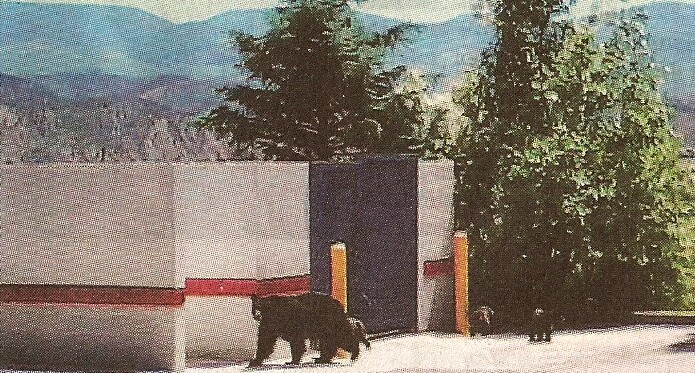
Cougars (top) and bears (below) are increasingly moving into more developed areas of Colorado because of the loss of habitat due to human encroachment.


Who can forget the end of the seventh verse of John Denver's terrific hit, 'Rocky Mountain High':

Why they try to tear the mountains down to bring in a couple more...
More people, more scars upon the land....


Well, we now know those words, written (and sung) more than 30 years ago, presaged what is happening to Colorado now. This was revealed in a Denver Post article four days ago, dealing with the increased takeover of once pristine or public lands for other uses, including fracking and private development.

"The more people" aspect was revealed three days ago in a front page article tracing the genesis of Colorado's Front Range housing crunch. To put it in numerical terms: 102, 000 poured into the state last year but only 25,000 new homes were built to accommodate them,  While in urban areas like Denver this is creating a pressure, high density crunch, in others it's causing gentrification. In the latter, long time residents complain about not even being able to see the mountains any longer because "newcomers have put up new, $1.25 million homes blocking the view".  The same old timers complain that these new arrivals "in BMWs" have incepted many new restaurants, but "most are unaffordable".

According to The Post's analysis:

"Urban sprawl, commerce and drilling claim the equivalent of a football field every 2 1/2/ minutes- roughly a Los Angeles sized open area every year."

The effect is to rapidly fragment the available land which isn't a good thing for humans or wildlife.. According to David Theobald, a Colorado State University conservation biologist quoted in the article:

"If we want to have wildlife populations be able to move across the land, the most widely recommended strategy is connectivity of landscapes. If we are increasingly fragmented that does not bode well."

What he means by that is Coloradans are then much more likely to encounter wildlife in their backyards that don't belong there, including: mountain lions (which have a nasty tendency to eat any pets left out), bear - black and brown, and coyotes.  Thus, the more open space is consumed - by either sprawl, development or fracking, the less habitat available to wildlife and the more probable encounters with humans - which usually don't redound to the benefit of the critters.

Fracking operations "tearing mountains down"  on W. Slope

Looking in more detail, the study found that "the main driver was energy development (i.e. oil and natural gas fracking) which drove 32.7 percent of the transformation in Colorado."

This energy development now includes no less than 55,000 active wells and 40,000 inactive . Next is urban sprawl which expansion has caused 22.3 percent of the change in land use in Colorado. Meanwhile, transportation activities are responsible for 4.1 percent of change.

  Apart from the human factor, climate change and nature are taking  a separate toll: As reported by the Post in a follow-up piece (May 21, p  13A), "the mountain pine beetle has chewed up 3.4 million acres of Colorado forest land - according to the state forest service." The origin of the beetle in Colorado forests is tied directly to climate change- global warming and interested readers can find details here:

http://www.nytimes.com/2008/11/18/science/18trees.html?pagewanted=all

Moving forward, it appears at the rate more people are entering and settling in our state - not all of whom have any affinity for the preservation of its natural beauty - it may not be long before John Denver's nightmare version of his song manifests.

Monday, January 6, 2014

YES – Global Warming IS Still Real and Ongoing! (Never Mind the Cold!)

NASA imagery
Satellite image of Arctic at point of maximal Arctic melting. Increasing warmth in the Arctic is influencing the polar vortex causing icy cold to spill southward to North America.

The disconnect between much of the media (and public) and ongoing global warming has never been more evident than the past week or so as we witnessed a Russian ship trapped by ice in the Antarctic and bone -chilling frigid air in the Midwest today.  But as I will show, none of these events - strange as they may seem  (i.e. Chicago being colder than Siberia this morning)  controvert global warming.

SF Chronicle conservo writer Debra Saunders thought she was being facetious when she wrote the following:


"To recap, when the Aussie expedition on the Russian ship got stuck, the Chinese Xue Long tried to icebreak its way to the stranded ship. But there was too much thick ice and the Xue Long could not reach the Shokalskiy. Then the Australian Aurora Australis tried to come to the rescue, but couldn’t get to the Russian ship either. Ditto a French icebreaker. There was too much thick ice to reach the global-warming research team.

More irony: The AAE was supposed to follow in the footsteps of the 1912 Mawson expedition – which is the last trek I would want to recreate.  The idea was to allow modern scientists to collect data to compare with the Mawson data in order to do improve climate models for global warming. But then there was too much ice, and now the party’s over."


Mayhap for the Aussie team, but that doesn't mean global warming is over. Indeed, what happened to the Shokalskiy can actually be said to have reinforced the theory of global warming. That is, it's been found (Nature Geoscience, March 31) that melting ice shelves actually spur the growth of sea ice - the form that trapped the Russian ship. While Arctic sea ice has dwindled, Antarctic sea ice has expanded nearly two percent per decade since 1985.
 

As oceans have warmed over the same period, their currents have carried heat to the deep waters surrounding Antarctica. This deflected warmth melts the base of ice shelves, i.e. sections of the Antarctic ice sheet that float over the ocean.  The melting then floods the ocean with cold fresh water that remains on the surface and easily freezes.  Hence, the trapping of the Shokalskiy.
 
 
Regarding the record breaking bone –chilling cold in the Midwest today, this can also be traced to global warming – as originally proposed in a theory by Gunther Weller, more than 25 years ago. That is,  something called “the polar vortex” is normally stable and circulating around the Arctic, like a massive cyclone. (Weller called it  a stable polar cyclone)   However, with increased warming in the Arctic (especially more than anyplace else on Earth) the circulation in the vortex is weakened and the vortex’s cold spills southward – discharging energy and creating the record breaking cold we’re now seeing in places like Minnesota.
 
As a weather specialist noted this morning (CBS), it is unwise to just cherry pick the frigid cold experienced in some parts today and laugh at global warming – since every place else is seeing a warming trend.  Also, warming begins much earlier than it had incepting natural changes in flora and fauna to respond to it. (For example, the dandelions in my yard now begin flowering in early to mid March as opposed to late April. Meanwhile, the maple syrup in Vermont is being adversely affected by too early warmth which is also now too enduring – into the fall).
 
Worse, the unabated general warming trend, such as here in the Rocky Mountain West, has meant the spread of the Mountain Pine Beetle - now destroying forests  by the hundreds of thousands of acres each year. The beetle basically turns trees into tinder for which the slightest spark  - say from a randomly tossed cigarette- can cause a densely forested area to explode into a wildfire. This is what happened with the Black Forest fire last year, and the Waldo Canyon fire the year before that.

 
Only a dunderhead  or nitwit would in any way use the bone chilling cold, snow or even ice storms to try to deny global warming. But don't worry, many idiots will still try!


Sunday, October 6, 2013

Homeowners in Fire Zones May Well Be Dinged Next Year- And They Should BE!

A house is fully engulfed by the Black Forest Fire.
A home is engulfed by flames in Black Forest back in June this year. Higher fees, taxes and insurance premiums on these home owners ought to limit future disasters here in Colorado.

"Wildfires have been part of living in the West ever since people first settled here. For several decades, there has been a continuous buildup of hazardous fuels and this growing risk requires a response."  - Governor John Hickloooper, last Monday at State Capitol after referencing the creation of his Wildlife Insurance and Forest Health Task Force in 2012 and the need to impose higher fees, taxes, insurance premiums on those living in fire danger zones.

Imagine a person choosing to live near a fuel dump where partly- filled cans and containers of gasoline are regularly tossed. Imagine also that each year fierce, dry heat is incepted by climate conditions which trigger one or more explosive fires  after the containers explode.  Yet each year the fuel dump dwellers expect government resources to bail their homes out, while also expecting insurance companies to cough up the bread for rebuilding and not raise their premiums.

What's wrong with this picture? Everything.

In the case of the Colorado fires, specifically the Waldo Canyon fire last year which destroyed over 350 homes, and the Black Forest fire this year which destroyed thousands, we know the fuel includes hollowed out pine and other trees,  turned into tinder by the Mountain Pine Beetle.  In effect, all those folks living in the forested areas of the state are inhabiting de facto "fuel dumps" which was the point of the governor's remark last Monday.  And if they are living in those fuel dump zones, then they ought to be expected to pay more for the privilege  - given precious fire fighting resources will most likely have to be expended there.

As the Colorado Springs Gazette pointed out Tuesday(page B-1) , according to Hickenlooper's proposal, home owners in high risk fire areas would "have their properties rated for wildfire risk and face special fees and taxes to help fund fire mitigation efforts - under recommendations released Monday by the governor's wildfire task force."

Of course, this is eminently reasonable! If you choose to live in a sequestered, private area laden with tinder for wildfires, you ought to be expected to pay for likely consequences and resources needed to help you - given the experiences of the last two years. To expect those of us who live in "normal" areas to swallow higher insurance premiums for your choices is nothing short of nuts. Why should we, given we derive no benefit? (I.e. being able to book your home for a weekend stay - getaway.)

Therefore, exceptionally assessing higher fees, taxes and even higher insurance premiums for properties in high risk fire areas is both rational and fair - and certainly not "spoils taking" ass suggested by Robert Samuelson (last blog).

Still, local GOP-ers, like Springs Mayor Steve Bach, are complaining and arguing that they "would not support a state wide fee for mitigation".  Oh, and he also rejects any talk of a "mitigation audit" - based on state assessors rating homes on a 1-10 scale for fire danger, as recommended by Barbara Kelley - executive  Director of the Dept. of Regulatory Agencies. (op. cit., p. B-5)

Such audits, if yielding scores as high as 9 or 10 would "render some properties uninsurable and thus unsellable". The task force has also recommended disclosures of the risk ratings when homes are sold.

Reepos like Bach hate such proposals because, of course, they don't wish to antagonize their higher income voters, most of whom are those with the properties in the higher risk areas.

But, if our legislators are sane they will ram this task force mitigation mandate through - like they earlier did Colorado's gun control legislation, including limiting magazines to 10 clips.

Stay tuned!

Tuesday, June 25, 2013

George Will: “No Warming for Last 16 Years” – Let Him Come to Colorado!

George Will is the geeky looking guy with spectacles and bow tie whose visage appears in his WaPo and syndicated columns. Ironically, though geeks are supposed to have higher IQs, Will often comes out with balderdash that more suggests a cretin. In the most recent instance, Will denies there’s been any warming the past 16 years while lashing out at Obama’s remarks on climate change recently delivered in Berlin. According to Will (‘Hitting a Wall in Berlin’, June 22, p. 5D, Denver Post):


“Then came Wednesday’s pratfall in Berlin. There Obama vowed energetic measures against global warming. The 16-year pause of the warming was not predicted by, and is not explained by, the climate models for which – in his strange understanding of respect for science- he has forsworn skepticism”


How so? Indeed, Will is caterwauling about a non sequitur since no serious climate scientist buys into any “16 year pause in warming”. Where did Will dredge up this codswallop? Well, from a misinterpretation of the data published in a Nature paper back in 2008 by Noel Keenlyside et al. Therein was made a tentative claim for monotonic global cooling since ca. 1998. This 'jumped the shark' and become embedded into the warming skeptics' arsenal of disinfo and set real global warming science education back at least a decade in my estimation.


At the root of this misapprehension by the faux skeptics is misinterpretation of the data appearing in the paper - not at all helped by the media (like the WSJ) which have also misconstrued it. Even Editors who fully know the actual original source still can't be bothered to consult it, they'd rather get their info 2nd hand (like from the 'Investor's Business Daily') then bloviate how global warming is wrong, or "hyped" in sundry editorials.


People prone to the denial weltanschauung then read these superficial reports, miss the key core clues, and bruit it all about that they (deniers, skeptics) were right all along. Instead of taking shortcuts, skeptics could have retrieved the ACTUAL paper from Nature! They could have studied the paper's key figure, the one that looks at past and (forecast) future global temperatures, "Hindcast/forecast decadal variations in global mean temperature, as compared with observations and standard climate model projections".


If really intelligent, the first thing Will ought to have noted about the figure -indeed, one major source of confusion - is that each data point represents a ten-year centered mean. That is, each point represents the average temperature of the decade starting 5 years before that point and ending 5 years after that point. Thus, the statistics for potential “cooling” could not possibly have been justifiably extrapolated beyond 1998 + 5 = 2003, or in Will's case, "16 years of no warming"  from 1998.


Second, would-be intelligent skeptics should have spotted the red line in the graphic of the Nature publication and – if bright enough – beheld that it was the actual global temperature data from the U.K.'s Hadley Center for Climate Prediction and Research. They then ought to have asked: "Why does the red line stop in 1998 and not 2007?"  Again, it’s a running 10-year mean, and the authors use data from a Hadley paper that ends around 2003, In effect, they can't do a ten-year centered mean after 1998.


Lazy deniers, however, have parlayed their own perceptual deficiency and this simple statistical peculiarity of the data into believing that global warming factually STOPPED in 1998! But the stunning fact is the evidence all around belies this canard!   For example, there was the black swan storm 'Sandy' that struck New York, NJ in late fall - and most climatologists trace its origins as climate-change born. I elaborated on the reasons in the first answer I provided to a reader's question in this previous Mail Brane: http://www.brane-space.blogspot.com/2012/11/maile-brane-seeking-answers.html    

Fast forward to January 2013, which  had barely begun when fiery images from Tasmania and Australia showed what we likely faced in the Northern hemisphere come June, July. For the record (no pun intended) July 2012 was the hottest ever recorded in U.S. annals with a mean tempeature of 77.6F. The average annual U.S. temperature for 2012 was 55.32F or one full degree higher than the old record set in 1998. (So much for the codswallop that all temperature increases ceased in 1998. )

Meanwhile, here in Colorado we’ve had over eighteen monster wildfires in the last 2 years, which can be tied inextricably to global warming-climate change. Whereas at one time a five day spate of 90-plus temperatures was rare, so much so that few Coloradans used a/c we now are in the midst of a 13 day string of such temperatures combined with extremely dry conditions and prolonged drought – ideal for fires.

In June the Black Forest fire erupted in northern Colo. Springs, burning 24 square miles. Barely a week after it was 95% contained the West Fork fire was ignited by two lightning strikes and has now burned up a total of 125 square miles. There is zero containment and fire fighters expect it will burn for months! Experts pinpoint the immediate cause as lightning striking dead trees, turned into tinder by the mountain pine beetle. The spread of the latter has been fueled directly by longer, warmer and drier springs and summers. If Georgie really does believe there was a 16 year pause in warming he ought to have been here in Colorado the past 12 ½ years with my wife and me, seeing year by year how the climate has turned hotter and drier and the beetle population in the forests increased as a result of the shorter cooling seasons. Obviously, the guy needs a practical education!

Actually, he might need ANY kind of further education, especially in basic research. He might start with The Economist (June 16, 2012) report that notes that Greenland's ice cap is "losing an estimated 200 gigatonnes of ice a year, enough to supply a billion people with water. " If this should continue, and lead to a predicted 59 cm (24 in.) rise in sea level by the end of the century, it will prove catastrophic for many population centers abutting the oceans.


  Before he next scribbles bollocks on Obama's lack of climate change insight or skepticism and the ineffectiveness of current models and how many "scientists' disagree with them, I suggest he consult Eos Transactions of the AGU, Vol. 90, No. 3, p. 22 , and the analysis therein of the extent of scientific consensus on global warming published by P. T. Doran and M. Kendall-Zimmerman . They found that (p. 24):

 "the debate on the authenticity of global warming and the role played by human activity is largely non-existent among those who understand the nuances and scientific basis of long-term climate processes". 

 In their analytic survey for which 3146 climate and Earth scientists responded, a full 96.2% of specialists concurred temperatures have steadily risen and there is no evidence for cooling. Meanwhile, 97.4% concur there is a definite role of humans in global climate change.   


Methinks Georgie really needs to stick to his avocation of baseball, or maybe the hack politics in which he's so proficient. He really has no future dabbling in climate science since he's already shown he can't even discern basic statistical results presented in research journals like Nature. But then again, maybe he's an agnotologist - one of those who deliberately sows doubt based on faulty economic, scientific reasoning. We also have another name for them: propagandists!


Wednesday, June 12, 2013

Raging Fires Return to Colorado!

A house is fully engulfed by the Black Forest Fire.

A home is engulfed in Black Forest, roughly 8 miles north of my place.


The choking smoke smothered everything in sight this morning, even as I struggled to get the hoses ready for front and backyards to water down the tinder dry lawn.  This experience was even worse than last year's (Waldo Canyon Fire) since I have been fighting an acute case of bronchitis for the past week. Despite that, I tied on a make-do face mask, dampened first, and went about soaking the lawn given the fire this year is even closer.

We suspected the worst might happen yesterday around 2 p.m. when 15 acres was first reported burning in the Black Forerst neighborhood, a tony uppercrust, "independent" subdivision about eight miles north of us. TV images taken from the corner of Powers and Woodmen in Colorado Springs showed billowing smoke and the TV meteorologist didn't make light of the fact that conditions were ideal for it to spread: 97 deg F, barely 7% humidity and winds out of the southeast at 30-34 mph.  He then showed a disarming photo of Black Forest lush with its green, well manicured lawns - but noted looks can be deceiving. Particularly as the trees that surrounded the area itself had literally become tinder for fire.

I noted the reasons why last year, when writing about the Waldo Canyon Fire that erupted south of us.That is, that the trees in Colorado have been victimized by sundry insects -particularly the mountain pine beetle -  mainly on account of the drought which has unleashed them in greater numbers.  They've essentially  converted the once living material into tinder that literally explodes when conditions are right- as they were yesterday afternoon.

So true, since from 2 p.m. to 4 p.m. the Black Forest Fire expanded to 400 acres, then reached 800 acres by 5.30 p.m. and 3, 800 acres by 9 p.m. When I awoke this a.m. it was at 8,000 acres with zero containment and people from Falcon were being required to evacuate. Already anywhere from 60-80 homes may have been destroyed.

One of the problems has been lack of adequate water and manpower resources, this as another fire is raging south of us and another erupted near the Royal Gorge, rapidly expanding to 3, 800 acres. The latter fire saw state bureau of prisons agents evacuating prisoners  from the Colorado Territorial Prison at Canyon City. At one point, water storage tanks had to be raided, and since no large slurry planes were available. Instead,  four odd Chinook helicopters (from Ft. Carson) had to be loaded, each with a few hundred gallons, to dump them on thousands of burning acres. A water "shortage" was referred to at one point, and I couldn't help thinking of the 14- 18 million gallons of water wasted so far in our area by fracking for natural gas wells (all of which have emerged 'dry') that might have been used now to put out the fires.

Will the frackers (and the state) learn from this? Somehow, I doubt it. This despite, as I also noted last year, the trend is for these hot, dry raging fire summers to continue in Colorado and the Mountain west. Recall my reference last June to a Washington Post article entitled: Pace of Climate Change Exceeds Estimates, wherein one read:

"Warmer weather, earlier snowmelt, drought and beetle infestations facilitated by warmer climates are all contributing to the rising number of fires linked to climate change. Across large swaths of the United States and Canada, bark beetles have killed many mature trees, making forests more flammable. And tropical rain forests that were not susceptible to forest fires in the past are likely to become drier as temperatures rise, growing more vulnerable."


The beetle referenced above is the mountain pine beetle, a variant of the bark beetle species. It's modus operandi is basically to convert living plant tissue - say in trees -  into highly flammable dead bark for which the slightest spark can set off a conflagration. The beetle then, is a major catalyst for all the presently raging and uncontained Colorado wildfires.

What will we do in the meantime? All we can do is hope the wind direction soon changes so that the acrid odor of smoke which now permeates the house can be abated. Most of it is drawn in with the operation of the evaporative cooler. But with temperatures set to hit 90 today there's no way to turn it off and close all the windows- we'd suffocate. So, we have to tough it out.