Showing posts with label Gentrification. Show all posts

Tuesday, May 24, 2016

John Denver's 'Rocky Mountain High' En Route To A Nightmare


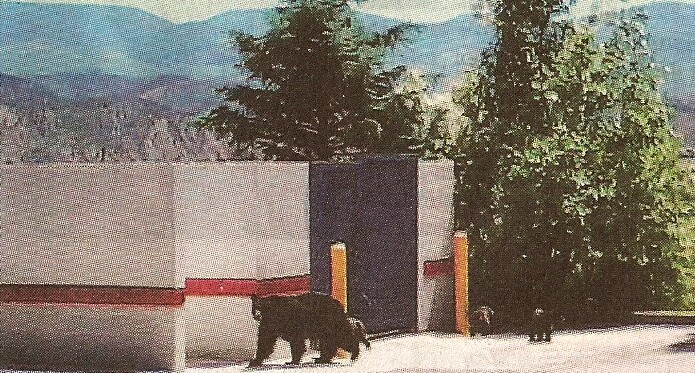
Cougars (top) and bears (below) are increasingly moving into more developed areas of Colorado because of the loss of habitat due to human encroachment.

Who can forget the end of the seventh verse of John Denver's terrific hit, 'Rocky Mountain High':

Why they try to tear the mountains down to bring in a couple more...
More people, more scars upon the land....


Well, we now know those words, written (and sung) more than 30 years ago, presaged what is happening to Colorado now. This was revealed in a Denver Post article four days ago, dealing with the increased takeover of once pristine or public lands for other uses, including fracking and private development.

"The more people" aspect was revealed three days ago in a front page article tracing the genesis of Colorado's Front Range housing crunch. To put it in numerical terms: 102, 000 poured into the state last year but only 25,000 new homes were built to accommodate them,  While in urban areas like Denver this is creating a pressure, high density crunch, in others it's causing gentrification. In the latter, long time residents complain about not even being able to see the mountains any longer because "newcomers have put up new, $1.25 million homes blocking the view".  The same old timers complain that these new arrivals "in BMWs" have incepted many new restaurants, but "most are unaffordable".

According to The Post's analysis:

"Urban sprawl, commerce and drilling claim the equivalent of a football field every 2 1/2/ minutes- roughly a Los Angeles sized open area every year."

The effect is to rapidly fragment the available land which isn't a good thing for humans or wildlife.. According to David Theobald, a Colorado State University conservation biologist quoted in the article:

"If we want to have wildlife populations be able to move across the land, the most widely recommended strategy is connectivity of landscapes. If we are increasingly fragmented that does not bode well."

What he means by that is Coloradans are then much more likely to encounter wildlife in their backyards that don't belong there, including: mountain lions (which have a nasty tendency to eat any pets left out), bear - black and brown, and coyotes.  Thus, the more open space is consumed - by either sprawl, development or fracking, the less habitat available to wildlife and the more probable encounters with humans - which usually don't redound to the benefit of the critters.

Fracking operations "tearing mountains down"  on W. Slope

Looking in more detail, the study found that "the main driver was energy development (i.e. oil and natural gas fracking) which drove 32.7 percent of the transformation in Colorado."

This energy development now includes no less than 55,000 active wells and 40,000 inactive . Next is urban sprawl which expansion has caused 22.3 percent of the change in land use in Colorado. Meanwhile, transportation activities are responsible for 4.1 percent of change.

  Apart from the human factor, climate change and nature are taking  a separate toll: As reported by the Post in a follow-up piece (May 21, p  13A), "the mountain pine beetle has chewed up 3.4 million acres of Colorado forest land - according to the state forest service." The origin of the beetle in Colorado forests is tied directly to climate change- global warming and interested readers can find details here:

http://www.nytimes.com/2008/11/18/science/18trees.html?pagewanted=all

Moving forward, it appears at the rate more people are entering and settling in our state - not all of whom have any affinity for the preservation of its natural beauty - it may not be long before John Denver's nightmare version of his song manifests.

Tuesday, March 17, 2015

Homelessness & Gentrification: Is There A Connection?


Michael Lee, 38, looks at a water bottle his daughter Kayah Lee, 6, brought back as her mom, Cristal Olko, 32, and sister, Kemani Lee, 3, look on at the
A homeless family crowds into a corner of an Aurora, CO shelter. A food shortage at the shelter meant it had to seek outside assistance. Will gentrification force even more into this condition?

In many cities right now there is an unseen battle ongoing, by millions of vulnerable citizens to prevent themselves from being homeless. It's a battle they are losing through no fault of their own. Well, the only "fault", in truth, is their wages are inadequate to afford the housing on offer. From San Francisco, where school teachers can no longer afford to live near their schools, to Denver where hundreds are about to be evicted from their apartments because developers want to construct high end condos and upscale apartments.

What is to become of these people? In San Francisco,  most teachers are fortunate (if you can call it that)  in finding affordable housing in the suburbs. The downside is that  they are locked into extended commutes which makes their days up to 40 percent longer.  In Denver the problem is not so simple.

For one thing renters, especially, are not aware of Colorado law which allows landlords to evict them so they can renovate and make room for tenants able to afford much higher rents. Worse, as one legal services specialist noted (Denver Post, Mar. 15, Business, p. 1K) "they are shocked and can't believe they have only thirty days to leave."   And month to month leases require only seven days notice.

Such is the specter that now hangs over the tenants of Denver's Autumn Arms apartments, many of whom are disabled, elderly or living on one income. For these the apartments' affordability is a lifeline that enables them to make it day to day - if not prosper. One tenant interviewed (ibid.) for example, noted that she earns $1,000 a month caring for the elderly in a nursing home blocks away -so she can walk, and doesn't need a car. She is able to make it because the rent is only $650 a month, This creates a percentage much larger than the "30 percent" limit (proportion of housing to total income) people are told to attend to, but she cuts corners.

However, the new investors (St. Anthony's Group) want to renovate and then increase rents to $950 a month. This is still a lot less than Denver's average $1700 but way more than the current residents can afford. So, though they have been invited back after the renovations, the 50% increase is way beyond their means.

In other apartments, like the Spartan Court in Capitol Hill, a formal eviction notice isn't needed, only the notice of rent increase, say from $575 /month to $975/month. That amounts to what one enraged resident said is a "quiet movement":

"They're not really evicting us. But when you hear of a 50% increase it is disconcerting."

Indeed.  But as a rep from new owner Hogarth Property Inc. puts it:

"If a property is  currently rented at a level which is substantially below market rent, then one can reasonably expect a rent review (at renewal of tenancy) to appear to be substantial when it is brought in line with the market."

But why is the "market rent" as rep Simon Lofts calls it. so out of whack with what so many can afford? That's the 64 dollar question.

The answer is that population growth for the area has outstripped the supply of housing, driving up rents and home prices across the board.  The shortage is especially acute in central Denver which has a disproportionate share of young adults moving in from other states. (Hmm....wonder why? Could it be the marijuana legalization factor?)

In any case, it leaves the apartment renters at Autumn Arms and Spartan Court (as well as many others) in the lurch. And now that they have to move the choices are few: move in with a kindly relative if they have space, or move to another (cheaper rent) state, or try a Section 8 voucher lottery. And if all three avenues fail for whatever reason, they may be looking at homelessness.

In regard to Section 8 vouchers (available to assist low income households) Denver currently has about 6,800 such federal subsidies, and holds a lottery every fall to award 700 to 1000. But let's get real here, having a decent place to live which one can afford shouldn't depend on a damned lottery.

And part of Denver's problem is it has deliberately given in to gentrification and "densification" turning the city into a place most residents no longer recognize.  Many blame Denver's mayor, Michael Hancock,  for caving into pressure from high power developers. But the developers lay blame on the state's new Construction defects law, i.e. disallowing the use of too many cheap or substandard materials - like Chinese-made wood treated flooring full of formaldehyde.

Whatever, the problem is serious and getting worse. Denver's mayor claims his administration has made affordable housing part of his development plan, but as residents ask: If so, why didn't the city buy those two lower end apartment complexes instead of allowing them to fall into the hands of high profit oriented "investment" outfits?

If the city had done that, hundreds of people would have a place to live instead of being forced out to some future that can only be imagined.

Meanwhile, farther east in Hartford, CT, a similar story is playing out as the city seeks to evict 11 people living in a 9 -bedroom home, because of "zoning  violations" (which zoning law only permits two people per home no matter how large).  Let us hope those residents - including three couples with 2 kids and three single people, win their current court case and don't meet a similar end to those evicted in Denver.