Showing posts with label habitable zone. Show all posts

Friday, December 15, 2017

Google AI (Neural Network) System Helps To Find Solar System with 8 Planets

The Kepler-90 star system has weight planets, like our own 
Artist's portrayal of the Kepler 90 solar system, 2, 200 light years from Earth.

The media, as usual, is literally breathless about the discovery of the new 8-planet solar system ("Just like ours!") using the Kepler space telescope. The system, named "Kepler 90" is 2,200 light years from us and no - we have no idea what the planets really look like. That graphic you see above is just an artistic rendering. No astronomer actually knows what any of the eight planets looks like, it's basically educated guessing.

Before dousing expectations that we may find extraterrestrials on any of these new worlds, let me note why the discovery has scientific importance - namely in the way the new planets were discovered. This entailed "machine learning"  via an AI (artificial intelligence) neural network system when ordinarily human astronomers would be  "trying to drink through a fire hose" in the words of astronomer Derek Pitt.

Thus, the Google AI system has been able to search through the billions of gigabytes of data much faster than any humans or group of humans.  In the words of Pitt again, using an analogy of stars in the galaxy to sand grains:

"It's as if you'd be forced to search through all the grains of sand on a beach to find only the red sand grains."

The greatest attention has been focused on the third planet from the central star, called Kepler 90i. Below is another artist's depiction of this world, which the media is comparing to Earth on account of its third position in order from the central Sun:
The new planet Kepler-90i is about 30 per cent larger than Earth and very hot

But make no mistake there is really very little resemblance and no, you won't find any intelligent species or any species at all there. Why? It orbits so close to its star that the surface temperature is a ‘scorchingly hot’ 800F (426C). It orbits its own Sun once every 14 days.  That period, P = 14 days, gives the clue of why it is so infernally hot.

By  Kepler's 3rd law:

3 = P 2


The quantity a or semi-major axis is what you want. First one finds P in years, which turns out to be:  0.00147 yr.


Then take its cube root:  a = [P 21/3   =  [0.001471/3 

Which answer I leave for ambitious readers to finish.

The point is that the so-called "Earth position" planet Kepler 90i is simply too near the central Sun to support life. If is outside whatever "habitable zone" exists around it. 

Despite the fact I may have squelched any notions of alien life on these worlds (they are all relatively "scrunched up" close to the central star) the excitement remains in the method used for discovery which can now be applied to hundred, thousands, millions of other stars - and putative solar systems.

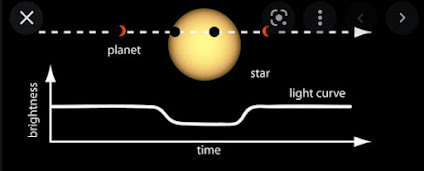
Kepler for its part has already spent four years scanning 150,000 stars and come up with 2,500 exoplanets - with 1,000 more expected. As usual,  the general analytical approach is to observe for minute dips in photo-intensity of the star's light curve as the putative planets pass in front of it in our line of sight, e.g.
Image may contain: text
Thus, any planet that passes in front of its Sun causes a measurable dip in the associated light intensity, betraying its presence via an occultation.  The longer  in duration the dip the larger the object, etc.

I should note here that the Kepler observation  mission  officially ended in 2013, but the spacecraft recorded so much data during its four year mission that scientists expect will be crunching the data for many years to come.


According to Christopher Shallue, senior software engineer at Google AI in Mountain View, California, who made the discovery, the algorithm was so simple that it only took two hours to train it to spot exoplanets. Tests of the neural network correctly distinguished  true planets from false positives 96 percent of the time. Google AI has promised to release all of the code so that amateurs can train computers to hunt for their own exoplanets.
Maybe one or more Brane Space followers will make a new solar system discovery using the data...who knows?

Friday, February 24, 2017

Tempering The Media Hype About The Newly Discovered Seven Planet Solar System

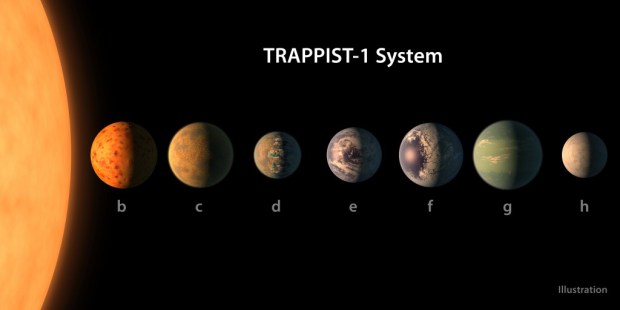
The TRAPPIST-1 star, an ultracool dwarf, is orbited by seven Earth-size planets.
An artists' depiction of the member planets of the newly discovered Trappist-1 System. No one has actually observed these worlds.

In one media spot or article after another one beholds elaborate images showing the 7 planets discovered in the Trappist -1 system. This is an exoplanet system in the constellation Aquarius,  about 39 light years away from Earth. Of course with all such finds, and especially this one, the media hype immediately goes to whether any of the worlds can support life.  And so we saw and heard much breathless speculation in the past few days of life maybe emerging on one or all of the three planets, designated: e, f and g

Let's first clear the air that despite the planetary images no one has actually observed these worlds. They were detected by ESO investigator Michaël Gillon, and his team of exoplanet researchers at the University of Liège in Belgium using the standard "eclipse" techniques. The basic principle at work is elementary to grasp and illustrated by the  graphic shown below:


In this method,  the exoplanet passes in front of its parent star producing a dip in the light curve over a defined interval t2 - t1(forming the dip).    The length of the "dip" enables the investigator to deduce the presence of an orbiting planet about the parent star.  To fix ideas, Gillon and his ESO team have been interested in TRAPPIST-1 since late 2015. Using the European Southern Observatory’s Transiting Planets and Planetesimals Small Telescope (TRAPPIST) in Chile, they detected small dips in the star’s brightness at regular intervals. As I noted, such dips are incepted when putative planet crosses between the star and Earth in our line of sight.

Last May, the ESO scientists published their discovery in Nature: citing three rocky bodies, dubbed TRAPPIST-1b, -1c and -1d.  Not long after the study was published, Gillon noticed that TRAPPIST-1d was behaving oddly. On taking a closer look with the Very Large Telescope, he realized that the dip in brightness he thought originated from 1d alone was actually caused by three planets, all transiting at the same time.  In other words, three "sub-dips" in the single light curve of 1d gave rise to 3 planet indirect detections.

According to one co-author or the study, Julien de Wit, a planetary scientist at MIT:

"This happens only once every three years. The chance of catching it is less than one in a thousand. It’s funny because it’s such a huge paper with amazing results, and we got it from sheer luck.”

Luck indeed! And having the instruments and insights to make these detections that have given rise to our acceptance of this compact solar system.

Let's examine further extracted data from the light curves analysis.

The periods of the three habitable zone planets are: 6.1 days for e, 9.2 days for f and 12.3 days for g. These compare to 365 1/4 days for Earth. Why are the periods of revolution so very brief? Well, because all seven planets actually orbit their within a very confined region. If Trappist -1 was at the Sun's position, all seven worlds would be within the orbit of Mercury - the nearest planet of our system to the Sun. The reason the Trappist planets aren't fried is that their star is much cooler. Specifically, it's classified as an ultraviolet dwarf star - less than a tenth the size of the sun and about a quarter as warm. 

So even granted that the Trappist planets are relatively close to this UV dwarf, we expect the conditions on these planets wouldn't exactly be called "balmy".  In fact, I can't imagine any sober human who'd actually want to travel to any of them and look around, even the ones in the so-called "habitable zone" Why?

The Gillon team that conducted the investigations determined that the six inner planets are locked in an orbital resonance, meaning that lengths of their orbits are related by a ratio of whole numbers. Because of this, the bodies are likely  “tidally locked.” In other words, the amount of time it takes a body to orbit matches the length of one rotation on its axis. This results in the same side of the planet always facing the object about which  it orbits. For example, the moon is tidally locked with Earth, which is why we always observe the same face (for the most part, we actually see a bit more due to nutation),  when we look up at night.

As I noted in previous posts about similar exoplanets, this means that one side of each body is constantly exposed to its sun's heat, while the other side is perpetually in darkness. This means that half of each planet freezes while the other half burns.  The only region where one would find tolerable temperatures would than be at the terminator or the "line"  separating day and night sides.

If one is going to do a "life search" on these Trappist worlds, I think they will be disappointed.  As one recent article put it, "even if they turn out to be warm and wet, these worlds might not be great places to live".   You think? Constant darkness and frigid cold vs. excess heat and constant light. Boil vs. freeze? Of course, there might be some form of primitive micro-organisms assuming there is water on any of the 3 "habitable" worlds. (Remember again when we use the term "habitable" we mean only in a potential sense, not that they actually are.)

As Elisabeth Adams, an exoplanet researcher at the Planetary Science Institute put it:

"The very idea of a “habitable world” is purely theoretical. Scientists have only one source of data on habitable planets, and that’s Earth. We don’t actually know the parameters that are needed for life on another world."

Indeed. So it is best not to jump too far ahead of what we actually know. That knowing must await (at least) further detailed analysis of the atmospheres of the e, f and g worlds of the Trappist -1 system.

Rather than hyping life on these worlds, a better take might well be acknowledging that Trappist -1's system presents an unprecedented window on how solar systems work. Thus, beyond the current data the each planet is more or less "Earth-sized", their varying densities and distances allow for detailed comparisons of the worlds.

This is a useful template that will be of inestimable benefit in further exoplanet system detections.


Thursday, February 27, 2014

Kepler Finds 715 New Planets - Does It Mean A Greater Probability Of Life On Them? No


No photo description available.
Two representations of 603 exoplanets around Sun-like stars found up to the end of 2013. The data are plotted with planet radius (R) vs. orbital period in days - P (a), and against stellar irradiation flux (b) (From Physics Today, January)

The news that the Kepler telescope has found 715 new planets is now making the general media rounds, but many outlets seemed to have jumped the gun and extrapolated from these a "higher possibility of life being found". This isn't true at all. As I noted in a previous blog post, one of the most critical first objectives  - to assess for an "Earth-like planet",  is to obtain the periodicity or the time it takes the planet to circle its Sun. This is based on the fact that with the period, one can determine a planet's distance, i.e. from Kepler's 3rd law, see e.g.
http://brane-space.blogspot.com/2011/08/solution-to-simple-astronomy-problems-6.html

If then the period is too short,  a planet will be too close to its host star, never mind it may have the mass or radius of Earth. Then it can't really be called "Earth like" in the strict technical sense of actually being a place one could survive.  With those limitations in mind, Geoffrey Marcy of the University of California, Berkeley and Andrew Howard of University of Hawaii, last year reported an analysis of 603 planets (found via Kepler)  orbiting Sun-like stars, including with a few having periods longer than 300 days.

Bear in mind the Earth's orbital period is 365 days so any exoplanets with P > 300 days are of major interest since they could mark a genuine Earth-like planet, i.e. which could actually be colonized one day. This makes the Marcy-Howard research especially significant given they also corrected for observational biases and limitations, and restricted their searches to stars less than 3,000 light years away - with low photometric noise and Sun-like surface temperatures, or around 11,000 F.

But at the end of the analysis, a core of only one single planet of the 603 was adjudged to be in any way "livable". (Which still doesn't mean anything actually inhabits it)  This was identified within the small green inset box (from 10 plausible initial candidates) seen in the graph (b) at the right. (Plotting the radius vs. stellar irradiation flux.)  The candidate planet met the key criteria for in occurring in the vicinity of stellar flux  Fo = 1 and planetary radius R =1 (determining the acceleration of gravity g) .

 NASA on Wednesday announced the discovery of 715 new planets, but of these only four were designated as existing in any habitable zone.  The 715 planets were found to orbit 305 different stars, and were discovered by the Kepler space telescope using a new technique called "verification by multiplicity".  It relies in part on the logic of probability. Instead of searching blindly, the team focused on stars that the technique suggests are likely to have more than one planet in their orbit.

Let's examine briefly an assay of the planets thus far discovered. According to NASA, 95% of the planets discovered by Kepler are smaller than Neptune, which is four times as big as Earth. With such large radii, and likely accompanying density, none of them are plausible habitable worlds.

Meanwhile, one of the new planets is about twice the size of Earth and orbits a star half the size of Earth's sun in a 30-day cycle. This again eliminates it as being habitable based on the Kepler harmonic law. It would be too close to its parent star, hence too hot.  The other three planets in habitable zones also are all roughly twice the size of Earth, again likely making their gravity too great for any life to evolve.
Of course, more observations are needed, and planetary astronomers expect to find a higher percentage of new planets that could potentially have a life-supporting climate like Earth's.
But still, the best approach is not to get ahead of ourselves. While the more than 1,700 new planets discovered is exciting to be sure it doesn't mean that any of them harbor any life forms.  We have a plethora of planets, thanks to Kepler, but so far zero evidence for life on any of them.

Friday, January 24, 2014

Finding a "Second" Earth? We Better Make the Best of THIS One!


Two representations of 603 exoplanets around Sun-like stars. The data are plotted with planet radius (R) vs. orbital period in days - P (a), and against stellar irradiation flux (b) (From Physics Today, January)

In  recent TIME article ('Finding A Second Earth') we learn that Harvard lecturer Lisa Kaltenegger is busy modeling previously discovered exoplanets. Of coure, many astronomers are also doing this. What's different with Kaltenegger is her incorporation of data about our own Earth: its meteorology, geology and volcanology......plus its history. The point is, our own planet - seen by any alien civilizations, would look very differently depending on the time point it was being observed. For example, the Earth observed 3.9 billion years ago, would have appeared very differently - as a brownish globe with an atmosphere mostly of hydrogen sulfide (the rotten egg smelling gas), CO2 and nitrogen.

Data collected by hypothetical advanced aliens-  using many of the same methods we're using today - i.e. parsing exoplanets' atmospheres during transits of their parent stars,  likely would have concluded an inhabitable world - never mind its placement in a "habitable" zone.  (Assuming the observing aliens have roughly the same biology)

Now, in terms of recent advances, we're actually able to discern the approximate number of livable, Earth-like worlds - from a photometric record of some 43,000 stars observed using the Kepler telescope. Launched in March, 2009, Kepler's primary mission was to continuously monitor  large numbers of stars over long periods to in search of the very slight dimming that indicates the repeated transit of an exoplanet across the face of its host star.

One of the most critical parameters to obtain - to assess for an Earth-like planet, is the periodicity or the time it takes the planet to circle its Sun. This is based on the fact that with the period, one can determine a planet's distance, i.e. from Kepler's 3rd law, see e.g.
http://brane-space.blogspot.com/2011/08/solution-to-simple-astronomy-problems-6.html

If then a planet is too close to its host star, never mind it may have the mass or radius of Earth, then it can't really be called "Earth like" in the strict technical sense of actually being a place one could survive.  With those limitations in mind, Geoffrey Marcy of the University of California, Berkeley and Andrew Howard of University of Hawaii, recently reported an analysis of 603 planets orbiting Sun-like stars, including with a few having periods longer than 300 days.

Bear in mind the Earth's orbital period is 365 days so any exoplanets with P > 300 days are of major interest since they could mark a genuine Earth-like planet, i.e. which could actually be colonized one day. This makes the Marcy-Howard research especially significant given they also corrected for observational biases and limitations, and restricted their searches to stars less than 3,000 light years away - with low photometric noise and Sun-like surface temperatures, or around 11,000 F.

To perform their automated searches they used a software package called TERRA - developed by Marcy's grad student Erik Petigura. The program cleansed the photometric records of suspected outliers, intrinsic stellar variations, and a variety of other systematic errors.  Incredibly, Petigura next vetted by eye thousands of records for which the program found transit evidence - to weed out any anomalies due to instrumental or cosmic ray effects.

The team also eliminated any candidates with binary companions with radii (measured by the depth of the dimming during transit  trough) that exceeded 20 times the Earth's radius. (The fractional dimming of a star of radius R* during transit of a planet with radius R(p) is (R(p)/R*)2

The graphic shown gives the Marcy-Howard final sample of 603 planets, plotted in two distinct graphs, with (a) showing planet radius vs. orbital period in days (P) and graph (b) plotting the radius vs. stellar irradiation flux. (Note: uncertainties in stellar size, diameter contribute to uncertainties in both R* and the stellar flux Fp.)

Figure (b) is perhaps the more crucial graphic, with the stellar flux Fp  calculated from the orbital separation and the star's intrinsic luminosity (which is determined from its surface temperature and area (deduced from radius), see e.g. http://brane-space.blogspot.com/2011/09/tackling-intermediate-astronomy_22.html

The solar flux ( Fo ) at Earth's mean distance from the Sun (1 A.U. = 1.5 x 10 11 m )  is 1.36 kW/ m2  for reference.  The green patch in (b) contains those few candidates occurring in Earth-like habitable zones, with fluxes limited to 0.25 - 4Fo   and with planet sizes 1-2 R.  

So  how many of those 603 planets might actually be livable habitats for Earthlings? As it turns out not very many! Inside the green box one counts 10 in all. But....in the vicinity of stellar flux  Fo = 1 and planetary radius R =1 (determining the acceleration of gravity g) we find exactly one candidate planet. Given the photometric uncertainty (vertical-horizontal crosses on right side of (b) even this candidate could conceivably be knocked out.

The takeaway? We had better be good stewards of this planet and not look afar for colonizing opportunities (assuming we reach the level of starship builders and don't blow ourselves up, squander all our resources on stupid wars, or perish in a greenhouse holocaust). At the rate we are going, consuming the equivalent of 1.5 Earths every year, the future isn't promising.