Showing posts with label Kepler's harmonic law. Show all posts

Saturday, August 27, 2016

Transcending The Hype Over The Proxima B Planet

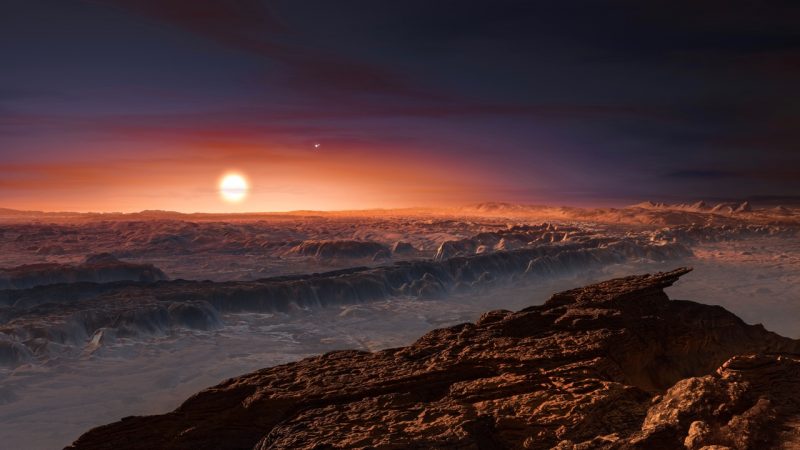
View larger. | This artist’s impression shows a view of the surface of the planet Proxima b orbiting the red dwarf star Proxima Centauri, the closest star to the Solar System. The double star Alpha Centauri AB also appears in the image to the upper-right of Proxima itself. Proxima b is a little more massive than the Earth and orbits in the habitable zone around Proxima Centauri, where the temperature is suitable for liquid water to exist on its surface.
Artist's conception of the view from the new planet circling the star Proxima Centauri B

It appears every time a new exoplanet is discovered, the hype of astronomers (and some physicists)  approaches that of the media commentariat. Three days ago  on CBS Early Show, for example, physicist Michio Kaku was heard to blab that "the holy grail of astronomy is to find an earth like planet that supports life."  Not really. The true "holy grail", if such a term can be applied to astronomy, would be to forge a consistent theory of stellar evolution by which each stage of a star's life cycle can be matched to an exact  sequence of nuclear fusion reactions and reaction cross sections. But, of course, this would likely be too complex for wide consumption.

Enter now a new exoplanet (in terms of its discovery) orbiting the star Proxima Centauri B in the triple star Alpha Centauri system,  roughly 4.3 light years distant. Its discovery began with an observing program  called Pale Red Dot, in early 2016. This was under the auspices of the European Southern Observatory (ESO).  (Not all exoplanet finds have been via the Kepler space observatory). In the case of Pale Red Dot, the goal was, specifically, to find a planet for this star.  This sounds somewhat like putting "the cart before the horse" and in many ways it was. But the ESO team had goon reason: namely, why shouldn't Earth's nearest neighbor star not have a planet or even planetary system?

Now ESO and several other institutions have released statements on their new discovery that yes, there is a new planet. Even better it's only slightly more massive than Earth. Yes, it’s in Proxima Centauri’s habitable zone, meaning there’s a potential for liquid water to exist on its surface.

The journal Nature is due to publish a paper describing the new planet – which is called Proxima b – on August 25, 2016. Guillem  Angada -Escude, an astrophysicist at Queen Mary University, London, said:

"The long-sought world … orbits its cool red parent star every 11 days and has a temperature suitable for liquid water to exist on its surface. This rocky world is a little more massive than the Earth and is the closest exoplanet to us — and it may also be the closest possible abode for life outside the solar system."

 Of the three stars in the system, Proxima – a small red dwarf star – is the closest star. Read about the Alpha Centauri system here.  Using Kepler's harmonic law or 3rd law of planetary motion, e.g.

http://brane-space.blogspot.com/2011/08/solution-to-simple-astronomy-problems-6.html


We can compute that the distance of Proxima b from its parent star is just over 4.6 million miles, or a factor twenty less distance than Earth is from the Sun.  But bear in mind the red dwarf sun is a much cooler star. This means Proxima is plausibly in the not too hot, not too cold "Goldilocks zone". If that is so it is possible that planet also has an atmosphere.

Image may contain: text

The radial velocity (RV)  plot shown above shows the variations in motion of Proxima Centauri over the first part of 2016.  The negative values denote approaching velocities in km/hr and the positive values denote receding velocities, i.e. when the component is moving away from Earth.  Thus, at some times it is approaching at ~ 5 km/hr and at other times receding at the same speed. As  Anglada Escude explained:
"At times Proxima Centauri is approaching Earth at about 3 miles (5 km) per hour — normal human walking pace — and at times receding at the same speed. This regular pattern of changing radial velocities repeats with a period of 11.2 days. Careful analysis of the resulting tiny Doppler shifts showed that they indicated the presence of a planet with a mass at least 1.3 times that of the Earth, orbiting about 4 million miles (7 million km) from Proxima Centauri — only 5% of the Earth-sun distance."

The greater mass of the planet, of course, means a higher g-value, i.e. for gravitational acceleration. So any Earthman arriving there would weigh more than on Earth. Thus:

g(Proxima b) =   G M/ r2

Where G is the Newtonian gravitational constant, M is then 1.3 x Earth's mass ( 6.0 x 1024  kg)  and r is the radius of the planet.

And the weight would be m g(Proxima b) where m is the Earther's mass in kilograms. (Note: Mass is an inherent property of matter, denoting the number of particles possessed, and hence doesn't change assuming a non-relativistic environment)

According to investigator Angada -Escude:

"The first hints of a possible planet were spotted back in 2013, but the detection was not convincing. Since then we have worked hard to get further observations off the ground with help from ESO and others. The recent Pale Red Dot campaign has been about two years in the planning."

When combined with earlier observations then, the Pale Red Dot data revealed the new planet,  Proxima b.

Obviously, further investigations are still needed to confirm Proxima b's other apparent peculiarities including that the planet doesn't rotate so one side is always facing its star while the other is darker and colder. Add the fact that it is also bombarded with ultraviolet light and x-rays and one can understand why it may be best at this point to contain the hype.

Friday, January 22, 2016

Parsing "Planet Nine" - It's Not Like Earth


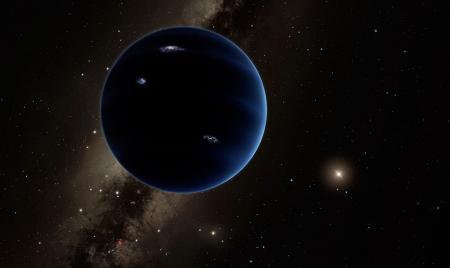
Artist's conception of 'Planet Nine' - predicted by Caltech astronomers

"Planet Nine" is the name given to the newest potential member of our solar system by astronomers at Caltech. Don't call it "Planet X", because to these guys - like Michael Brown (former 'slayer' of Pluto) it reeks of aliens and sci-fi.   Planet Nine then simply designates the recognition of the ninth actual planet belonging to the Sun's family - after Pluto was summarily ejected some 8 years ago for being a "dwarf".

Let's also get it into our heads Planet Nine has not been "discovered", as in actually training the Palomar telescope on a portion of the sky and seeing it. No, its existence has been inferred from the marvelous science of celestial mechanics, based on the gravitational effects detected on smaller objects in the Kuiper Belt - and from mathematical modeling techniques and computer simulations.

According to the Caltech site, the two scientists - Konstantin Batygin and Brown  describe their work in the current issue of the Astronomical Journal and show how Planet Nine helps explain a number of mysterious features of the field of icy objects and debris beyond Neptune known as the Kuiper Belt. Those who wish to access the actual paper can get the .pdf here:

http://iopscience.iop.org/article/10.3847/0004-6256/151/2/22/pdf

To say the paper is a work of stupendous scientific inference and deduction is an understatement. In fact, the current work didn't launch until after two earlier researchers (one a postdoc of Brown) noted that 13 of the most distant objects in the Kuiper Belt are similar with respect to an obscure orbital feature. To explain that similarity, they suggested the possible presence of a small planet. Brown's interest was piqued and he enlisted the help of Batygin - whereupon the two commenced a year and a half long collaboration.

The pair quickly found that the six most distant objects from the original collection of 13  all followed elliptical orbits that pointed in the same direction in physical space. That was particularly surprising because the outermost points of their orbits moved around the solar system, and they traveled at different rates.  According to Brown:

"It's almost like having six hands on a clock all moving at different rates, and when you happen to look up, they're all in exactly the same place,"

 The odds of that happening were something like 1 in 100, but on top of that, the orbits of the six objects were also all tilted in the same way—pointing about 30 degrees downward in the same direction relative to the plane of the eight known planets. The probability of that happening is about 0.007 percent. "Basically", Brown said, "it shouldn't be happening randomly. So we decided to look for something else shaping the orbits."

After a number of trials they noticed almost by accident that if they ran their simulations with a massive planet and an anti-aligned orbit (i.e. the orbit's perihelion is 180 degrees opposite the perihelions of all the other objects and planets) then the 6 distant Kuiper Belt objects assumed the alignment actually observed.

In other words, a massive planet (10 times Earth's mass) was needed in order to have alignments observed jibe with the data. It was somewhat like finding the piece to a puzzle which finally fits with the rest of the pieces.

Brown and Batygin estimate the planet takes from 10,000 to 20,000 years to make one orbit around the Sun. Using Kepler's harmonic law, e.g.
http://brane-space.blogspot.com/2011/09/tackling-intermediate-astronomy_10.html

 One can then work out the range for the semi-major axis. With a 10,000 year period it turns out to be 434 AU (astronomical units) and at 20,000 years it's 736 AU. Since Neptune is at about 40 AU, that makes Planet Nine up to almost 20 times more distant. From the nearer distance the Sun would appear in the sky as barely a 2nd magnitude star in brightness (about like Polaris). Needless to say the temperatures would be unthinkably frigid - think close to absolute zero Kelvin, or -273 C. With an order of magnitude greater mass than Earth a 200 lb. Earth astronaut would weigh in at nearly 290 lbs. there.

Now, it remains for someone to actually observe the planet (estimated at about +6.5 absolute magnitude) and maybe even lay claim to naming it. Once that actual observation occurs we will be able to finally say the planet has been "discovered". I'd try myself, but my eyesight simply isn't that great and my remaining telescope is only a 2.4" Tasco refractor - mainly used  to observe the occasional unusual astronomical event - like five of the planets (Mercury, Venus, Mars, Jupiter and Saturn) lined up in the morning sky right now.

Thursday, February 27, 2014

Kepler Finds 715 New Planets - Does It Mean A Greater Probability Of Life On Them? No


No photo description available.
Two representations of 603 exoplanets around Sun-like stars found up to the end of 2013. The data are plotted with planet radius (R) vs. orbital period in days - P (a), and against stellar irradiation flux (b) (From Physics Today, January)

The news that the Kepler telescope has found 715 new planets is now making the general media rounds, but many outlets seemed to have jumped the gun and extrapolated from these a "higher possibility of life being found". This isn't true at all. As I noted in a previous blog post, one of the most critical first objectives  - to assess for an "Earth-like planet",  is to obtain the periodicity or the time it takes the planet to circle its Sun. This is based on the fact that with the period, one can determine a planet's distance, i.e. from Kepler's 3rd law, see e.g.
http://brane-space.blogspot.com/2011/08/solution-to-simple-astronomy-problems-6.html

If then the period is too short,  a planet will be too close to its host star, never mind it may have the mass or radius of Earth. Then it can't really be called "Earth like" in the strict technical sense of actually being a place one could survive.  With those limitations in mind, Geoffrey Marcy of the University of California, Berkeley and Andrew Howard of University of Hawaii, last year reported an analysis of 603 planets (found via Kepler)  orbiting Sun-like stars, including with a few having periods longer than 300 days.

Bear in mind the Earth's orbital period is 365 days so any exoplanets with P > 300 days are of major interest since they could mark a genuine Earth-like planet, i.e. which could actually be colonized one day. This makes the Marcy-Howard research especially significant given they also corrected for observational biases and limitations, and restricted their searches to stars less than 3,000 light years away - with low photometric noise and Sun-like surface temperatures, or around 11,000 F.

But at the end of the analysis, a core of only one single planet of the 603 was adjudged to be in any way "livable". (Which still doesn't mean anything actually inhabits it)  This was identified within the small green inset box (from 10 plausible initial candidates) seen in the graph (b) at the right. (Plotting the radius vs. stellar irradiation flux.)  The candidate planet met the key criteria for in occurring in the vicinity of stellar flux  Fo = 1 and planetary radius R =1 (determining the acceleration of gravity g) .

 NASA on Wednesday announced the discovery of 715 new planets, but of these only four were designated as existing in any habitable zone.  The 715 planets were found to orbit 305 different stars, and were discovered by the Kepler space telescope using a new technique called "verification by multiplicity".  It relies in part on the logic of probability. Instead of searching blindly, the team focused on stars that the technique suggests are likely to have more than one planet in their orbit.

Let's examine briefly an assay of the planets thus far discovered. According to NASA, 95% of the planets discovered by Kepler are smaller than Neptune, which is four times as big as Earth. With such large radii, and likely accompanying density, none of them are plausible habitable worlds.

Meanwhile, one of the new planets is about twice the size of Earth and orbits a star half the size of Earth's sun in a 30-day cycle. This again eliminates it as being habitable based on the Kepler harmonic law. It would be too close to its parent star, hence too hot.  The other three planets in habitable zones also are all roughly twice the size of Earth, again likely making their gravity too great for any life to evolve.
Of course, more observations are needed, and planetary astronomers expect to find a higher percentage of new planets that could potentially have a life-supporting climate like Earth's.
But still, the best approach is not to get ahead of ourselves. While the more than 1,700 new planets discovered is exciting to be sure it doesn't mean that any of them harbor any life forms.  We have a plethora of planets, thanks to Kepler, but so far zero evidence for life on any of them.

Friday, August 5, 2011

Tackling Simple Astronomy Problems (6)


IN this instalment we examine a number of short answer questions of the type that were tested regularly by many of us during the CXC Astronomy course in the late 70s. Mostly, we used short answer format questions to obtain a quick grasp of the extent to which students mastered the principles and how well they could apply them.

As an example consider the appended diagram which shows an ellipse said to be representative of an asteroid orbit. The sketch shows a point P(x,y) on the orbit and also the two foci, f1 and f2. An example problem is to find the eccentricity (e) of the orbit, given only the information evident in the graph.

How to proceed?

First one must be aware of the assorted parameters for the ellipse. There are basically three: a (the semi-major axis), b (the semi-minor axis) and c, the distance between the foci or c = f1f2.

What is c, mathematically?

It is the square root of the difference between the semi-major axis squared, and the semi-minor axis squared:

c = (a^2 - b^2)^½

Note that when c = 0 we have a = b. (One constant fixed radius: e.g. r = a = b)

This means the figure is a perfect circle.

When, however, a > b then the shape alters to elliptical.

Again, in general, since the shape of an ellipse requires TWO descriptors, or parameters- one needs to know BOTH a and c to calculate the eccentricity, e, viz.:

e = c/ a = (a^2 - b^2)^½/ a


Solution:

Now, from the graph, one obtains a = 4 cm and b = 2.8 cm, so c = 2.85 cm. Then to obtain e:

e = (4^2 - (2.8)^2)^½/ 4 = 0.71, which is highly elliptical as an asteroid orbit would be.

Then, there is Kepler's Third Law of Planetary Motion' or 'The Harmonic law,' can be written out in terms of:

(P1/ P2)^2 = k(a1/ a2)^3

That is, the squares of the periods (P1, P2) of revolution of two planets (being compared) equal k times the cubes of their semi-major axes (a1, a2). The last is also known as the 'mean distance from the Sun'. Usually - to make things simpler- we adopt Earth values for P2 and a2, and convert the other planet's (that we wish to find) for P1 and a1. In the case of the (other) planet's distance, we therefore want to solve for a1.

In the original preparatory workshops I usually laid out the problem as follows:

We take P2 = 1 year (the period for Earth to make one revolution). We take a2 = 1 AU or astronomical unit (= 93 million miles). Then the equation simplifies to:

(P1/ 1 yr)^2 = k(a1/ 1 AU)^3

with k a constant of proportionality that can be set equal to 1. Or, on solving for a1 (and remembering the units used):

a1 = {[P1]^2}^1/3


Example Problem:

If for Mars, P1 = 687 days, find its mean distance from the Sun (note mean distance taken to be equal to the semi-major axis, a).

Solution:

First convert Mars' period P1 to years, given one Earth year = 365 days. Therefore: P1 = (687 d/ 365 d/yr) = 1.88 years.

Then, solving for a1:

a1 = {[1.88]^2}^1/3 = {3.53}^1/3 = 1.52

I left out units, but we understand that a1 is in AU so

a1 = 1.52 AU

This can also be converted into kilometers:

a1 (km) = 1.52 A.U. x (1.49 x 10^8 km/AU) =

2.26 x 10^8 km


Some Short Answer Problems:

1) A CXC student draws a sketch (Fig. 1) of what he asserts is an asteroid orbit. Using the graph shown, find:

a) the semi-major axis a

b) the semi-minor axis b

c) the eccentricity e.

2) Given the same student orbit sketch, if we let the dimensions be astronomical units (AU) instead of centimeters, then use the graph to estimate the period of the asteroid.

3) A solar system 100 light years from Earth has two planets, X and Y. Planet X has a period of 8 Earth years, and Planet Y has a distance from its Sun of 2.8 astronomical units.

a) Using Kepler’s 3rd law of planetary motion, find the distance of Planet X in astronomical units and kilometers.

b)Using the same law, find the PERIOD of Planet Y in Earth years.

4) Consider the table shown below, applied to circular satellite orbits around the Earth:

------------------------------------------------------------------------------
Distance from Center of Earth: 2 r --3 r ---3r/ 2 ---4 r ---5 r/2 --- 5 r
------------------------------------------------------------------------------
Acceleration of gravity--- ----g/4
------------------------------------------------------------------------------

Complete the Table above given that r = 6.4 x 10 ^6 m. Hence or otherwise, deduce the value of the acceleration of gravity g at distance 10r.

5) You are required to calculate the hour angle of the Sun (HA ☉) from a place with longitude 163 deg 14’ E. The observation is made at a standard time of 8:46 a.m. on March 10, the standard time being referred to the meridian of longitude 165 deg E. (The Equation of Time for the particular date is approximately E = - 10 min. Note that Equation of Time is just the difference (Apparent time – Mean time). If you need to refer to: Tackling Simple Astronomy Problems (1) )