
Not too many people, I warrant, would have been aware how close the financial markets came to perdition on March 16. They'd not have been aware of a "liquidity panic" in the municipal bond and commercial paper (money market funds) arenas or that the Choe Volatility Index - known as Wall Street's 'fear gauge' - closed at its highest level on record: 82.69. Nor would people - certainly not Janice or myself (with investments in money market funds) have been aware that on March 16 investors ceased to believe these funds were cash equivalents, i.e. liquid enough to function like checking accounts to help firms manage payroll, pay office leases and move cash to finance daily operations.
We didn't know any of this until the WSJ lead story, 'The Day The Markets Seized Up;, appeared on the front page on May 21. To be sure, the information and graphs shook us to our core, as they ought to have any American invested to any degree in the financial system. Basically, as the piece noted:
"Investors lost faith in Americas public infrastructure. As schools and universities shut down and airports and public transit services emptied out, the market began to question what had previously been considered gold-plated bets on the core institutions that make up community life in the country."
And so (ibid.):
"Terrified investors ditched municipal debt at fire sale prices, underwriters canceled billions of dollars worth of deals, and new borrowing stopped. There was less issuance in the week of March 16 than at any point since the 2008 financial crisis, or the 2001 terrorist attacks.... The liquidity panic quickly leaked into the stock market."
In other words, we came about this ( ) close to another credit freeze financial calamity. According to one money manager in an email to The Journal (ibid.):
"I don't think anyone has experienced anything more violent"
Perhaps the most important line in the whole piece appeared earlier on, in the continued discussion on page A10:
"A barrage of government programs has since pulled the system back from collapse."
Note, it pulled it back from collapse, but that doesn't mean the threat of collapse is expired. Not by a long shot. The reason is that the tight -fisted GOP Senate is not prepared to pass anything more, whether in financial infusions to the states, or more infusions of cash into citizens' pockets. They expect people to either get by going back to work (hardly possible for three quarters of workers as noted in the Denver Post (May 24) - given most jobs are now service-related and workers not able to even pay rent or get adequate food. We further have learned ('More Borrowers Fall Behind In Payments', May 21, p. B10):
"Millions of people are behind on their credit card and auto loan payments, the latest sign of pandemic financial devastation. Lenders in April had nearly 15 million credit cards in financial hardship programs."
And still, despite this havoc, there is no more money coming in for people, no thanks to the GOP's austerity hawks. This is risking yet another liquidity panic which will make the one on March 16 look like a walk in the park. Especially as people with no $$$ coming in are "tapping credit cards and auto loan at record levels." But...at some point that money has to be paid up or the credit-lending markets will themselves collapse, with ordinary citizens' bank accounts.
Other bad news emerged in the WSJ piece, 'Workers Face A Long Road Back To Normal', May 9-10, p. B14, noting how the climb back to normal will be "slow and painful". Indeed, subsequent WSJ articles have pointedly noted how many millions of workers currently furloughed will not get hired back. That means they cannot contribute to purchasing goods or services, i.e. to aggregate demand. Aggregate demand is composed of two parts: 1) demand generated by consumers for goods and services, and 2) the demand for investment goods. When the level of aggregate demand is high, both these components are generally equally high, and the levels of production and employment are high. On the other hand, when aggregate demand is low - or even one of the components (e.g. (1)) is very low, then levels of production plummet.
'Powell Urges Policy Makers To Spend More' (WSJ, April 30, p. A2) showed the Fed Chairman Jay Powell is terrified of another liquidity crisis erupting. He likely suspects it will be triggered by a massive drop in aggregate demand, especially consumer spending which supports 70 percent of GDP. But with no more cash infusion, how can ordinary (not rich) citizens contribute? How can an economy based mostly on ordinary consumption thrive? Well, it can't! People can't just live on air! That includes state employees, local government workers. We know, for example ('State, Local Budget Woes Threaten Recovery', WSJ, p. A2 today):
"When those (state) workers are laid off they have to cut back on spending. That reduces the income of others in the economy, which amplifies the initial cut."
This, according to Gabriel Chodorow-Reich, an economist at Harvard University who estimates that "every dollar in cuts cost the overall economy $1.50 to $2.00." Hence, the imperative of a badly needed cash infusion to the states.
As I made clear in my May 4 post, we desperately need not just a $1, 200 one off payment to each American, but a universal basic income (UBI) of at least $2,000/ month for the next 6 months. (As policy analyst Heather McGee noted on 'All In' last week). So despite the caterwauling and gaslighting from the Repukes, it is clear we need a massive infusion of at least $800 b to help the states, and possibly another $2 trillion more by the end of the fiscal year. This despite the endless austerity whining of the likes of The Wall Street Journal (e.g. 'The Government Economy', April 30, p. A14) who bellyache the states "contributed only 0.2% to the CARES Act". Well, duh! That's because THEY took the brunt of the lockdown hit ("economy put into the equivalent of a medical coma"), and also they have laws that require balanced budgets - so must cut if spending exceeds a certain threshold. Also they have no latitude to print money like the Federal Reserve.
But this is the gist of the Republican penny-pinching strategy which - if it succeeds - will see the U.S. end up in a 2nd Great Depression, not just a bad recession. In fact, while the austerity -minded Repubs have resisted calls for additional funding, citing added debt burdens, Jay Powell pointed out (ibid.):
"This is not the time to act on these concerns. This is the time to use the great fiscal power of the United States to get through this with as little damage to the longer run productive capacity of the economy as possible."
As I wrote in my May 4 post:
"It's incredible that a Scrooge like Mitch McConnell don't grasp this, and would rather put us into another Depression but there it is. They would rather be chintzy now - especially with the states, local governments- and pay ten to fifty times later to dig out from the carnage. Which is why it's good we didn't have these losers in power after the credit meltdown in 2008."
Incredibly, the WSJ's op -ed writers- like Phil Gramm and Michael Solon- continue to peddle their rubbish that no more money is needed, e.g. ('More Stimulus Would Crush The Recovery', WSJ, April 15, p. 17) .
What is their solution? It's "rely on private capital and initiative and our free enterprise system". In other words, let the loafers waiting for new handouts get off their butts and figure out - using "initiative" - ways to enhance their cash flow without depending on gov't handouts. Else, "all this new government borrowing will consume the very oxygen a powerful recovery will need,"
Not to be outdone, WSJ op-ed contributor John Cochrane offered up this gem ( 'How to Treat the Financial Symptoms of COVID-19') .just over a month ago:
"Loans are better than gifts. Rather than give each of us $1,000, allow us to borrow a fraction of last year's income from the Internal Revenue Service and repay it when we file our taxes."
Fortunately, the Senate at the time had the sense it was born with and didn't pay attention to this nonsense. It delivered the CARES Act with a $1,200 cash infusion for each person- no strings, no owing anyone- or begging 'forgiveness' for loans to be repaid in huge lump sums. Just as well given even with that infusion and the extra unemployment ($600/week) some "840,000 personal loans were in deferment or some other type of financial hardship program in April" - according to the May 21 WSJ piece on more borrowers falling behind. So good to know cockeyed loans schemes like Cochrane's didn't add even more hardship borrowers.
The answer then is clearly not loans, or asking for "forgiveness" for such, nor raiding Social Security in a payroll tax cut, or any of the other dumb right wing solutions proffered - usually in the editorial pages of the Wall Street Journal. But that's not to say all the offerings were drivel. Standing out for its sanity and reason was William Galston's May 19 piece 'Heed Powell's Call For Fiscal Stimulus', e.g.
https://www.wsj.com/articles/heed-powells-call-for-fiscal-stimulus-11589927206
Galston makes a compelling case for more 'no strings' cash infusions, echoing Jay Powell's call for more fiscal support for citizens and small businesses alike given that:
"demand will remain depressed and unemployment elevated well into 2021. Many households will struggle to pay for food, shelter and medical care. And many small businesses will shut their doors permanently."
And what is the GOP's and Trump administration's brilliant response? Well, it's to "adopt a wait and see stance". But see citizens without money can't "wait and see" about their next meals or keeping a roof over their heads. They need the money now, and as Galston points out "even delay isn't cost free"
As I wrote before, the hesitation in coughing up more money is largely due to the GOP's anti -statism posture. They simply don't believe the government should be "doling out" free money "at taxpayers' expense". Never mind those suffering and waiting in bread lines ARE taxpayers, last time I checked. But the conservos want limits. They want set dates after which they don't give any more money, not one cent. As one WSJ editorial ('The Fiscal Stimulus Panic', p. A16, March 18) howled:
"The checks no doubt will be popular....but they won't come cheap, running at a cost of hundreds of billions of dollars for the first round. What happens if the pandemic lasts into the summer? The clamor will be for another round and then another."
:
And then the "clamor" must be met, but which I tend to think of more in terms of need. But for the WSJ editors and their stable of tightwad hacks, it's the clamor for more money that must be quashed. The Reepos in the Senate then channel these austerity messages and act in kind. Hence the latest twist ('Republicans Seek Alternatives To Jobless Benefits', WSJ, p. A4) where we learn the GOP savants want the increased unemployment benefits cut out ("it's making too many reluctant to return to work") and instead replaced with a 'stipend' paying $150 less. This the brainchild of Sen. Rob Portman of Wisconsin.
Meanwhile, workers across the board are struggling to make ends meet, and pay their just debts. Lenders, credit sources are also being squeezed given the CARES Act "allowed homeowners to suspend mortgage payments for up to a year, but provided no way to pay for this." (WSJ, p. A1 today) Thus saddling lenders with the burden and setting the stage for a ginormous credit crunch. To fix ideas - and perspectives (ibid.): "As of last week 4.5 million households had filed:" for such suspensions, "representing about $1.04 trillion of unpaid principal" - according to Black Night. Meanwhile, "markets froze for s-called jumbo loans" which are too large for gov't baking. (Jumbo loans would be theoretically allowed should homeowners need to pay back a year's worth of mortgage payments at once.)
Well, if there is another depression you know who to blame, given just the "unintended consequences" of what could happen in the mortgage-lending market. . Clue one: think of an elephant.
See Also:
by P.M. Carpenter | May 22, 2020 - 7:07am | permalink

And:
"Loans are better than gifts. Rather than give each of us $1,000, allow us to borrow a fraction of last year's income from the Internal Revenue Service and repay it when we file our taxes."
Fortunately, the Senate at the time had the sense it was born with and didn't pay attention to this nonsense. It delivered the CARES Act with a $1,200 cash infusion for each person- no strings, no owing anyone- or begging 'forgiveness' for loans to be repaid in huge lump sums. Just as well given even with that infusion and the extra unemployment ($600/week) some "840,000 personal loans were in deferment or some other type of financial hardship program in April" - according to the May 21 WSJ piece on more borrowers falling behind. So good to know cockeyed loans schemes like Cochrane's didn't add even more hardship borrowers.
The answer then is clearly not loans, or asking for "forgiveness" for such, nor raiding Social Security in a payroll tax cut, or any of the other dumb right wing solutions proffered - usually in the editorial pages of the Wall Street Journal. But that's not to say all the offerings were drivel. Standing out for its sanity and reason was William Galston's May 19 piece 'Heed Powell's Call For Fiscal Stimulus', e.g.
https://www.wsj.com/articles/heed-powells-call-for-fiscal-stimulus-11589927206
Galston makes a compelling case for more 'no strings' cash infusions, echoing Jay Powell's call for more fiscal support for citizens and small businesses alike given that:
"demand will remain depressed and unemployment elevated well into 2021. Many households will struggle to pay for food, shelter and medical care. And many small businesses will shut their doors permanently."
And what is the GOP's and Trump administration's brilliant response? Well, it's to "adopt a wait and see stance". But see citizens without money can't "wait and see" about their next meals or keeping a roof over their heads. They need the money now, and as Galston points out "even delay isn't cost free"
As I wrote before, the hesitation in coughing up more money is largely due to the GOP's anti -statism posture. They simply don't believe the government should be "doling out" free money "at taxpayers' expense". Never mind those suffering and waiting in bread lines ARE taxpayers, last time I checked. But the conservos want limits. They want set dates after which they don't give any more money, not one cent. As one WSJ editorial ('The Fiscal Stimulus Panic', p. A16, March 18) howled:
"The checks no doubt will be popular....but they won't come cheap, running at a cost of hundreds of billions of dollars for the first round. What happens if the pandemic lasts into the summer? The clamor will be for another round and then another."
:
And then the "clamor" must be met, but which I tend to think of more in terms of need. But for the WSJ editors and their stable of tightwad hacks, it's the clamor for more money that must be quashed. The Reepos in the Senate then channel these austerity messages and act in kind. Hence the latest twist ('Republicans Seek Alternatives To Jobless Benefits', WSJ, p. A4) where we learn the GOP savants want the increased unemployment benefits cut out ("it's making too many reluctant to return to work") and instead replaced with a 'stipend' paying $150 less. This the brainchild of Sen. Rob Portman of Wisconsin.
Meanwhile, workers across the board are struggling to make ends meet, and pay their just debts. Lenders, credit sources are also being squeezed given the CARES Act "allowed homeowners to suspend mortgage payments for up to a year, but provided no way to pay for this." (WSJ, p. A1 today) Thus saddling lenders with the burden and setting the stage for a ginormous credit crunch. To fix ideas - and perspectives (ibid.): "As of last week 4.5 million households had filed:" for such suspensions, "representing about $1.04 trillion of unpaid principal" - according to Black Night. Meanwhile, "markets froze for s-called jumbo loans" which are too large for gov't baking. (Jumbo loans would be theoretically allowed should homeowners need to pay back a year's worth of mortgage payments at once.)
Well, if there is another depression you know who to blame, given just the "unintended consequences" of what could happen in the mortgage-lending market. . Clue one: think of an elephant.
See Also:
by P.M. Carpenter | May 22, 2020 - 7:07am | permalink

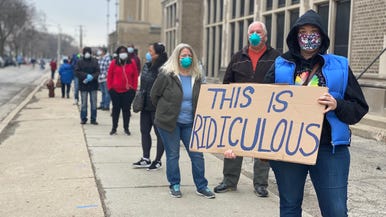 Voters in my hometown of Milwaukee - waiting to vote while the nation is in the grip of a pandemic. All the Repukes who ordered this atrocity ought to be hung, drawn and quartered. Then the parts tossed into a bonfire.