

''Why My Generation Is Turning To Financial Nihilism"(WSJ, Dec. 20-21, p. C1) by Gen Z'er Kyla Scanlon, explains a lot about why her generation is turning to desperate financial gambles to try to survive. Especially in Dotard's AI- bubbling, crypto-addicted, tariff torn economy. As she explains the term in her header in the lead paragraph:
"My generation is accused of treating finance like a game. We trade options, buy meme coins, play prediction markets, venture into crypto and bet on sports as if the entire economy was a casino.
But what seems like recklessness to parents and grandparents is actually a form of financial adaptation. It's known as financial nihilism, a term coined by Demetri Kofinas several years ago. It describes an economic system that no longer rewards prudence or long term planning."
She wastes no time getting down to specifics:
"For many young people education has become a liability. Student loan debt now totals $1.6 trillion, according to the New York Federal Reserve. Even the college wage premium has slipped...falling to about 75% of what it was in 2023. This has happened even as the cost of college has climbed by roughly 40% over the same period. Early career roles have eroded too.
Entry level jobs have thinned out due to automation and cost pressures, with only 35 percent of 2025 college graduates able to find entry level jobs - a dropoff of 11 percent since 2024. And then there is homeownership. Only about 32% of 27 year olds owned a home in 2024."
This last data point was also reinforced in a separate Dec. 23rd WaPo article ('Abandoning homeownership may be changing how people behave at work and home' by Julie Weil, asking: What happens when a generation gives up on ever owning a home?
Weil writes:
"With home affordability increasingly out of reach, many young adults are making choices that are reshaping the economy — and mostly for the worse — a new research paper says. They don’t think they’ll ever be homeowners. So they stop trying, and focus on the here and now.
That’s the interpretation put forth by economists Seung Hyeong
Lee and Younggeun Yoo — doctoral candidates at Northwestern University and the
University of Chicago, respectively — who built a mathematical model of
consumer behavior. When people conclude they will never be able to afford a
home, they put less effort into their jobs, tend to spend more on luxuries and
do less long-term saving, and are more likely to invest in riskier assets such
as cryptocurrencies, the economists’ findings suggested."
The outcome? Those affected just give up. No surprise the authors posted "Giving Up,” a draft of which they posted online last month.
Kyla Scanlon, in her WSJ piece, delves into a lot of the financial futility of the young and also the "reckless reactions" e.g.
"Crypto, prediction markets and online betting have rapidly expanded among younger adults because they offer the immediacy of outsized gains, something the S&P 500 can't always do."
Scanlon, alas, is not aware that a cosseted minority has access to vastly superior investment opportunities - and has accrued enormous wealth from them (see e.g. 'Inside the Stock Market For The Wealthy (It's Invitation Only)'. WSJ. Business Exchange, Dec. 13-14, p. B1). As noted in the piece:
"For most Americans, the universe of stocks they can invest in is rapidly shrinking. The number of public companies in the U.S. is half its peak from the late 1990s. This is not a problem for the rich. The ultra wealthy are able to buy and sell shares at the buzziest private companies via invitation-only transactions long before their shares are listed on public stock exchanges.
That has created a two-tier market where a privileged group can obtain shares of companies still in their early growth stages. Everyone else is left with older, slower growing names. The dynamic is exacerbating the wealth disparity in the U.S. as the growth in the net worth of the richest Americans is far outpacing all other income groups."
And those other income groups being outpaced include Scanlon's Gen Z lot, now forced to engage in risky practices like crypto, sports betting, and prediction markets to try and just break even. As she emphasizes:
"The mistake is in assuming young people want chaos. They don't...They are engaging in these risky activities in an attempt to find personal agency in a system that's increasingly denied to."
Thus, with no access to the high profile, invitation -only stocks, or multi-millions in inheritance, or the benefits of legacy college attendance, they congregate in digital commons like Reddit and Discord to find answers. And who can blame them, given the costs of food, housing and health have all been rising faster than the incomes of most working Americans - especially the Gen Z cohort. Add in the mounting costs of education in overdue student loans i.e.
Student Loan Borrowers in Default Could See Wages Garnished in Early 2026
And one can see why the young tilt to financial nihilism. Which turns out to be the sole rational option for agency and potential financial benefits, given all others have been foreclosed. So let's not bark outrage at our younger citizens but hope they also see how and why the nation's economic system mutated so harshly against them. A topic I cover in Chapter 6 ('The Market Corporatocracy') in my 2011 book, The Elements of the Corporatocracy.
See Also:

“The only thing wrong with the U.S. economy is the failure of the Republican Party to play Santa Claus.”
—Jude Wanniski, March 6, 1976
The Washington Post published an article this week titled A Middle-Class Family’s Only Option: A $43,000 Health Insurance Premium about how the GOP’s refusal to extend ACA/Obamacare subsidies means that Stacy Newton’s family in Jackson Hole, Wyoming will have to pay $43,000 a year for health insurance if they want to stay covered.
If, however, the United States had an extra trillion dollars a year — the amount we’re now spending every year on interest payments against the GOP’s $38 trillion national debt — the Newtons would only pay a few hundred dollars a month and we could also have Universal Childcare & Pre-K, Paid Family & Medical Leave, Tuition-Free College, Affordable Housing & No More Homelessness, End Child Poverty & Hunger, and, as mentioned, Affordable Healthcare for all Americans.

Yesterday, both Trump and his Secretary of Housing and Urban Development told us that 50-year home mortgages may soon be a thing. While seemingly insane (you could end up paying more than three times the cost of the house and never escape the burden of debt before you die), this is just the latest iteration of one of American businesses’ most profitable scams: the rental economy.
It’s a growing threat to the American middle class that rarely gets named, even as it reshapes our lives every day. Over the past two decades, it’s snuck in quietly, disguised as convenience, efficiency, and “innovation.”
As a result, nothing is “ours” any more. Instead, we’re renting our lives away.
There was a time when you bought things.
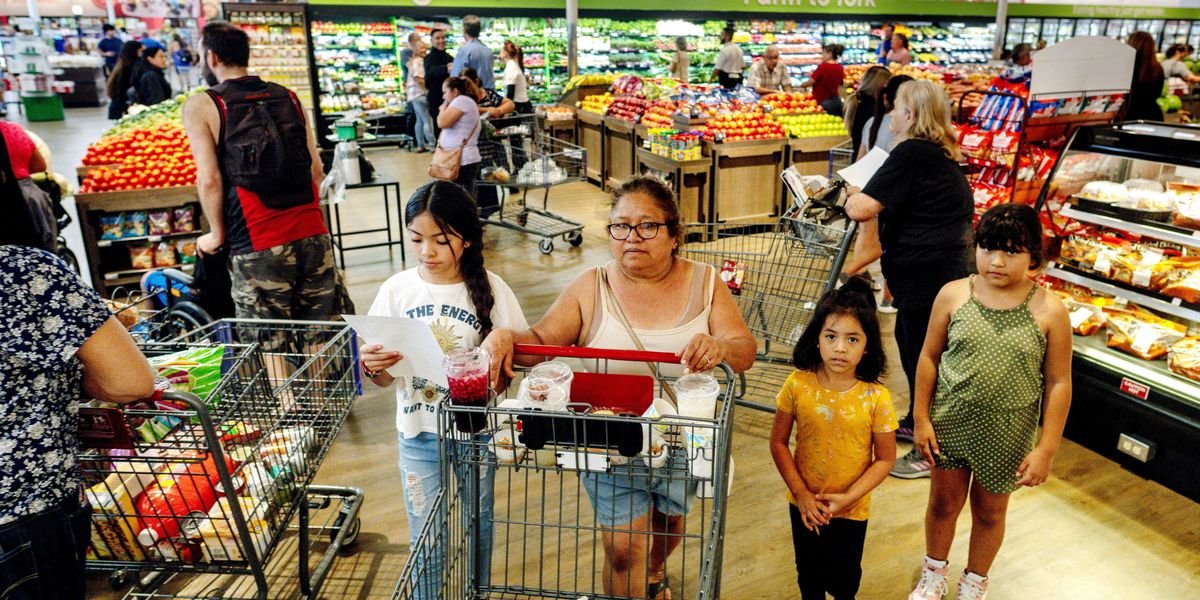
Somewhere, a mom taps through her grocery app while waiting in the school pickup line, purchasing a box of Wheat Thins for $5.99. Across town, someone else scrolls through the same grocery app and adds the exact same box of Wheat Thins to their cart. For them, the crackers ring up at $6.99. It is the same item, from the same store, at the same time, but one unlucky shopper is stuck paying a higher price. Neither shopper has any idea this pricing game is even being played.
This is not a hypothetical scenario. Increasingly, it’s happening all over the country. Right now, grocery delivery app Instacart is conducting large-scale, hidden pricing experiments on unsuspecting shoppers to determine just how much money they can extract from customers on the groceries they buy to feed their families.
How do we know? Our team at Groundwork Collaborative had a feeling Instacart might be experimenting on shoppers, so we decided to run an experiment on them. Alongside our partners at Consumer Reports and More Perfect Union, we recruited over 400 volunteer secret shoppers to shop for the same basket of 20 items at the same grocery store at the same time. We ran the experiment in four different stores across the country.

No comments:
Post a Comment