Pope Francis - soon after ascent to papacy
Predictably Pope Francis' death April 21, has resulted in numerous media appeals for his successor - whomever that might be - to return to "doctrine'. We can start with the Friday May 1 WSJ column ('What the Church Needs in the Next Pope', p. A13) by Archbishop Emeritus Charles J. Chaput, who insists:
"Francis papacy...was more process than substance and reopened debates from the Second Vatican Council (1962-65) that had been addressed and settled by previous pontificates. The unintended but corrosive result is the spirit of fracture that now infects millions of otherwise faithful Catholics. Internal conflict is the menu of the day. This is the legacy that the cardinal -electors of the next pope urgently need to address.
They must attempt to restore clear teaching - to build on the good Francis accomplished- while purging the confusing, incoherent and bad."
And what, pray tell, constitutes the "confusing, incoherent and bad". It's not hard to find so we can look at a couple examples. None of which, I will argue, need to be "purged."
As a point of entry we can reference an earlier WSJ column (Pope Francis' Legacy of Question Marks', April 22, p. A15) by Francis X. Maier who wrote:
"Confusion on matters of doctrine is lethal for a creedal community like the Church."
So let's begin by noting Maier's' unmentioned violation of his 'creeds' which have caused so much consternation among the Church's conservatives. I referenced one in my earlier post after Francis death. Therein I noted a homily Francis delivered in December, 2013 at the Chapel of the Domus Santa Marta speaking thusly:
"The Lord has redeemed all of us, all of us, with the Blood of Christ: all of us, not just Catholics. Everyone! 'Father, the atheists?' Even the atheists. Everyone! And this Blood makes us children of God of the first class. We are created children in the likeness of God and the Blood of Christ has redeemed us all. And we all have a duty to do good. And this commandment for everyone to do good, I think, is a beautiful path towards peace.
If we are each doing our own part, if we do good to others, if we meet there, doing good, and we go slowly, gently, little by little, we will make that culture of encounter: We need that so much. We must meet one another doing good. 'But I don't believe, Father, I am an atheist!' But do good: We will meet one another there."
Headlines across the world immediately proclaimed, "Even Atheists Can Go To Heaven.".
And the conservo cardinals, especially the recently retired Ratzinger, went batshit nuts. No Hell for atheists? What is wrong with this guy? Of course atheists must go to Hell! Comedian Bill Maher on his 'Real Time' show opined the new Pope "is really an atheist". But he missed the point.
That is, the Pope was really referencing an ancient teaching from the time of Origen of Adamantius, i.e. of being a Universalist or embracing the potential of 'Universal Salvation' . I had my first encounter with this teaching during a debate with an Anglican priest in 1982. But in truth one needn't go to historical teachings at all to dismiss the fantasy notion of a Hell. I have already done this in previous blog posts, e.g.
Indeed, on being invited to attend one Catholic students seminar at the University of Alaska-Fairbanks in February, 1986 - while doing a research assistantship in Space Physics- I interjected similar questions. When discussions turned to the afterlife and punishments, I asked the gathering of mainly freshmen and sophomore UAF students:
"Okay
if God is infinite, how can there be a Hell? Wouldn’t Hell have to be a part of
God?
If not, then how can God be
infinite if there is a place-abode (“Hell”), even supernatural, He isn’t?"
To which their heads nearly exploded, some crying and pleading to the priest in charge to "correct this heretic". But he merely calmed them down and answered:
“I
believe your concept of God is the same as mine, the All. The One.”
This is basically what the fuss is about. The chance that Francis' homily remark might neutralize or deflate the Church's final card to keep its minions in check: Hell. But if there is only one reality, ultimately, one universal mind -if you will - then clearly whatever exists now on the material plane must be subsumed into it.
More to the point, some years after Francis' homily, RC fossils really went ballistic after he himself rejected the very notion of "Hell", e.g.
Brane Space: Pope Denies Existence Of "Hell" - Why The Big Fuss?
Now, in the interest of honest and full disclosure, let me say again: I do not believe there is any "heaven" or "hell". We each create our own heavens and hells on this Earth, in the here and now. Basically "salvation" is accomplished on one's own terms to redeem his or her life here on Earth to become the best human he can be...with the resources allotted him over a finite time. In other words, there is no hereafter of the kind the orthodox religious types - including Catholics - believe.
Once the Hell bogey is punctured, none of the other RC doctrinal obsessions amount to a hill of beans. That leads us to the next bugbear, first mentioned by Francis X. Rocca in a WSJ column 9 years ago:
"What has changed since 1968? Pope Francis has laid
increased emphasis on the role of an individual’s conscience in discerning
factors that mitigate culpability in particular circumstances."
This specifically referred to Francis' relaxing standards for artificial birth control during the Zika virus plague in Brazil and Africa. To fix ideas, Pope Francis suggested that artificial contraception "may be morally acceptable to avoid spreading the Zika virus." He opened the doctrinal 'door' just a tad, and in the process killed the absolutist basis for the idiotic proscription against using any artificial birth control. Since a 'mortal sin' and "Hell" eternal punishment was visited upon violators, he ditched them as well. Again!
We needn't get into all the particulars of why the birth control doctrine was bogus, but suffice it to say, it relied on the antiquated bunkum known as "natural law'.
As
a matter of theological record the anti-artificial birth control dogma was
based on "natural law". The problem is that there is no genuine
theological or other (scientific) basis for this antiquated belief, given it rests entirely on reducing human sexuality to the state of lower
animals- with their "natural" reproductive cycles.
But it ignores that, unlike the lower animals, humans have the intellectual
capacity and sense of novelty to introduce a vast variety of pleasure-play into
their sex relations - none of which require conception. Thus humans aren't
yoked to primitive instincts to simply mount and hump at specific
times. As observed by Biologist Elizabeth A. Daugherty, ( in Contraception and Holiness, pp. 96-97):
"Humans are free from physiologically determined sexual desires so
we possess a more or less permanent sexuality from adolescence to old age."
So this lays waste to the whole natural law moral underpinning, which is more
subjective moralism. This is tied to an emotional reaction to an act, or behavior, rather than any objective measure or index. As
Ethics professor Cheryl Mendelson has pointed out ('The Good Life',
p. 157), this mindset:
"confuses
the disgusting with the wrong and retains an infantile fear of things sexual.
Its rationality is overcome by emotion, fantasy, wish and projection,"
And as I wrote in an earlier post:
"Recall the Church once believed it "natural" that some men be enslaved because they were “unable to manage their own affairs” (ibid.). So why be surprised when the same Church seeks to ordain all her members abide by a sexuality more fitting of lower primates? "
So in the end, natural law is another 'macguffin' like Hell. Indeed, all the various doctrines fall like a house of cards, because that is what they are. If one more or less serious doctrinal canard is punctured, they all are. And lest we forget, the RC Church lost whatever moral credibility it had once the sexual abuse scandal erupted and the two popes preceding Francis (John Paul II and Benedict) sought to conceal the extent.
What Catholics need then, is for the successor to Francis to continue along the path he's set, diminishing the import of rules and doctrines, in favor of reflecting on and embracing the actual values Yeshua demonstrated.
See Also:
And:
And:
And:
And:
And:
by Alex Henderson | May 4, 2025 - 5:36am | permalink— from Alternet
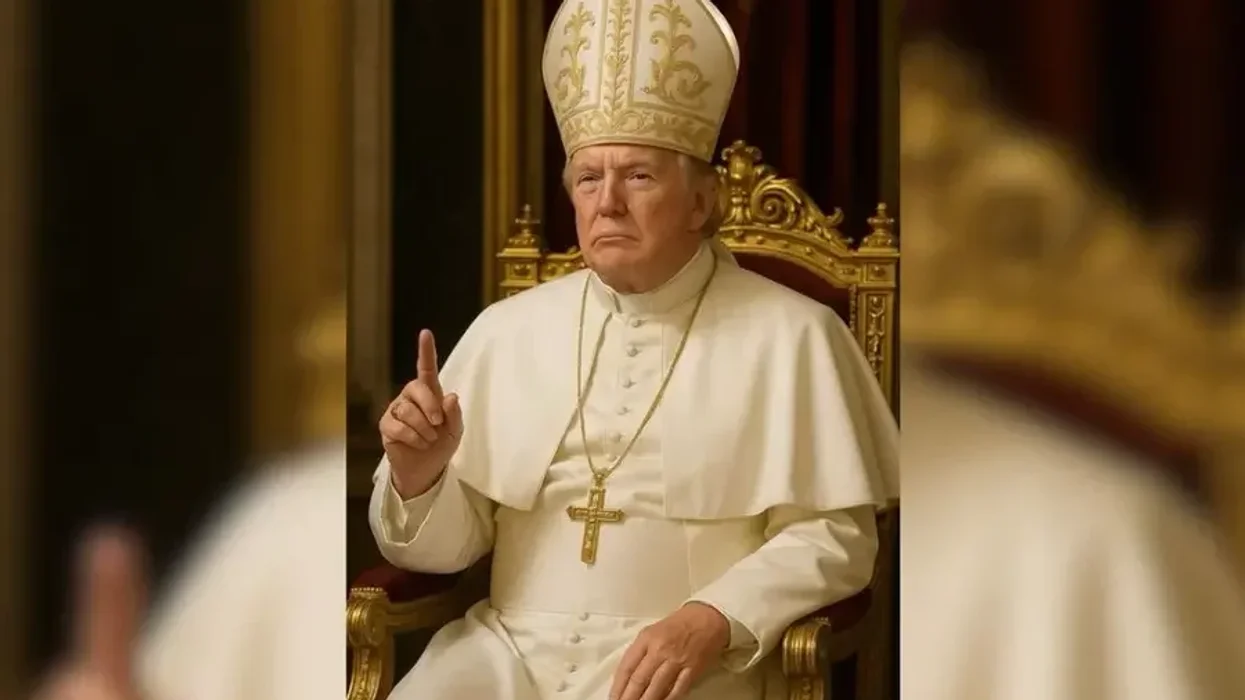
Following the death of 88-year-old Pope Francis, the Vatican is considering its possibilities for a successor. President Donald Trump, on Tuesday, April 29, joked that his "number one choice" for the Catholic Church's next pope is himself.
Later that day on X, formerly Twitter, Sen. Lindsey Graham (R-South Carolina) humorously posted, "I was excited to hear that President Trump is open to the idea of being the next Pope. This would truly be a dark horse candidate, but I would ask the papal conclave and Catholic faithful to keep an open mind about this possibility!"
Although Trump and Graham were joking, some MAGA Republicans are taking the idea seriously. Trump, however, isn't Catholic; he is a Mainline Protestant who was raised Presbyterian in Queens.
MSNBC's Ali Velshi examined the "Trump for Pope" campaign in a Saturday, May 3 commentary, laying out some reasons why he finds the idea ridiculous.


