Showing posts with label internal energy. Show all posts

Friday, March 9, 2018

Perhaps The Strangest Supernova: One That Re-Explodes

Image result for luminosity graph of iPTF14hls supernova
Light curve for the exploding star designated iPTF14hls (yellow) and the light curve (blue) for a normal  Type II supernova.

Imagine an astrophysics class and the lecturer asks: "What could possibly be the strangest supernova you can imagine?"   One student might actually chirp up: "Well, one which explodes and then leaves two cores behind, one forming a neutron star, the other a black hole."

Of course, such a scenario is preposterous because it ignores all the fundamentals of stellar physics and stellar evolution. To wit, collapsing stars in the throes of a supernova never leave behind two cores, only one. It's either a neutron star or black hole, not both. But one answer that might be deemed equally implausible is that of a collapsing stat that re-explodes, never reaching the climax/

This acknowledges that a normal supernova - or exploding star - is a one off event. The star explodes, it's dead, it's done, finito. The layers ejected from the event then also cool and expand, leading to a "supernova nebula" such as the Crab Nebula, e.g.

The Crab Nebula

This was the result of a supernova explosion observed in 1054 A.D. and which left behind a highly compact neutron star or pulsar.

But in the actual case of the star  iPTF14hls, there is no definitive ending explosion, say leading to either a neutron star of black hole. In the word of astrophysicist Iair Arcavi:

"A supernova is supposed to be a one time thing - the star explodes, it's dead, it's done. This is the weirdest supernova we've ever seen ...it's like the star that keeps on dying."

The star was discovered in September, 2014 at Mt. Palomar Observatory and at the time it looked like a typical Type II supernova in a galaxy 500 million light years distant.   Typical type II origin stars reach masses up to 50 times that of the Sun, and glow for 100 days before starting to dim. The first sign that iPTF14hls was unusual came a few months after its discovery, when it started growing brighter. This turned out to be one of five irregular cycles of brightening and dimming.

Stranger yet, data collected from Sept., 2014 through June, 2016, show that the supernova remained bright for more than 600 days.  By December of 2017 the eruption just showed signs of winding down.  Normally, layers of gas ejected from a star in the throes of a supernova slow and cool as they expand. But iPTF14hls maintained a high temperature between 4700 and 5700 Celsius for the entire time it was observed. Moreover, its outer layers didn't slow down as they should have.
Related image
The artist's sketch above depicts the normal sequence of events for this type of supernova.

What about theories to account for the anomalous behavior of this supernova?  Well, at least one suggests that those stars with masses in the range:

        95 Ms       <     130    Ms

where Ms   denotes "solar mass",  can explode several times in succession. (Though these types of cyclic star deaths have never been seen before).   The basic idea behind such models is rooted in the basic equations governing stellar structure, e.g.

The binding or total energy of a star ET is:

  ET  = K + V  = GM2/ 2R  + (- GM2/ R) = - GM2/ 2R

where G is the Newtonian gravitational constant, M is the stellar mass and R is the radius. V is the potential energy and K the gas kinetic energy.

But:  W=  - GM2/ 2R    so: K =   -W/ 2 

And:    ET  =  W/ 2 = -K   (or K  =   -  W/ 2)  

Thus, the total energy of a star is negative and equal to half the gravitational potential energy or the negative of the gas kinetic energy.

Now, internal energy U also factors in:

U = P/ (g   - 1) r 

where  r   is the density of the stellar material, P the pressure and   g  the ratio of specific heats.  Further, we can write:

3 ò (P/r) dm = 3 ò U (5/3   - 1) dm = 2 K =   2 ( -  W/ 2 )   =   -  W


 Basically then, in the case of a potentially collapsing stellar mass,  we need the internal energy U to be large enough to counterbalance the negative of gravitational potential energy:  - W=  GM2/ 2R .   We suspect the internal energy arises from a heating effect whereby gamma rays are converted into electrons and their antimatter counterpart, positrons, e.g.

g     ->   e-  +    e+


Without sufficient internal energy the core collapses and gets hotter. This vastly additional heat would then trigger a partial explosion in which the star blows off a large amount of gas.  But....after the explosion - lo and behold - the electrons and positrons recombine into gamma rays, e.g.

e-  +    e+    - >   g 

This also generates internal energy and helps to prevent the remaining stellar core from collapse.  This cycling reaction, we believe, enables the star to blow off mass several times before finally ending in a supernova flash.   Ultimately, given the initial mass (see the mass range provided earlier for iPTF14hls)  the remnant core from such a supernova would collapse to a black hole of mass   40  Ms.


The problem with the above theory, neat as it appears, is that it also predicts the star will expend all its hydrogen in the first explosion.  That doesn't comport with iPTF14hls which expelled an equivalent hydrogen mass of   50  Ms   in  2014.  (The amount of energy released in the most recent explosion is also greater than it should be).

Even more mysterious?  Palomar Observatory photographic plates show yet another birght burst from the same part of the sky in 1954.  This indicates a star that's exploded multiple times over a more than 50 year period.  

 "Zombie" star? Maybe this is one that merits the name.. Strange? You bet.

Thursday, November 30, 2017

Selected Questions-Answers From All Experts Astronomy Forum (Cold Space and Cold Fusion?)

Question -
Dear Sir, A young person told me that the Sun was cold, hence cold fusion.
Reason: the higher up the mountain you go the colder it is. Space is cold,
it is the microwaves from the Sun that excite the atmosphere and hence
make us warm. I am a Civil and Mechanical engineer but this stumped me.
Please help.


Answer -

Your young person has misinformed you re: the Sun. It is assuredly not "cold" with

a surface temperature of 6,000 C (11,000 F) and a core temperature of 15
million Celsius.  Given the latter, you can see that fusion in the Sun's core
is not "cold" but extremely hot.

Indeed the temperature of  15 million C is needed in order to achieve the fusion of
hydrogen nuclei into helium., the net effective reaction being:

H1 + H1 + H1 + H1  ->  He4


Regarding colder temperatures with altitude, this has everything to do with
the density of oxygen, nitrogen (e.g. air) molecules decreasing.  Hence,
the higher one goes up a mountain the fewer molecules (matter) there are
to absorb heat- or retain it.

What we call 'heat'  (internal energy) is really energy associated with the motion
of molecules in a medium.  The graphic shown below illustrates the relation of

heat energy to kinetic or motion energy in a gas contained within a cylinder. The
cylinder has a solid bottom at one end and a moveable piston at the other..


In this case the heat imparted by the Bunsen burner causes the molecules in the gas to move more rapidly - colliding with each other and causing the piston to move upward -expanding the gas volume. This changes the volume of the gas from V1 to V2 where V2 > V1.

Space is "cold" because there are so very few molecules of matter in it, being nearly a perfect vacuum.  The presence of so few molecules means very few collisions and little available internal energy.  Hence,  even if you try to heat a volume of space there will be little detectable difference.

Regarding the Sun, it radiates at all wavelengths of the electromagnetic spectrum - not just microwaves.

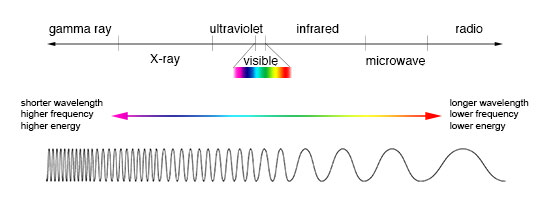
If you study the diagram of the EM spectrum below you will see that microwaves form only a relatively small region:
Illustration showing comparison between wavelength, frequency and energy

These are associated with longer wavelength EM radiation, as are radio waves. The
shorter wavelengths (to the left) include what we call the "visible" band - as well as
ultraviolet, x-ray and gamma ray.

The Sun actually shines with its maximum radiation emitted at about
5500 Angstroms (550 nm)   - or in yellow light. It radiates at all wavelengths
but has the maximum at that band. This is depicted below:
Image result for solar radiation spectrum


The conversion of radiant energy - say from the Sun- is really a conversion of large
scale energy, e.g. in electro-magnetic waves- to internal or microscopic energy.

In effect, if air is thin, as it is at the top of a mountain, there isn't enough mass

present to enable or facilitate energy transfer to the medium. Hence, it feels 'cold'
to the human observer. But this has nothing to do with the Sun being 'cold'. (As I noted
earlier.)

The fact is the Sun's radiant energy is being transferred to the Earth through space
by the process known as radiation - which can occur even in a vacuum (or in a
medium of very low particle density).  But the fact the Sun's radiation (including as

heat) can be transferred through space doesn't mean space itself will be hot - as 
I've explained.

The point here is that no heat energy transfer occurs from a cooler body to a
hotter- ONLY from a hotter to cooler. Hence, it follows the Earth must be
the cooler body compared to the Sun

Space is 'cold' not because it absolutely lacks heat  but because its
density (of particles) is too low to have much quantity of heat, or
'thermal capacity'.

The thermal capacity is defined by the amount:

W = mc

where m is the mass and c, the heat capacity. It is a measure of how difficult

it is to increase the temperature of a medium by one degree (e.g. Kelvin).

Obviously, since space is a near-vacuum, m is near 0, and c is near 0, so little

or no thermal capacity exists. What this means is that energy from the Sun (via
radiation) can be transferred through space, without appreciably heating
space.


What about in the vicinity of Earth? Similar arguments apply. The higher
one is above the Earth, the lower the thermal capacity of the medium (e.g. air) -

hence the lower the amount of heat that can be retained, or measured.

Conversely, the more one descends in altitude, the greater the number of particles,

and the greater their retention of heat.


Your young person does have one part of the concept roughly correct: in
linking solar radiant energy to activity of  molecules in the atmosphere. What is

happening is that the radiant energy (mainly from the infrared region, transfers
kinetic energy to the molecules of the atmosphere, thereby raising its internal energy.

The internal energy is defined:  U = 3kT/2

where T is the temperature, and k is Boltzmann's constant (1.38 x 10^-23
J/K)

The equation above is actually a statement for what we call the
equipartition of energy amongst the air molecules - with kT/2 being
transferred to each "degree of freedom" (defined in x, y and z directions)
that a molecule of atmosphere can move.

This internal energy, defined along with the thermal capacity of the air
(W = mc as noted earlier) is what enables us to feel warmth.

Two further points:

i) There is as yet no confirmed evidence for any 'cold fusion' that
extends beyond the magnitude of experimental uncertainties or errors.
(E.g. all results disclosed thus far fall well within the limits of
experimental error).

ii) One can have an enormous temperature - say for the Sun's corona- which
is still not enough to burn anybody!

In the case of the solar corona, we estimate a kinetic temprature of 2
million degrees K, yet if one could insert a finger into it, there'd be NO
burn. Why is this?

Because the corona is essentially a vacuum containing very few particles (low
thermal capacity). However, those few particles have very high velocities, so
possess extremely high 'kinetic temperature'  - which is most of what the '2
million Kelvin' magnitude is about.

Hopefully, this answer will  also prove enlightening to the young person who
claimed the Sun was 'cold'.