Showing posts with label Karl Marx. Show all posts

Tuesday, September 3, 2019

The Lies And Propaganda About How Working Americans Have It So "Great" Have Never Been More Pronounced


The mind boggling stat from The Sunday Denver Post (p. 11A) that the U.S. is the only nation in the OECD that mandates no paid vacation days was hard to swallow.   Even more difficult,  when employers (91 percent) do offer such time off, only 70 % of workers take advantage.

Recall here that according to surplus value theory proposed by Karl Marx in his work, Kapital, if the labor value sold as a product or service is L, and V is the labor value embodied in the production of the item or service then the surplus value S is:

S = L - V

If an employee then earns $36,000 a year for generating a service or whatever other labor, and yields 6.2 days of his vacation time to the Boss Man, this translates to roughly $150 per working day assuming 20 such days per month. Then 6.2 days given up per year on average amounts to $930.

Then, by this reckoning V is the yearly paid labor or $36,000 and S is the unpaid labor or $930 per year. . The amount of labor expropriated per year is therefore equal to $930. Now, add in possible employee extra costs of $1,000 - say for health care or unpaid sick days - and you have $1,930 of labor exploited. 

Meanwhile, the rate of surplus value per year, or the rate of yearly exploitation is:

S/V = ($1,930)/ ($36,000) = 0.053

In other words, the company or Boss Man is extracting 5.3% more work per year out of his forlorn employee than that employee is being remunerated.  It was computations similar to these that led a statistics outfit called 
Hotwire to conclude American workers were leaving nearly $126 billion total "on the table" - and that was 7 years ago. 

Those who do take their paid vacation days too often remain willing hostages to their email or cell phones - effectively working even on vacation.  But this is small potatoes compared to the other indignities paid labor is having to withstand in the country - even when the economy is "doing great' according to Donnie Dotard.  Alas, too many American workers aren't aware of the bill of fake goods they've been handed because, well, most do not read the financial press.  (Which may be just as well given the gigabytes of pure propaganda and hog swill peddled therein, which we'll get to.)

But a bit of perspective first. Probably no truer a statement ever appeared than barely 21 years ago, in an issue of Psychology Today no less (July-August 1998, p. 10. Includes graph):

"Starting in the mid-1970s, the nation's quality of life parted company with its wealth, and the gap between social health, and GDP is now bigger than it's ever been."

A graph of 'quality life indices' vs. GDP (ibid.) shows the measured divergence. More recent data also suggests that we are currently a much sicker society than at that (PT publication)  time and beyond what anyone imagined. The marginalization of the workforce is surely one major barometer of that: the inability of so many millions to secure enough remuneration from one job to afford rent in most U.S. cities. The GINI coefficient is also trending worse (i.e. greater inequality), and there's more recent research disclosing how it portends social and economic upheaval..

Have things really changed for the better since the 2008 financial crisis? Well, the recession finally gave way to a tight labor market with many jobs, but alas too many of these jobs don't pay the freight.  By that I mean that one such job will not earn you enough to pay for rent in a decent place, say here in Colorado Springs.  That rent now approaching $1,100 a ,month,  whereas the average worker's wage here is just above $20/ hour.  Do the math and it does not favor the lower wage renter!  (Rent or mortgage should be no more than 30 % of total monthly expenses.)

According to a recent TIME article  ('Living on Tips'',  Sept. 2-9, p. 40)  food service (wait) jobs now number 12.2 million and continue to proliferate across the country even as manufacturing  jobs  (currently at 12. 8 million ) continue to suffer attrition.  Mainly owing to Trump's ongoing, relentless trade war with China, which will see further high end wage losses to the service-gig sector.

  Perhaps as many as twice that number of  12.2 m cited in the TIME article  are either stuck in Amazon- controlled warehouse jobs or gig jobs like Task Rabbit, Task Easy, Uber, Grub hub etc..   Worse, those workers who've lost manufacturing or coal mining jobs are often tossed headlong into the expanding gig  or service sector which pays 40-50% less than their original jobs - which also had benefits. We also learn (p. 42) that those who lose jobs in a recession usually move down the income scale and seldom move back up.  They are stuck in positions like "personal care aide ($24,020 median wage)",  "food prep worker ($21,250 median wage" and "wait staff ($21, 780 median wage)" - none of which is adequate to pay for rent in most areas of the nation now.

And yet we are informed by the likes of WSJ op-ed columnists Phil Gramm and John Early ('Americans Are Richer Than They Think', Aug. 22, p. 15A)  that if the pointy- headed gov't statisticians and economists just stopped "overstating inflation" all would be well given such "overstatement leads to understatement of America's well being".  In other words, hell, you'd then actually be richer than you've been led to believe!  And indeed this would be dramatically reinforced if "consumers always bought the same amount of goods and services."

Which make one wonder what planet (in what alternate cosmos)  these two nattering nabobs inhabit, because it sure isn't the US of A on this planet Earth.  I mean,  if I purchased pork chops one week and they were priced (at Safeway or King Soopers) at $.1.50 /lb. then came back the next week and found them at $2.75 a pound, there is no way I am purchasing the same amount. I may then elect to decrease my purchase from 3 lbs. of chops to 2 pounds.  The same, obviously applies to other goods  such as shoes, jackets, shirts or shorts, and services - including haircuts.  Speaking of the latter, those were once $10 per haircut for a senior here in the Springs and I usually went once per month. They are now $13 per cut, and so I go every two months.  My point:  only an independently wealthy person like Gramm would always buy the same volume of goods and services irrespective of costs.

The claptrap of the two WSJ writers was also corrected in a followup letter ('The BLS Strives To Track Inflation Accurately',  Aug. 30, p. 12A) written by one William W. Beach Ph.D., Commissioner of the U.S. Bureau of Labor Statistics.  In the reply he writes:

"In constructing the (price) indexes, the Bureau of Labor Statistics follows the guidance of the International Labour Organization's  consumer price index manual, an internationally recognized authority on price index theory and practice. In fact, the U.S.  CPI not only meets the best practices recommended in the manual, it exceeds many of them.  Thus we take issue with the authors' notion that the BLS produces ;bad measures of inflation'"

But, of course, that is Gramm's and Early's intention. To muddy the water on inflation indexes to try to snooker American workers that they really have it much better than they believe. Hell, don't go buy those high-priced pork chops or chicken thighs! Don't believe your lying eyes or pocket book! Just believe our codswallop!  You'll be richer for it!

Another letter writer (Jim Smedra) actually pulls up the two propagandists directly, writing:

"Messrs. Gramm and Early state that inflation readings (about 2 %) are overstated. I disagree. The Journal has published several articles describing how Americans are struggling with higher costs for homes, rent, health care, college and vehicles.".

A third WSJ letter writer clobbers the pair from a different direction, that rising debt is the real culprit, not overstated inflation, i.e.

"The measure of inflation today isn't rising prices but rising debt - the opposite side of the ledger. Debt is nothing more than collapse of purchasing power, or 'what your money buys'."

Which, of course, is why so many young Americans can't afford rent or even a first mortgage in Denver, or Colorado Springs.  Their purchasing power simply isn't enough to buy in.  Plus, most are already saddled with enormous student loan debt. So they either have to rent  chintzy rooms at $550 a month, or share an apartment with 3 or 4 others. Those are the choices granted.

But let's remind ourselves Messrs. Gramm and Early tried a similar stunt back in May when they churned out 'The Myth Of Wage Stagnation', (WSJ, May 18-19, p. A15) trying to argue that if we just added employer benefits to the wages actually earned everyone would be seen to be paid much better.   But that increment, or any other tack-ons the pair propose, is still not going to get those Denver workers a new home or apt.   As we learned (Denver Post, May 15, p 2A):

"A middle of the road home in metro Denver now costs more than five times the median household income, a record. "

Again, a lack of purchasing power, which then leads the buyer to have to take out more debt than he or she can afford - if they can afford a down payment at all.  But looking all through the median household worker economy this is what we see: exploding debt because the wage standards have collapsed to the point they can't support current purchases, whether of homes, special services, or even medical care.  The Fed's recent stat showing that nearly half of most middle income earners can't even afford a $400 emergency expense was one of the biggest shockers in the past 4 months.  Then there was JP Morgan's prediction that U.S. households will pay an extra $1,000 this year thanks to Trump's trade war.  Yet Gramm and Early don't mention any of this.   They also would be taken more seriously if they'd referenced the WSJ piece of August 1: 'U.S. Workers' Wage Growth Levels Off' (p. A2) which noted that even the pitiful little increment increase in compensation gains of American workers had "leveled off"

Wage stagnation a myth? Propaganda!  Americans are really richer than they think? Even more propaganda designed as a kind of  'opiate' for the masses to imbibe.

Another reality needle puncturing the fantasy balloons of Gramm and Early appeared August 30, on page A3, e.g.

Historic Asset Boom Passes by Half of Families - WSJ


https://www.wsj.com/articles/historic-asset-boom-passes-by-half-of-families-11567157400

Wherein we learn the decades long economic boom has effectively passed by nearly half of American families who "still have 32 percent less wealth than they had in 2003 adjusted for inflation".  Americans ricer? Only the top 1 percent who saw the value of their assets soar with the over heated, cheap money infused Stock market.

Lastly, bear in mind when the glowing jobs numbers and low unemployment stats are trotted out, they don't tell the full story. That is,  "The BLS official unemployment rate only counts as unemployed those who are available to work and actively searching over the past 4 weeks" to find a job.  Not counted are the 2.3 million -plus between the ages of 25 to 54 who have basically dropped out since 2000.

What becomes of these, what has become of hem? Most likely they live mainly in debt - as one of the WSJ letter writers pointed out - but this isn't being wealthy or rich.   Then there is the underemployment rate for those who are working. Especially forlorn are those with a B.A. or B.Sc. degree and working in an Amazon   Those who may have aspired to get a decent job with benefits that makes use of their degree- but to no avail.

Well these workers definitely need to read the book The Winner Take All Society -to explain  why the U.S. has a narrow 'pyramid' of jobs with quality conditions.   At the very narrow peak or top (Google engineers, software testers, etc.) are the few winners in terms of salary and benefits.  

Thus the observed asymmetry in the U.S. job market(Ch. 6, 'Too Many Contestants?', p. 102):

"Market incentives typically lure too many contestants into winner take all markets, and too few into other careers. One reason involves a well documented human frailty: the tendency to overestimate our chances of prevailing over our competitors."

Adding:

"The decision to compete in a winner take all market is akin to buying a lottery ticket. If you win you win many times more than if you were in a less risky career. If you lose, you earn much less."

The takeaway in terms of newly minted Ph.D.s  for example,  is don't obsess over getting into a university teaching job for status - because that is a winner take all market - too many competing. So you are as likely as not to lose the lotto and end u an adjunct on food stamps, e.g.

http://chronicle.com/article/From-Graduate-School-to/131795/


Better by fare to snatch a good paying job at a private or STEM high school, where the students' caliber often compares favorably with 1st, 2nd year university students. 

As for one way workers can correct the imbalance between capital and labor, well take all your paid vacation days! Don't leave any on the table which amounts to a de facto pay cut for you.  Also don't take cell phones or activate emails on holidays.  To do so merely keeps playing into the exploiters' paws.

See also:


And:


Monday, May 7, 2018

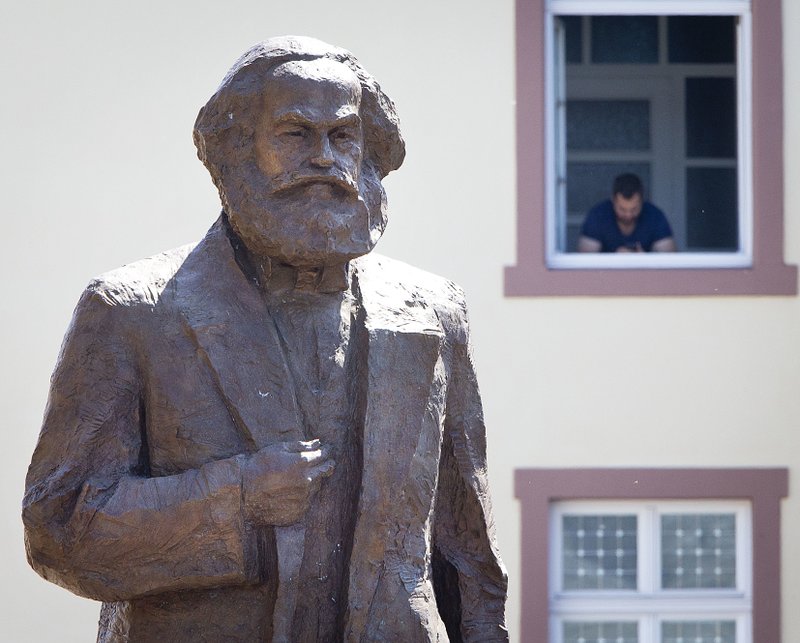
Karl Marx Statue Is Unveiled As 'Moderate' Marxism Still Makes Life Better For Millions - And Naysayers Yap


Top of the Karl Marx statue unveiled in Trier, Germany Saturday.

It is safe to say that if you asked 100 Americans what Karl Marx is most famed for, his actual works - not even two would be able to name them. And yet, when they bitch and moan about how they can't make ends meet and whine "the rich are getting richer" at their expense, and inequality only seems to be growing - they ought to have known that Marx did his best to change that dynamic.  But such is the deplorable state of education in our country, that a huge bottomless pit of ignorance is what one must contend with.

And into that bottomless pit, as often as not, propaganda, anti-Marx slander and brainwashing enter. Such as in the WSJ op-ed piece, 'Marx's Apologists Should Be Red In The Face', p. A13, May 4), by Paul Kengor - a "professor of history at Grove City College" - according to the endnote.

Numerous myths and slanders were trotted out in Kengor's piece and it is perhaps easiest to dispatch them by way of listing then skewering them.  But let me start with the biggest, e.g.

1) The "Bloodletting" inspired by Marxism/ Communism:

With Kengor writing:

"We're told the philosophy (of  Marxism) was never the problem- that Stalin was an aberration as were, presumably, Lenin, Trotsky, Mao, Pol Pot the Castros, not to mention the countless thousands of liquidators ..Couldn't any of them read?  ...This is the bicentennial pf the man whose ideas killed millions.'

Of course, this is balderdash. But sadly, this trope and fairy tale has become entrenched in the densan portion of the populace, as it's been subjected to decades of corporatist brainwashing.  If people knew the true facts, they'd appreciate Stalin was indeed an aberration, in a way he "ate his own young" to advance his megalomania. This was not anything to do with Marxism,  which is a philosophy, not a political orientation, e.g. communism.   Specifically, Stalin, in his paranoid cruelty, not only had Russian revolutionary leaders assassinated and executed, but indeed exterminated entire affiliate parties. For example, Stalin raged that Leon Trotsky and his followers were most outspoken against him. He therefore ordered “Trotskyites” to be butchered remorselessly. Estimates from released former Soviet archives show more than 44 million Trotskyites were butchered.

What does this all mean? It means it wasn't Marxism responsible for the slaughter and butchery, but individual megalomania!  It also means it wasn't atheism responsible for the slaughter. Neither Marxism nor atheism created the single-minded dictators, like Stalin, Pol Pot or Mao (in China) who brooked no competition and used the levers of state power to exterminate opponents.   Now, is it possible that communism - as the then practical manifestation of Marx's  "stateless society" - provided the means for Stalin to "stack the deck " to inflict his monstrous harm?   Yes, it is true, but this is no different from Trump using his own megalomania and constant deranged outbursts,  and lies  to stress and destabilize our constitutional structures and norms. Those actions, including his ceaseless slander of the FBI,  could also materialize  ultimately  in monstrous harm -if we don't get rid of him soon.

The difference is that the concentrated power in the Soviet state made it almost impossible to get rid of Stalin short of assassination. But we can choose to get rid of Trump by gathering our wits and first claiming back the House in the coming midterms to reaffirm separation of powers (and cross checking Trump's worst instincts), then getting rid of him either via impeachment (and indictment in a Dem -run Senate) or in the next  general election.  But be warned even then!  As per Ian Bremmer's piece ('The Strongman Era', TIME, May 14, p. 43):

"An August, 2017 Washington Post poll found that 52 % of Republican voters would support postponing the 2020 election if Trump said the delay was needed to ensure that only eligible American citizens could vote."

Make no mistake if we crossed this dangerous 'Rubicon' all bets would be off about a peaceful,  democratic transition of power. We'd truly be in a "Stalinesque" era and there's no telling what further Trump transgressions could follow.

It would do well for Kengor in this sense to attend to the words of European Commission President Jean-Claude Juncker - who pointedly observed in the run up to the Marx statue unveiling that Marx was not responsible for the horrors committed long after his death in 1883.

2. Communism Marxism relies on state violence to seize private property:

Americans here get hung up on account of their failure to distinguish personal-private and public property. They also fail to process differences, because of capitalist blinders, to see how their own country exercises violence against THEIR property.  For sure, Communism necessarily distributes PUBLIC property universally, but, at least as far as the communist is concerned, you can still keep your smartphone.

Americans will yelp, 'See, told ya!' But not so fast! As Douglas Rushkoff points out ('Life, Inc,', p. 54) the very construction of the federal highway system (to serve the automobile manufacturers) "didn't bother to consider the effects of their constructions on the people around them. Huge swaths of territory were considered only for their value as rights of way not places in themselves."

The result?

"Neighborhoods were uprooted, divided and demolished. Local governments that attempted to resist were quickly neutralized in the courts."

I can cite also the case of my own grandfather, whose beloved corner grocery at N. 27th St.. and Meinecke in Milwaukee was seized by "eminent domain". He was paid only a fraction of its worth. All this to make way for a new expressway which ended up never being built. Don't think he experienced state violence at the literal seizure of his property? Think again!


3) Communist economies aren't  based on free exchange, Capitalist economies are:

In fact, barter and 'black markets' have always been part of communist economies, as they are in the capitalist ones. The reason is to get around state-centrally controlled markets in the former, and capitalist Neoliberal controlled markets in the latter. Rushkoff again, shows how we are all puppets in the capitalist market system as well as victims, from gentrification of neighborhoods - with long time residents (usually less wealthy displaced)  to make way for new condos or Starbucks, to fracking polluting air and water - to make way for drilling gas or shale oil, to the toxic polluting of water supplies.

The idea that we’re all going around  in the US of A making free choices in an abundant market where everyone’s needs get met is patently belied by the lived experience of hundreds of millions of people. Most of us find ourselves constantly stuck between competing pressures and therefore stressed out, exhausted, lonely, and in search of meaning. — as though we’re not in control of our lives. From the type of isolated subdivisions we inhabit, to the jobs we can get, to the restrictions placed on us by banks and the Fed, and even the way the stock market is rigged against us (some small niche getting info on companies in advance) we are all living in a fool's paradise where we think we're exercising enormous freedoms - but are merely doing what our capitalist overseers expect.


By comparison,  in the old Soviet Union, at least every Russian really had a job if he wanted it, even it was filing cards, being a teacher assistant,  or road works. The state truly supported the citizen. No, it wasn't nirvana - hell no, but economic security and having food on the table  - even if only Borscht and bread-  was a given. No Soviet kid would go hungry because of cuts to food stamps, or cuts to his parents' unemployment benefits.

 The origin of capitalism was depriving British peasants of their access to land (seizure of property, you might call it), and therefore their means of subsistence, making them dependent on the market for their survival. Once propertyless, they were forced to flock to the dreck, drink and disease of slum-ridden cities to sell the only thing they had – their capacity to use their brains and muscles to work – or die. Just like them, the vast majority of people today are deprived of access to the resources we need to flourish, though they exist in abundant quantities, so as to force us to work for a boss who is trying to get rich by paying us less and working us harder.

Kengor barks about the central principle of Marxism being the "abolition of property" - and in this case he really needs to read a book on how capitalists spawn shock crises to grab property - mainly from the downtrodden  in the newly- shocked nations, societies. I am referring, of course, to Naomi Klein's book,  'The Shock Doctrine: The Rise of Disaster Capitalism' (2007).  As Klein describes, the shock doctrine's basis of "disaster capitalism" is to deliberately use assorted confected crises - whether military  or economic- to justify subverting the will of many other nations and their citizens to make the world "safe" for global capital. In one chapter where Klein coins the term "disaster capitalism" she analogizes it to the electric shocks delivered via certain tortures, say to a person's head & genitals. The shocked victims became so mentally incoherent, terrified -  that they were ready to accept just about anything demanded of them.

In the case of  the newly "de-communized" Russians,  following the fall of the Soviet Union,  Klein notes that after only a year of Neoliberal thuggery and "market therapy" millions of had lost their life savings when the ruble lost nearly all its value. Adding insult to injury, abrupt cuts in government subsidies meant that millions of workers had not been paid in months. Consumption? The average Russian consumed 40 percent less in 1992 than 1991 - and they weren't even consuming that much in '91!   Basically, to survive, the Russian middle class was forced to sell all or most of their belongings - setting up card tables on the streets to do so. As Klein describes this travesty:

"Desperate acts, that the Chicago School of Economics praised as 'entrepreneurial' and proof that a capitalist renaissance was indeed under way."

Recall here Henry Giroux's description of Neoliberalism's mandate:

"As an ideology, it casts all dimensions of life in terms of market rationality, construes profit-making as the arbiter and essence of democracy, consuming as the only operable form of citizenship, and upholds the irrational belief that the market can both solve all problems and serve as a model for structuring all social relations. As a mode of governance, it produces identities, subjects, and ways of life driven by a survival-of-the fittest ethic, grounded in the idea of the free, possessive individual, and committed to the right of ruling groups and institutions to exercise power removed from matters of ethics and social costs...."


Having skewered Kengor's main points and Marxian slanders , it behooves us to note there are examples of democratic socialism - call it "moderated Marxism" -  that persist today in assorted nations and which redound to the benefit of their citizens. I am writing about nations such as Germany, Denmark, Norway and Sweden.  Germany, for example, has a "heavy, progressive income tax" of the type Kengor disparages as :"Marxist" but lo and behold, Germany has recently  posted a projected, consolidated budget surplus of 50 million euro ($62 billion) between now and 2021. Most of which will be spent on social services, e.g. unemployment compensation, child care, as opposed to reckless tax cuts like the debtor nation U.S. (See 'Germany, Awash In Money, Shies Away From Tax Cut'' , WSJ,  Feb. 21, p. A11)


And then there is Denmark, also benefiting from much lower inequality and citizen social enrichment from higher taxation, as two of her citizens had to educate Oprah, see e.g.
Oprah got perfect response from Danish woman on their social welfare state 
 

The  "welfare states" Marx envisaged, actually states which address the economic needs of ALL citizens, remain alive and well all the anti-Marx hysteria and contempt nothwithstaning.


See also:

http://www.smirkingchimp.com/thread/kevin-zeese-and-margaret-flowers/79037/for-his-200th-birthday-honoring-marx-as-an-activist

Excerpt:


"At 24 years of age, Marx was writing fiery articles opposing Prussian authoritarianism. The newspaper he edited was closed in 1842 by the government, he was exiled and moved to Paris from where he was expelled in 1844.


In 1848, Marx and Engels published the Communist Manifesto. “The Manifesto” was written as a declaration of the principles of socialism for the Communist League in Brussels. It remains a statement of the core principles of socialism to this day. At 45 years of age, Marx was elected to the general council of the first International where he was active in organizing the International’s annual congresses.


Marx’s vision of socialism had nothing in common with one-party dictatorships like the former Soviet Union that declared themselves to be socialist or communist. For Marx, the key question was not whether the economy was controlled by the state, but which class controlled the state. "