
Kilogram prototype number 38, which resides at the Federal Institute of Metrology (METAS), Switzerland, is one of the 40 initial replicas of the international prototype kilogram. Under the revised (S.I.) definition such prototypes have become redundant.
Back in November, scientists from 60 countries voted in a historic event in Versailles, France to change the definition of the kilogram. Instead of a solid "standard" one kg mass - the new definition will be based on electric currents. The decision, made at the General Conference on Weights and Measurements, will retire the object known as "Le Grand K,"- a small cylindrical ingot made of platinum-iridium that's been used for more than 130 years to define the S.I. unit of mass.
As we learned in 1960s general physics, the (then) standard kilogram mass exerted a specific amount of force in Earth’s gravity. How much had been given by the 'g-form'' of Newton's 2nd law of motion, i.e. F= mg. Then: m = F/ g. The problem is that we know g changes from place to place on the Earth's surface given the Earth is not a perfect sphere. It doesn't have constant radius r everywhere, say to measure the distance to the object and obtain F, e.g.
F' = mg = GMm /r2 And g = GM /r2
It is actually an oblate spheroid. As one NIST spokesperson put it at the time of the proposed change and vote:
“The revised definition replaces this determination of mechanical force with an electromagnetic measurement tied to the Planck constant and based on electrical current voltage.”
Barry Inglis, director of the International Committee for Weights and Measurements, in a statement made on Nov 16 last year said:relying on a natural constant to define kilogram will pave the way for more accurate and precise work, particularly in the fields of science and technology
Here's the newsflash for those who may have missed it: On November 16th last year the ties to old prototype metal cylinders of kilogram mass were forever severed and the kilogram definition was changed.
That was when the kilogram’s physics-based definition was officially adopted.. To appreciate this momentous step we need to review a bit of units-standards history. Scientists around the world rely on the International System of Units (S.I.) as a common basis by which to record and report their findings. The units used in this system are based on the meter, kilogram, second, kelvin, ampere, mole, and candela. Originally, many if not most of these units had properties related directly to Earth parameters, measures.
For example, the SI unit of time, the second, was originally defined as 1/86,400 of the mean solar day. Subsequently, clocks reached a precision that allowed monitoring irregularities in the Earth’s rotation and revolution. In 1967, the General Conference on Weights and Measures (Conférence Générale des Poids et Mesures; CGPM) changed the definition of the second to “the duration of 9,192,631,770 periods of the radiation corresponding to the transition between the two hyperfine levels of the ground state of the cesium-133 atom.”
In effect, the revision broke from the more understandable Earth-linked one. Geodesy, the science of the shape of the Earth, was key in the definition of the metric system during the French Revolution.
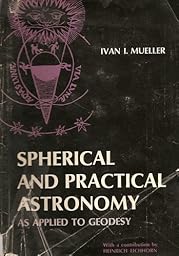
Indeed, it should not come as a surprise that geodesy was inextricably linked to spherical astronomy, e.g. this text from 1969 - a standard one at USF:
Another example: In 1791, the French Academy of Sciences defined the meter as 1/10,000,000 the length of a quadrant of Earth’s meridian. However, since 1983, the meter has been redefined as the length of the path traveled by light in a vacuum during an interval of 1/299,792,458 of a second. Hence, c, the speed of light in a vacuum, was fixed to a given value, and the definition of the meter now derives from that of the second.
The various changes in definition show that S.I. units are increasingly defined by the properties of atomic physics. In 1799, the kilogram was defined as the mass of 1 cubic decimeter of water at a temperature of 4°C. This unit is unique in that the standard is still based (for now) on a manufactured object rather than on a physical constant. The prototype kilogram from 1799 (the “kilogram of the archives”) and the present artifact from 1875 (the international prototype kilogram, or IPK) were manufactured to be consistent with this definition. The IPK is a cylinder of 39-millimeter height and diameter, made of 90% platinum and 10% iridium. (At present, the IPK is kept at the Bureau International des Poids et Mesures in Sèvres, France.)
Forty replicas of the IPK were manufactured in 1884, and 34 were distributed to the signatories of the Meter Convention. The United States was allocated prototype numbers 4 and 20; Belgium received numbers 28 and 37, and Switzerland got number 38 and, more recently, number 89. These replicas have been used as national standards ever since.
The kilogram is now scheduled to join the other SI units, and prototypes as museum items after having been officially redefined in terms of the Planck constant h (6.6260693(11) x 10-34 J s). This change in definitions became necessary because the use of the IPK, an actual physical artifact, posed various problems. For instance, there was no way to ensure its long-term stability. it might be destroyed or damaged, then what's left to compare any other designated standard mass to?
Also, on account of changing g-values as noted earlier (since Earth isn't a perfect sphere, so differing radii r) there emerged problems when it had to be compared with copies at other national metrology institutes (NMIs).
Comparisons of the mass of the IPK to those of official copies and the national prototypes in 1889, 1948, 1989, and 2014 indicated that the IPK seemed to have lost about 50 micrograms over 100 years (five parts in 100 million). It was also possible that all the prototypes showed a common mass drift, which couldn't be detected by intercomparisons. Physicists thus faced a strange situation: By definition, the mass of the IPK was invariant, but there was no means to check its stability using an absolute reference!
Worse, the instability of the IPK propagated to other base units tied to the kilogram, such as the candela (luminous intensity), the mole (number of atoms in a mass of material), and the ampere (electric current). It also influenced the derived quantities such as force, density, and pressure. Thus, the situation begged for a revised definition independent of physical attributes subject to change or location.
Here's an interesting irony on the new units: While the definitions of the second and the meter, previously derived from geodesy (the science of the shape of the Earth, its orientation in space, and its gravity field, ) now rely on laboratory physics experiments, the new definitions must be consistent with the previous ones. In other words, still related at least indirectly to Earth’s shape and motion.. This is crucial in order to be able to conduct ordinary (physics) lab experiments or even to analyze the astrodynamics of space craft, say, headed for Mars or Venus.
To fix ideas, on its redefinition, a first step to standardizing the kilogram will consist of counting the number of atoms in a silicon-28 (28Si) single-crystal sphere using the X-ray crystal density approach. However, students conducting experiments in high school and college physics labs - say measuring the dynamics of bodies according to Newton's 2nd law- will not have to use x-ray crystal density approaches (or know Planck's constant or how it related to the new definition) to conduct their experiments. So there remains a continuity between new and old units.
Another route to the kilogram is based on the Kibble balance . In this case, the mechanical power of a mass in a gravitational field is balanced by the electrical power of the balance. See e.g.
 The measured kilogram here depends on Planck’s constant h (see above), which appears in the quantum phenomena used to determine the balance’s current and voltage.
 Knowing the current, voltage, length, and time to measure the velocity of the coil moving within a magnetic field and the local acceleration of gravity, one then defines the mass as the amount of matter required to balance a given amount of electrical power. To allow this derivation of the kilogram, the gravity acceleration must be determined at the 10-8 level by absolute gravimetric tracking of the free fall of an object, or "cold" atoms repeatedly dropped inside a vacuum chamber.
Will many people understand the new definition of the kilogram? Probably not. The good news is that it won't matter for ordinary mortals, those not involved in critical physics experiments or at standards institutes.


