Showing posts with label Brexit vote. Show all posts

Saturday, June 25, 2016

Are Greedy Elders Taking Advantage of the Young? Not In U.S. - But Perhaps in the U.K.


In a WSJ piece from several months ago ('When Older People Do Better Than The Working Age', March 21, p. A2) a number of claims were made concerning economic advantages reaped by seniors not shared by the young working contingent. All of these bear closer examination, especially in the wake of the Brexit vote (previous post).

According to the authors (Jason Douglas and Jon Sindreu):

"Seniors in the U.S. have recently enjoyed healthier income gains than their younger counterparts, census data show...The average person 65 years and older in the U.S. earns  77% of the income of the average citizen up from 69% in 2008".

Okay, several points, since the earlier claim - preceding this statement is that "the divergence is exacerbating generational imbalances in government pension systems".

In other words, geezers are supposedly profiting at the expense of the youngsters who have to pay into "entitlements" like Social Security to support them.  This is confirmed as the authors later write (ibid.):

"As the elderly population increases, younger workers face a rising bill for the extra tax dollars needed to fulfill past government promises to retirees".

So....according to the WSJ duo, it's evidently the fault of the parasitical seniors for bleeding down the pay and resources of the young - keeping them poor and on a losing treadmill.

Of course this is bollocks. Apart from the fact no account is taken that those on "government pensions" had already put in their working years (decades, in fact) - thank you very much - there is no attention paid to the fact what those pensions don't exactly provide a princely sum. To shed needed light we can thank Nancy J. Altman and Eric Kingson, authors of 'Social Security Works' .

As the authors observe (p. 40):

"It is false that most older Americans are on "easy street". A very small percentage are, many more are poor or near poor, while some maintain a modest, middle class life style, often struggling to make ends meet."


In the graphic shown on page 47, the authors present the actual income distribution for the elderly which shows nearly three out of four senior households have incomes below $50,000 - which is not a majestic  sum considering health costs, etc.. Not when a senior might be one bad fall from a nursing home stay  that will suck up $70k a year. Or,  one major medical catastrophe can savage  frugal savings. (Dunned by continuous zero interest rates for years.) These are problems the young don't have, and the young always have time to get back on their feet - most seniors do not  - say after a major medical calamity.

Anyway the income distributions are indicated a follows:

- 72.5% have less than $50,000 /yr.

- 18.5% have from $50,000 - 99,000

- 5.3% have $100,000 - 149,999

- 2.0 % have $150,000 - 199,999

- 1.9% have more than $200,000

In other words, barely 9 percent of elderly - or 1 in 11, has more than what is regarded as a middle class income. So we (they) are not exactly living on "Easy Street". Other objections to seniors' benefits as being "too much" I already skewered in this blog post, which I invite people to read:

http://brane-space.blogspot.com/2011/11/no-oldsters-are-not-gluttonous-uncaring.html


Interestingly, the situation may well be different with respect to oldsters in the U.K., especially in the wake of the Brexit vote. As noted in the same WSJ piece, seniors in the U.K. "earn 89 percent of the average citizen's income".   And yet these older folks found it necessary to vote "leave" in the Brexit vote, thereby taking away opportunities in work, travel, and advancement for the 18-34 age set.

As expressed in opinions of some of the younger U.K. demographic in today's New York Times ('Among Young Britons, A 'Bad Feeling' On Result', p. A1:

From Louise Driscoll, a 21-year old barista in London:

"What do we do now? I am very scared!"

And from Lewis Phillips, 27 of London:

"We're the ones that have to live with it for a long time but a group of pensioners have managed to make a decision for us."

From Dan Boden of London:

"Truly gutted that our grandparents have effectively decided that they hate foreigners more than they love us and our futures."

Hannah Shaw, 25, who works at the National Health Service, had this to say:

"I'm already part of a generation stuck in rented property, unable to buy a house. The older generation seems so happy with the result, almost smug like it's some sort of victory completely unaware of the chaos they've caused for my generation. I'm dreading what will happen to employment, worker's rights, the environment and our economy"]

Which are certainly valid worries for those her age, given the narrowing of opportunities expected now that England likely recedes to merely being an island state again.

The outrage of the U.K. youthful segment is perhaps best summed up,  NY Times p. A8:

"They have expressed astonishment, anger and despair that their parents and grandparents would seek to limit the travel, exposure to other cultures and opportunities to work and study that being part of the European Union afforded them".

Thus, the Brexit vote effectively took away their acquired European identity, feeling part of a whole culture and continent as opposed to merely citizens of a provincial island nation.

From the level of their rage it will be a long time before they get over it, if ever. Meanwhile, the geezers in the U.K. need to ponder now what they have done by actually limiting the work and educational opportunities of the young which bears no comparison to anything oldsters have done in the U.S.

But to be sure, Neoliberalism has wrought havoc in the States too. But this is not the fault of oldsters who are equal victims of its excesses, in terms of extreme increases in prescription drug prices, further increases in Medicare premiums -  while cutting S.S. COLAs, and having to support their offspring and often their offspring, because the Neoliberal state has found it expeditious to retain a service -oriented, low wage society with little or no chance of upward mobility.

The populism expressed in the Sanders'  -- and to a lesser extent Trump campaign- have touched on these divisive issues, but there may yet be more unsettling events to come.

See also:

http://smirkingchimp.com/thread/richard-eskow/67837/after-brexit-who-will-lead-the-new-global-rebellion

Update:

An analysis by The Financial Times in the wake of the Brexit vote found that only 36% of 18 to 24 year olds actually cast a vote in the election. In effect, these complacent young voters contributed to their own demise, much as they have tended to do by not turning out in U.S. off year elections.

Friday, June 24, 2016

The Brexit Vote -What It Means, Including To Your 401k

calais, migrant, britain, welfare, economic, immigration, population ...
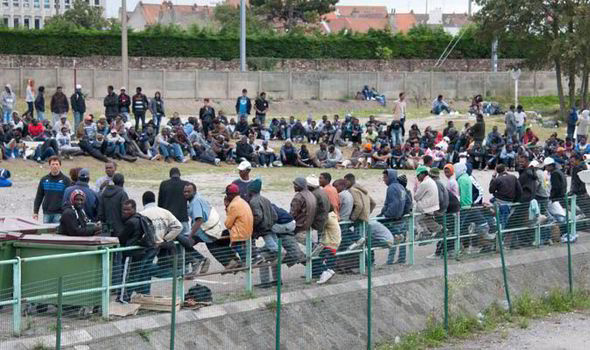
One of the triggers for the 'Leave' vote in the UK had been images such as this showing migrants near Calais, France ready to bolt across the 'Chunnel" to England.


Back in July, 1978, on my first trip to the UK and London (where we stayed with a friend of Janice's) the character of "old England" was ubiquitous. The beauty of the London transport system was that one could take  the "underground" wherever he or she chose, from Piccadilly Circus, to Earl's Court (where we watched a medieval jousting match) to the Royal Albert Hall where we were privileged to see (and hear!)  a fantastic performance of Tchaikovsky's 1812 Overture.  Along the way foreign tongues were seldom heard, either in the tube stations or the venues themselves.

There were no mullahs standing in any area we went (and we covered a lot of London) ordering women to shield their faces with burkas or whatever. The only terror incidents were carried out by the IRA, including one bombing which killed several London police and some of their horses.

Now, flash almost forty years later and all that's changed, the whole UK landscape. Migrants have been pouring in from many nations - particularly Middle Eastern and African - for decades, and the character of the place has altered. One will now often hear as many foreign tongues as native Brit (whether Cockney, Yorkie, or whatever other dialect).

This altered character of the nation, coupled with loss of what is perceived as a British identity since the Maastricht Treaty - otherwise known as the 'Treaty to Integrate Europe' - ultimately drove the "Leave" majority yesterday (winning by 52% to 48% in the "Brexit" vote).  Despite London and Scotland voting to remain, most of the rest of the UK and especially rural or working class areas saw things differently.

Many on the Right, including the odious Nigel Farage (who use scare tactics such as thousands streaming through Slovenia) to depict a direct migrant threat to the UK, are now cheering about "Independence Day".   But as Richard Haas pointed out on MSNBC this morning, it is more akin to dissolution day, given Ireland and Scotland (which voted remain) will now themselves likely call referenda to leave England to itself - dissolving the UK.

Despite the Farage exaggerations, it is true that migrants have been making their way into the UK in greater numbers, often gathering near Calais in France before attempting to bolt across the Channel tunnel otherwise known as the "chunnel".  The spectacle of this happening, added to the existing tensions with mainly Islamic immigrants (recall one of them running amok and chopping off a head barely two years ago)  has enraged many to the point they'd had enough.

Economics was the other rallying point though not as passionately framed as arguments from the anti-migrant segment. Those on this side were basically tired of Brussels calling the shots regarding trade despite the fact the Brits were allowed to keep their own currency (the pound) as opposed to using the euro.  The econ leavers insisted they would carry on just fine, thanks, and no need to worry about repercussions.

But that may be akin to whistling in the dark as the wolf comes to the door.  The fact is the UK had been sending 44 percent of all its exports to the single EU market. That can simply no longer happen any longer since the UK will not have that privileged advantage. They will now have to "go to the end of the line". German Finance Minister Wolfgang Schäuble put it bluntly barely three days ago in The Financial Times: "In is in and out is out". Meaning if the UK votes 'out', they are out of the EU market - no special benefits or advantages conferred. The extreme case? The EU, if it really wanted to be punitive, could force the UK to make separate deals with each of the 27 remaining EU nations.

This means exports will likely shrink and drastically, with whatever factories left shuttered and their workers laid off.  This is what happens when your biggest customer is now effectively taken away, or at least its impact drastically reduced. It will be even worse if Ireland and Scotland themselves vote to leave England al alone, and remain with the EU. Then England will truly be "little England" with an emphasis on little.

This is what caused the  global markets to react badly early this morning, with the German DAX (.GDAX) dropping 731 points and the Nikkei Index more than 1286.  The DOW is expected to take a dump too, and I'd be amazed if is less than 700 points drop. Further, the turmoil could go on for months as the UK attempts to sort out its new position, and get a new government (David Cameron is now out as PM having called the Brexit vote)

In the end, the vote for Brexit means chaos in the short and possibly long term. It means European issues will be roiled and possibly other EU members now also emboldened to try to leave. We already saw last year the fomenting for "Grexit" or Greek exit, but the Greeks eventually came to their senses and realized they might be better in than out, even with a lot of debt. ('Out' and they likely wouldn't even be able to muster a loan)

For your 401k, as financial guest Melanie Hobson noted yesterday on CBS Early show, it will mean a lot of volatility. I myself expect to see massive dives in the stock market in the coming weeks until the issues are resolved to the markets' liking. Remember, that includes all the markets, not just the U.S. ones.  Keep in mind also that Britain's economy is the 5th largest in the world - meaning a "sneeze" in the UK (as with Brexit fallout) could trigger pneumonia in some places. Pneumonia there (in the UK) could trigger....well, you don't want to know!

Anthony Mason, covering the Wall Street markets opening this morning stated a "pretty bleak opening is expected", which may be an understatement.  The main barometer to watch, I think, is the extent of the flight to safety. Already we're hearing about foreigners buying up treasurys which will have implications for the bond markets, and it also could for money markets.

At the very least, given the low global GDP of barely 3%, the Brexit vote likely brings interest rates down further, and slows growth significantly. (Some even warn the UK could go into recession, but we will have to see what happens in any Scottish or Irish separate referenda to leave the UK.)

On the positive side, central banks are still propping up the markets around the world with their next to zero interest rates thereby  providing a "balm" as the turmoil continues over the next  few years. If nothing else, Janet Yellen  will plausibly assert:  "Well, because of the economic uncertainties inherent in the Brexit vote, no more interest rate increases for at least 3 years". This will make Wall Street's day and so provide a counter force to the Brexit negative influences.

So those with 401ks, while they will sustain some stomach-churning days, shouldn't go into hysterics. Yet.....

See also the related articles here: 

http://www.theguardian.com/us

See also:

http://www.ft.com/cms/s/0/bbd593ee-39d4-11e6-9a05-82a9b15a8ee7.html#axzz4CWIGLKRv