Showing posts with label 2nd law of thermodynamics. Show all posts

Monday, March 4, 2019

"Empty Planet"? Nope - One with Far Too Many Humans - Beyond Carrying Capacity


Once again, we have the Neoliberal  and reactionary financial media trying to gloss over the population crisis.  The latest manifestation arrived in the guise of a  WSJ book review by one Lyman Stone )'A Drop In Numbers') in terms of reviewing a book 'Empty Planet' - by Darrell Bricker and John Ibbitson. (Both from the American Enterprise Institute).

Stone writes:


“Their book is a vital warning to the world that the risks associated with population have been catastrophically misread: Governments and activists have spent decades fighting the specter of overpopulation but now face the looming demographic calamity of global population collapse.”

Adding:

Fewer people participating in the economy will mean slower economic growth, less entrepreneurship, rising inequality and calamitous government debt.


To which I say ‘Hogwash!’  Because the solution of more people born to support those already alive is merely a Ponzi scheme.  Since the libertarians in this country get their panties in snits  over "Ponzi schemes" they ought to pay especial attention to this one. Because if 50 million additional workers are needed to support the existing 45 (retired) million people, how many more will be needed to support those 50 million and the tail end of the earlier 45 million? Can't these imbeciles see that the base of population support is a never-ending growth proposition? 


There are more than sufficient unemployed or underemployed people in the developed world to make up for the deficits anywhere.  At last reporting the OECD estimated 230 m in Europe alone.  Even the authors at least conceded there is merit to allowing foreign workers in to fill the bill but with "selective standards. As Steon puts it (ibid.):

"Of course there are plenty of immigrants today to prop up growth and the authors sensibly suggest the U.S. should adopt a Canadian -style, merit based system Buyt then they worry that by giving in to anti-immigrant, nativist sentiments the UNitied States will "throw away the very tool that hs been the secret to its greatness."

Well, those libertarian authors do have a point and more  to support their arguments than the reviewer, Stone, i.e. "if we admit more immigrants our demographic bubble bursting will only be postponed."

Not really!  Africa, for example, is on a tear to sport the world's largest population increase by 2050 - nearly 2.5 billion. Surely many millions of African immigrants can help with our demographic issues (and less population of whities). That is, if we can ever rid ourselves of Trump's dismissive  epithet of "shithole countries".

Indeed, in yesterday's WSJ there was a further wake up call piece ('Employers Push For More Seasonal Visas', p. A6)  on why we desperately need more lower wage immigrants, especially to do the jobs Americans refuse to do - from carcass butchering at meat plants, to landscaping, to farming to fish and crab cleaning in Maryland.  


The article noted that employers who rely on seasonal (temporary) H-2B visas are renewing their fight to lift limits.  The situation with too few needed workers became so desperate that the Labor Dept. website crashed "after a scramble by employers chasing 33,000 available permits."  This is absolute nonsense.

The piece added:

"The Jan. 1 meltdown stemmed from high demand and a move to make the process first come, first served."

We also learned:

"Industries ranging from tourism to agriculture to landscaping to amusements say they are reliant on foreign workers and the H-2B program"

Note that congress can allow up to 69,000 such permits if the administration agrees, but up to now the Trumpie dolts - lead by Nazi wannabe Stephen Miller - have not. Hell, these nincompoops are even trying to cut back on the H-1B visas for more professionally qualified workers.

My point here is that all the hand wringing about too few people to support growth and we need more babies is plain hogwash. 

Stone also babbles, re: why the population is supposedly crashing:

"The authors pin the blame on faulty assumptions by the population establishment as represented by the UN Population Division. They don’t use the U.S. as an example but I will. The UN’s most recent population forecasts suggest the average U.S.  total fertility rate from 2015 to 2020 shold be 1.9 children per woman. In reality, CDC data shows U.S. fertility has averaged about 1.8 children per woman from 2015-2018,”

Not taking into account the Earth overshoot phenomenon, e.g. as illustrated below:


At root, the issue is sustainability - especially for water which is needed for crops. NO water, no crops to feed a growing population. The interpretation of the graph (upward) is simple. By June, 2030 TWO full Earths - that is the resources therein - will be needed to support the then population. Already we are at 1.5 Earths. Every year Global Footprint Network raises awareness about global ecological overshoot with its Earth Overshoot Day campaign. Earth Overshoot Day is the day on the calendar when humanity has used up the resources that it takes the planet the full year to regenerate

Even Terry Spahr, Executive Director of Earth Overshoot, was compelled to send a letter to the WSJ to contradict the Stone review and many of the claims made by the book's authors. Spahr emphasized the clear benefits of a less populated world, including: "Fewer workers will command higher wages, the environment will improve,  the risk of famine will wane and falling birthrates in the developing world will bring greater affluence."   

A huge additional benefit is there will be fewer abortions in the developed world (cf. 'Fewer Births, Fewer Abortions', WSJ, Feb. 23-24, by Jo Craven McGinty).  As the author observed, "At 1.8 total fertility the number of children women are expected to have in their lifetime is near the 1976 low of 1.7."  "And "for the first time since 1975 the number of abortions in the U.S. dropped."  

The basis here is not mystifying and doesn't require one pass a Mensa admissions test.  Essentially, when women can choose the size of their families (for economic and other reasons) then they will be less likely to hit the abortion switch in the case of children not wanted.   The point is there are multifold benefits to keep our numbers lower.


Further, it is preposterous for those like the AEI authors to chirp about Americans needing to increase baby production when there is no incentive from the gov't to do so.  I refer to those like an ER nurse featured in a spot this a.m. on CBS Early Show. She took her allotted 12 unpaid weeks to care for her newborn, then found her family on the ropes financially.  By the end she was deep in debt and had to cash out a portion of her 401(k) to make ends meet.  Even then, she was left with barely $500 in the bank to pay her bills.

That contrasts with another new mom (Marquita Staples-Green)  - also presented in the segment- who was able to get 26 weeks of fully paid leave- compliments of her company, software firm Adobe. As she put it:

"By the time I went back to work, I was ready, I was prepared. I had some time off, I could think about my new goals as a working mom.  I am completely grateful but I just wish this was the norm."

Well, sadly it isn't the norm, given only 16 percent of American new moms are the enviable position of Ms. Staples- Green, i.e. having access to paid leave via their employers. That is not even 1 in 6 women!  It also explains, as presenter Alex Wagner noted, why so many women in this country need to secure infant care within weeks of giving birth.

So why should these Neolib knuckleheads, ensconced in capitalist outposts like the AEI,  incessantly express surprise that fewer American women are having kids in this "lotto" environment? (And we won't even get into how much it takes to even raise 1 kid to high school graduation level now, far less through university.)

To be sure, the Democrats' "Family and Medical Insurance Leave Act"  would give workers twelve weeks of partially paid leave funded by a payroll tax.  That is, workers would be able to draw on their Social Security early to get the needed leave.  I don't believe I need to explain why this is dead in the water, given the basis is  almost as bad as the ER nurse taking out part of her 401(k).  In other words, if enacted (which odds I place at slim to none) it would just add to the nation's retirement crisis. 

In  many respects this latest AEI- based effort reminded me of the book, 'The Birth Dearth' by Ben Wattenberg. He was also then a fellow at the conservative American Enterprise Institute. This association no doubt accounts for the thesis expounded in his book that the "Western industrialized nations are flirting with economic disaster and marginalization by maintaining too low birth rates."

 By Wattenberg's analysis from over 30 years back, the resulting missing babies would be translated into "missing producers and consumer, soldiers and sailors, mothers and fathers".


Again, nonsense not too different from the latest AEI iteration.  Then as now, in terms of the impact on non-renewable resources, each child in a Western-developed nation consumes a disproportionate share of limited resources.   The U.S. offers the worst example: 6% of the world's population gobbling up some 25- 30% of the available resources in a given year. What Wattenberg and now Ibbitson & Bricker are proposing (and largely for purely economic gains) is nothing short of lunacy in this light.


A far more rational take is afforded by Herman Daly, University of Maryland Professor of Ecological Economics, in his book 'Steady State Economics'. The problem is the concept of "growth" is bogus on its face. Only a congenital moron would continue to pander to unchecked growth (and the increased population that feeds it) in a finite, zero-sum environment or planet. Especially one in which artificial wealth is created by extracting resources  that necessarily diminshes and degrades the remaining resource base. By "artificial wealth" I mean materials or converted resources (other than food) that cannot sustain your life. They may window-dress it, like the latest X-box game, but they won't sustain it.

Another sane alternative is offered by Aurelio Peccei's `One Hundred Pages for the Future' . Peccei makes a passionate plea for humans to notch their numbers down to replacement levels or lower since they've exceeded the Earth's ability to support them. (Part 1: `The Ascent and Decline of Humankind'). Peccei refers to an enormous supplemental population - one that exists beyond the ability of additional resources to support humans, hence  existing as a "human bomb threatening the planet".

Meanwhile, the late, noted science writer and biochemist Isaac Asimov- in various essays written over decades- has also warned of similar constraints on humanity's use of resources, particularly in terms of how population growth impinges on finite resources and sets limits to growth. Asimov was probably also the first to use the term "carrying capacity" * which he estimated to be 3 billion humans for this limited world.

By contrast, Wattenberg's book essentially tosses the very concept of carrying capacity out the window.

More recently, in an article appearing in `Physics Today' (July, 2004 issue): `Thoughts on Long-Term Energy Supplies: Scientists and the Silent Lie', Albert Bartlett pinpointed the failure to name human population growth as a major cause of our energy and resource problems.

Bartlett avers that "their (scientists') general reticence stems from the fact that it is politically incorrect or unpopular to argue for stabilization of population - at least in the U.S. Or perhaps scientists are uncomfortable stepping outside their specialized areas of expertise".


But Bartlett himself, in books and lectures, i.e.


https://www.youtube.com/watch?v=kZA9Hnp3aV4

 Has perhaps given the best reason for this reticence of scientists to speak out: the realization that too few Americans understand the concept of exponential increase which lies at the heart of population increase.


But if Americans' math issues and  physicists (and other scientists')silence share blame, the corporate media also shares as much or more for having the facts and refusing to level with the public. For example, on the issue of overshoot of our finite resources. 


Indeed, I doubt any major newspaper (or corporate media website)  has published any relevant data on it since it became available. Why not? Because it would cut through all the propaganda, PR and 'feel good' economic bunkum (e.g. about needing more people to increase global GDP) to show we are unambiguously in a crisis with regard to resource sustainability.
 

 There is also no mention that every energy conversion pollutes and degrades the environment we depend upon.  Multiply those conversions - say via more and more people- and we quickly descend into a higher entropic, higher waste world.  

Are we there yet? Actually, we're way beyond it. As pointed out by Christopher Mims (WSJ, Exhange, Mar.2-3, p. B10):

"In 1950, the world produced about 4 billion pounds of plastic per year.  Today, we produce 600 billion pounds. Every year 20 billion pounds of it ends up in the ocean.  Over 90 percent of produced plastic has never been recycled, and it typically takes more than 400 years to break down naturally."

Think there's gotta be a techno fix? Dream on!  As Mims goes on to note, after citing the Chinese refusal to process any more foreign waste:

"It's a crisis so big that no amount of technology, innovation or policy can solve it in the near future ..."

In other words, we are converting the planet's oceans into massive crypts that will likely sustain no living things - maybe not even jellyfish - in another 100 years.

Sadly, too many of our citizens fail to appreciate that every energy conversion process features an accompanying entropy or increased disorder.  Thus, the combustion of fuel in an internal combustion engine releases carbon monoxide as well as CO2 and other pollutants. Further, the 2nd law of thermodynamics states that the expelled constituents can never be used again for positive energy.   


Turning resources into waste faster than even a fraction of waste can be recovered-recycled thereby sets the stage for global ecological overshoot which depletes the very resources on which human life and the natural environment depends.

The astute and aware citizen must be sentient enough to know more people is not in humanity's best interest. Isaac Asimov, as part of his February, 1976 Barbados lecture e.g.

warned that humans had two choices: decrease their population to the carrying capacity limit to live in an equilibrium with the Earth and its resources, or let nature “increase the human death rate” (e.g. by starvation, pestilence, wars over resources etc.)

He also remarked:

"It is now the willingly childless woman who is the heroine of our planet. She is the one who now deserves all the kudos and praise, for helping to do what is necessary to spare humanity from the ravages of over-population"


Empty planet? No. A perilously overpopulated one, and more than twice in excess of its carrying capacity. 

See also:

https://www.ft.com/content/c0a77b28-3c2c-11e9-b856-5404d3811663
----------------------------------------
*  Carrying capacity = (usable land-water resource base providing water + food + fuel) / (individual food, fuel + water requirement)


Now, if the numerator is  11.4 x 10 9   hectares of usable aggregate equivalent land-water resource base and if 6 hectares is the ideal mean individual requirement over a lifetime (e.g. meet all basic needs and have a few private luxuries) , that means:

 CC = (11.4 x 10  9 hectares) / 6 hectares/person   =  2 billion.

Obviously, this can be increased if the numerator can be increased or the denominator (each individual's ecological footprint) decreased.

Thursday, December 29, 2016

Earth "Over Shoot Day" By 2030 - What Will We DO To Avoid It?


Graph showing absolute 'two planet' overshoot by 2030. This assumes 'business as usual' which will be the case certainly in "Trump world".

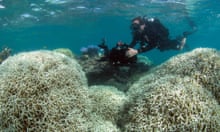
As we approach a new year it is useful to think about the planet's limited resources, our stewardship of them and the potential for overshoot. Even moderate UN scenarios suggest that if current population and consumption trends continue, then by the 2030s we will need the equivalent of two Earths to support us. Of course, we only have one, and that is now badly polluted, including with coral reefs dying throughout the world's oceans,

.
Too many of our citizens fail to appreciate that every energy conversion process has as an accompaniment entropy, or disorder. In most cases this appears as waste heat, as well as pollutants. For example, a car engine produces carbon monoxide as well as carbon dioxide and waste heat generated via the internal combustion engine.  The 2nd law of thermodynamics or entropy law  states that the expelled gas constituents cannot ever be combined again to produce the original fuel. In other words, resource consumption here is a one way process. Resource extraction, such as oil shale fracking also has many adverse effects on the terrestrial environment, apart from the CO2 released when the stuff is burned (e.g. as kerogen)

Turning resources into waste faster than waste can be converted into resources puts us in global ecological overshoot, depleting the very resources on which human life and biodiversity depend.
Every year Global Footprint Network raises awareness about global ecological overshoot with our Earth Overshoot Day campaign. Earth Overshoot Day is the day on the calendar when humanity has used up the resources that it takes the planet the full year to regenerate. Just like the hands of the  'doomsday clock'  approaching 'midnight' for nuclear cataclysm, Earth Overshoot Day  has moved earlier and earlier each year across metaphorical calendar months. By way of comparison, it has already shifted from early October in 2000 to August n 2015 and will arrive by early July next year - but many predict by early May under a Trump administration's excesses. This is nothing to cheer about but instead something to fear because it shows our time is running out..

The inevitable result will be dying coral reefs,  collapsing fisheries, faster melting polar caps and glaciers, diminishing forest cover, depletion of fresh water systems, and increasing ocean acidification as well as sea level rise.  Overshoot also contributes to resource conflicts and wars, mass migrations, famine, disease and other human tragedies—and tends to have a disproportionate impact on the poor, who cannot buy their way out of the problem by getting resources from somewhere else.

When famed science and science fiction writer Isaac Asimov arrived in Barbados in February, 1976, the entire island was in an uproar The reason was eager anticipation of his public lecture at the venerable Queen's Park Theater.


Isaac Asimov makes a crucial point concerning overpopulation at his Queen's Park Lecture in Barbados, in February, 1976.

Asimov's general theme was 'The Moon and What It means To Us' but - as usual- his lecture did veer off into other important areas, especially the increase in human population, and its dire effects on the welfare of everyone.

A metaphor that Asimov used to make his point then has since become known as "the bathroom metaphor" and it works to get people to understand the debilitating, disastrous effects of too many people, and particularly overshoot of limited available resources.. As Asimov noted, if two people live in an apartment, and it comes with two bathrooms, they have a comfortable life. Either one can use the bathroom anytime he or she wants, and can remain in there as long as they desire, even reading while doing business.

One can say, that for the purpose of "Bathroom freedom" - 2 is the carrying capacity for a two -person apartment. Now, let there be twenty people occupying the same apartment, and what happens? Bathroom freedom evaporates. Visits now must be regulated by the clock, and no one may stay in for too long. Indeed, a timetable likely has to be set up for each person's bathroom use. (Don't laugh too hard at the improbability of this example, since we now know of numerous cases where immigrants have been found crammed into such conditions - but usually in a house)

The point is, that the liberating use of the bathroom which applied for two persons, no longer applies with twenty, and probably evaporated by the time there were five or six occupants of the apartment. By the latter numbers, say at two or three times the normal occupancy - one attains "overshoot" for the apartment. In a similar way overpopulation of a finite planet with limited resources and space  degrades the quality of living, and cheapens it for all.

Is Asimov's example a tad too extreme or is there a real world, historical example to support it? In fact, there is, and it can be traced to Easter Island. The Easter Islanders went from a maximum 20,000-odd population ca. 1600 AD to barely 1,000 when the first Europeans landed in 1720. (Massive civil war broke out ~ 1680) The newcomers had found that the natives had descended into war and cannibalism. In the case of the E. Islanders, they expended all their wood, forest stores – and were reduced to living in caves by the time the Europeans arrived.

What happened? The Islanders grew too comfortable with their existing resources, and began to consume them at a rate beyond their replacement leading to overshoot. This had a critical impact because of the fact: a) Easter Island was so remote - closest other island is Pitcairn, 1240 miles west, and b) the trees that formed the base of the resource supply were limited in extent.

Because of the trees, the Islanders could build adequate shelters, plus construct boats able to navigate many miles offshore to catch large dolphin (fish, not mammals) and eat heartily. But they became too sated too soon. Their ability to provide a bounty of food early drove their birth numbers higher. From a base population of ~ 3500, they grew to 5500, then 7800, then 10,000, then 15,000. In all likelihood they were already on the verge of overshoot by 5500.

As their numbers increased on the tiny island, the demand for lumber did as well. Massive deforestation was now the rule, as they cut down trees to try to keep pace with the exploding population. Before long, new seedlings planted could not reach the maturity needed to build the sturdy fishing boats to go miles offshore and catch dolphin. The populace was now reduced to scavenge for small mollusks near the tidal basin, and to hunt whatever birds there were (the birds were hunted to extinction).

As people, then animals, soon descended to eating the seeds of the trees, collapse set in. By the time the Europeans arrived there were no more wood shelters, and the people had retreated into caves and had been eating each other for decades. Such are the horrific fruits of overshoot, when people become desperate.

Like Easter Island before its overshoot, the Earth has provided humans all that's  needed to live and thrive. But also like Easter Island and its then inhabitants, we are approaching the critical limits beyond which it will be impossible to survive - far less thrive. So what will it take for humanity to live within the means of one planet? Individuals and institutions worldwide must begin to recognize ecological limits. We must begin to make ecological limits central to our decision-making and use human ingenuity to find new ways to live, within the Earth’s bounds.

This means investing in technology and infrastructure that will allow us to operate in a resource-constrained world. It means taking individual action, and creating the public demand for businesses and policy makers to participate.

Using tools like the Ecological Footprint to manage our ecological assets is essential for humanity’s survival and success. Knowing how much nature we have, how much we use, and who uses what is the first step, and will allow us to track our progress as we work toward our goal of sustainable, one-planet living.

Regrettably, such objectives will now be vastly harder to achieve under a Trump administration which has appointed a horde of climate deniers who don't give a damn about planetary stewardship. Further, they deny global warming reality in favor of a business model that is totally unsustainable in a world beset by the runaway greenhouse effect.

See also:

http://www.smirkingchimp.com/thread/gaius-publius/70443/north-pole-50-degrees-warmer-than-normal-in-december


Tuesday, June 21, 2016

Another Wealthy Moron Buys Into the Life Extension Research Nonsense

Larry Ellison is best known as the founder of Oracle and an America's Cup financier. He is also the latest wealthy bozo - with more money than brains - to fall victim to the life extension malarkey. Or as one recent Denver Post Op-ed put it: "Ellison has found a new calling for his outsized ego: Cure death, or failing that, extend life spans to 150 years".

Of course, that extension would mainly be used to extend the lives of the top 0.00001 percent who might be able to afford such measures should they ever materialize. (I happen to believe they won't.)

Never mind, Ellison plans to put $450 million of wasted bucks toward that challenge - so he and other people with too much moola and too little sense can extend their money-grubbing existence,

According to Ellison, quoted in the Op-ed:

"Death has never made much sense to me. How can a person be there and then just vanish, just not  be there?"

My question is: How can a guy that asks such a stupid fucking question actually be the brains behind Oracle? Or did he just steal the system and claim fame? One begins to wonder.

At the very least this fool ought to have taken a first year college biology and physics course to learn :a) biological organisms do not "vanish", their cells experience breakdown wherein the process of catabolism exceeds that of anabolism. As noted in one recent journal on Nutrition:

"Aging causes loss of many of the anabolic signals to muscle that are present in young adulthood. Recent research suggests that there is also an increase in catabolic signals with age."


And b) at root of all cell breakdown - ultimately leading to death-  is a certain level of increasing disorder as predicted by the 2nd law of thermodynamics. The law can also be stated as "the entropy law", i.e.

The entropy (degree of disorder of a closed system) increases in probability for  all natural processes


In terms of biological -organic systems it means that death is the highest entropy state. This means that once one is dead he remains dead.  There are no "Lazarus-type" resurrections.  Once one's life is extinguished it remains so. In other words, if one adheres to the laws of the natural world there can be no extensions of human lives beyond defined biological limits (depending on the knowledge base at the time). 

In a real sense, one begins the death process from the moment of birth. From then assorted external and internal factors - genetic and other (e.g. toxic chemicals, diseases, poor nutrition etc.) begin to wear one's body down, give rise to more catabolic than anabolic inputs   Nor is it a given that the effects of these inputs means a person dies in "old age" (a relative term if ever there was one.) After all, children of 5 or 6 years of age can die of childhood cancers. My cousin Lois Jean died at the age of 5 from leukemia. That was in 1955. She may have lived longer today with bone marrow transplants, but other kids die from assorted cancers of the liver, kidneys, etc.

Bodies - of whatever age at death -  do not just "vanish"-  they progressively waste away over time by the inexorable power of higher entropy as expressed in a disease (e.g. cancer) or some other . degenerative condition or even the effects of a fall or other accident. At the very least it is supercilious nonsense to believe one can summon the power to defeat the inexorable ravages spawned by entropy no matter how much money one has. But this appears to be Ellison's fantasy. Obviously also, the guy never studied Darwinian evolution which unfolds precisely because it is contingent on deaths-replacement of species' members.

Think of it! If Homo Erectus could have lived 'forever' then modern man would never have appeared. The hominid species would have been stuck at the level of Homo Erectus.  Similarly, if dinosaurs had never died out, we'd never have beheld the emergence of birds  - their evolutionary offshoots. Death then fulfills a critical role, apart from preventing the explosion of populations and allowing these to overrun limited food and  resources.

Imagine then, if instead of funding such a Rube Goldberg scheme Ellison put his money to more practical use for human advancement and welfare.  The site CostHelper.com recently estimated what Ellison's $450 m could have done - including covering prenatal care for 225 million women.  Also, at $1,288 per first year of baby care, including immunizations, that $450m would cover 350 million infants.

Another billionaire, Bill Gates, who's donated a lot toward advancing health and education in the Third World chides Ellison (ibid.):

"It seems pretty egocentric while we still have malaria and tuberculosis for rich people to fund things so they can live longer."

Indeed, and what would these rich people do with those extra years anyway? Clearly the egocentric nature of their quest shows they wouldn't be helping most of humanity. More than likely they'd just be contributing to the global state of inequality. So who the hell needs them sucking up any more air?

A more astute observation is what would happen IF - I say IF - even one offshoot of Ellison's research led to an increase of just 5 years in overall lifespan. That's assuming the benefit extends not just to his top tier wealthy cohort but to millions of other ordinary folks.  Well, it doesn't take a genius to see that it would wreck our current Social Security and Medicare systems which were not really designed to support too many 110 to 115 -year olds! (Which translates to 45-50 years of continuous benefits.)

Those social insurance systems are successful only to the extent the population meets certain thresholds of mortality over time (based on gov't actuarial tables). That means no significant extension of current lifespans.

Even more trenchant, and a point I've belabored,  the primary issue is not quantity of life but quality. Ellison's money then would be better put toward further Alzheimer's disease research if he really wants to make the lives of older folks better. As it is, the proportion of those with Alzheimer's doubles every five years after the age of  65. It is possible here that prostate cancer could cut my own life short - I am still awaiting the MRI results - but I'd rather die at 75, than live to 90 and have incurable Alzheimer's those extra 15 years. (My own mother died of Alzheimer's at age 91).

In any case, no one in human history has ever escaped death and no sane person should want to. It is as much a part of the cycle of existence as life, and indeed, is essential to preserving a relative quality of life for those that continue in the evolutionary path.  Imagine then, if all the humans that have ever lived -all 100 billion of them - were still around. You would not even be able to remotely think of the level of destitution and misery - not to mention cannibalism - this would have unleashed on the world, the human community. Too few resources, too many mouths to feed.

See also:

http://brane-space.blogspot.com/2015/03/no-this-baby-wont-be-living-to-142.html

Tuesday, January 6, 2015

A New Theory of Evolution That Trumps Darwin?

A new theory of evolution has been advanced by Jeremy England, a young MIT professor who’s proposed a thesis based on thermodynamics, showing that the emergence of life was not accidental, but necessary. In an article in Quanta magazine early in 2014, that’s since been republished by Scientific American and, more recently, by Business Insider, he’s  quoted as saying, life itself evolved out of simpler non-living systems. In his words:

"Under certain conditions, matter inexorably acquires the key physical attribute associated with life,

In a way this touches on the theory of the origin of life, abiogenesis. This is generally distinguished from the theory of evolution which shows how life evolves and speciation occurs.  Creationist Ken Ham’s Answers in Genesis (AiG), after one Cosmos episode on the issue last April, asserted:

"Abiogenesis has never been observed in experimental biology and violates the most fundamental law in biology, the law of biogenesis. Nevertheless, the authors of the review are confident there was a naturalistic chemical origin for life.” [Biogenesis is the natural law that life comes from reproduction by living things].

But curiously, around the same time, a remarkable find was published in The New Scientist (Vol. 209, No. 2794, p. 11), by two investigators: Kunikho Kaneko and Atsushi Kamimura. The pair made a remarkable breakthrough in devising a testable model that was able to replicate the Abiogenesis process. The two basically solved the problem of how a lipid-coated proto-cell can divide into two (displaying reproduction) when the genetic material replicates.

Enter now, Jeremy England. According to the Quanta magazine piece:

From the standpoint of physics, there is one essential difference between living things and inanimate clumps of carbon atoms: The former tend to be much better at capturing energy from their environment and dissipating that energy as heat. Jeremy England, a 31-year-old assistant professor at the Massachusetts Institute of Technology, has derived a mathematical formula that he believes explains this capacity. The formula, based on established physics, indicates that when a group of atoms is driven by an external source of energy (like the sun or chemical fuel) and surrounded by a heat bath (like the ocean or atmosphere), it will often gradually restructure itself in order to dissipate increasingly more energy. This could mean that under certain conditions, matter inexorably acquires the key physical attribute associated with life.

This means that “under certain conditions” where life is possible — as it is here on Earth, it is also quite probable, if not, ultimately, inevitable. Indeed, life on Earth could well have developed multiple times independently of each other, or all at once, or both. It does not mean that life is ubiquitous and can emerge on any planet anywhere in the galaxy or the universe. There still remain limiting factors defined by what we call the "habitable zone" around our own star -  which is of specific spectral type (G2).  Thus,  if the same conditions are found elsewhere then Earth-like planets circling other suns would have a much higher likelihood of carrying life as well.  See e.g.

http://brane-space.blogspot.com/2014/01/finding-second-earth-we-better-make.html


If England’s theory proves to be consistent and is confirmed, it will  be an epochal scientific advance but also be a fitting rebuke to pseudo-scientific creationists. Recall they have long mistakenly claimed that thermodynamics disproves evolution (specifically the 2nd law).  The error of the AiG crowd is two-sided :a) They assumes that evolution means more primitive organisms develop into more complex or organized ones, and, b) They misunderstand the second law (because it refers to increasing disorder or "entropy") as applicable to all living things- hence believe it is impossible they can "evolve" to more orderly, organized forms.

Consider (a) first: At no point and no place do evolutionists claim that more organized forms are the inevitable manifestation of natural selection and adaptation, and represent evolutionary success. What evolution states- which any high school biology student learns -  is that the species which survive best are the most well adapted to their environment.

Thus, the humble cockroach beats just about all other species on Earth for evolutionary success given it's been around for 150 million years. Humans, though much more complex and organized than cockroaches, have only been around in their modern form for barely 1.5 million years, if that. Humans, up to now, have enjoyed  barely 1/100 th the evolutionary success of the cockroach, measured in time!

Now, as to (b), this is a common error of those who've never taken advanced physics, but just read Googled excerpts. It's basically a direct result of misinterpretation of the 2nd law, something I often see from those who've never taken a serious physics course. Strictly speaking,  the law states:

Entropy (the state of disorder) will tend to increase over time in any closed system

This is generally expressed in statistical mechanics terms as:

s = log g

Where 'g' denotes the number of accessible states. In other words, in a closed system we will expect the probability of increasing entropy and that means increasing accessible states.  This was discussed at length when we looked at assorted spin systems (see the posts on 'Order and disorder'  on April 5th and 9th, 2013) and note that higher entropy - as in a state with low excess spin- corresponds to the most probable state. Say a  closed magnetic spin system S(2), has 10 spin ups while S(1) has five, then S(2) has a much higher degree of order (less entropy) than the system S(1). 

The part about closed systems is crucial since it is exactly the part that the creationist-ID crowd omits, which renders their complaints using the 2nd law non-starters. The reason is that neither the Earth nor its biological systems are "closed" systems, hence do not exhibit constantly increasing disorder. The Earth, for example, receives a constant input of radiant energy from the Sun - quantified as some 1360 joules per square meter per second. Plants on the Earth are likewise OPEN to solar energy, and receive it and then use it in the process of photo-synthesis.

Bottom line: Evolution is no more a violation of the Second Law than life itself is.

Germane to the point of England's thesis is that flows of energy — whether from the Sun or some other source — can give rise to what are known as dissipative structures, which are self-organized by the process of dissipating the energy that flows through them. Russian-born Belgian physical chemist Ilya Prigogine won the 1977 Nobel Prize in Chemistry for his work developing the concept. Common to all the examples is that order can arise from disorder.

In the thermodynamic study of chaos, similar approaches to equilibrium can be examined but permitting far from equilibrium changes. Given the right fluctuations, it’s even possible to generate self-organization from pre-existing chaos.

One of the simplest examples of a non-equilibrium system is a simple chemical reaction of the form:

X + 2Y <-> 3Y

X <-> W


where X, Y, W are arbitrary reactants that meet the conditions and the symbol (<->) denotes a two-way equilibrium process. We note here that at equilibrium detailed balance requires (with k1, k2, k3 and k4 the respective concentrations):

k1 xy2k2 y3

k3 y = k4 w

Similarly, a stationary state ‘far from equilibrium’ is disclosed by the concentration equation:

k1 xy2 + k3 y = k2 y3 + k4 w

Or:

k1 xy2 + k3 y - k2 y3 - k4 w = 0

 
Note that in such a state, far from equilibrium, it isn’t necessary for each separate chemical reaction to balance in both directions. Clearly, non-equilibrium discloses aspects of the system that are inhibited when it is at equilibrium.  Prigogine in his monograph 'Order Out of Chaos'  cited the example of  individual tumor cells, for example, emerging from a disordered background (cf. Garay, R.P. and Levefer, R.: 1978, Theoretical Biology, 417, p. 73.) The cell appears as a fluctuation,  and is then able to develop by replication.

In a true sense, then, 
Prigogine’s work laid the foundations for what England is doing today, which is why it might be overstated to credit England with originating this theory. Several commentators at Quanta have pointed this out, noting other progenitors as well (here, here and here, among others).
 
In a sense then, it may be more accurate to say that rather than Jeremy England and his research group advancing a whole new theory, they are instead formulating an alternative multidisciplinary,his theoretical approach to evolution and abiogenesis. (You can search his research group home page for more.)  As the Quanta article puts it:

Above all, as described on the home page mentioned above, England is involved in knitting together the understanding of life and various stages of life-like processes combining the perspectives of biology and physics:

Living things are good at collecting information about their surroundings, and at putting that information to use through the ways they interact with their environment so as to survive and replicate themselves. Thus, talking about biology inevitably leads to talking about decision, purpose, and function.

Hence, it will be the development of a detailed body of specific mutually interrelated results that will distinguish England’s articulation of his theory from other earlier formulations- that have yet to be cast into a testable research approach. And whether or not England’s approach is validated in the end, he’s already doing a lot to build bridges between worldviews and inspire others to make similar efforts.  As the Quanta article explained:
England’s theoretical results are generally considered valid. It is his interpretation — that his formula represents the driving force behind a class of phenomena in nature that includes life — that remains unproven. But already, there are ideas about how to test that interpretation in the lab. 
“He’s trying something radically different,” said Mara Prentiss, a professor of physics at Harvard who is contemplating such an experiment after learning about England’s work. “As an organizing lens, I think he has a fabulous idea. Right or wrong, it’s going to be very much worth the investigation.”
Those readers who fancy themselves science nerds might enjoy this hour-long presentation of his work


Wednesday, February 19, 2014

Resolving the ‘Natural Afterlife’ issue: It Seems There’s No Real 'Natural Afterlife' After All


Natural Afterlife proponent Bryon Ehlmann insists I have no clue about how the NA works, and that “there is no violation of the 2nd law of thermodynamics”.  He writes:

Because the natural afterlife involves absolutely nothing that is physically any different from what science assumes occurs at or after death, it cannot possibly violate any physical laws, including the 2nd law of thermodynamics. If it does violate these laws, then such laws are being violated every time someone dies.”

 
Let’s drop the semantics and just cut to the chase: whether we are talking about the dead person locked into an “ideation” or a “perception” it still requires ENERGY to sustain it.  This is irrespective of whether the person is actually DEAD and in a natural AFTER-life, or is "near" - dead, in which case remaining living processes ensure further energy inputs!

Meanwhile, you cannot have a perception for an already dead man, unless you are arguing for a non-physical existent, in which case your afterlife is little different from supernaturalism.

 Now, since energy at death has reached the ultimate disordered state, as I showed in my blog post of Feb. 10, it means there is no further capability to support any kind of an ordered state, i.e. bearing content or information. This includes a “perception” which, irrespective of being for dead man or living, must embody an energy content per bit. This informational energy per bit has been quantified as 0.693 kT where k is Boltzmann’s constant and T is the ambient temperature.

 As for “laws being violated every time someone dies” – yes – they seemingly are, by the natural afterlife brigade! Specifically the 2nd law of thermodynamics is being violated. We are expected to believe that an entity in a state of maximal entropy, including its brain, can be expected to give rise to any kind of “perception”.
 
But wait! Hold strain! Evidently I got it all wrong and my presumption that the natural afterlife is really an AFTERLIFE, is totally mistaken! Evidently, according to a further comment from Mr. Ehlmann,  I have conflated a pre-death perception with a post –death “never ending dream” or dream state (never mind proponents refer to it as an NED, or “never ending dream”).   It’s time to really clean up the language here, especially the  murky semantics.

Fortunately, Mr. Ehlmann’s next comments help immensely:

My bottom line: the natural afterlife DOES NOT “persist indefinitely” in any physical way following death and thus needs no energy to support it!”

 But again, the problem is in the semantics! If it “does not persist indefinitely in any physical way following death”, then what NON-physical way is left?   It is clear that we are being led into metaphysical territory here. The only alternative is the supernatural.  

Let’s lay this out in clear terms: There are only two defined possibilities for bracketing conditions of life and afterlife: the physical and non-physical. If then the conditions don’t meet the first, then the second are all that’s left, and the only non-physical realm which has been adequately elaborated (by theologians) is the supernatural.

 
Bryon could help us out here by providing the necessary and sufficient conditions for the natural “afterlife” to occur, but he has not yet done so. This shows me the NA concept isn’t clear in his own mind. It’s more a matter of words or rhetoric, with overtones of philosophy.

Fortunately, an additional, clarifying  comment by Mr. Ehlmann seems to clear the way for final resolution, making it feasible for us to not even have to ‘agree to disagree’:

Your blog posts of Feb. 9-10 clearly indicate that you mistakenly think that the natural afterlife requires a dream state that survives death. IT DOES NOT! A timeless, everlasting natural afterlife exists only as a perception in the mind of the dying person BEFORE death. The combination of matter and energy required to produce this perception does not survive death.

 
Okay, I guess I can be forgiven for taking too literally the natural afterlifers’ NED – or “Never ending dream”….or AFTER-life concept. So, okay it’s not a never-ending dream after all, it exists only as a “perception” in the mind of the dying person before death. So, in other words, the natural after life doesn’t exist at all!  There is NO  “after”  in any real, objective sense.

 What we have here then is a phenomenon of subjective timeexperienced by the dying person before he shuffles his mortal coil.

 If this is so, then Ehlman is correct that the 2nd law doesn’t apply. (However, if he objects to the subjective time format, he essentially contradicts himself).

 The downside is that then there is no genuine afterlife, only a semantics ploy based on a perception that erupted in the dying person’s mind before death. Nothing is carried on.

 Let’s now examine subjective time as represented in the graphic shown at top. Here I plot the subjective time t on the abscissa vs. the proper time (actual clock time) T, in the objective physical world.  We assume an inertial reference frame to measure T, and no relativistic motion.  In addition, we adopt the (Henry Stapp) version of the Copenhagen Interpretation and assume that the angle f is linked to the presence of an evolving wave function y so long as there is an objective passage of time.  (In which case the time -dependent Schrodinger equation applies).

 As shown, the peculiar nature of subjective time is that a psychological, internal state is able to “stretch” the experience of objective or proper time. In the case shown, 1 minute is stretched to roughly 4 mins. of subjective time, though it could also be 1 hour vs.4  hours, or 1 yr. vs, 4  years. The point is that given an appropriate psychological state to induce it, yes, the personal experience of time can be subjectively extended at the level of t, but despite that the actual clock time hasn’t changed.  (I.e. minutes are still minutes, hours are still hours, etc. Perception doesn't change the units of proper time, only internal or subjective time!)

 Now,  what if the extreme case occurs such that f = 0?    This logically means there is no further evolution of  y   in time.  (Hence, by the CI model, consciousness is no longer applicable since it requires y,  according to Stapp's CI variant).  If we are reluctant to identify definite states, i.e. death – then we might use an analog of the limit concept such that:

 lim  t ® ¥    (T /t)  =   tan f = 0 

In other words, as the subjective time t tends toward infinity, the tangent of f  tends to 0, and of course so does the proper (clock) time T. (When T = 0 entropy ceases to enter into  further considerations. Bear in mind in our context here,  T is paired to the person's biological processes. Thus, at T= 0 there is full biological death)

 Bear in mind given the use of a limit here, we aren’t technically talking of a post death state, we are only approaching death as the time T  ® 0 (i.e. t ®  ¥).   But for all intents, to the person, it is a "timeless" state. In effect, we have finally come to agreement in what Ehlmann refers to as:

“A timeless, everlasting natural afterlife exists only as a perception in the mind of the dying person BEFORE death”

Indeed, in the subjective temporal context  the person would be in a timeless state, since for him the clock time T = 0 (i.e. “timeless”) but in his experience his perception is “ever lasting” given the subjective time t ®  ¥. (Again, bear in mind the limit concept!)

 My problem again, is the use of the term “after life” for this pre-death subjective, temporal anomaly  – experienced by the dying person. Indeed, given Ehlmann admits the NED isn’t a true post-death state then it bears some analogy to the NDE, which also isn’t a genuine post death state  - only “near” death. (I won’t get into all the technicalities of how NDEs differ from NEDs).

I am not sure what term (or acronym)  is better suited, but perhaps we might finally be able to agree on:

Ersatz afterlife, or NEAR Afterlife, e.g. NAL

Of course, this means that  the de Broglie wave option is the only true natural afterlife left – justified by the name!   That is, it is applicable to the post-death state, unlike the NED, which Ehlmann admits is only applicable to the pre-death state (irrespective of whatever “perceptions” the person has)

 
One more caveat. The Heisenberg energy- time uncertainty principle, e.g.

D E D t  ³  Ä§  

Can certainly be applied to the case of a dying person’s synapses up to the point the proper clock time T = 0 (i.e. all biological 'clocks' cease). Hence, Ehlmann’s complaints that it’s “not applicable” are irrelevant. So long as any (biological) clock time is recorded, one can estimate energy in the dying person’s synapses using it.

In conclusion, it occurs to me – after seeing all these semantic contortions (in order to proffer an “afterlife” that’s not really an afterlife) - that the NAL proponents are more lost in their own rhetoric than they realize. It also brings to mind the old adage of Lord Kelvin: "Unless a man can quantify what he's talking about, he isn't saying anything."

But at least it appears we can finally end this debate if the NALs will at last acknowledge that what they have is no real afterlife but a facsimile of one- based on their insistence of a perception in the mind of the dying person BEFORE death.