Showing posts with label 1996 Telecommunications Act. Show all posts

Thursday, December 21, 2017

Winners And Losers After Net Neutrality Has Been Trashed


I've always maintained that net neutrality ought to be on the radar screen of any blogger or ordinary person that uses the net frequently. The reason is that its existence is crucial to sustaining quality of communication and also free speech.  If I was unable to get my blog up in an expeditious and timely manner, despite a particular topic (say quantum statistics) that may only be read by 10 people - believe me I wouldn't be doing this much longer. The headaches simply wouldn't be worth it. I do it now because I don't have to pay higher than normal costs to get my material published - whether educational or political opinion..

This elicits the question of why there would be those who seek to abolish net neutrality. Well, as with most arenas in our declining land, the major  Neoliberal moguls detest little guys having any say equal to their own- so hope to buy their way to faster internet speeds at the expense of the rest of us. Or to put it more bluntly, to perhaps eliminate the rest of us.

Who can forget the stirring and robust defense of net neutrality - as well as its explication - by John Oliver some months ago? The  segment can still be seen it at this link:
https://www.youtube.com/watch?v=fpbOEoRrHyU

Oliver argued the net in its current form was not broken, while noting the FCC was
pushing for a 'two tier' system.  Killing net neutrality would allow private companies to go into the fast lane leaving everyone else in the slow line. To get your streaming movies or shows then might take twice as long as it does now, while higher paying corporate entities and ISPs  like Comcast - could either afford to go into the fast lane or (in the case of ISPs) charge more to average Joes to use it.

.To refresh memories, the Obama FCC - to preserve net neutrality - ceased treating the internet as an unregulated information service- instead reclassifying it as a "telecommunications service". Thereby the FCC could assert authority to regulate the net as a utility under Title II of the Communications Act of 1934. Oliver was so energized at the prospect of the new FCC chairman (Ajit Pai) overturning the Obama FCC rules that he provided viewers with a rapid link to enter comments at the FCC - supposedly seeking them for 120 days: www.gofccyourself.com. 

Last week, the unthinkable transpired and Pai represented the tiebreaking vote to enable this travesty to pass. It behooves us then to look at winners and losers and also what the 3-2 decision means for free speech.


Led by Trump  toady Ajit Pai, the FCC is now set to spend the  coming months drafting new rules that, if implemented, will slow down the net considerably for any who use DL'ing, including streaming of videos (including for Netflix and Amazon services).  Pai, like other Trump -appointed hacks (Tom Price at HHS, out to destroy Medicare, Scott Pruitt at EPA, out to destroy that agency or weaken it to the point of uselessness) is convinced the Obama era rules adopted in 2015 have "harmed the internet" by retarding investment in broad band infrastructure. 


In other words net neutrality is a no-no because it represents the continuation of "heavy handed regulation which will chill investment in a service increasingly critical to life in American society".

According to Pai, mastering the lingo of Wall Street speak (WSJ, May 20, p. A11), the small ISPs are being left out of the market because they can't compete with the big boys. Pai claimed he "heard from 19 small, government -owned, municipal broadband providers" who insisted that Title II regs stood in the way of their further investment. In effect, depriving hundreds of thousands living in those municipalities of accessing new services and the small ISPs from deepening their networks.

In Pai's mind,  the basic error of too many on the left is thinking "there is a dichotomy between the consumer and the market". No, there isn't, given consumers help to define the market - but the market so formed has to be fair: not playing favorites. After all, the bible mantra of the capitalists is that the market works best when consumer choice is maximized. But it can't be if my net speed is only 1/4 as fast as that slobby looking Wyatt Koch - son of billionaire Bill Koch, eg.
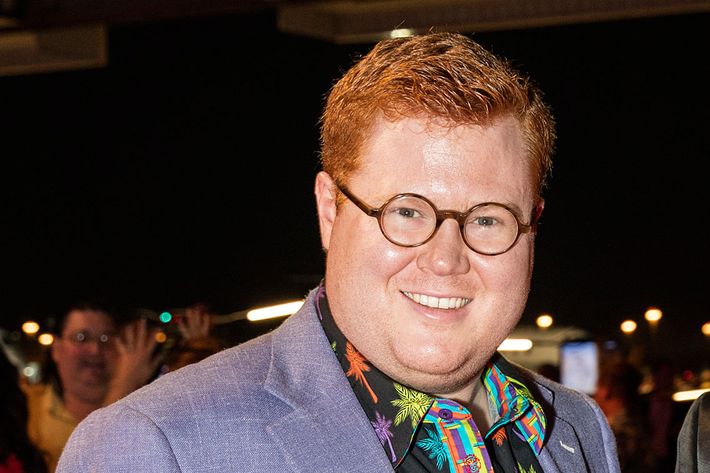
Should that rich slob, just because he's rolling in inherited money,  have more right to higher web speeds (to sell his stupid rich man shirts)  because he can pay for them? Hell no!

 According to Pai (ibid.):

"To me, markets and market -oriented policies have delivered far more value to the consumer than pre-emptive regulation ever has."


If Pai's arguments were really sound why not first do all he and the FCC can to make all net speeds much higher as opposed to "comparable to Estonia" as John Oliver joked in his piece.  The reason is that Pai and his cronies want to slow net speeds down even more for the rest of us so that private entities, that can pay a lot more, get preferential treatment in the form of much greater speed, efficiency.

What about winners and losers in the coming debacle?

After the FCC released its plan in late November, well-known telecom and media analysts Craig Moffett and Michael Nathanson wrote in a note to investors that the FCC plan dismantles “virtually all of the important tenets of net neutrality itself.”

That could result in phone and cable companies forcing people to pay more to do what they want online. The technology community, meanwhile, fears that additional online tolls could hurt startups who can’t afford to pay them — and, over the long term, diminish innovation.

Losers then will almost certainly include most millennials who consume their sports, news, entertainment via online streaming. They can expect speeds to slow to a snail's pace unless they pay more. Also affected will be those who do frequent youtube spots. With no net neutrality they will be relegated to the slow lane and take hours to upload even a five or ten minute video.   In 2007, for example, the Associated Press found Comcast was blocking or throttling some file-sharing. AT&T blocked Skype and other internet calling services on the iPhone until 2009. They also aren’t backing away from subtler forms of discrimination that favor their own services.

Of course, the deep pockets of Google, Netflix, Amazon may well be sufficient - provided their share prices remain high - to pay off ISPs to make sure consumers can access our service.

A far more likely target for loss is free speech.With this FCC ruling, corporations will have control over what content citizens can access on the internet. It could be as simple as Comcast blocking websites with negative comments on their service. Or it could be as sinister as an ISP blocking access to political content, news and writing that it opposes. Just think of it! Much of the content on this blog is highly controversial, for example the strong anti-Trump stance, and also to a degree the anti-conservative stance.

If you are a proponent of every American’s right to free speech, this should be frightening to the core. No company or corporation should be able to control what information we can consume, with a few exceptions, e.g. bomb- making manuals put out by terrorists. But no interested reader should be denied anti-Trump material such as often appears on this blog.

ISPs like Comcast have said they would never take it this far. But why do they even need the option? When Comcast is your only choice, what prevents them from extracting every penny possible from you and the online businesses that constantly inundate our lives?

This is exactly why many of us inveighed against the 1996 Telecommunications Act.  Writing in his book, The Problem of the Media, Robert McChesney had this to say (p. 51);

"The corruption in media policy making culminated in the passage of the 1996 Telecommunications Act, arguably one of the most important pieces of U.S. legislation. The law rewrote the regulatory regime for radio, television, cable television, and satellite communication - indeed, all of electronic communication including the internet.


The operating premise of the law was that the new communications technologies - combined with increased appreciation for the genius of the market- rendered the traditional regulatory market moot.

The solution therefore was to lift regulations and ownership restrictions from commercial media and communication companies, and allow competition in the marketplace to develop, and reduce the government's role to that of protecting private property.

There was virtually no dissent whatsoever to this legislation from either party, the law sailed through both houses of congress, and was signed by a jubilant President Clinton in February, 1996. Corporate CEOs regarded it as their "Magna Carta"."


The preceding  lesson from McChesney ought to be a no-brainer for us now: not to be fooled again by the "deregulation is good for ya" banter. Fool us once, shame on them, fool us twice, shame on US.


So far, there have been hundreds of public protests against Pai’s plan and more than 1 million calls to Congress through a pro-net neutrality coalition’s site. Smaller tech websites such as Reddit, Kickstarter and Mozilla put dramatic overlays on their sites Tuesday in support of net neutrality. Twitter on Wednesday was promoting #NetNeutrality as a trending topic. Other big tech companies were more muted in their support.

Public-interest groups Free Press and Public Knowledge are already promising to go after Pai’s rules in the courts. There may also be attempts to legislate net neutrality rules, which the telecom industry supports. Sen. John Thune, a South Dakota Republican, on Tuesday called for “bipartisan legislation” on net neutrality that would “enshrine protections for consumers with the backing of law.”

See also:

http://www.smirkingchimp.com/thread/david-morris/76842/to-save-the-internet-we-must-own-the-networks

Excerpt:

"Pai is dead wrong that this flurry of activity has been done to advance the public interest. Indeed, as one might expect from a man who once worked for telecom giant Verizon, Pai has directed an unprecedented abdication by the FCC of its responsibility to protect the public welfare. ...The Electronic Frontier Foundation (EFF), the oldest organization defending civil liberties in a digital age, warns that allowing ISPs to monitor and manipulate data makes the web more vulnerable to attacks....

Adding insult to injury, Pai’s FCC also halted enforcement of a rule demanding Internet providers “take reasonable measures to protect customer (personal information) from unauthorized use, disclosure or access."

And:

 http://www.smirkingchimp.com/thread/jacob-sugarman/76774/is-fcc-chairman-ajit-pai-a-closeted-alt-right-sympathizer

Saturday, May 20, 2017

Net Neutrality On The Chopping Block - Thanks To Another Trump Toady

Image result for AjitPai protest images
Protesters outside Ajit Pai's home, for net neutrality and against his scrapping of Title II regs.

Two weeks ago, comedian John Oliver delivered a superb explanation of 'Title I' and 'Title II' regs in respect to the internet and how assorted spinners sought to confuse the public on net neutrality. Oliver argued that Title II regulations are designed to protect the net,  i.e.  barricade it against the sole use of private interests.

Those who missed the segment can watch it at this link:

https://www.youtube.com/watch?v=fpbOEoRrHyU

 
Oliver argued the net in its current form is not broken, while noting the FCC was pushing for a 'two tier' system.  Killing net neutrality would allow private companies to go into the fast lane leaving everyone else in the slow line. To get your streaming movies or shows then might take twice as long as it does now, while higher paying corporate entities - like Comcast - speed their ads through with ease. To refresh memories, the Obama FCC - to preserve net neutrality - ceased treating the internet as an unregulated information service- instead reclassifying it as a "telecommunications service". Thereby the FCC could assert authority to regulate the net as a utility under Title II of the Communications Act of 1934.

Oliver was so energized at the prospect of the new FCC chairman (Ajit Pai) overturning the Obama FCC rules that he provided viewers with a rapid link to enter comments at the FCC - supposedly seeking them for 120 days: www.gofccyourself.com. 

This latest influx of viewer comments came quicker than 2 years ago, adding about 150,000 in a little more than a day . But it appears the FCC Trumpazoids anticipated it and created a Box.com account for bulk comment filings. The effect has been that commenters' requests have been getting blocked or tied up by an automated attack.  It seems that barely any have made it through, but we're expected to believe this change was made to "better handle traffic than last time".

Now we know why. According to a story yesterday in the WSJ Business & Finance section (p. B1) it is clear the FCC plans to "chip away at net neutrality". As reported, the FCC on Thursday "approved a plan to begin rolling back Obama era net neutrality rules".  This was accomplished by virtue of the 2 Repukes on the FCC panel overriding opposition from the lone Democrat to push this perfidy through.

Led by Trump  toady Ajit Pai, the FCC is now set to spend the  coming months drafting new rules that, if implemented, will slow down the net considerably for any who use DL'ing, including streaming of videos (including for Netflix and Amazon services).  Pai, like other Trump -appointed hacks (Tom Price at HHS, out to destroy Medicare, Scott Pruitt at EPA, out to destroy that agency or weaken it to the point of uselessness) is convinced the Obama era rules adopted in 2015 have "harmed the internet" by retarding investment in broad band infrastructure. 

In other words net neutrality is a no-no because it represents the continuation of "heavy handed regulation which will chill investment in a service increasingly critical to life in American society".

According to Pai, mastering the lingo of Wall Street speak (WSJ, today, p. A11), the small ISPs are being left out of the market because they can't compete with the big boys. Pai claimed he "heard from 19 small, government -owned, municipal broadband providers" who insisted that Title II regs stood in the way of their further investment. In effect, depriving hundreds of thousands living in those municipalities of accessing new services and the small ISPs from deepening their networks.

In Pai's mind the basic error of too many on the left is thinking "there is a dichotomy between the consumer and the market". No, there isn't. It's all in our imaginations - or our paranoid ideations- take you pick. According to Pai (ibid., today):

"To me, markets and market -oriented policies have delivered far more value to the consumer than pre-emptive regulation ever has."

It appears then that Pai like his FCC R-commissioners, is ignorant or oblivious to the lessons of the 1996 Telecommunications Act.  That also was promised to us as the be-all 'elixir' to finally get our cable TV rates down because of increased market competition. Instead, after a few years we found (n Maryland) competition diminished and less resourceful companies moved out allowing Comcast to charge whatever it wanted.  People were furious because they'd been sold the "de-regulated bait and switch".

If Pai's arguments were really sound why not first do all he and the FCC can to make all net speeds much higher as opposed to "comparable to Estonia" as Oliver joked in his piece.  The reason is that Pai and his cronies want to slow net speeds down even more for the rest of us so that private entities, that can pay a lot more, get preferential treatment in the form of much greater speed, efficiency.

Writing in his book, The Problem of the Media, Robert McChesney had this to say (p. 51);

"The corruption in media policy making culminated in the passage of the 1996 Telecommunications Act, arguably one of the most important pieces of U.S. legislation. The law rewrote the regulatory regime for radio, television, cable television, and satellite communication - indeed, all of electronic communication including the internet.

The operating premise of the law was that the new communications technologies - combined with increased appreciation for the genius of the market- rendered the traditional regulatory market moot.

The solution therefore was to lift regulations and ownership restrictions from commercial media and communication companies, and allow competition in the marketplace to develop, and reduce the government's role to that of protecting private property.

There was virtually no dissent whatsoever to this legislation from either party, the law sailed through both houses of congress, and was signed by a jubilant President Clinton in February, 1996. Corporate CEOs regarded it as their "Magna Carta"."


The preceding  lesson from McChesney ought to be a no-brainer for us now: not to be fooled again by the "deregulation is good for ya" banter. Fool us once, shame on them, fool us twice, shame on US.

See also:

http://www.smirkingchimp.com/thread/paul-rogat-loeb/72909/how-the-christian-coalition-and-moveon-saved-internet-neutrality-and-why-we-need-to-save-it-again
 

Tuesday, May 31, 2016

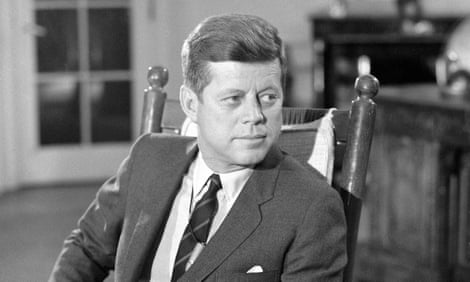
Am I A ' Leftist Radical'? Nope, Just A JFK- Era Liberal Who Never Changed Over 54 Years!


JFK - denounced as a "statist" as well as a "commie"  - so I figure I'm in good company!

Back in in the mid-90s I was taken aback at the accusations of "commie"  hurled at me by unhinged lone nut defenders (e.g. of the 'lone nut',  Warren Commission codswallop) on the JFK usenet groups. It was particularly evident on alt.jfk.conspiracy (moderated) run by erstwhile Marquette political science prof John McAdams. The reason for their ire? My robust defense of JFK's decision to issue National Security Action Memorandum 263 to pull all U.S. personnel out of Viet Nam by calendar year 1965.

Of course, the original retort of Warrenite pawns was to insist JFK never intended any such thing. Then, I had to inform them that what has often been cited as the NSAM, i.e.

http://www.jfklibrary.org/Asset-Viewer/w6LJoSnW4UehkaH9Ip5IAA.aspx


Is in fact only the cover letter by McGeorge Bundy. It has only passing relevance to the actual content of the NSAM, but it does clearly state “the President approved sections IB(1-3) of the report". Which report? To find these, the researcher must turn to Document 142 in The Pentagon Papers: ‘Report of McNamara Taylor Mission to South Vietnam'. Then the serious researcher will read:

IB(2) A program be established to train Vietnamese so that essential functions now performed by U.S. military personnel can be carried out by the Vietnamese by the end of 1965. It should be possible to withdraw the bulk of U.S. military personnel by that time.

IB(3): In accordance with the program to train progressively Vietnamese to take over military functions, the Defense Department should announce in the very near future presently prepared plans to withdraw 1,000 U.S. military personnel by the end of 1963.


When that clarification became impossible to refute, they jumped on the "commie" epithet bandwagon. This then brings us to: What happens in this country if one comes to a certain political position then retains that position while the entire political spectrum shifts around him?  This is a question I've frequently asked myself as I've beheld dozens of people around me shift their politics to suit the mood of the moment or the media's tune. It has included family, friends as well as others.

For reference, let me make it clear I am not only knowledgeable of JFK's many anti-war policies (including the Nuclear Test Ban Treaty of Aug., 1963) but also embracing them. That's because I am an old line Kennedy-style liberal who has never altered his position an iota since the early 1960s.  (Even years before I could vote). I  make no apologies for that, though the party I once belonged to has now moved center -right and corporate. In the words of a recent salon.com piece: "The majority of Democrats have shifted to the right so far that the two-party system is almost unrecognizable, according to Noam Chomsky".

 The same piece quotes MIT Prof Noam Chomsky:
There used to be a quip that the United States was a one-party state with a business party that had two factions: the Democrats and Republicans—and that used to be pretty accurate, but it’s not anymore. The U.S. is still a two-party state, but there’s only one faction, and it’s not Democrats, it’s moderate Republicans. Today’s Democrats have shifted to the right,”

This was originally related to an interview by RT America’s Anissa Naouai.
Chomsky's insights are spot on, and as I've posted before, the only reason some perceive me as a Marxist Socialist or "communist" (as opposed to FDR-JFK style liberal) today is because: 1) Their own positions have shifted radically right and 2) they're unaware how the political spectrum shift has been warped by propaganda, revisionist history. (Such as the Rightist trope that JFK was "really a cold warrior" and 'fiscal conservative' when all the evidence indicates this is balderdash, e.g.

http://brane-space.blogspot.com/2012/07/thats-right-now-blame-60s-jfk-for.html


For example, invoking moderate deficit spending of the type used during WWII, as noted by Prof. Donald Gibson "(Battling Wall Street: The JFK Presidency') :

"What Kennedy attempted to effect .....in the three years he was in office, was a moderate peacetime version of the federal policy during World War Two."

What was the result? Professor Gibson once more:

"During the years affected immediately by Kennedy's policies , 1962 to 1964-65, the U.S. economy returned to and even exceeded the rapid growth displayed during the pre-stagnation period" (of WWII).

But the philosophic conflation of liberals with commies  (as JFK himself was identified after signing the 1963 Nuclear Test Ban Treaty) occurred long before JFK reached office. Commie hysteria - the "Red Panic"- probably began in the late 1940s soon after the Russians got the A-bomb.

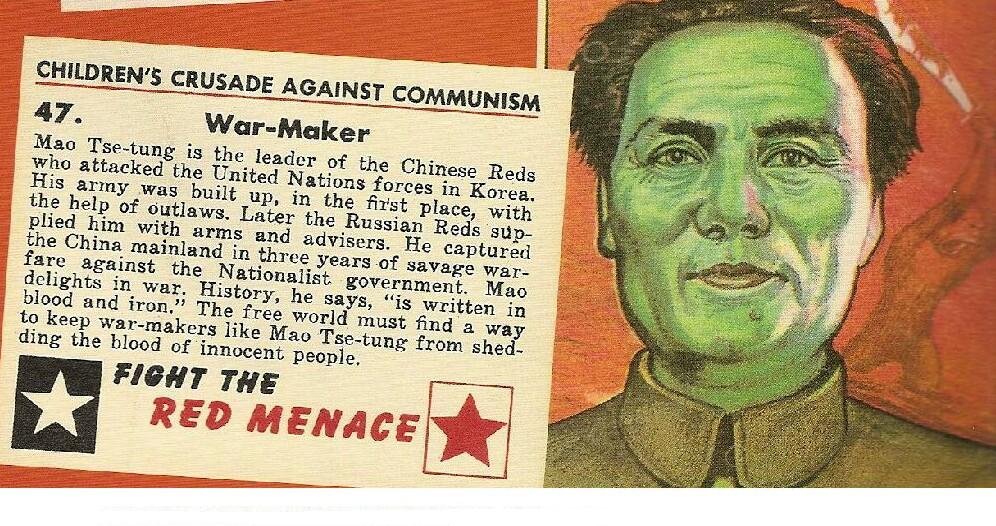
The 1950s then became a decade of runaway paranoia which most of those who didn't live then can't even begin to imagine. One marker is shown below,  in one of the "Crusade Against Communists" trading cards produced by TOPPS, e.g.

 The aim was to inculcate ‘Communist Recognition’ in children 7 to 10 years old, and get them to hate this system even before they knew what it was about. The garish depictions, such as that shown of Mao Tse-Tung with ghoulish green face  - helped to reinforce the propaganda.   Hysteria grew as an admixture when millions of grade schoolers - like I was in 1952- had to duck under our desks in regular drills to "escape the fallout from Communist atomic bombs". Air raid sirens screamed as whole cities underwent "emergency drills" and CONELRAD broadcast its ominous messages and beeps. 

The TV at the time didn't help either, with propaganda shlock like "I Led Three Lives" fucking up viewers' brains to a far-thee-well.

Then there were the House Un-American Activities  Committee (HUAC) sessions convened by rabid, anti-commie ideologue, Sen. Joseph McCarthy - who makes Ted Cruz look like a wienie or wimp. McCarthy's insane crusade ended up tarring thousands of innocent Americans with the "commie" brush, because too many lame brains were caught up in his nonsense and never approached his hearings analytically until the very end.

By the 1960s, I'd had it with the American propaganda and began sending for 'Soviet Life' magazine from the Russian Embassy in D.C. Sure it was propaganda - I knew that - but I wanted to see what the other side had to say. After receiving about seven issues, however, I grew bored reading of all the "agrarian reforms". 

By the end of Reagan's 2nd term, commie myths and hatreds were well entrenched and Ronnie the pop-eyed fool (who once asked a Naval commander if cruise missiles could be "recalled")  could get away with calling the USSR the "Evil Empire". Never mind this "evil empire" saved the West's living ass as it turned back Hitler's troops in World War II, at the cost of losing 20 million of their own people. Think about that! How do you think America would have handled a vicious aggressor actually invading the nation and laying waste to major cities as the Hitlerites did to Russia? And losing 20 million?  (For some insight, google: "Battle of Stalingrad")


What about Trump who seems neither left nor right? One commenter's take on smirkingchimp.com encapsulates him:

"Trump is a giant sized real estate salesboy, nothing more. he is used car sales trash grown fat. Trump is a reflection of a society turned away from productive activity, belittling honest labor and skills as nerd stuff, glorifying sales trash and marketeer "sell the sizzle" non values. It is a reflection of a world that promotes "selling the brand" over the product. It is a reflection where the ONLY purpose of a business is to make money with no ethics, no expectation to produce anything, no obligation to the employees, no obligation to the community. It is a broken society. trump is not a healthy human being."

 
What  'Blood Red Sun' is writing here I pretty well agree with. Trump is more a carny barker or "sales pitch man" than actual politician - of the Left or the Right. Those party demarcations mean nothing to him so he can easily flip flop - whether on abortion rights, Social Security, military expenditure, taxes or whatever he wants.

Back to the Democrats. Their mutation toward corporate elitism began when they embraced Neoliberalism via the Democratic Leadership Council  (DLC) in the Reagan era, and 'Fix the Debt' by 2010.  The Party effectively became Republican lite – though they've always tried to make us believe they’re the 2nd coming of true Dem liberal populists.

Bah!  If you want to behold true Democratic populists look at the Bernie Sanders' campaign. Then look how shabbily it's been treated by the Dem establishment, aka Neoliberals.

Some perspective on this is provided by Robert McChesney in his excellent book, The Problem of the Media, Monthly Review Press, 2004, p. 49:

"With the election of Ronald Reagan, the neoliberal movement had commenced. Neoliberal ideology became hegemonic not only among Republicans but also in the Democratic Party of Bill Clinton, Al Gore, and Joseph Liebermann. Differences remained on timing and specifics, but on core issues both parties agreed that business was the rightful ruler over society.

It was a return to the 1920s - if not the Gilded Age of the late nineteenth century. Few industries seized the neoliberal high ground as firmly as the media and communications industries.

A new generation of economists trumpeted the value of applying market principles to all communication policy matters, as one of them put it, 'the ancien regime was often dominated by ad hoc prescriptions premised on shaky economics applied to dubious histories'.

--snip--

Behind the mighty rhetoric, the stakes were clear. These corporations knew if they were granted First Amendment protection, their existence and operations "would be placed beyond the reach of majorities"


McChesney goes on to note (p. 51) that this is pretty well what DLC'er Clinton accomplished with his 1996 Telecommunications ActWhich as we may recall, also set the stage for Bernie Ebbers' WorldCom scandal, as well as the Adelphia travesty.

Again, McChesney (p. 51):


"The corruption in media policy making culminated in the passage of the 1996 Telecommunications Act, arguably one of the most important pieces of U.S. legislation. The law rewrote the regulatory regime for radio, television, cable television, and satellite communication - indeed, all of electronic communication including the internet.

The operating premise of the law was that the new communications technologies - combined with increased appreciation for the genius of the market- rendered the traditional regulatory market moot.

The solution therefore was to lift regulations and ownership restrictions from commercial media and communication companies, and allow competition in the marketplace to develop, and reduce the government's role to that of protecting private property.

There was virtually no dissent whatsoever to this legislation from either party, the law sailed through both houses of congress, and was signed by a jubilant President Clinton in February, 1996. Corporate CEOs regarded it as their "Magna Carta".


It was around this time I ceased membership in the Democratic Party and became an Independent instead. This meant I had the total freedom not to be bound by a party -  or its platforms -  that no longer embodied my old line JFK-FDR principles. Was I wrong? No!


The Democrats had indeed forgotten the foremost words of JFK himself:


For the Democratic Party is not a collection of diverse interests brought together only to win elections. We are united instead by a common history and heritage--by a respect for the deeds of the past and a recognition of the needs of the future.


Personally, I predict a schism in the D-party as it  drifts ever more rightward. On one side you will have the wine and brie eating elite Dems who man the investment banks, are CEOs of corporations and make up most of the "super delegates" that ensured Bernie's loss. On the other side will be the 10 million plus who voted Sanders in the primaries and are dedicated to  defending and speaking for its traditional constituencies - as well as the millions of new immigrants entering the country.

The choice of the current  Dems is this: do you continue your DLC ways - which have now cost three consecutive congressional elections (including the Dem loss of the Senate in '14) or do you change your ways?

Do you continue to whore for corporate America in the perverse belief that "business is the rightful ruler of the society" or do you return to the defense of the interests of the ordinary Joe and Jane?

The answers to these questions will ultimately determine the quality of life for the citizens of this country.

Thursday, November 20, 2014

Net Neutrality: A Case of Free Speech vs. Money Speech

I don't believe any blogger or ordinary person that uses the net frequently is unaware of the consequences if net neutrality is somehow derailed, despite President Obama's recent statement praising an even playing field. But, as with most arenas in our declining land, the major  Neoliberal moguls detest little guys having any say equal to their own- so hope to buy their way to faster internet speeds at the expense of the rest of us.

If I was unable to get my blog up in an expeditious and timely manner, despite a particular topic (say quantum statistics) that may only be read by 10 people - believe me I wouldn't be doing this much longer. The headaches simply wouldn't be worth it. I do it now because I don't have to pay higher than normal costs to get my material published - whether educational or political opinion.

But that may not last, especially as it really comes down to the principle of free speech, the ability of people to speak out on any issues and not be censored or impeded, versus monied speech- which currently inundates and corrupts our political system. In the case of the latter, money can buy whatever it wants and currently dwarfs citizen speech in the political domain. This, of course, is why money can't be considered speech at all. But don't tell the ISP providers that and others that want to take advantage of higher net speeds. If they could slow contentious bloggers to a crawl, believe me they'd do it in a heartbeat.

And if you don't believe this pertains to you, say as a FOX watcher, think again! As has already been noted the scenario of zero net neutrality could allow Comcast (which owns MSNBC) for example, to slow down access to the FOX News site simply because it wishes to limit its competitor. ('Whose Internet Is It?', TIME, Nov. 17, p. 14).

Now, while it is true that the FCC in May did propose new rules that prohibit ISPs from blocking or slowing legal Internet traffic, it did not ban paid prioritization - which to me is a back door means to undermine net neutrality. This "paid prioritization"   means that companies can deliver their particular content faster to their customers for specific paid fees. In other words, the companies gain a technical advantage over the rest of us.

Some deluded citizens see no problem with this, as the case of a letter writer in yesterday's Denver Post, who bawled "There is another urgent need for postal neutrality! Why should my package get there faster than anyone else's just because I can pay more."  But what the meat head fails to grasp is that net speech is not in the same category as package delivery by a business like Fed-Ex, UPS or the USPS. (Which is why the only rational resolution may be to somehow resolve the net into business and speech enclaves - and have net neutrality in the latter and paid prioritization in the former.)  This may be a difficult technological problem, but I don't believe it's insuperable.

If it had been feasible then there wouldn't have been the public outcry in the wake of the FCC's proposed rules which preserved the fees ISPs collect from big content producers like Netflix. They pay to connect directly to the back end of their networks and reach customers more quickly.  When ordinary folks learned of that, nearly 4 million wrote to the FCC to complain.(Ibid.)

Comcast and others claim back end connections have nothing to do with net neutrality, but clearly if the business component of the net is gaining speed advantage, it does. Alas, the FCC's Tom Wheeler also seems to believe paid prioritization over the last mile of broad band ought not be considered a fast lane, though in principle it is.  Thus, it appears the definitions are being obfuscated to disinform the communication landscape - as most tech companies like Google and Facebook don't agree.

Again, the solution appears to be arriving at the ability to separate the net into distinct enclaves - one for speech, the other strictly business. However, this likely wouldn't be remotely feasible until the first real quantum computers come online - and who knows when that will be? Recall that quantum computers use qubits, superpositions of 1s and 0s, as opposed to either one binary bit or the other to code information.

Until then, the only reasonable solution - it seems to me - is for the FCC to propose new rules and reclassify broadband under Title II of the Communications Act which would give the FCC authority to fully regulate broadband. Of course,  the big ISPs will surely oppose this but most savvy internet lawyers are clear that this would be the only way the FCC can have the legal authority to withstand Big Money court challenges.

Yes, in the end it's about free speech vs. money speech, especially as 80 percent of Americans (according to the FCC's Wheeler) with high speed broad band have access to only once choice of ISP. A travesty that was forseeable after the Telecommunications Act was passed in 1996. The long and short of it is the lack of ISP competition means most Americans are hostage to a single ISP. That means any back end moves or paid prioritization effectively detract from free speech.

We can't let this happen no matter how much the Neoliberal free marketeers or their political lackeys scream and bawl.


Friday, February 14, 2014

The Comcast $45 b Merger: Will Rampant Neoliberalism Prevail Again?

According to Wikipedia:

"The Sherman Antitrust Act (Sherman Act,[1] July 2, 1890, ch. 647, 26 Stat. 209, 15 U.S.C. §§ 17) is a landmark federal statute on United States competition law passed by Congress in 1890. It prohibits certain business activities that federal government regulators deem to be anticompetitive, and requires the federal government to investigate and pursue trusts.  It has since, more broadly, been used to oppose the combination of entities that could potentially harm competition, such as monopolies or cartels. According to its authors, it was not intended to impact market gains obtained by honest means, by benefiting the consumer more than the competitors"

This is relevant now as the news that the largest cable provider in the U.S. plans to buy the second largest cable company, Time Warner Cable, for $45 billion is an obvious antitrust violation.  It will create a gigantic media-telecommunications monstrosity that will not only be able to control consumer access but content.  It will also drive up the costs of cable TV - perhaps as much as 14%.
We all expected this when the 1996 Telecommunications Act was passed under Clinton's watch, and while it was touted as a pathway to greater competition and lower costs, that wasn't how it panned out. Indeed, within a year Comcast had driven out all competition in Maryland, as cable prices soared.  But none of us familiar with the Neoliberal idiom thought anything different would happen. We understand that the dictates of  Neoliberalism actually require a coercive market, meaning choices collapse and citizens are left with few options. (Given Neoliberalism demands a retraction of citizen security on all fronts.)
One of the classic examples has been book publishing What had been a vigorous industry of competition with 30 or more publishers at the end of the 1960s has now mutated into one controlled by 2-3 mega-players like Bertelsmann AG. Why does it matter? Because firstly, reading options can be severely foreclosed. Hard hitting atheist books, for example, will be much less likely to be published, certainly by a major company. This means far less exposure. Ditto for books that reject the Warren Commission conclusion to do with the Kennedy assassination. In many cases then, authors may be forced to take the route of self-publishing.

 Secondly, this accounts for why midlist or lower authors who could find a niche and make a living some 45 years ago can no longer do so.  The multinational publishers barely look at an unknown, they're not certifiably profitable enough. While small independent publishers in the 60s would tolerate even a 5-6% profit margin and often less, the big players today demand 15% or more. Thus, they won't take an author on unless s/he's a J.K. Rowling or Tom Clancy.
In the case of telecommunications the issues are more critical for many more citizens, because what's at stake is not only content and cost, but access.  Jodie Griffin, senior staff attorney at the consumer rights group, Public Knowledge, made it clear:
"This is a deal that needs to be blocked"
. She said Comcast would use the leverage to "drive up costs and reduce choices for consumers."
She also added it would be a 'gatekeeper' - throttling competition.

How big a deal is this merger? After it occurs, if it does,  Comcast would boast 33 million broadband Internet subscribers and control half the market for so-called triple play (broadband, TV, telephone) access in the U.S. As GigaOm immediately pointed out, this is best understood as a broadband Internet play, not a traditional cable-TV access move.  Also noted by GigaOm:

"If it is allowed to gobble up its number two rival, Time Warner Cable. Philadelphia-based Comcast will become the largest broadband provider in the United States, and perhaps the largest outside China.”
 
Those are numbers that should give pause to every Netflix-watcher, as well as YouTube users, Spotify streamers, or any other consumer of high-bandwidth Internet services.The sheer physical reality of our nation’s telecommunication infrastructure means that whoever controls the cable network has the biggest leg up in the Internet access sweepstakes. Verizon and Google are attempting to roll out fiber-optic “last mile” networks that can compete effectively with cable speeds, but right now, the cable companies already own a considerable advantage over all their competitors in terms of being able to offer the fastest download and upload speeds.

This is a BIG deal unless you are like me, and don't fret over slower speeds. (I do something else like read a book if a DL - say of an MIT physics lecture - is taking longer).
 
A post-merger Comcast operating in a marketplace in which the courts have ruled against network neutrality would be immensely powerful, able to dictate bandwidth consumption fees to consumers and content providers at will.  But this is the very essence of the Neoliberal market imperative, which isn't about competition or lower costs for consumers but rather more profits for the mega-companies that contribute more in political largesse to our Neoliberal pols.
The onset of the Neoliberal meme was well articulated by Robert McChesney in his excellent book, The Problem of the Media, Monthly Review Press, 2004, p. 49:

"With the election of Ronald Reagan, the neoliberal movement had commenced. Neoliberal ideology became hegemonic not only among Republicans but also in the Democratic Party of Bill Clinton, Al Gore, and Joseph Liebermann. Differences remained on timing and specifics, but on core issues both parties agreed that business was the rightful ruler over society.

It was a return to the 1920s - if not the Gilded Age of the late nineteenth century. Few industries seized the neoliberal high ground as firmly as the media and communications industries.

A new generation of economists trumpeted the value of applying market principles to all communication policy matters, as one of them put it, 'the ancient regime was often dominated by ad hoc prescriptions premised on shaky economics applied to dubious histories'."
In other words, a coercive market via mergers is created, which exists in order to self-reinforce the Neoliberal political and media establishment that already exists. Don't believe me? Look back at November and the travesty of how the 50th anniversary of the JFK assassination was reported by ALL the media! It was uniformly portrayed as being a "settled issue" and Lee Harvey Oswald dunnit- never mind I showed the opposite in my blog posts for that month. This is one example - a critical  one- of how a uniform, undifferentiated media can manipulate thought and debate.
Given the stakes in this merger decision,  Tom Wheeler, the newly installed chairman of the FCC — will be on the hot seat. Will he disclose himself to be a Neoliberal lackey, or do the right thing and kill this deal where it stands?   The omens aren't fortuitous given Wheeler is a former cable industry lobbyist. This alone exposes the intrusion of the Neoliberal virus into our political-economic landscape. Because in a true liberal,  market competitive arena there'd be no transitions between "foxes" and the "hen house".  In this way, we'd be assured no fox is guarding the henhouse, as we too often behold with federal agencies in this country.
We also know that in the Neoliberal gestalt, tricks and gimmicks can be used to ease the corporate consolidations and monopolies.  Early analysis of this  proposed merger suggests that Comcast might evade antitrust scrutiny by shedding 3 million or so cable-TV subscribers, giving it just under one-third of the total number of such subscribers in the U.S. But don’t be fooled by this tactic.  Netflix CEO Reed Hastings has attacked Comcast, has accused the cable firm of capping data it provides to streaming companies like his own in order to favor Comcast’s own Xfinity video-on-demand. Recent studies show that Comcast users receive their Netflix media at significantly slower speeds than those using other internet service providers.

The Neoliberal puppets (as in the WaPo comments the other day) who defend the upcoming merger in "free market" terms, argue along the lines of "Well, in true competition Time -Warner lost out to Comcast so should be taken over."  Thereby, disclosing they have no clue. How to know if a market is free or coerced? Charles Reich provided the test in his 'Opposing the System’, 1995, p. 22:

"A free market produces results that favor the health of society as a whole, because an essential balance is maintained. But in a coercive market, the balance is destroyed, the earning power of work and the standard of living of workers declines, and society as a whole is devastated while those with economic power gain an ever more unbalanced share of the nation's economic wealth"

This is exactly what we have with the top 1% controlling 57% of the nation's wealth, and 400 billionaires with the same monetary resources as 150 million fellow citizens!
Keep an eye on the aftermath if this merger is approved by the FCC. If you're not convinced already, the likely approval and negative effects ought to finally convince you we are inhabiting a Neoliberal Corporatocracy, as opposed to any genuine, free market democracy!