Wednesday, May 4, 2022

Solutions To Differential Geometry Problems (Part 3)

 1) Sketch the graphs of;

x 2  = - Ö ( 8 2   -   x 1 22)

And:

x 2  = - Ö ( 16 2   -   x 1 22)

On the same Cartesian axes.

Soln.


2)(a) Write the polar form of the equation of the line:

3 x 1   +   4 x 2   =  5

Soln.

x 1 = r cos q

x 2   =  r sin q

then:  3 x 1   +   4 x 2   =  3 r cos q + 4 r sin q

The polar form of the equation is:

r [3 cos q + 4 sin q]  =  5

b)Determine the polar (r,  q) equation for :

x 1 2  + x 2 2   -  2ax 2  =  0,    a  ≠   0

And sketch the resulting curve.

Soln.

x 1 2    +    x 2 2  =   ( r cos q ) 2  +  ( r sin q ) 2

=   r 2 (cos 2 q   +   sin 2 q) 

=> (eqn. of circle)   r    =   2 a x 2  =   2a  sin q  


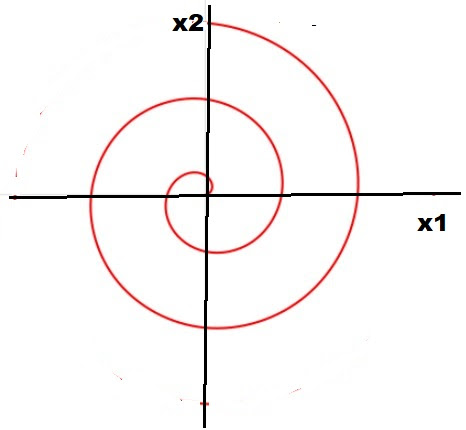
3)(a)  Let r and  q  be polar coordinates in the x 1 x 2 - plane. Give the representation of the following curve in Cartesian coordinates:

r =   a q

And sketch it.

Soln.

 (x 2 -   x 1)  tan  Ö ( x 1 2  +   x 2 22) /  a  =    0

This is an Archimedian spiral:


b)  A student's analysis of the curve (cardioid):

 r =   6 (1 - cos q),    is shown below:

Using differential calculus show how an expression for the angle y  can be obtained in terms of the angle   q.

Soln.

r =   6 (1 - cos q)

dr =   6 sin q  dq

tan y   =  r dq /  dr

tan y   =  6 (1 - cos q) d q /  6 sin q  dq

=   tan q/ 2

Tuesday, May 3, 2022

With Leaked Draft Of SC Extremists' Plan To Overturn Roe Colorado Prepares To Be Abortion Refuge- Sanctuary State

                      Virginia women celebrating after Youngkin win last year.  How will they feel when their rights to contraception are removed too?


A  sociological  'nuclear' bombshell went off yesterday evening with the leak of a 98-page  draft opinion circulated among Supreme Court justices  which indicated that a majority plan to overthrow the 1973 case Roe v. Wade that legalized abortion nationwide.  This was according to a report published Monday night in Politico.

It’s unclear if the draft represents the court’s final word on the matter. But knowing the radical Right Catholic extremists the traitor Trump succeeded in getting confirmed, i.e. Gorsuch, Kavanagh, Amy Coney-Barrett, it won't surprise if it does.  That's for those of us who've paid attention to all the radical Right's authoritarian moves.  (And whose next step, if we let them win this year and in '24, may be getting rid of contraception access as well. But too many are too fogged by inflation worries to see through to the real threats to their well being.)

The contentious  “1st Draft” of the “Opinion of the Court” involves  a case challenging Mississippi’s ban on abortion after 15 weeks, known as Dobbs v. Jackson Women’s Health Organization. Many court observers and activist progressive groups - from NARAL to Planned Parenthood - believed the SC would use the case as a 'pivot' to overturn Roe and it appears now it has. 

True, the Supreme Court has yet to issue a ruling in the case, and opinions — and even justices’ votes have been known to change during the drafting process-  but that doesn't assuage the fears of those who've been following the assorted Red state moves the past 2-odd years, from Texas to Oklahoma and beyond. The court is expected to rule on the current MS case before its term is up in late June or early July.

More evidence the 'writing is on the wall' for abortion rights: The draft is signed by Justice Samuel Alito, a member of the court’s 6-3 conservative majority and one of the most outspoken Catholic extremists,  who was appointed by another popular vote loser (in 2000) Gee Dumbya Bush.  According to the fulsome wording and codswallop of Alito's draft opinion:

“Roe was egregiously wrong from the start.  We hold that Roe and Casey must be overruled.  The Constitution makes no reference to abortion, and no such right is implicitly protected by any constitutional provision. ”

The Constitution was heeded you extremist Nazi nitwit!  It was the law of the land since 1973 and based on the concept of an unenumerated right, as elaborated by Prof. Garry Wills  (‘A Necessary Evil: A History Of American Distrust of Government’, Simon & Schuster, 1999), i.e.

"the unenumerated rights are all those rights not already specifically declared or described in the existing document. The Founders thereby realized and understood there could exist rights in the future they hadn’t conceived of at the time of the Constitutional Convention, and so allowed those (then) undefined rights to become realized later. In other words, the rights allotted citizens are not limited to the rights actually and specifically delineated, i.e. in the Bill of Rights."

 The recognition of this dissolved once the yahoos in the damned Red states began pecking away at it, finally achieving a breakthrough in Texas, e.g.

  • Texas Version Of Taliban Imposes Draconian Abortion Law...
    •  Thanks to you Rightist SC bots who never looked askance at the Texas 'vigilante' law.  (A 'bot' being a programmed entity incapable of intellectual insight or self-awareness.)

      The leaked SC draft opinion in effect states there is no Constitutional right to abortion services.  This means the only relief for women who need abortions will be to come to Blue states, like Colorado, Connecticut and others.

      Colorado has long recognized legal abortion without any restrictions on when in a pregnancy one can access abortion care. Further, a Colorado legislative vote last month solidified the right to abortion as part of the state’s Constitution so no matter what the extremists on the Supreme Court do it won’t affect our laws.  But it does mean Colorado will now become an abortion sanctuary and refugee state – at least until the abortion pill RU-483 can be distributed nationwide and out of sight of the authoritarians.  This may be the only option for women to regain control of their bodies that the Court’s radical right Nazis have taken away.

      Demand for abortion care is certain to increase in Colorado in a post-Roe future. Among the U.S. states with “trigger laws” to ban abortion if and when Roe v. Wade falls, many either share a border or are close to Colorado: Idaho, Wyoming, Utah, South Dakota, Oklahoma and Texas.  In the words of Colorado House Majority leader Daneya Esgar (from Pueblo)  who sponsored this year's state law:

      "We knew this could happen. We knew this was coming. We know that there are going to be states where folks don’t have this access and we’re going to be the place they seek. … I’m hoping we have the capacity.”

      Those of us living in the only sane remnant of the country, the Blue states, hope this capacity is available too.  If not, we need to make it to ensure women get the care they need and ability to retain control of their bodies. In the meantime, citizens must realize - inflation pain or not- they cannot cede any more power to the Reep Right with bad voting choices, i.e. out of desperation that a change will be a cure all.

      And:

      by Joan McCarter | May 3, 2022 - 7:10am | permalink

      A First Look At Fresnel Diffraction (Part 1)

       Fresnel diffraction is the less well known version of diffraction and this is on account of it being more mathematically demanding than Fraunhofer diffraction - which I've already covered in several instalments, e.g.

      The Basics of Fraunhofer Diffraction & Its Applications (Pt. 1) (brane-space.blogspot.com)

      We begin our introduction by noting the irony of this form, i.e. it is the easiest to observe but also requires much more complex mathematical theory to explain it. The latter aspect is because Fraunhofer diffraction - dealing with light sources at a distance - treats plane waves, while Fresnel diffraction treats spherical waves, wavefronts. 

       Spherical wavefronts in Fresnel diffraction


      By their very nature then - because of the geometry - one will enter a more difficult mathematical realm.  Fortunately, because Fresnel diffraction was the first type to be observed, there was a longer lead time to develop the math behind it.


      How is it that Fresnel is easier to observe?  Well, for one thing,  one doesn't need lenses but can observe effects directly, such as shadows produced around edges. For example, consider the following: An opaque object - say coin - placed in the path of a point light source will produce a shadow with a fairly well defined outline with the same shape as the object. (The edge is not absolutely sharp when observed closely, however, but it seen to have alternating dark and light bands in the immediate vicinity of the edge.  According to Fresnel, this is because in the regions beyond the limits of the geometrical shadow secondary wavelets arrive with phase relations that destructively interfere with each other and produce practically complete darkness.  In other regions where there is slight reinforcement we observe lighter bands of shadow. 

       Central to Fresnel's approach to most diffraction problems are his "half period zones" whereby he found that a slightly divergent spherical wave will produce a point ahead of the wave and the resulting paths could be quantified in terms of the wavelength l, e.g.

      Here we have a spherical wave segment BCDE of monochromatic light traveling to the right to point P. Each point on the spherical segment can be thought of as an origin for secondary wavelets for which the resultant is found to terminate at point P.  The problem then becomes how to find the resultant effect.  Fresnel's approach prescribed dividing the wave front into a series of concentric "zones" as are visible in the image as something like circles on a target.  

      The specific technique then means drawing a series of circles around the point O.  The distances from point O, measured along the arc are: s 1 ,  s 2 ,   s 3,  ..... s n.  They are such that each successive circle is a half-wavelength farther from P.  Therefore, if the distance OP = b, we would have: b  + l /2,  b  + 2l /2,  b  + 3l /2,  ........b  +   m l /2  and so on.  

      The areas Am   of the  rings (zones) between successive circles are roughly equal to each other which can be proven by reference to the diagram below: 

      Here a section of the wave spreads out from P' with radius a.  If a circle of radius b is now drawn with center at P and tangent to the wave front at its pole O, the path P' QP is longer than the path POP by the short segmented denoted by D .  Then, quantifying:

       D  =  s 2 / 2a   +  s 2 / 2b     =   s 2  [(a + b)/ 2 ab] 

      Then the radii  sm   of the Fresnel zones are such that: 

      m l /2   =    s m 2  [(a + b)/ 2 ab]

      Then the area of any one zone is expressed:

       A m(D) = p  (s m   -  s m-1  ) 2  =    p l /2 {2 ab /  (a + b)} = 

      p l ab/ (a + b)  

      To the approximation considered, the area   is therefore independent of m .  (A more exact computation would disclose that the area icreases only very slowly with m.)

      Suggested Problems:

      1) The innermost zone of a zone plate has a diameter 0.425mm.  

      (a)Find the focal length of the plate when it is used with parallel incident light of wavelength 4471 Å from a helium lamp.

      (b) Find the first subsidiary focal length for the zone plate.


      2) A zone plate is to be set up on an optical bench where it will be used as an enlarging lens.  Its innermost zone will have a diameter of 0.2250 mm with monochromatic green light of wavelength 4800 Å  to be used.  If all enlargements are to be eightfold in diameter find the focal length f of the zone plate.

      Monday, May 2, 2022

      Is This The Most Distant Galaxy - Or Is The Freakish (Z-Shift) Object HD1 Something Else?


                          Three -color image of HD 1 based on data from recent Ap J paper


      Using the Atacama Large Millimeter/submillimeter Array, or ALMA — a collection of radio telescopes in Chile — a team of cosmologists lead by Yuichi Harikane and his team may have found the most distant galaxy yet, as reported in a recent issue of The Astrophysical Journal  (Vol.929, No. 1) :


      A Search for H-Dropout Lyman Break Galaxies at z ∼ 12–16 (iop.org)


       In particular they got a tentative redshift for HD1 of 13, meaning that the wavelength of the light emitted by an oxygen atom had been stretched to 14 times its wavelength at rest. Try to process that!  The other distant blob, HD2 is also under study but its redshift has not yet been determined.   But the data for the presumed galaxy HD1 tracks its existence to only 330 million years after the Big Bang, or smack in the hunting ground of the Webb telescope, which will also be able to confirm the redshift.


       That astronomic epoch of time is so far unexplored given it is so close to what we call the "decoupling" of matter from radiation.  The period is defined for when different types of particles fell out of thermal equilibrium with each other.   The effect basically being to make the mean free paths for particles (namely electrons) longer and hence the interaction rates less, meaning objects are more transparent to radiation.


      This occurs as a result of the expansion of the universe. In the expanding universe, the farther an object is from us, the faster it is moving away, which motion causes an object’s light to shift to longer redder wavelengths.  This is based on applying the principle of the Doppler effect.   This is analogous to the sound of a receding ambulance siren shifting to a lower tone or frequency as it gets further away. The gold standard of cosmic distances, however is the redshift, derived by obtaining a spectrum of the object and measuring how much the wavelengths emitted by characteristic elements have increased or shifted to the red.  See e.g.


      In search of the most distant galaxies the ALMA team sifted through some 70,000 objects, and HD1 was the reddest one they could find. It’s thought that HD1 may be home to the Universe’s very first stars, known as Population III stars, which until now have never been observed. In the words of the research paper's lead author, Yuichi Harikane:


      “HD1’s red color matched the expected characteristics of a galaxy 13.5 billion light years away surprisingly well, giving me a little bit of goose bumps when I found it,”


      Though the going bet is that the pair of HD objects are galaxies, the ALMA team can only guess for the time being. They may also be quasars or maybe something else entirely. What, exactly? Who knows? There can be no certainty until they get the chance to observe the objects directly with the new James Webb Space Telescope. But whatever they are, astronomers say, they could shed light on a crucial phase in the cosmos as it evolved from pristine primordial fire into planets, life and us. In the words of another co-author Fabio Pacucci of the Harvard-Smithsonian Center for Astrophysics:


      “I am excited as a kid who spots the very first firework in a magnificent and highly anticipated show. This could well be one of the first glimmers of light to illuminate the cosmos in a show that ultimately created every star, planet and even flower that we see around us today — more than 13 billion years later.”


      Pacucci was part of the ALMA team led by Yuichi Harikane of the University of Tokyo that spent 1,200 hours using various ground-based telescopes to search for very early galaxies.    The  ALMA team basic observations of HD2 conforms more or less with those of HD1, but the other blob’s redshift has not been determined.  In the words of Marcia Rieke of the University of Arizona, who is a principal investigator for the Webb telescope:


      “If the redshift from ALMA can be confirmed, then this would indeed be a spectacular object,” 


      According to the cosmological narrative thus far, the road to the material universe as we know it started about 100 million years after the Big Bang, when hydrogen and helium created in the primordial explosion began to condense into the first stars, known as Population III stars (Population I and II stars have large amounts of heavier elements, are present in galaxies today). Pop III stars, composed of only hydrogen and helium, have never been observed, and they would have been much bigger and brighter than the ones in the universe today. They would have burned hot and died fast in supernova explosions that then jump-started the chemical evolution polluting a pristine universe with elements like oxygen and iron, the stuff of us.


      Pacucci said the ALMA team  first thought that HD1 and HD2 were what are called starburst galaxies, which billow with new stars. But after further research, they discovered that HD1 seemed to be producing stars more than 10 times faster than such galaxies usually do.


      Another possibility, Pacucci said, is that this galaxy was birthing those very first ultra-luminous Population III stars. Yet another explanation is that all this radiance comes from material splashing into a supermassive black hole 100 million times the mass of the sun. But astronomers have trouble explaining how a black hole could have grown so big so early in cosmic time.  Avi Loeb, a co-author on Pacucci’s paper, and most famous for his paper on the strange object called Oumuamua, e.g.


      1810.11490.pdf (arxiv.org)


      said in an interview:


      “HD1 would represent a giant baby in the delivery room of the early universe,” 


      Giant baby or not, those of us invested in astronomy and cosmology can't wait to see what the Webb Telescope will reveal about these objects.


      See Also:

       Meet HD1, The New Most Distant Galaxy Found 13.5 Billion Years Back In Time And Close To The ‘Big Bang’ (forbes.com)