Wednesday, October 5, 2016

Rocketry: The Gateway To Understanding Space Technology


Few people living today are aware the Space Age began on October 4, 1957 with the launch of the Russian Sputnik satellite. (See newspaper clipping). Sputnik was a resounding event, and had the impact of a train collision on the American educational system and citizens'  consciousness. As the attached graphic shows, Sputnik was a 184 lb. satellite that orbited the Earth every 96 minutes at an altitude of about 900 km (600 miles).

I was 11 at the time, and had much more interest earlier on that particular day (a Friday) in how my Milwaukee Braves would fare in Game 3 (the next day, Saturday) of the World Series against the New York Yankees - than in any space exploits.

Some days later, we heard the first radio 'beeps' from Sputnik. The signal had been picked up by an RCA receiving station at Riverhead, New York and relayed to the NBC studios in Manhattan, when most of us alive then in the U.S. heard it over the Huntley-Brinkley Report.

How did the nation, including  politicos, react? (This was during the Eisenhower administration which alas, for most of the population today constitutes ancient history!) According to Paul Dickson, author of Sputnik: The Shock of the Century, p. 23:

"Polls taken within days of the launch showed that Americans were concerned - so concerned that almost every person surveyed was willing to see the national debt limit raised and forgo a proposed tax cut in order to get the United States moving in space"

The Sputnik moment triggered a space competition that would ultimately see the United States reaching the Moon before the Russians. It disclosed a collective willingness to sacrifice financially, via raising the debt limit,  and rescinding a proposed tax cut to achieve it.  And with very good reasons. By the time of Sputnik's launch in October, 1957, the Russians were producing some 66,000 engineers a year compared to the United States' 22,000. In addition, the key subjects of higher math and physics were almost nowhere to be found in the U.S. secondary school curriculum - nor were there the teachers to teach them. All this had to be factored into the coming expense to get the U.S. on a competitive par with the Soviets. Teacher education and training alone came to over $1 billion by the time of the Apollo 11 lunar landing.

By the early 1960s, physics, astronomy, math as well as the hobby of model rocketry had become a part of many students' lives. Those who might have been mildly interested in psychology or medicine turned instead to mathematics, physics, and rocket engineering. And the memory of Sputnik became the driving impetus leading many of us to want to build our own rockets - with their own payloads.
Space phenomena such as auroras, asteroids, cosmic rays and solar flares - while important -  also often provoke the desire to learn more about space technology. After all, getting a space telescope in orbit above Earth is the optimum way to observe celestial objects, only surpassed by  sending space probes to actually land on asteroids to take samples, e.g.

http://www.esa.int/Our_Activities/Space_Engineering_Technology/Asteroid_Impact_Mission/The_art_of_landing_on_an_asteroid

Thus the study of space often itself begins for many with the study of space vehicles and also construction of rockets. If one then begins by building and launching simple rockets - he or she goes a long way to becoming informed about the physics of space flight overall, as well as energized to learn more about advanced space propulsion systems.

My own rocketry exploits ran in parallel to my astronomy devotion. At the same time I was building my own refracting telescopes to observe celestial phenomena from M13 (globular cluster)  in Hercules to M 8 (Lagoon Nebula) in Sagittarius, I was also constructing my own model rockets to launch publicly - e.g. at Mgsr. Edward Pace High (where the entire school would be let out to watch a launch).  Below is shown a typical 2- stage design I'd use, with dimensions.


My single stage rockets were up to 16-18" in length and generally contained a payload section with parachute, within which a lizard, frog or cricket was often placed - on a comfortable wad of cotton to withstand the g-forces. A tiny side panel was cut out with plastic glued over it to allow a kind of small window.

Rocketeering, of course, also required a thorough study of the related physics principles. What is it that causes that single stage rocket to be thrust upwards? And can one compute the altitude from certain basic parameters? The first question can be answered with respect to the diagram below, and a model rocket launched by Colorado high school rocketeers::


As indicated in the diagram, the rocket’s motion changes when a fraction of its mass (D m) is released in the form of ejected gases. Since the gases acquired their own momentum, the rocket receives a compensating momentum in the opposite direction.  Therefore, the rocket is accelerated as a result of a push from the gases. In free space, or a vacuum, the entire system works independent of the presence of any opposing medium.

Assume at some time t, the momentum of the rocket plus fuel is: (M + D m)v, then at some later time: (t + D t), the rocket ejects some fraction of mass D m, so the rocket’s velocity must increase to (v + D v). By appealing to Newton’s 3rd law via an application of conservation of momentum,  we may write:


Total initial momentum of the rocket system = Total final momentum of the system

Then we get:

(M + D m)v = M(v + D v) + D m(v – v’)


Where v’ is the velocity with which the fuel is ejected relative to the rocket. The equation can then be simplified to yield:  Mdv = v dm, which may be integrated, viz.:

M òv1v2  dv = v òm1m2  dm

Or, letting m2 = M f, m1 = M i and v2 = v f, v1 = vi:

v f – vi:   = v’ ln [M i / M f]

Where the left side shows the difference between the final and initial velocities, M i refers to the initial rocket mass (fuel plus rocket proper) and M f refers to the final rocket mass with fuel expended.  (In general, for most rockets,    M i  >> M f ).

To see how this works, say a model rocket is launched by an amateur group in central Colorado (see image  at top)  of initial  total mass 1.0 kg. They used a Zn S (zinc sulfide) solid fuel engine for which the exhaust gases attained a velocity of 100 ms -1 relative to the rocket for 3 seconds.  After this interval, the rocket mass decreased to 0.05 kg.   We can then find the rocket’s acceleration and estimate the altitude assuming zero air drag and a near –vertical launch angle.

We have: M i = 1.0 kg, M f  = 0.05 kg

 Therefore, the difference between initial and final velocities is:
v f – vi:    =  v’ ln [M i  / M f]

v f – vi:     = (100 m/s) ln [1.0 kg/ 0.05kg]

v f – vi:    = (100 m/s) ln(20) = (100 m/s) (3) = 300 m/s

The altitude can be estimated by using the kinematic eqn.

s = ½ at2

where s is the vertical displacement for an acceleration a, over time t.

s = ½ (300 ms-2) (3)2  

s = 450 m  or  1 485 ft.

For the rocket itself, the key parameter is usually the thrust, on which the rocket's velocity will depend. The graphic below gives an idea how the average thrust of a given rocket engine is obtained:


Total Impulse, as indicated above, is extremely critical and a property of the solid rocket engine one uses - each of which has a specified value in model rocketry with units in Newton-seconds or pound -seconds. The 16 0z. in the factor on the extreme right is because this is generally regarded as the upper limit for the model rocket. Above this and there is too high a danger of instability - mainly that the design will not allow the center of gravity to be ahead of the center of pressure as it needs to
be.

Let's say the model rocketeer wishes to compute the velocity v2 from the equation above, using the units (feet-pounds) as indicated.  Let the total impulse of the engine be 10 pound-seconds, and the burn time of the engine be 2 seconds. Then the force F or thrust is:

(10 lb-sec)/ 2 sec  x (16 oz/ 1 lb) = 80 oz.

Then the velocity v2 = (80 oz/ 10 oz   - 1)  32 ft/ sec/sec (2 sec)

Assuming the average weight of the rocket at lift off is 10 oz.

v2 = (8 - 1) (64 ft/ sec)  =  7( 64 ft/ sec)=  448 ft/ sec or about 135 m/sec

Which is a reasonable value.

Many model rocket enthusiasts  of course, go on to full amateur rocketry which entails the construction of large metallic tube rockets capable of going thousands of feet in altitude. Different safety rules apply to these "full fledged" rockets, and their design and construction is also much more complex because now instead of buying a ready -made engine as in the case of the model rocket, you are designing your own. This means you need to get the design of the rocket engine nozzle very precise.  A typical design layout is shown below:

The computation for the effective thrust coefficient CF shown at the bottom is related to the physical specs including the atmospheric pressure,  Pa    , the chamber pressure,  Pe  , the ratio of specific heats (Cp /Cv )  for combustion products k .

The combustion chamber cross-sectional area (Ae / A t)  is the ratio of nozzle exhaust area to throat area) given by:


(Ae / A t)   =  (M t / M c)  [(1 + M c
2 (k -1 )/2/ 1 + M t 2 (k -1 )/2] k+1/2(k+1) 


Where M t is the Mach number of the gases in the throat, and M c is the Mach number at the end of the cylindrical section.

Generally, the diameter of the nozzle throat needs to be about one third the diameter of the combustion chamber, while the angle of the converging section of the nozzle needs to be approximately 30 degrees, and the angle for the diverging section 15 degrees. The failure to properly design the nozzle is probably responsible for most amateur rocket misfires.


Of course, those of us doing any rocketry back in the early 60s didn't have access to computers or even scientific calculators like the spoiled students today. Nope, we used the one reliable instrument we had, the slide rule. For me, the good ol' Mannheim type as shown below:


Today, most of these instruments are relegated to mathematical displays in certain museums, but I still have mine and even check it out every now and then, computing a tangent, cube root or ...a rocket's thrust, velocity.

In more than a few ways, today's space exploits and technological developments - including many citizens' continued interest in space- was incepted by the launch of Sputnik - and more critically, the proactive response to it.

For those who'd like to learn a lot more, I provide the link to MIT's Astrodynamics course below:

https://ocw.mit.edu/courses/aeronautics-and-astronautics/16-346-astrodynamics-fall-2008/

Enjoy!


Tuesday, October 4, 2016

The Aurora - The Linchpin Of Space Physics

With today commencing the recognition of World Space Week (Oct 4- 10) I plan to post space-related blogs each day on different space-related topics.


In Alaska in March, 2005, I took the above photograph of an auroral display just outside Chena Hot Springs, Alaska. I was glad my wife was with me to behold the sight (her first time) since it later evolved to an exciting electronic scene with bursts of red and green interacting and changing positions.  An even more impressive image is shown below:


While the aurora is a fantastic sight, few may realize that it also has served as a spring board to detailed studies of near Earth plasma - treated as magnetic storms. But mote on this in a bit.

How are these magnificent displays caused?

One can visualize the Earth as a giant spherical magnet, with magnetic field lines extending from its north to south magnetic poles, e.g.

No photo description available.
These magnetic field lines have the property that any charged particles (+protons, - electron or ions) that approach from the Sun, will spiral along them.

The Earth itself is "bathed" in the solar wind, a stream of high speed charged particles that flows into space, originating from the Sun's corona. (A hot, gaseous envelope that spews these particles out continuously – moresso when there is a violent explosion known as a Solar Flare)  Around the Earth the speed of these particles can reach 400- 500 km/second. (Because of its high temperature, over a million degrees, the corona gas is ionized so must consist of charged particles, mainly (+) protons, and (-) electrons).

During high solar activity (e.g. near sunspot maximums) a higher flux of these charged particles inundates the solar wind, and the region around the Earth. The Earth's magnetic field traps these charged particles, and the highest density is around the polar regions - which we refer to as the "auroral ovals". In these regions, very large electric currents are set up, as the charged particles start moving in unison about the magnetic field lines. These currents can easily reach a few million  amperes.

As this discharge occurs, one or more outer electrons is stripped from the atoms, for example from oxygen in the atmosphere - then recombines again - to form new (e.g. oxygen) atoms.

With this recombination - there is accompanying emission of light, for a certain part of the visible spectrum   For example, in the case of recombination of oxygen atoms - their emitted light is in the green region of the spectrum, such as seen in my photograph above. The remarkable red aurora is produced by emission at the 630 nm (nanometer) line of oxygen and at relatively high altitudes (e.g. 200-600 km) compared to green - which tends to form below 100 km and the oxygen line at 557 nm is excited.

Auroras can display as both diffuse and discrete. In the first case the shape is ill-defined and the aurora is believed to be formed from trapped particles originally in the magnetosphere which then propagate into the lower ionosphere via wave-particle interactions.

Thus, multiple- colored auroras can be explained by emissions from different atoms in the upper atmosphere, mainly in the region of the magnetic poles. This is also why, of course, they are more often seen in the vicinity of the N, S magnetic poles.

A great analogy has been given by Prof. Syun Akasofu-  former Director of the Geophysical Institute in Fairbanks, AK - who compared the generic aurora to an image on a TV screen. In this case the (polar) upper atmosphere corresponds to the screen and the aurora to the image that would be projected on it, say for a cathode ray TV. The electron beam in the TV  corresponds the electron beam in the magnetosphere. In the conventional TV motions of the image are generated by the changing impact points of the electron beam on the screen. Similarly, with the aurora, its motions – such as moving sheets or curtains- are produced by moving impact points of the magnetospheric electron beams.

In gauging the power and intensity of auroras at different times, it is useful to remember that ultimately the aurora derives its power and potential from the Sun and specifically the charged particles of the solar wind. This is why the most spectacular displays are usually near sunspot maximum. Around those times the currents I noted earlier are “amped” up – no pun intended- to 106  A or more. To give an example, during a quiet Sun interval (like we are in now)  the residual power for the magnetospheric generator is on the order of maybe a tenth of a megawatt. If we see a new cycle coming on and solar wind activated – we may get that power up to a million megawatts for a few hours.

In light of the above, it would be no exaggeration to say the aurora is the linchpin for the discipline of space physics. Generically, "space physics" refers to the study of plasmas that occur in the region of Earth's atmosphere. The most accessible (and visible) such plasma we know of is the aurora .

While computer simulations and numerical analysis have dominated auroral studies, such as at the Geophysical Institute of the University of Alaska, there are also space-based techniques which have provided significant data to refine the simulations as well as auroral- magnetic substorm models. At the University of Alaska - Fairbanks, for example, the Poker Flat rocket range serves as a critically important means to acquire plasma data from the plasma itself.  The image below shows the team assembled for one of the missions:

Readers interested in many more details of the Poker Flat rocket operations to do with auroral studies  can go to this link:

http://www.pfrr.alaska.edu/

Or, get  hold of the book- 'Rockets Over Alaska' -  by Neil Davis:
ROCKETS OVER ALASKA, The Genesis of Poker Flat by [Neil Davis]

A less well known mode of auroral study entails injecting electrons artificially using a space -borne accelerator.  Few are aware that NASA has previously flown devices that have fired beams with energies of a few to tens of kiloelectron volts (keV).  In a new study, Marshall et al (Journal of Geophysical Research, Space Physics, 2014) have used computer simulations to explore the capabilities of a small but powerful particle accelerator positioned at an altitude of 300 km and aimed at the atmosphere.

This space-borne accelerator would feature energies three orders of magnitude greater than the actual ones already used by NASA. Thus, it would be capable of generating a beam with particles in the 0.5 - 10 MeV range via pulses lasting 0.1 microsecond and carrying 0.1 amp of current. The simulated specs for the device are based on the Compact Accelerator for Space Science (COMPASS) currently being designed by the SLAC National Accelerator Laboratory and the nonprofit research institute SRI international.

The authors note that deploying such a device would offer many scientific opportunities to study the behavior of particles in the upper atmosphere. We'd see, for example, the paths of injected electrons trace out the arcing field lines of Earth's magnetic field - illustrating how they bend and snap during intense geomagnetic activity caused by magnetic storms.

We'd also see how visible, aurora-like emissions would be generated as the particles descend into the Earth's atmosphere and strike atmospheric molecules. Make no mistake this is exciting stuff especially for those involved in space physics. If such a particle accelerator could shed more light on magnetic substorms it would be more than welcome.

How does space physics approach the aurora?

Given the aurora is basically regarded as a magnetic substorm we use what are known as "substorm models".  In most current ones some dynamo action is required which sends currents to specific regions to provide a Lorentz force: (J ⊥ X B) where J ⊥   is the vertical current density and  B  the magnetic induction associated with the system.. At a particular altitude then, these J ⊥ currents can trigger a substorm. In the proper space physics (magnetospheric) context, a “neutral wind” arises from a force associated with the neutral air of the Earth’s atmosphere  This force can be expressed:

F = mU f

where f is the collision frequency.If one solves for f above, and uses the magnitude of magnetic force (F = qvB) where B is the magnetic induction, and v the velocity one arrives at two horizontal flows for electrons and ions moving in opposite directions. mU f = qvB = (-e) vB = (e) vB

Thus,

v1 = mU f / (-e) B and v2 = mU f / (e) B

A terrific articulation of this process can be found in a paper by Syun-Ichi Akasofu ( Auroral Substorms: Paradigm Shifts in Research', Eos Transactions, Vol. 91, No. 31, August 3, 2010, p. 269) wherein the author points out:

"The transfer mechanism of solar wind energy to the magnetosphere...is now known to be a dynamo process that converts the kinetic energy of the solar wind to electrical energy on the magnetopause - because most auroral and geomagnetic phenomena are various manifestations of energy dissipation processes."

This amounted to a brilliant recognition of the energy aspects but more work needs to be done, especially in developing self-consistent models for "loading" and "unloading" processes.  These refer to two distinct energy paradigms, the B-v (driven) and E-J . In the former observations of the magnetic field and motions govern the models, in the latter it is the magnitude of currents or current densities (J ).

One of the most intriguing discoveries of recent decades has been the identification of auroras on Jupiter.  A major difference is that unlike Earth's auroras, those on Jupiter are nearly continuous - driven by the planet's rapid rotation and its volcanic moon (Io),  which spews out sulfur and oxygen ions as well as electrons into space, The latter speed along the planet's magnetic field lines and - if powerful enough - slam into the atmosphere causing its particles to glow.

One of the highly enhanced images of Jupiter's aurora is visible in the Hubble Space Telescope photograph below;
Image result for brane space, Jupiter aurora
Only recently Tao et al (Journal of Geophysical Research -Space Physics, Oct. 2015, p. 1002), using the Japanese Hisaki Space Telescope, measured variations in the brightness of the Jovian aurorae. They reported observing two kinds of auroral pulses. In one, the aurora brightened for up to several days at a time, and the authors attributed this to the solar wind. Thus, as it 'washes over' the planet, the charged particles are buffeted and compress Jupiter's magnetic field. This is very similar to what happens on Earth.

The team also observed much more rapid variations, with pulses typically lasting less than ten hours. By comparing the Hisaki images with images taken simultaneously by the Hubble Space Telescope, Tao et al could see these variations arose from the aurora brightening at lower altitudes, at the bottom of the auroral arc and as reported by Kimura at al (op. cit.)

Using Hisaki's onboard spectrometer, the Tao team was also able to estimate how fast the electrons were traveling on the basis of how deep in the atmosphere the light originated. They found that when the aurora flares up it's not because faster, more energetic electrons are penetrating deeper into the atmosphere. It is instead due to the overall increase in the number of electrons.

All of this indicates that Jupiter's most intense auroras occur when plasma is suddenly injected into its magnetic field, most likely from Io.

The aurora is a fantastic phenomenon for detailed plasma study that has not only aroused awe in Earthbound observers, but prompted the timely development of sophisticated space-based methods of detection.

Monday, October 3, 2016

Skewering The Spurious Global Warming Narrative Of Another "High IQ" Libertarian: Thomas Nelson


As I predicted it wouldn’t be long before another Intertel Libertarian hack expelled his balderdash about global warming in the next “Port of Call” – now the official rag of the organization. In his fulsome gibberish entitled ‘A Brief Note On Global Warming’, Oct.-Nov. p. 1, 6) , Tom Nelson claims to have “debunked the whole scientific effort” of global warming science. To fix ideas, we're talking of over three thousand top tier climate researchers belonging to professional organizations and who regularly have peer reviewed papers published. Something I warrant Nelson has never done.


What I want to do here is begin by lambasting the last two thirds of  Nelson's semi-literate nonsense wherein he emphasizes the effects of "propaganda" and "gullibility". I promise to try to go easy on him, but I confess it will not be something that comes naturally. I have a very low tolerance level for members of high IQ societies that attack actual science in favor of cheap pseudo-science from assorted scientific whores and lackeys.

 
Under his header "The Propaganda Game"  (p. 6), he scribbles:

"The global warming campaign is explainable in one word: propaganda: It has been a major propaganda campaign for several years now. Its goal is the implementation of a new heavy tax called 'cap and trade''"


Let's  pause right there, and try to educate this genius- ignoramus. Most global warming researchers, and honest politicians,  have known for at least seven years that cap and trade is a fool's errand. As the MIT Technology Review puts it: "cap-and-trade, by itself, won’t make much of a dent. "
See e.g.

https://www.technologyreview.com/s/414025/the-problem-with-cap-and-trade/


What WOULD make a dent - but likely would generate a hysterical Nelson and his fellow Libbies- is imposing a direct carbon tax on all oil supplies (including gasoline for autos) around the world. But the likelihood of this passing legislatures anytime soon  is about the same as Martians landing and kidnapping Trump before November 8th.  So, in the meantime, too many push "cap and trade" as a solution when it is only a Potemkin solution.

Nelson, having already screwed the pooch making his case, goes on to blabber:

"It's a clever program. The scientists who are telling us what's going on are the very people who are funded by government to give the propaganda foundation a measure of credibility."

Can anyone believe that an allegedly intelligent guy could believe this crap?  I mean, it's incredible a member of Intertel could demonstrate such profound ignorance. First, being "funded by the government" is not a priori given for any climate scientist. Yes, there are grants that provide some funding but not all scientists receive them, or the same amounts. Those likely to receive the most support are often stellar researchers like Gunter Weller - formerly of the Geophysical Institute -  or Michael Mann of Univ. of Pennsylvania.  Second, most climate researchers like Carolyn Snyder   whose research I described two blogs ago, are actually also employees of federal agencies that would ordinarily support the research of their workers anyway.

Third, scientists like many others in different fields (e.g. finance, economics,, genetic research) compete for scarce resources.  They are not about to help a competitor - say with a competing model or theory - be published merely because they propose global warming models.  Thus, if anything,  peer review is likely to be even more brutal than for deniers.

Fourth, last  I checked (maybe Nelson didn't), the "government" is not some vast, monolithic behemoth. It has branches, e.g. executive, judicial, legislative that don't  always see eye to eye. In the current cycle, last I looked, the conservative Republicans in the HOUSE have control of the purse strings, and aren't about to just dispense monies for scientific research - especially if they (like Sen. Jim Inhofe) don't like it!

Even the federal agencies, e.g. NASA, NOAA, EPA etc are not cash cows unto themselves to just dole out funds wherever (or to whomever) they want.. The House, in terms of its FY budgets, must allocate funds. Truth be told, it hasn't been too generous lately especially for critical pure scientific research including work on climate change, as well as space and solar physics.  This explodes Nelson's codswallop that "the grants and jobs depend upon their propaganda contribution". No, they depend on House budget allocations for their respective disciplines, as well as the quality of their publications - as members of professional organizations such as the American Geophysical Union.

The question now becomes, Can a guy THIS poorly informed actually be taken seriously? Or is he more like that clown king of Libertarian candidates, Gary Johnson? The dope who had an "Aleppo moment" and followed it up with another one when he was unable to name a single living world leader that he respected.

What confirms that Nelson is a total fool, never mind his writing in Intertel's PoC, is the following:

"Not surprisingly a few years ago they were caught lying in emails about the data behind their ominous predictions."

Guess Nelson never got the memo that this has been long since debunked. But like his oblivious cohort he picked this trope up from a WSJ article (Nov. 28, 2011)  by James Delingspole ('Climategate 2.0", p. A13) . Delingspole wrote at the time that a new release of mails showed that top scientists in the field fudging data, conspiring to bully, and silence opponents and displaying far less certainty about the reliability of anthropogenic global warming theory than they ever admit in public"

Delingspole  named  Phil Jones of the University of East Anglia, and Michael Mann of Penn State University. This, despite the fact that three separate independent investigations found the researchers at East Anglia to be guilty of nothing more aberrant than academic hubris, some mild snark and poor decision making. The last investigation conducted for 6 months under the severe scrutiny of Sir Muir Russell, e..g.


Climate emails and climagate : Sir Muir Russell


who found that the "rigor and honesty of the climate scientists at the Climate Research Unit (CRU) of East Anglia were not in doubt."  The Muir report panel did say the scientists'  responses for reasonable requests for information were "unhelpful and defensive". Those interested can read more of the details here for the  Muir Russell report .

The takeaway point is that NONE of the climate researchers were guilty of the "data manipulation" accusations that Delingpole hurled  - and his "hi Q" libertarian peanut gallery continues to invoke. Bad judgment on the part of Mann, Jones etc.,  yeah, maybe! Because in the end scientists are human and the CRU researchers and Prof. Mann likely suspected their work would be twisted just as the deniers did with the work of Noel Keenlyside et al in Nature back in '08. Therein the authors rendered a tentative claim for monotonic global cooling since ca. 1998. This 'jumped the shark' and become embedded into the warming skeptics' arsenal of disinfo and set real global warming science education back at least a decade in my estimation. For details of how and why the deniers were wrong in their interpretation go here:

http://brane-space.blogspot.com/2013/06/george-will-no-warming-for-last-16.html


In his next section headed "The Requisite of Gullibility" Nelson really runs off the rails of intellectual discipline showing again this Intertel Libbie lot has allowed their high IQs to run amuck like a wild stallion - dragging them into making ludicrous statements that are unsupportable. Nelson writes:

"The people who are taken in by this swindle have gullibility quotients that do fall into a Gaussian distribution. In the left tail of the curve are the severely ingenuous and plain stupid. In the right tail are the hard-headed cynics who tend not to believe anything. In the middle are the standard, statistically normalized simpletons who were also taken in by the disappearing ozone scare.."

Of course, there is no such entity or measure as a "gullibility quotient".  It appears in no statistical monograph or journal of statistics and is evidently an invention of a group calling itself "the astute bloggers".  They base their "GQ" on a highly subjective "gullibility" test with more leading questions than a KKK entrance inquisition. See : http://astuteblogger.blogspot.com/2009/09/gullibility-test.html


One is thereby led to impute more than a little gullibility to Nelson.  He  places credence in a gullibility quotient but dismisses what he calls "the Ozone scare". That was no "scare" but actually an observed significant erosion of the ozone (O3) layer in the 1980s on account of chloroflourocarbons- or CFCs.  The phenomenon was as real as a heart attack and one which the late astronomer Carl Sagan took so seriously that he penned numerous popular essays on it..

See also e.g.


http://brane-space.blogspot.com/2016/08/new-paper-shows-antarctic-ozone-hole.html


But see, to those who never took a serious college science course, and are invested in economic, political or general humbug,  genuine science and its methods are beyond their grasp.  In such a circumstance everything falls onto a spectrum of "belief" as opposed to QA related to evidence.  If a phenomenon doesn't jibe with their belief matrix it's a "hoax". I traced the "ozone hole is a hoax" claptrap to the same source as "nuclear winter is a hoax"-  to groupies of the political crackpot Lyndon LaRouche, e.g.

Image result for lyndon larouche
Recall this was the nut who supported Reagan's unworkable SDI program, as well as having ties to far right groups including the Liberty Lobby.  Might Nelson be a "LaRouchie" instead of a Libbie? It is possible, but I lean to the latter because that's the direction the Port of Call editor Kort blows.

Now, as to his claimed Gaussian distribution showing the spread of the "plain stupid" to "standard simpletons" to "hard headed cynics" - where the hell is it? He provides no graphic or paper citation, say from The Journal of the American Statistical Association.  This jive turkey doesn't even provide any indication of the standard deviations separating one group from the other, say the 'cynics" from "statistically normalized simpletons".

Would this condescending Babbitt also list the Pentagon and Dept. of Defense among the global warming believing simpletons? If so, I'd suggest he look up last year's 'Defense, National Security And Climate Change Symposium' , held in Washington, D.C.  At the Symposium,  Brigadier General Stephen Cheney stepped up to the podium to discuss 'Conflict and Climate Change'. Cheney, like some other speakers- zeroed in on climate-driven migration, asserting:

"We know for a fact that climate change is already driving internal and cross border migration"

Referencing here, for example, that in Bangladesh - the 'ground zero' of global warming- rising sea levels could displace 15 million by 2050. Oxford University's Norman Myers has projected there could be as many as 200 million climate refugees by mid-century.  Cheney's presentation tagged a number of conflict climate triggers, including the desertification in the borderlands between Chad and Nigeria which "has caused a lot of migration". He also indicated that the terror organization Boko Haram "is simply taking advantage of that".

Other aspects of Cheney's talk cited beefing up military infrastructure at home and abroad to be resistant to harsher climate. The army, in fact, has adopted a 'Net Zero' initiative to make its U.S. bases water and energy independent. I'd also advise Nelson to look into all the reinsurance companies (like Munich Re) that have climate change factored into their tables, costs, plans - but given his paranoid streak he'd probably blame that on a "scheming profit motive".


Image result for brane space, I don't need TIME magazineNelson claimed he "read a book some years ago called 'The Big Con'" - which "included a colorful glossary of all the terms con artists use e.g. sap, sucker, mark etc." So one can conclude from this that his Gaussian distribution for global warming "suckers" doesn't actually exist. It is really a take off on the book he read, with his own subjectively applied regions (again, no stds) superposed . In other words, Nelson pulled it out of his ass, to be blunt.

Maybe the dumbest statement of all he leaves for the penultimate:

"None of this means that global warming is not happening. Whether it is or not is as unknowable as next week's lottery."

Is he serious? Unknowable?  Is he suffering from major cognitive decline?  Or, more likely, is it a manifestation of the Dunning -Kruger Effect?   Maybe this turkey just needs to leave his  armchair and little den to venture forth into the outside world and see some of the melting ice sheets as well as receding glaciers such as we observed in  Switzerland (Sept., 2014), and in Alaska in March, 2005. E.g. this plateau scene from Jungfraujoch which we also visited in 1978:

Note the people,  but most especially the lines of rope  tied to posts in the foreground,  in the photo taken by Janice in Sept., 2014.  None of those ropes existed when we last came in July, 1978. Unlike when we were there in 1978, the powers-that-be had roped off the entire plateau area and posted signs to warn visitors not to jump over the ropes to go beyond. With no such rope boundaries in '78,  we managed to hike far beyond those confines to the top of a steep slope nearly parallel with the Sphinx Observatory (far right). This time we observed chunks of snow and ice falling and suspected a primary reason was that global warming had rendered the snow-packed slopes more treacherous, and the risk of avalanche much greater. We'd have had to be fools to attempt what we did 36 years earlier, and in JULY at that time.

When we traveled to Alaska, in March, 2005, we saw similar unnerving sights. Many of these while we traveled in a small 'flightseeing' plane  to Mount Denali. One view from the cockpit of the plane is also shown below the whole plane view.


The original deal was that we were to land on a glacier near the peak and be able to walk around and see Denali up close and personal. This was the package promised. However, after several swoops low over the area the pilot warned us he wouldn't be able to fulfill it. His 27 years of experience and trained eyes informed him the supporting snow and ice was much too treacherous to sustain even a small plane landing. Did we really want our "money's worth"? Uh,  no.  What we saw, however, was enough to show that those who denied global warming were spouting absolute bollocks. Indeed, when I was at the University of Alaska over 1985-86 it was none other than Prof. Gunter Weller who had first shown how the Arctic was warming much more rapidly than the lower continent (up to 7F more) - and this was part of his anthropogenic warming predictions. (Nelson, in a footnote, refers to only 3 or 4 degrees - no  specific units, C or F-  as a "sign of "doomsaying".)

Then there is the coral bleaching arising from higher ocean temperatures that was painfully visible to us when we took a tour-based submarine ('Atlantis II)  across Carlisle Bay in Barbados in 2014, e.g.


The degree of bleaching and coral death was appalling. Also the increase in acidity of the oceans. See e.g.

http://brane-space.blogspot.com/2014/08/physics-today-report-indicates-ocean.html

Perhaps this "genius" is too enthralled with his own propaganda narrative on global warming to do even minimally competent investigation and googling that would have led him to actual videos of unprecedented ice sheet and glacier melting, collapse. See e.g.

https://www.youtube.com/watch?v=iRTInYTxLr4

Clearly, Nelson wouldn't recognize global warming if it burned his ass off and then sunk him in the next moisture-laden atmospheric driven deluge.

Now, let's go to the beginning of his "note" . He insists that for the "dire predictions" of global warming to be valid the following conditions must be met:

1)The input data must be scrupulously correct as a tiny error will be greatly multiplied by the long period of prediction.

2)The simulation modeling must be flawless for the same reason as (1)


3) There must be an absence of ‘black swans’ for the entire period.

He adds:

“To promulgate dire conclusions in the absence of the above disciplines presumes a deep gullibility in the targets of the propaganda effort”

In the case of (1) Nelson confuses error propagation applied to a stochastic phenomenon (like global warming) with a chaotic phenomenon, For example, any attempt to predict Jupiter's position in two million years would interject nonlinear aspects typically associated with "chaos".  Chaos, intruding via real number extra digits used in the parameters (e.g. the longitude of the perihelion),  would play havoc with the result and propagate a seriously large error.  But by virtue of being a stochastic science, no climate researcher with more than air between his ears would use such long strings of digits, say like  0.0000001133444 for the eccentricity (e) of the orbit.

The inputs that most predict the most dire effects of rapid warming then, are not so stringent nor do they have attached to them such absurd levels of accuracy. One we can name for instance is the concentration in parts per million of CO2 in the atmosphere. This is currently at about 400 ppm. Attendant on that is the fact that in the historical record (analysis via ice cores) there has never been an ice age when the CO2 concentration was higher than 200 ppm (See: 'Greenhouse' by Gale Christianson).

These two quantitative indices already tell us we are in dire straits, because: 1) we have surpassed the 200 ppm threshold and by a factor 2, and 2) the concentrations are increasing. The El Nino effect alone predicted to add 0.5 - 1.5 ppm to the existing increment of 2.0 ppm/ year. (Betts et al, EOS: Earth & Space Science News (Vol. 93, No. 15, p. 5):

http://go.nature.com/296UOpy

The temperature of the planet is currently out of balance by 0.6W/ m2  and this is almost entirely due to the annual rate of CO2 concentrations increasing. Further,  every increase in CO2 concentration by 2 ppm increases the radiative heating effect by 2 W/ m2.

The one uncertainty amongst all these numbers is exactly when  (at what threshold) the runaway greenhouse effect kicks in.  The late Carl Sagan who wrote the generalist essay "Ambush - The Warming of the World", estimated (in a CNN interview with Ted Turner in 1990) that the runaway would emerge when the mean global temperature exceeds 6 degrees Celsius. Right now, we are well on the way to reaching 4 C by 2100.  Prof. Gunter Weller estimated it would kick in when the CO2 concentration level of 600 ppm is surpassed which seems reasonable. If it is at 400 ppm now - by many conservative measures -  then doing the math (adding 2 ppm  per year and 2 W/ m2   radiative heating contribution), gives us approximately 100 years. But bear in mind all this is conservative given the inputs from El Nino are actually increasing the yearly concentrations (Betts et al). 

Now, by the 2 ppm/yr. computation we have 100 years until the CO2 concentrations reach 600 ppm, which would be by 2116. By this same time, the value for the solar insolation or constant would be effectively at 1360  W/ m2     + 100 ( 2 W/ m2   ) =  1560  W/ m2     

At that point there is no issue of "dire consequences" - they will be legion- especially the millions dying from heat deaths as heat waves make the recent one in India - reaching 110 F for several weeks - look like a "walk in the park". Expect instead months of temperatures in the 130F - 140F range, more common to Death Valley or the sands of Iraq in the summer, for most of the globe.

But really, seriously now, are we really going to quibble about how "dire" the effects are at that 600 ppm level say, compared to 550 ppm, or even 520 ppm?  The conditions in even civilized,  advanced nations will border on the horrific in the pre-runaway years.  This will range from power grids crashing from overuse, to lack of water from utilities (because power is needed to pump water for use), to the spread of diseases such as dengue fever, as well as brain infestations by worms, e.g.


Now, Nelson can choose to 'believe" any of this or not. That is his privilege and right, but as I wrote in a recent response to Kort Patterson's trash "Tolerating Dishonesty" in the latest Integra ( September, p. 11):

"Clearly, a high IQ society above all ought to be dedicated to scientific facts, not hearsay or propaganda".

I stand by that. As for Nelson's condition (2), again, for the same reasons as already given the inputs (forcing component, solar insolation at time t, CO2 concentration etc.) do not have to be "flawless". Whether we are in a 550 ppm world, or a 600 ppm one, we shall see holy hell. We already are seeing various dire effects from terrible droughts and heat waves in India (Schools had been shut down in the eastern state of Orissa and more than 100 deaths from heatstroke had been reported from across the country. These include the states of Telangana and Andhra Pradesh which saw over 2,000 heat deaths last summer.  The Indian government has reported nearly 256 districts affected across India, home to nearly a fourth of the country's population - or 330m.)

Nelson's "no black swans" condition (3) is ludicrous given the whole thing is really based on a metaphor. As noted in the  Wikipedia entry:

"The black swan theory or theory of black swan events is a metaphor that describes an event that comes as a surprise, has a major effect, and is often inappropriately rationalized after the fact with the benefit of hindsight. The term is based on an ancient saying which presumed black swans did not exist, but the saying was rewritten after black swans were discovered in the wild.
The theory was developed by Nassim Nicholas Taleb to explain:
  1. The disproportionate role of high-profile, hard-to-predict, and rare events that are beyond the realm of normal expectations in history, science, finance, and technology.
  2. The non-computability of the probability of the consequential rare events using scientific methods (owing to the very nature of small probabilities).
  3. The psychological biases that blind people, both individually and collectively, to uncertainty and to a rare event's massive role in historical affairs"

The point seemingly missed by Nelson is that putative "black swans" only transpire because conscious, scientific observers have not always been around to observe them or may not have the technology to forecast them currently. (Because budget tenders won't provide the money, say in the case of tracking asteroids)  They may also not use the appropriate statistical techniques - say for the probability of "consequential rare events" like large solar flares. Does Taleb (or Nelson) even know about the Poisson distribution and statistics?  In the case of Poisson investigations, these are specifically designed for rare events amongst many other 'no events'. Thus, one typically may look at "no flare" days for particular spot classes and assess whether any null hypothesis makes the mark. The figure below shows an example for one Poisson distribution obtained by Beta-class sunspot  no flare days in 1980.

Such a Poisson process, e.g.  of the form P(t) =   exp (- l)   lt  / t!, where the Poisson mean rate of occurrence is: lm =   l Dt, with Dt  = t,  generally assumes the time interval Dt = 1d. In reality, measuring constraints (say achieving uniformly equal time intervals between successive Mt. Wilson magnetograms), will usually ensure  Dt ¹ 1d, so Dt  ¹  t thereby introducing a selection effect variability, complicating computation of P(t).


Major asteroid strikes are also inherently rare events and may be investigated using Poisson methods.

The Chicxulub  impactor event which took out the dinosaurs is a case in point. We also know that somewhere in space, right now, a planet killer asteroid is achieving orbital elements that might put it on a collision course with Earth. By the same token, solar physicists are aware that at some future time a solar CME could spell the end of civilization, all power systems, GPS too.  See

http://brane-space.blogspot.com/2013/02/asteroid-hit-or-solar-meridian-centered.html

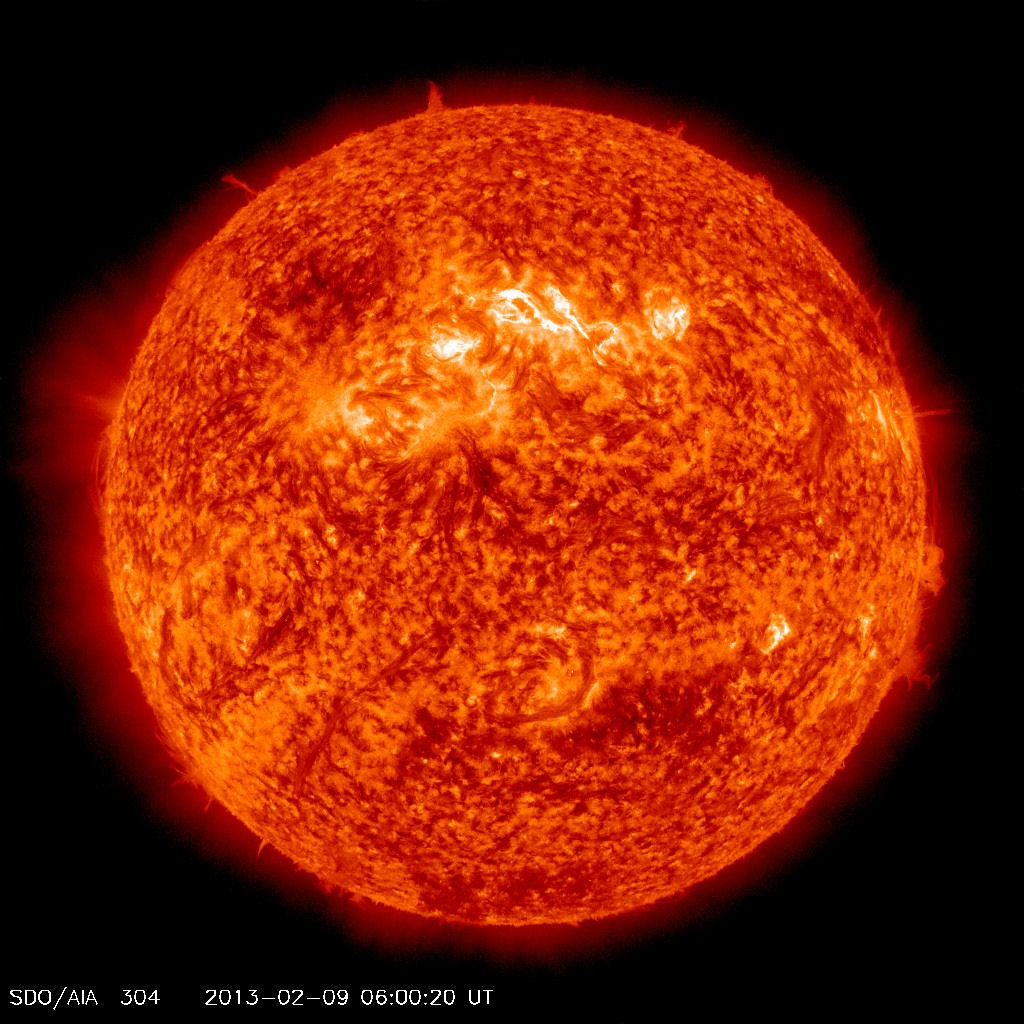
For reference, a CME in February 2013,  captured by the Solar and Heliospheric Observatory, is shown below as it shot away from the Sun at 800 km/s.

 The initial prediction was that the bulk of the ejected mass would sail over the Earth’s north pole. However, spaceweather.com warned there was still a chance of a glancing blow. The former likely meant high latitude observers on Earth would see brilliant auroras, but  experience no serious disturbance. A glancing blow possibly also meant one or more power grids knocked out such as occurred in Quebec in 1989 after a giant solar flare. As it turned out we missed the worst effects, only some SIDs.

Is this type of event a "black swan"? No, I don't believe so, because we could predict them IF we possessed the instruments and technology to track their evolution. We don't now. Currently the technology exists for the Advanced Composition Explorer (ACE) satellite which can measure the intensity and magnetic orientation of any CME that sweeps by it. The problem is that ACE is nearly on its last legs and a replacement monitor is needed, lest we become "blind" to the killer CME with our name on it.

Fortuitously, a fully -ready space craft that can undertake ACE's duties exists. The problem? This Deep Space Climate Observatory (or DSCOVR) sits mothballed in storage at the Goddard Space Flight Center in Greenbelt,  Maryland. It sits idle because the Obama administration's $47.3 million budget request to refurbish and launch DSCOVR was forthwith rejected by the Republican-controlled House.

Perhaps, black swans happen because a supposedly intelligent species refuses to do the things necessary to protect itself from events which - while not totally "forseeable" - are nevertheless on the radar screens and early warning systems of the scientists who study them - including solar physicists (for CMEs), planetary astronomers (for asteroids), and climate research scientists (for climate change- global warming).

Narratives like Nelson's don't help, and are not appreciated, as they disparage the enterprise of real science while giving cover to pseudo-science, genuine propaganda - such as exposed in the fossil fuel companies' own documents e.g.

www.ucsusa.org/decadesofdeception

Maybe Nelson ought to wade through these phony documents and admissions by the likes of Exxon  before he next aspires to pin the "propaganda" tail on actual climate scientists!


See also:

http://smirkingchimp.com/thread/thom-hartmann/69222/time-to-save-the-world-now

And:

http://brane-space.blogspot.com/2016/08/the-inteliigent-irrationalists-why-so.html

And:
http://brane-space.blogspot.com/2014/04/how-global-warming-deniers-get-better.html


Saturday, October 1, 2016

One Way Death Trip To Mars Compliments of Elon Musk? No Thanks!


Mars' surface as it might appear to passengers on Elon Musk's space ship - if they last that long.

It seems too many want to get to Mars in a hurry, and safety systems be damned. I noted three years ago the “Inspiration Mars” nonsense  which would cover 150 million miles and take 501 days overall to do a brief Mars "flyby".  Then there was "Mars One" through which nearly 200,000 volunteers from around the world signed up to "land on Mars and colonize it."  That has since been whittled to four, and meanwhile a robot prelim space craft is slated for launch in 2018, and that  mission aims to pave the way for the final volunteer crew by testing technology they will need should they reach the red planet in good enough shape to start the first human space colony. But the odds are they won't They will likely arrive DOA - if they get there in one piece at all - by virtue of receiving nearly the same amount of radiation as those 5 km from the Hiroshima atomic blast.

Now, we have wannabe commercial space pioneer Elon Musk, who recently declared in a speech ( at the International Astronautical Congress) entitled “Making Humans a Multiplanetary Species”,  that his goal was to “make Mars seem possible. To make it seem like it’s something we can do in our lifetimes. That you can go.” Musk, not meek about his ambitions, showed a video of his imagined Mars  rocket taking off from the Kennedy Space Center with 100 people on board, refueling in orbit and then landing on the surface of Mars. The audience fairly gasped at such a wondrous sight when NASA wasn't making similar plans until the 2030s.

By contrast, Musk's vision featured an ambitious timeline, starting with the first launch of an unmanned craft as soon as 2018, then the first paid passengers making their way to the Red Planet by 2024-25.  When asked if he himself would make the trip, he said "I'd have to get all my plans for succession in order first."  Just as well, because it's doubtful anyone would survive that trip any more than the Mars One journey.

Musk's design imagines a Mars rocket a towering 400-feet tall, with lots more thrust  than the Saturn V that took the Apollo astronauts to the moon. He acknowledged the immense, if quixotic, challenge he was undertaking would begin not just with creating a spacecraft that could keep dozens of humans alive for extended periods but with producing rocket fuel from the resources on Mars. And he acknowledged the difficulties of lowering the cost of the flights from $10 billion a person to $200,000 or less, in part by reusing rockets to fly repeat missions ferrying lots of people.

Now, try to imagine this, paying $10b each for a one way death trip. As one late night comic put it: "What better way than this to get rid of the billionaires!"

Let's also bear in mind that currently Musk’s Falcon 9 rocket is grounded, after blowing up for a second time. The maiden flight of its more powerful Falcon Heavy has been delayed again and again. I ask in all seriousness, would you really trust this guy to get you to Mars in one piece?

Musk, like Bas Lansdorp, CEO of MARS One, is also vastly understating the costs,, which he estimates at maybe $100b - say for 10 billionaires to take the first trip at $10b each. But as I've previously noted the more likely price of a first manned trip is $1 trillion - in today's dollars, and probably at least $1.4 trillion by the time the first ship is ready to launch in 8 years. That math would require at least 140 billionaires ready to launch to the Red Planet. I don't think there are that many who'd pay for a death ticket no matter how exciting Musk makes it. They want to remain here on good old planet Earth to see how many more hedge funds they can control, and how many resources they can consume for themselves.

Less clear is how SpaceX would pay to get to even that point. Musk did say he would “make the biggest contribution I can” of his own wealth, and at one point he joked that the company might have to use Kickstarter, the online fundraising platform, to raise money. Somehow, I don't think that would work for a project of this kind. Apart from that and outside of a few ambiguous technical details of the spacecraft he offered few specifics on how this monster ship would get built, where and what propulsion system might be used.

Nor did he address the hazards of radiation exposure for such a voyage- which might be just as well. To be clear, the radiation issue isn't necessarily a "show stopper" - but it means the proposed craft would need adequate shielding, and that means more money. Is $1 trillion too low then? Probably! That low figure gets you the basic "no frills"  craft to get there, but the highest probability of arriving as a corpse.

Reference can be made to a paper entitled  'Measurements of Energetic Particle Radiation in Transit to Mars on the Mars Science Laboratory" .  It revealed that the spacecraft containing the Curiosity Rover for its 253-day, 350-million-mile (563 million km) trip to Mars, indicated a radiation dose equivalent for even the shortest round-trip with current propulsion systems and comparable shielding at 0.66 Sievert (Sv) in a range of plus or minus 0.12 Sv.  NASA lifetime astronaut limits are between 0.6 and 1.2Sv, depending on sex and age. So that's at best more than half a career of radiation exposure, even disregarding time spent on the surface, or indeed on any preparatory missions.


The takeway? Without radical progress in reducing the duration of the Mars journey and breakthroughs in increasing the radiation shielding of craft, suits and other habitats, human trips to Mars will likely be ruled out by NASA for exposing astronauts to more than a three per cent increase - such as stipulated in "Risk of Exposure-Induced Death for Fatal Cancer", a threshold set by a working group panel of radiation specialists in the aftermath of Hiroshima

Make no mistake that getting to Mars is exceedingly difficult. On average, it’s 140 million miles from Earth, though the planets do come to within about 35 million miles of each other every 26 months.  But that doesn't mean you can make a 35 m mile direct trip from Earth to Mars. From the laws of celestial mechanics and Newtonian dynamics you still need to plot a long, curving arc or trajectory. Even under the best circumstances it would take months to get there, being exposed to radiation levels unheard of on Earth.

Musk claims SpaceX could do it in 80 days and eventually in 30, but I doubt it, and I'd have to see the rocket design and trajectory - as well as source of propulsion first.

As I also previously noted, referencing radiation levels,  the deep space environment can also be tremendously harsh on ordinary space faring. Of the 43 robotic missions to Mars, including flybys, attempted by four different countries, only 18 have been total successes. You can be sure with any humans aboard that percentage would be lower, maybe even zero.

Musk - conveniently -  didn’t address the explosion that blew up one of his rockets earlier this month. He has previously said the incident, which occurred while the rocket was being fueled ahead of an engine test firing, was the most “difficult and complex” the company has ever faced. This follows another Falcon 9 failure last year, when it blew up a couple minutes into flight.

It would be tremendous if a bunch billionaires - starting with Donald Trump after he loses this election  took Musk up on his offer to get them to Mars. But I somehow doubt even Trump is dumb enough to do it.