Showing posts with label radio waves. Show all posts

Wednesday, March 20, 2019

Selected Questions -Answers From All Experts Astronomy Forum (Radio Telescopes)

Question:  I am interested in the workings of radio telescopes. Can you explain for me how these instruments work?  -  Curious, Santa Fe, NM,

Answer:

Below I show the basic design of a dish type radio telescope, the one most often used:


Image may contain: possible text that says 'Receiver Receiver ANTENNA Radio waves to focus at receiver Parabolic dish Detector Computer Recorder'
Note the parts labeled, namely the  receiver, the parabolic dish and the antenna - essentially some element of metal wire or a metal rod - which can be said to be the heart of the instrument. The basic function is to capture incoming electromagnetic waves (in the radio spectrum) and turn it into an electric current. in the wire. (The wire for the antenna is usually made of a good conductor such as copper or aluminum).  What about the dimension of the antenna probe?  For maximum efficiency it should be one fourth of the size of the wave it's going to intercept. Thus, for the 21 cm line of hydrogen, the probe should be about 5 cm in length.

In this radio telescope sketch above I show a parabolic dish which has the receiver at the prime focus.  Note in the case of a parabolic dish that is has the property such that a radio waves reflected off of it all come to the focus at the same time.

Note the receiver basically amplifies the signal and passes it off to the detector where it can be measured then analyzed subsequently, e.g. using computers. All receivers are located at the focal point because even the best (antenna) wires experience loss due to thermal noise and so introduce a high  noise to signal ratio. So we want the amplification to occur as close to the antenna as possible.

Once the radio signal has been captured by the antenna and converted into a current then amplified, radio astronomers use a technique called "heterodyning" or mixing.  This allows them to change the frequency of the signal while preserving while preserving all the information it contains.


You can get an analogous idea to what goes on if you own an AM-FM radio and have ever tuned to a specific frequency. Thus, to tune to say 900 kHz on your radio dial this illustration helps to fix ideas:

Image may contain: possible text that says 'Bandwidth of signal 900 kHZ 904.5 895.5'
In this case of prosaic radio reception - on the AM band, for example, "tuning" a station means moving a variable capacitor so it is in resonance with the incoming radio wave.  The tuner on your AM radio then acts as a bandpass filter. Here the bandwidth of filter = bandwidth of the signal (D f). 

For commercial AM this is generally  +  4.5 kHz.  We call 904.5 the "upper sideband" and 895.5 the lower sideband (i.e. f(c) + D f   or  f(c) -  D f). A similar process applies to the tuning of radio waves.   In the case of the prosaic radio we may use, heterodyning, which  means mixing the original EM radio signals down into the audio range (kilohertz) where our ears can pick them up.

In the case of the radio telescope  we use a superoheterodyne  receiver  which also features a center signal frequency (f(c)) that is amplified in a radio frequency (RF) amplifier, after which a mixer takes the weak signal and mixes it with a strong local oscillator signal at a frequency say f (o) producing an output signal at an intermediate frequency f' '. (Where f ' is directly proportional to the RF signal power).

One such radio source signal - after detection and analysis is shown below for Cygnus A at a frequency of 238.5 megahertz (MHz):
No photo description available.
Now, every radio telescope receives waves that come from fairly restricted areas of  the sky and this is defined by what's called the beam.  Every antenna - and by extension radio telescope- has a main lobe called the "main beam" and also side lobes off to the side.  The side lobes have different causes but most result from diffraction (Consult the astronomy archives for past answers pertaining to diffraction in optical telescopes).   The pattern of a radio telescope beam and typical side lobes are shown below:
Image may contain: possible text that says 'Incident waves'
Note the side lobes are weak but can still represent a significant fraction of the power a radio telescope receives. Generally 80-90 percent of the signal entering a receiver from a typical dish comes through the main beam, the other 10-20 percent through the side lobes.  Now, in the case of the initial radio telescope diagram, try to imagine the wave fronts coming in at an oblique angle instead of directly., e.g.
No photo description available.
Here, the arrival of the left side of the wave is later than the right, because it happens to travel an extra distance.  If one finds this distance d is such that:

 d sin  q     =     l/  2

Then we have the left -radio wave fully cancelling the right and no signal gets through. Obviously one wants to avoid this condition.  Ideally then, we need:  d sin  q     =  0.

Again, every radio telescope has maximum reception in location and this falls off according to the beam pattern.  A convenient way to specify this pattern is by using the beam width and one half the peak (power) height.   From this one can deduce the optimum beam width in terms of the resolution. Thus, if two objects are closer than the beam width then they will blur into one, and the astronomer will be unable to distinguish the sources.  This conveys the importance of a narrow beam width, which just means the signal falls off rapidly as one shifts from one side of the source to the other.The narrower the beam width the better the resolution of the radio telescope. In general:


Beam width =  Resolution =   Wavelength /   diameter    =     l/  D 

Hence, if the wavelength is 21 cm (say for the hydrogen line) and the diameter D  of the telescope is 10 m (1000 cm) we have:   21cm /  1000 cm  = 0.021 arcseconds

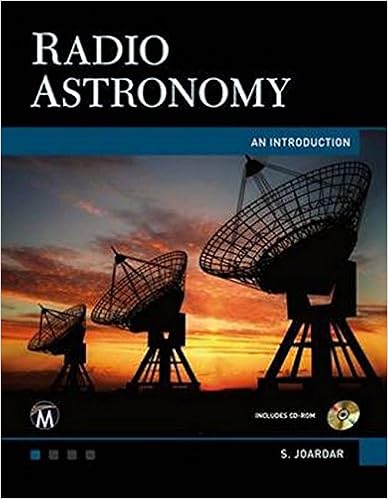
Again, this answer entails only the most basic introduction of how a radio telescope works. To get into more details it is good to consult basic texts such as this excellent introduction (see Chs. 4-6)


Sunday, September 29, 2013

Mysterious Radio Bursts Detected - Of Alien Origin?


The Parkes 64 m radio telescope which detected the strange radio bursts.

Six years ago, radio astronomers were baffled on detecting 4 energetic bursts of radio waves that lasted only a few milliseconds. Their bafflement was engendered by being unable to associate the bursts with a specific object.  Now, more recently, we find in the July 5 issue of Science, that Dan Thornton of University of Manchester and colleagues also reported 4 mysterious bursts.

Interestingly, they exhibited energies similar to the 2007 events,  and also resembled them in appearing only once. While researchers still aren't sure what might have caused such a signal they know it wasn't a fluke. The parameters for the radio telescope and the observed events all check out and conform to radio astronomy physics.  So we do know in order to be detected at all,  radio waves must fall within certain physical limits, i.e. brightness temperature, received flux, solid angle etc. One also needs to look at properties of the antenna -receiver such as beam width, gain, antenna temperature, etc. Since all the detected parameters were within conformance to standard radio physics we know the bursts aren't flukes.

In the Science paper, the radio astronomers reported scanning the sky with the 64 m Parkes radio telescope in New South Wales, Australia (see image).  They'd actually been searching for the rapidly spinning compact remnants of once massive stars as well as other transient radio sources. In the first case, one expects a supernova would have erupted leaving a neutron star (at least) in its wake. (The 4 newly observed bursts originated in the high latitudes of the Southern hemisphere, and roughly 40 degrees south of the Milky Way's disk.)

The first order of business was to determine the distance of the events. We know as radio wavelength radiation propagates through gas and dust it impacts electrons which smear the signal. The four strange burst emissions showed such a smearing, indicating the bursts were from space and not from Earth. Also, since the point of origin was 40 degrees off from the galaxy's disk the researchers concluded the burst originated outside the Milky Way. Following a computation of how much material the radiation had to travel through, they estimated the bursts' distance at between 5.5 and 10.5 billion years.

As for the energy signature, it was astounding. Each of the four bursts released as much energy in its brief emission time as the Sun puts out in 3,000 years.  So what is the source?

Could it be an advanced alien civilization which has somehow managed to exploit the energy of powerful astronomical objects to dispatch brief, but energetic signals? Granted, this hypothesis can't be totally excluded, since one must recall E.A. Milne's rubric of always dealing with physical proposals by using the concept of a bead on a wire and never letting the bead get to one end (certainty) or the other (impossibility). However, if the distance calculation for the events holds up - it is doubtful aliens are the source. At such immense distances, in effect looking that far back in time, it is improbable advanced alien civilizations existed.

In an article appearing 25 years ago, in The Journal of the Barbados Astronomical Society, I also argued against the likelihood of extra-terrestrials using radio signals to communicate. In order to communicate, say over thousands (or even hundreds) of light years' distance, information is transmitted. It requires energy to do this. Interestingly, a relation between energy and information is available. It can be written as:

E = 0.693 kT

Here, E is the energy associated with transmission of 1-bit of information. T is the temperature of the environment in which it is sent (say the radio transmitting antenna) and k is a physical constant known as the Boltzmann constant. Imagine an alien civilization sending the equivalent of a small novel to humans. This would be approximately 1020  bits of information. The associated energy would be about 0.3 (three tenths) of a Joule.  The energy required, from a practical standpoint, would be much, much larger - maybe 100 million times larger. Why? Because in the process of pure transmission (over light years distance) a significant fraction of signal dilutes. So, at least 30 million Joules would be needed, to have it get to Earth in a useful form.

Arguably, aliens genuinely interested in contact would not waste time or effort with anything so puny as a small novel. It is more probable, if they went to the trouble of first contact (as in the film 'Contact') they'd send a lot of information. Say, equal to an alien encyclopedia of mathematics, or their most prevalent language. In this case, the information content soars to billions of megabytes, and the energy accordingly. For one million megabytes (1012    bits) the aliens are looking at an energy for transmission on the order of 3 x 1019  Joules.

It is well to realize that time factors into this as well. If the aliens kept the transmission going for at least one hour (Earth time), 3 x 1019   kilowatts of power are needed (assuming the aliens are able to sustain a rate of energy conversion of 1 Joule per second). In the civilization classification scheme of the late Russian astrophysicist I.S. Kardashev, this would put them at a bit beyond Type I, but not quite Type II. Kardashev's three-class scheme is:


I: Able to harness the equivalent power of the planet Earth

II: Able to harness the power equal to a typical star (1023  kw)

III: Able to harness the power equal to a typical galaxy (1033  kw)


While the burst energies appear to be close to the last category, there is one problem: no decipherable or intelligible communication was recorded. In this case, it leaves a powerful astronomical object as the likely source.

The astronomers themselves, in their Science paper, propose the most convincing cause is a neutron star known as a magnetar.  Thornton and colleagues suggest some 1,000 of these magnetar bursts occur across the sky every year. We will wait for confirmation to see if this is in fact, the best explanation