
Prof. Paola Caselli, a Director and Scientific Member at the Max-Planck-Institute for Extraterrestrial Physics in Munich, Germany, gave last Tuesday's spellbinding Laboratory Astrophysics Division (LAD) Plenary Lecture (The Crucial Interplay of Laboratory Experiments, Observations and Theory to Unveil our Astrochemical Origins)at AAS236.
Her keynote talk not only described some of the cutting edge research her group has been doing, but also reviewed some of the major questions and recent discoveries in the field of astrochemistry. This discipline, as she lucidly showed, is intimately bound up with astrophysics given the complex molecules that are located within assorted astrophysical objects.
At its heart, as Prof. Caselli explained, astrochemistry is all about molecules. “The molecules that we see in space […] give us information about regions where stars and planets are forming.” The spectral lines formed by molecules are able to trace the dynamics of gas clouds, giving us “very detailed information about how material is collected in these regions, which are the future generations of stellar systems like our own.”
Furthermore, as she noted in her talk, the chemistry of molecules in these stellar nurseries are a clue to the origins of life. These molecules are relatively basic compared to what we know here on Earth—to astrochemists a “complex organic molecule” is something with at least 6 atoms, nowhere near the millions or billions of atoms in a strand of DNA—but as Caselli put it, the basic chemistry in space was still “the first step toward more complex chemistry that we see on the ground.”
Prof. Caselli's emphasis in her plenary lecture was on the presence of organic molecules, in the interstellar medium - namely associated with interstellar dust, as well as in protostar cores. Some of this I'd addressed on my own in a previous post from two years ago, e.g.


In the image shown above, say for a proto-solar nebula, the distinct profiles of the dust are shown for each region of the nebula they are likely to be found. The whole point is that stars form out of interstellar molecular clouds by gravitational collapse.
Another intriguing result arising out of laboratory work by Caselli and her team involves the deuterium fractions peculiar to comets (denoted o104 etc.) , e.g

Note here the deuterium to hydrogen (D/H) fraction (y-axis or ordinate) and its variation for assorted objects, including Saturn's moons Titan and Enceladus, the range applicable to interstellar material (ISM) and star forming regions (e.g. dense molecular clouds) and the protosolar nebula. The youngest protostars, as Caselli pointed out, display the largest "deuterations", especially for organic molecules.
It is also of interest, as Caselli showed, to compare the D/H fraction results in a class of meteorites called carbonaceous chondrites with fraction in interstellar dust particles. Note the difference in scale between D/ H say in hydrated silicates (top panel) such as one might find in terrestrial oceans, and the micrometer-sized 'hot spots' in the organic matter within the meteorites and interstellar dust particles (IDPs).
Silvia Spezzano, a co-worker of Prof. Caselli's, has also been instrumental in assaying the abundances of complex organic molecules - such as shown below:

Her research, published in the Astrophysical Journal (2017) has also shown these organic molecules "thrive" in pre-stellar cores wherein the environmental conditions are conducive to their survival.
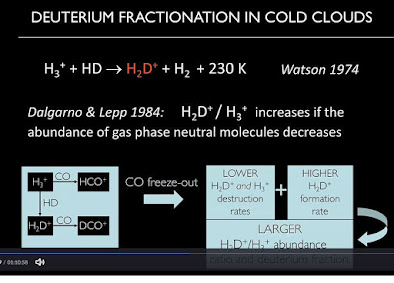
Caselli's lecture also stressed the role of deuterium fractionation in cold molecular clouds, i.e.

Thus the key reaction at the top (Watson, 1974) is used as a starting point. The reaction is exothermic, and Casselli took pains to note that the strong presence of ortho- H2D+ in pre-stellar cores actually has led to the revision of some astrochemical models. For this fractionation reaction to be sustained one needs the ratio of the ortho-H2D+ to Helium 3 to increase. The further investigation is ongoing with new lab work, and Caselli emphasized there is an interplay with a number of other molecules, e.g.

Note (in the preceding slide) the input of cosmic rays in step (1), and the part of the deuterium fractionation equation seen earlier. This also has a bearing on ice formation time associated with dust particles in dense molecular clouds, for example, e.g.

Note at the extreme left we have the dust particle, and a set of impacts, e.g. from UV radiation, cosmic rays etc. which then enable the aggregation of an ice mantle around the dust particle.
For the past three or so decades astronomers and astrophysicists have known that to account for interstellar extinction - i.e. less light exiting an interstellar cloud than entering- one can appeal to a core-mantle model for interstellar dust. Thus the brown central region shown in the above slide tend to be silicates (e.g. such as sands found on Earth) while the mantle is typically composed of a set of ices, e.g. H2O, CO2 etc. Thus, when the grain drift into hot region - such as H II region- the mantle evaporates leaving behind the bare core.
For the past three or so decades astronomers and astrophysicists have known that to account for interstellar extinction - i.e. less light exiting an interstellar cloud than entering- one can appeal to a core-mantle model for interstellar dust. Thus the brown central region shown in the above slide tend to be silicates (e.g. such as sands found on Earth) while the mantle is typically composed of a set of ices, e.g. H2O, CO2 etc. Thus, when the grain drift into hot region - such as H II region- the mantle evaporates leaving behind the bare core.

In the image shown above, say for a proto-solar nebula, the distinct profiles of the dust are shown for each region of the nebula they are likely to be found. The whole point is that stars form out of interstellar molecular clouds by gravitational collapse.
Another intriguing result arising out of laboratory work by Caselli and her team involves the deuterium fractions peculiar to comets (denoted o104 etc.) , e.g

Note here the deuterium to hydrogen (D/H) fraction (y-axis or ordinate) and its variation for assorted objects, including Saturn's moons Titan and Enceladus, the range applicable to interstellar material (ISM) and star forming regions (e.g. dense molecular clouds) and the protosolar nebula. The youngest protostars, as Caselli pointed out, display the largest "deuterations", especially for organic molecules.
It is also of interest, as Caselli showed, to compare the D/H fraction results in a class of meteorites called carbonaceous chondrites with fraction in interstellar dust particles. Note the difference in scale between D/ H say in hydrated silicates (top panel) such as one might find in terrestrial oceans, and the micrometer-sized 'hot spots' in the organic matter within the meteorites and interstellar dust particles (IDPs).
Silvia Spezzano, a co-worker of Prof. Caselli's, has also been instrumental in assaying the abundances of complex organic molecules - such as shown below:

Her research, published in the Astrophysical Journal (2017) has also shown these organic molecules "thrive" in pre-stellar cores wherein the environmental conditions are conducive to their survival.
In respect to the above slide, Prof. Caselli noted the Spezzano finding that formation of these complex molecules occurred at a very early phase and at low temperature, ~ 6K. Also, Spezzano has found methanol forming at the boundary of these large molecular clouds, also rich in carbon atoms which can form carbon chains. Her research has also led to the identification of host of complex organic molecules (COMs) such as displayed below:

Note that these complex organic molecules tend to surround pre-stellar cores and stay away (with respect to distribution on the surface of the dust) from the irradiation source. This is especially applicable to methanol (CH3 OH). This has led to the finding that COMs form in pre-stellar cores at the edge of the CO (carbon monoxide) "freeze out" zone. I.e. where that organic molecule is frozen out. Many of these more recent results arrived via experiments in gas-grain chemistry, reactive desorption, photo-desorption and neutral-neutral reactions.
Professor Caselli's riveting plenary lecture, at the AAS 236th Meeting last Tuesday, showed us that molecular astrophysics is now in a golden age. It also indicates astrophysics discoveries can benefit from such work, and as new-generation telescopes such as ALMA and NOEMA remind us every day the importance of laboratory data on molecular transitions and reaction rates.
These high sensitivity observations in the direction of Galactic and extragalactic sources - - such as outlined in the lecture- have revealed a chemically rich universe, where simple radicals as well as complex organic molecules thrive. This is extremely important for astrophysics, as molecular spectra are unique tools to study the dynamical evolution of interstellar clouds, where stars and planets form. For completion and sound conclusions, accurate transition frequencies measured in the laboratory are required.
Molecular line observations also provide the opportunity to study the chemical composition during the various steps toward star and planet formation. Thus, interstellar molecules allow us to gain understanding on the evolution of chemical complexity from the cold and quiescent pre-stellar clouds where stars form, to the hot proto-stellar envelopes, to protoplanetary disks where planets are assembled, to exoplanet atmospheres, to comets and carbonaceous chondrites in our Solar System.
Thanks to Prof. Paola Caselli the minds of hundreds of astrophysicists and astronomers were opened to the critical import of astrochemistry and its conclusions.

Note that these complex organic molecules tend to surround pre-stellar cores and stay away (with respect to distribution on the surface of the dust) from the irradiation source. This is especially applicable to methanol (CH3 OH). This has led to the finding that COMs form in pre-stellar cores at the edge of the CO (carbon monoxide) "freeze out" zone. I.e. where that organic molecule is frozen out. Many of these more recent results arrived via experiments in gas-grain chemistry, reactive desorption, photo-desorption and neutral-neutral reactions.
Professor Caselli's riveting plenary lecture, at the AAS 236th Meeting last Tuesday, showed us that molecular astrophysics is now in a golden age. It also indicates astrophysics discoveries can benefit from such work, and as new-generation telescopes such as ALMA and NOEMA remind us every day the importance of laboratory data on molecular transitions and reaction rates.
These high sensitivity observations in the direction of Galactic and extragalactic sources - - such as outlined in the lecture- have revealed a chemically rich universe, where simple radicals as well as complex organic molecules thrive. This is extremely important for astrophysics, as molecular spectra are unique tools to study the dynamical evolution of interstellar clouds, where stars and planets form. For completion and sound conclusions, accurate transition frequencies measured in the laboratory are required.
Molecular line observations also provide the opportunity to study the chemical composition during the various steps toward star and planet formation. Thus, interstellar molecules allow us to gain understanding on the evolution of chemical complexity from the cold and quiescent pre-stellar clouds where stars form, to the hot proto-stellar envelopes, to protoplanetary disks where planets are assembled, to exoplanet atmospheres, to comets and carbonaceous chondrites in our Solar System.
Thanks to Prof. Paola Caselli the minds of hundreds of astrophysicists and astronomers were opened to the critical import of astrochemistry and its conclusions.


