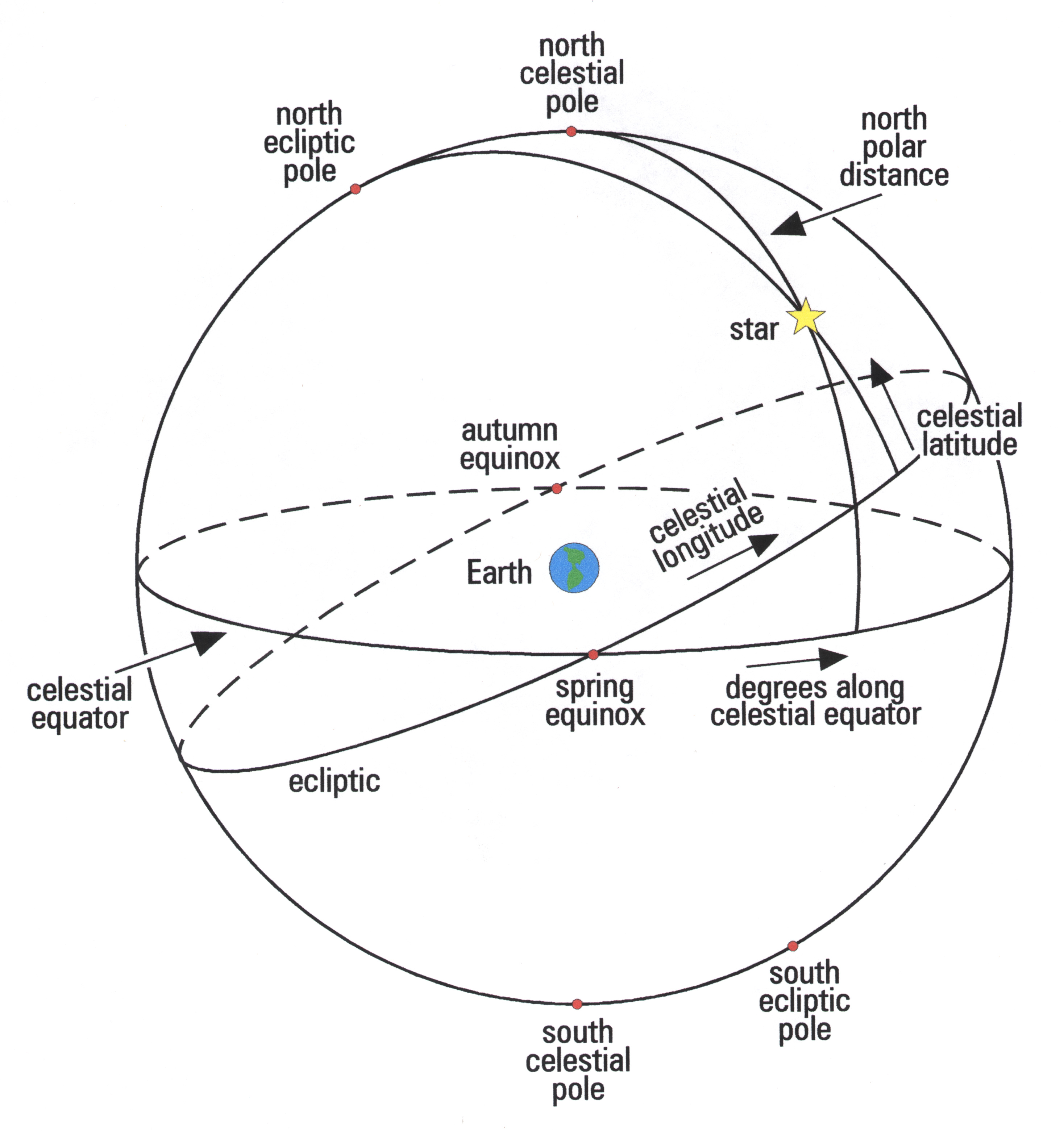
Showing posts with label Vernal Equinox. Show all posts

Thursday, December 13, 2018

The "Persistence of Astrology"- Arising From Fear, Insecurity Or Blindness To Bunkum?


The geometrical aspects for the planets defined. (From 'Astrology' by Hugh Arthur, 1979)


In his  recent editorial ('The Persistence of Astrology') in Physics Today,  Charles Day bemoans how the pseudoscience of astrology has persisted through countless decades. This despite its obvious, palpable and loopy means of "divining information about human affairs and terrestrial events" - quoting a Wikipedia piece.  Day then writes:

"It is absurd to assert, as astrologers do, that the planets influence human character and that these influences are stamped on us at the moment of our birth. Isaac Newton was born prematurely on 4 January,  1643. If his mother had carried him to full term, the Sun would have been in Aquarius , not Capricorn, when he emerged from her womb."


He then goes on to cite former Miami Dolphin RB Ricky Williams who's become a firm devotee of astrology, noting:

"Williams's love of astrology is evidently sincere. He finds studying and interpreting the movements of celestial objects to be a source of order, comfort and enlightenment."


Well, then why not go all in, and pursue celestial mechanics, for example?  Well, because the mathematics is yet a whole other order beyond what's used in horological astrology, so a goofball like Williams would not be too interested. It would be beyond his mathematical - or analytical - ability.

But this begs the question of why supposedly sober journalists (Day cites USA Today reporter Josh Peter), make so much ado over Williams's fascination with twaddle.  As Mr. Day writes:

"Peter's USA Today story is devoid of skepticism about astrology. Given how assiduously journalists challenge the claims of politicians, government officials and CEOs, their timidity in the face of astrology's adherents is striking."

Well, to be fair, it might be best not to conflate an entertainment reporter like Josh Peter - clearly operating in journalism's "softball" domain - with a serious political journalist like Nick Confessore,  the NY Times politics correspondent.  Or with  former former Washington Post reporter Carl Bernstein (who helped break open Watergate.).  Hence, it is most likely true that Peter is paid a whole wage scale lower than Confessore to do basically 'ooh and ah' puffball pieces, like Ricky Williams's fascination with astrology..

More distressing is Prof. Day's  citation of the prevalence of this malarkey in women's magazines, i.e.:

"Lastly, there's the troubling prevalence of horoscopes in women's magazines. In a June post to Examplore, "a site created by spiritual, magical and lore enthusiasts" astrologer Silvia Sky reviewed the horoscopes in newsstand magazines. The best, she wrote, appear in Elle, Cosmopolitan, Marie Claire, Seventeen and Town & Country."

Adding:

"That horoscopes survive in women's magazines is evidence that the magazines' editors know that their readers appreciate them."


The question is 'Why?' and is it a gender thing, a class thing or perhaps some other aspect at work? If women's magazines in the U.S. are a huge repository of astrological rubbish, I suspect that is due to wanting to fill content with lighter fare that is not necessarily to be taken seriously.  With the torrent of bad news about incessant sexual assaults, the Trump Cabal and its multiple attacks on the nation's fabric, not to mention Republicans' assaults on women's reputations, it makes sense.  Women -  via horoscopes appearing in magazines  -  can get a bit of escapist fare and it kind of serves a therapeutic purpose.  But let's be clear the interest in astrology is not confined to the gentler sex.

I explored many of the reasons in an article 'Astrology And Astronomy' that I wrote for The Barbados Nation back in March, 1976,  (never mind the editor misspelled my surname) e.g.


I noted the same prevalence in (then) current magazines on offer, though not necessarily concentrated in "women's magazines."  My point was that the prevalence of astrology coincided with being "in extremely troubled times" adding:  "Into this bleak picture comes astrology with its pat answers and pseudo-scientific jargon (e.g. cusps, ascendant) which make it just believable enough for many people."

I also emphasized the theme of tumultuous times playing a huge role in fueling fear, insecurity and a search for meaning. That theme is with us today too, maybe even more powerfully than in 1976.  We now are on the cusp of a mega-climate apocalypse, countless school and mass shootings, not to mention three times the nuclear weapons  - or ample nukes to incinerate the planet ten times over instead of three.  We also have a pussy grabber, criminal and traitor fouling the White House - who even now is vowing to shut down the government over a delusional border wall.  We also have a majority party that,  as political commentator John Heilemann put it two nights ago, is now in the throes of "moral, intellectual and ideological bankruptcy" especially after refusing to do a thing to check the renegade in whom they've invested everything. To the extent of  even making excuses for him, and cooperating with a network (FOX News) that runs in a parallel thought universe.  Therein it conjures up whole cloth rubbish (Clinton Foundation and Uranium One conspiracies) to spread to its zombie viewers who suck it all up like so many millions suck up astrology horoscopes.

So it is hardly a surprise insecurities and fears are heightened, not only among women but men as well.  Indeed, the larger point made in my original article 42 years ago was that too many gravitated toward horological astrology out of intense insecurity as well as a feeling of lack of control.  Given that both appeared to be intertwined, i.e. lack of control fueling more uncertainty and insecurity, it made sense millions would seek a system which at least provides the facade of control of their lives. In this way people - if very vulnerable - could become "blind to bunkum."

That was the primary conclusion I drew from my own observations, and it seems as good a basis now to invoke for the "persistence" of astrology.  In effect, knowing certain aspects of the astrologers' heavens enables the believer to allay her fears and delude herself into gaining more control of her life, simply by knowing how the stars (and planets) foretell fortunes or setbacks.   This was especially as "traditional religion afforded few answers and little solace."

The fly in the ointment, as I first pointed out, is that the horological signs are fictions based on subjective perceptions instead of physical reality. Hence, trying to extract "control" from them is akin to trying to build a bungalow on quicksand.   Specifically, the alleged "signs" based on visible constellations, didn't really exist. They were mere random collections of stars, often at widely differing distances, into which human perception read a pattern forming one coherent whole. (When humans look up at a starry night sky it is impossible to discern which stars are nearer, which farther - especially as brightness is no kind of guide.)

Thus, horological astrology reduced to a subjective template that actual astronomical observations and data didn't support.  To fix ideas, the Vernal Equinox is called the "first point of Aries" by astrologers, since it was originally in that sign two thousand years ago. The problem is that this celestial reference point is no longer located in Aries, but in the adjacent constellation/sign: Pisces! In the two thousand years since the Sun signs were devised, the Earth's axis has undergone precession out of the original alignment, and with it the equinoxes! This means that each of the other eleven so-called Sun signs used in horoscopes is out by the same amount: one entire Sun sign. For consistency, all present day birthdays would need to be re-calibrated to the preceding sign. So if your birthday is July 4th, say, you are no longer a Cancer but a Gemini! If it is October 18th, you are no longer a Libra, but the sign just before, Virgo. And so on.

Incredibly, many of the astrologers I've encountered over the years are rather blase about all this.  They usually say something to the effect that the "real" (original twelve signs) are "forever fixed" as they were two thousand years ago. They insist that my preoccupation with "signs being out of step"  is not a matter of genuine signs at all, but the constellations (star patterns) associated with them! In their incredible view, the zodiacal constellations are shifted by the Earth's precession but not the "fundamental" signs! These signs will remain firmly anchored in the sky, immune to all Earth's motions, forever and ever!

As one can see,  all of this leads down a never ending subjective rabbit hole wherein the astrologer gets to define his -her celestial reality devoid of actual astronomical inputs. It all becomes a matter of "cartoon" images and perceptions reigning over science.  An example of what I refer to as "cartoons" includes the so-called planetary aspects used to craft personal horoscopes (see top image).

Here certain geometric relations and alignments are deemed to be interpreted in terms of the planetary aspects. For example, in the conjunction two planets -  say Venus and Jupiter - essentially "line up" so the planets' "principles"  combine to reinforce each other.

This bears some superficial similarity to the astronomer's computations of planetary configurations, e.g.
http://brane-space.blogspot.com/2011/08/tackling-intermediate-astronomy_17.html

But, the astronomer does not impute any personal or character traits to these configurations whatsoever. The astronomer is interested in them purely for the objective purposes of future (or current) observations, say in calculating when a future occultation (i.e. of star and planet) or other astronomical event will be visible. Say the most favorable opposition of the planet Mars, for optimal telescopic viewing, e.g.


http://brane-space.blogspot.com/2018/07/mars-closest-approach-to-earth-in-15.html

By contrast, the astrologer will become animated when any two planets, say Mars and Venus, appear in a "square" aspect. He may then conclude the  emission of a discordant influence which results "in frustration, imbalance and inner conflict."  In other words, the planetary aspects determine the outcome of one's  personality or dynamic for personal interactions on a given day,  or whatever.

Frankly, it is as if astrologers inhabit a parallel universe of their own creation, almost like the pro-Trump, WSJ op- ed  Foxites who have invented their own Hillary - Jim Comey- Christopher Steele conspiracy theories targeting Trump - to counter Mueller's own findings.

So perhaps it isn't so much a matter of persistence of just astrology per se, but the persistence of magical  and  pseudo conspiratorial thinking throughout the country - even in the illustrious Wall Street Journal.  Recall its op -ed pages continue to spin the Hillary- FBI- DOJ- Steele dossier as a viable alternative construct to the Trump-Russia conspiracy investigation pursued by Robert Mueller, e.g.

http://brane-space.blogspot.com/2018/02/wsj-editorial-again-spouts-balderdash.html

What we do know from history is that such bifurcations in reality perception never end well for a country. We can only hope that our nation soon gets its collective perceptions in order (by which I mean achieving an agreement on what constitutes reality)  before the proverbial shit hits the fan.

Saturday, September 22, 2018

Selected Questions- Answers From All Experts Astronomy Forum (Design of the Celestial Sphere)

Question: I've been learning  about the celestial sphere lately and wonder how it was originally designed? What exact considerations led to the form it has including the coordinates of Right Ascension and declination? - Curious in Michigan

Answer:  The celestial sphere, probably since antiquity, has been perceived as a sphere of infinite radius, only half of which we can see at any one time.  (The other half on the opposite side of Earth). Using it to fix on the distant stars, it also appears to be rotating in an east-west direction.  Basically, it is a result of projecting the Earth's own latitude and longitude lines - as well as the Earth's north and south poles - onto the sky,  thereby yielding a corresponding sphere in the sky which has its own coordinate system. This can then be used to locate sky objects presumed to be on its interior surface.


Image result for celestial sphere
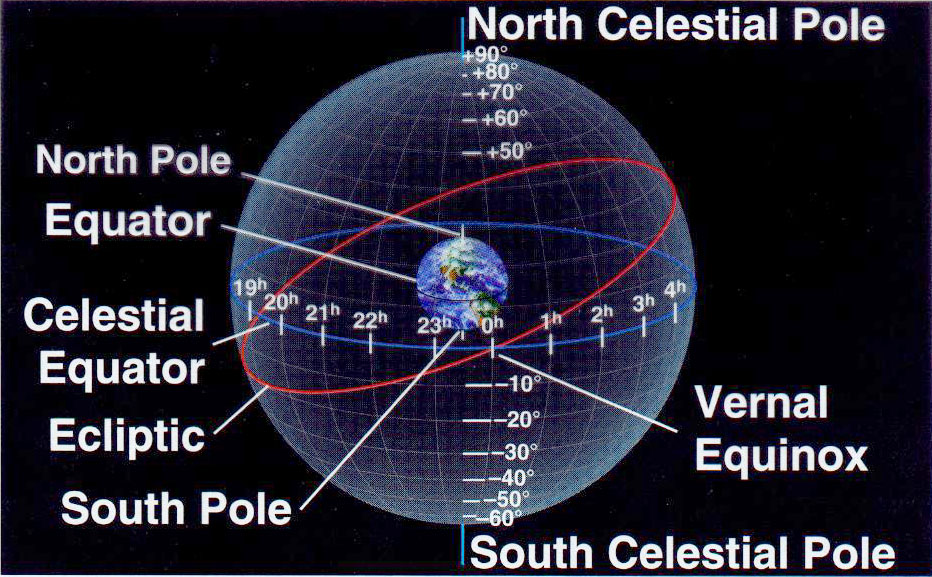
The projected coordinates corresponding to latitude circles are called declination, and those corresponding to longitude are called Right Ascension.  Given this, the "celestial equator"  would simply be the Earth's own equator (latitude 0 degrees) projected onto the sky sphere, while the North Celestial Pole is the projection of the Earth's north pole and the South Celestial Pole is the projection of the south pole.   These projections are shown on the accompanying diagram.

In effect, the "design" of the celestial sphere is such that if one were travel to one of the Earth's geographical poles, the corresponding celestial pole would be directly overhead (at the zenith).  If one were to travel to Earth's equator, the celestial equator would pass directly through your zenith.

Declination circles, like latitude circles, run in the east-west direction parallel to the celestial equator, starting at 0 degrees and increasing to +90 degrees (North celestial pole or NCP). Also decreasing in the opposite direction to (-90) degrees, or the South celestial pole. When one superimposes these lines one would envisage this more complete celestial coordinate system:

Image result

The other celestial sphere coordinate, Right Ascension,  corresponds to Earth longitude. Both longitude and Right Ascension circles run from pole to pole.   However, the 'prime meridians' are different. For Earth, the prime meridian of longitude is the same as the Greenwich meridian defined as 0 degrees. All longitude circles to the west, e.g. Barbados at 60 degrees W., are designated such that times are earlier than a calibrated clock reads at Greenwich.  All longitude circles to the east are designated as having later times than at Greenwich.

By contrast, for Right Ascension we need to use a specific abstract point in the sky, called the Vernal Equinox, to mark the meridian of origin.  This is the point at which the Sun - on its journey north (seen as a projection via the ecliptic on the celestial sphere) crosses the celestial equator. This is visible in the second diagram, where you will see the reddish line for the ecliptic (which is the projection of the Sun's apparent path onto the celestial sphere).  Bear in mind here, the Sun is not really moving across the sky.  It is only the appearance of such because the Earth is really doing the moving, i.e. orbiting about the Sun.  Hence, in a real sense, the ecliptic is the projection of Earth's own orbital motion onto the celestial sphere, but which is embodied in the Sun's apparent path.

The point called the Vernal Equinox -  as can be seen in the diagram - occurs on or about March 21 each year.  Now, the celestial circle of longitude which passes through the Vernal Equinox is defined as 0 hours Right Ascension.    Note here that Right Ascension is measured in hours and minutes (60 minutes being  equal to one hour), and increases numerically eastwards from the Vernal Equinox This would be continuously (unlike Earth longitude - which divides into E. and W. ) from 0h through 24 h.

Using the design conventions given here any astronomical object, planet, star, star cluster, etc. can be pinpointed by coordinates in the night sky.


Friday, September 7, 2018

Selected Questions - Answers From All Experts Astronomy Forum (Abolish Kepler's 2nd Law?)

Question:  If we relocated the Sun in one focus of the orbit - say from the diagram in the link below


we will discover that the straight line between the Earth and the Sun sweeps the interval of time between March 21 and Jun 21 is much bigger than that swept between September 21 and December 21, and the distance crossed by the Earth from March 21 to Jun 21 is also bigger than that crossed from September 21 to December 21.  This is  contrary to Kepler's second law so I say it must be  abolished.   Try it by yourself.. it is inevitable!  Do you concur?
regards,     Dr. Mohammed Barzaq


Answer:

The foci-adjusted mean daily motion for the Earth, from a celestial mechanics table, is 0.9856874 deg/day. When this is multiplied by the correct time interval for each given “quarter” orbit the same area will be obtained. There is no "violation" of the 2nd law.

With sufficient accuracy each area mapped out in accord with the 2nd law is given by:

½  r 2  (D  Θ)

Where Θ is the angular difference between t2 and t1 in the orbit..

The rate of areal description (mapping)  is then usually divided by (D t) so:

A =   ½  r 2  (D  Θ)    / (D t)

But, since this rate is constant (by the 2nd law) we may write:

h  =   r 2   d ( Θ) / dt

where h, a constant is 2x the rate of mapping of area by the radius vector.  We may also express it in terms of three constants c1, c2 and c3 defining the orientation of the orbital place, e.g.

h =  [c1 2 +  c2 2   +  c3 2]  ½)   

 Thus, n, the mean daily motion is the mean value of  d ( Θ) / dt

 For all points in the orbit.

Re: your specific examples of time intervals, i.e. March 21 to Sept. 21, and Sept. 21 to Dec. 21, it is evident to me that your construal of “unequal” areas is based on the misconception that the dates of solstices and equinoxes are absolutely  fixed when they are not.

 For example, the date for the winter solstice which you fix as Dec. 21 can actually be any of the dates: Dec. 20, 21, 22 or 23. That is as much as a 3 day spread which will make a significant difference in your computations.

The same applies to your dates from March 21 (vernal equinox)  – which can also vary, and June 21 (summer solstice) , ditto. My point is that when the proper specific dates are used (for the given year – they change year to year) you will find the same areal ‘map out’ for each quarterly interval of the orbit – even with the differing distances factored in.

Thus, it follows that when the greater distance (radius vector) is entered for one interval, the comparison interval (in days, and hence degrees per day) will be counter -balanced by a different date, e.g. for the winter solstice – which would have to be larger (i.e. Dec. 23 >   Dec. 21), to compensate for the lesser r.

Again, the error is in presuming fixed dates to mark the termination and initiation points of your orbital (seasonal)   intervals.

Thursday, December 21, 2017

Selected Questions -Answers From All Experts Astronomy Forum (The Winter Solstice)

Given that today marks the Winter Solstice, the following previous  All Experts question is relevant:

Question: What exactly is the "winter solstice"? Is it a date or an astronomical event?

Answer: In fact it is both. As an astronomical event it marks the date on which when the Sun is at its maximum declination below the celestial equator (calculated to be at -23.5 degrees). The diagram below helps to show the relations, where we see the celestial sphere projected as a 3D lattice onto the sky from the Earth:
Image result
Thus, the north pole is projected to the North Celestial Pole, the equator is projected to the celestial equator, and all latitude lines are projected to become declination lines, while longitude lines become Right Ascension lines. Thus, just as every geographical location on Earth has a latitude and longitude so also every sky location has a declination and Right Ascension.   The "vernal equinox" position, for example, is at 0 degrees Declination and 0 hours RA.  (The vernal equinox marks the  first day of spring.) 

The red circle projected onto the celestial sphere defines the ecliptic or the projected (apparent) path of the Sun onto the celestial sphere through the year.  If we follow the red circle - the ecliptic - UP from the vernal equinox we come to the northernmost point at +23.5 degrees declination and 6h  RA. This coincides with the summer solstice - or when the Sun appears over that latitude on Earth. This marks the longest day of the year in the northern hemisphere.

If we go 180 degrees opposite, we come to -23.5 degrees declination for the Sun, which means it's now over Earth latitude of 23.5 deg. S.  This marks the shortest day of the year and is the winter solstice.

We can go to a different diagram for another perspective, this one showing the Earth in its orbit about the Sun over the year:
No photo description available.

At point A in the diagram, we have the commencement of summer in the northern hemisphere (summer solstice) because the Sun is directly over the Tropic of Cancer (lat. 23.5 N) and Earth's axis is tilted toward the Sun. Hence the N. hemisphere receives more direct sunlight, radiation. Also at point A, we have the longest day.

Summer lasts up to point B which marks the autumnal equinox,  but during this interval the length of day is continually growing shorter.  Again, the proportion of N. hemisphere area exposed to the Sun continually decreases which means from point A onwards the days continually grow shorter. The N. hemisphere observer notes the Sun's altitude in the sky is becoming lower and its path across the sky (diurnal circle) less.

This extends to point C, or the winter solstice, which marks both the shortest day (again for the N. hemisphere) and the beginning of winter. Note the Sun is now directly over the Tropic of Capricorn (lat. 23.5 S.) and the  tilt of the Earth's axis is away from the Sun, indicating less direct solar heat, radiation - while the S. hemisphere now receives more - hence it is now summer in the southern hemisphere.

The winter season extends from point C to point D, with the day lengths now increasing all the while, until the vernal equinox is reached around or about March 21, the first day of Spring. Spring then extends from March 21 to the summer solstice, with the length of days increasing further as the observer notes the  Sun now gains greater altitude in the sky, and thus longer diurnal circles (as it approaches the summer solstice (A).)

In summary then, the tilt of the Earth modulates the extent or the amount of sunlight-radiation (including heat) a hemisphere receives at a particular time, or over a given interval. Onset of winter and summer are defined respectively by the extreme axial tilts of  either "fully away" from the Sun, and "fully toward", while Fall, Spring are defined by neutral tilts - i.e.  neither away nor directly toward.

More technically, the specific points on the ecliptic  - for both solstices and equinoxes - are marked by the technical coincidence of the Sun's position with specific coordinates on the celestial sphere, as I showed earlier. 

The winter solstice then is just one of those specific points on the ecliptic but which now coincides with the specific celestial sphere coordinates of:   -23.5 decl. and 18h 00 m Right Ascension.

Monday, February 29, 2016

Of Leap Days, Leap Years & Altered Calendars

Today, February 29th -  the 'extra' day this February - is designated a 'leap day' in this leap year of 2016. Few people, however, understand how leap days and leap years arose and just how they are tied to astronomical timekeeping and the calendars we use.

Time keeping by calendar.

One might say it all began with the development of the Julian calendar, named after Julius Caesar. He had introduced a calendar with 365 days and a leap year every 4 years with 365 days. This meant an average length of year of 365.25 days.  But that extra 0.25 days for the mean Julian year made it in fact a smidgeon longer than what we define as the tropical year of 365.242374 days (or 365 days 5 h 48 min 46 s).

This set the stage for future problems, especially as the  role of the astronomical point known as the vernal equinox (also associated with a date) came to prominence. (The vernal equinox marks the intersection of the ecliptic with the celestial equator. The ecliptic is the projected path of the Sun - as it appears from Earth - onto the celestial sphere, but in reality is the plane of the Earth's own orbital motion).

In the wake of the Edict of Milan, the Council of Nicaea in 325 A.D. defined the dates of Easter and certain other religious holidays by reference to the vernal equinox. . In particular, March 21 was re-specified as the date of the vernal equinox while Easter was defined to occur on the first Sunday after the 14th day of the Moon (e.g. days after the full Moon). It ought to be noted here that the Christians at Nicaea didn't willy- nilly just change the date of the vernal equinox from March 25 back to March 21. No, what happened is that between 45 B.C. and 325 A.D. that date had slipped back from March 25th to March 21st. The reason is based on simple math: Because the Julian year was defined with an average of 365 ¼ days and is 11 mins. 14 secs longer than the tropical year of 365 days 5 h 48 min 46 ec then the slight difference had accumulated to 3 days in those 4 centuries.

Anyway, the ecclesiastical choice of March 21 as the vernal equinox did not always agree with the precise astronomical definition, i.e. when the astronomical point described above transited the meridian. This year, for example, that occurs on March 20th. The proximity is close, but because it isn't exact divergence occurs.

The divergence was such that by 1582 Pope Gregory XIII was tasked with another adjustment. This is because the original tiny deviation between Julian and Tropical year, e.g. of 11 mins and 14 seconds,  had grown to another 10 days so that the first day of spring was now occurring on March 11 and not the prescribed March 21.  What to do? In order to re-align his now (Gregorian) calendar with the actual vernal equinox (or the Church's approximation to it) Pope Gregory removed ten days from the middle of October.  This was undertaken on October 4, 1582 when the next day was proclaimed as October 15, 1582. (Some idiots at the time actually complained that the pope had "taken 10 days out of our lives".)

The effect of the Gregorian change was to realign the seasons but the primary goal was to calculate the  date of Easter based on the Church's definition of the vernal equinox on March 21.  Alas, not everyone in the world was committed so that much confusion reigned with different calendars and dates being kept in different places. Britain, for example, kept the old Julian calendar until 1752.

In the wake of the above the rule for the leap year was changed so that the average length of the year would closely approximate the length of the tropical year. The rule then applied was that only century years divisible by 400 would be leap years. Thus, 1700, 1800 and 1900 - all leap years under the Julian calendar - were not under the Gregorian, while 1600 and 2000 were.

Meanwhile, the average length of the Gregorian calendar, at 365.2425 days, was correct to within 1 day every 3300 years.

Incredibly, a more rational World Calendar was proposed in the 1950s, according to USF visiting astronomy professor Anthony Aveni. The device will replace the Gregorian calendar with its numerous peculiarities. The benefit of this calendar would mainly be that it is identical from one year to the next - so fewer calendars would have to be printed.  The design gives each quarter of three months of 31, 30 and 30 days, respectively, for a total of 91 days or 91 days x 4 = 364 days for each year.   The 365th day, deemed, "Year end day" is simply denoted December W or "Worldsday".  The economy is thereby built into the design so you get just one calendar and can follow it for x years.

  Alas, the U.S.  - after objections  from religious groups (about the dates of Easter, Christmas, etc.), rejected it.  Some religious reactionaries have gone so far as to claim "adoption will mean the end of religious liberty for million" since special holydays will be absorbed into the design and no longer stand out. 

The takeaway? While we often view timekeeping as a precise enterprise, the interjection of politics and religious' dogmas often undermines that assumption. Today, people need to remember that as they do whatever on this special day.
 
Enjoy today as the leap day it is and be thankful you weren't living back in 1650 or 1700.

Thursday, May 21, 2015

So Wait....The Days Grow SHORTER In The Summer? Yes!

No photo description available.
It is astounding and kind of ironic that too many (who likely never had exposure to basic astronomy ) fail to realize the days actually get progressively shorter during the summer (which begins at the summer solstice, or about June 21st.)   Reference to the above diagram can help to clarify this, including that (for the northern hemisphere):

1) The shortest day of the year is at the winter solstice (Dec. 22-23)

2) The longest day of the year occurs at the summer solstice (June 21-22)

Let's examine this in a bit more detail, paying attention to the proportion of n. hemisphere solar exposure between points A and C. At point A in the diagram, we have the commencement of summer in the northern hemisphere (summer solstice) because the Earth's axis is tilted toward the Sun hence the N. hemisphere receives more direct sunlight, radiation. Also at point A, we have the longest day.

Summer lasts up to point B which marks the autumnal equinox,  but during this interval the length of day is continually growing shorter.  Again, the proportion of N. hemisphere area exposed to the Sun continually decreases which means from point A onwards the days continually grow shorter. The N. hemisphere observer notes the Sun's altitude in the sky is becoming lower and its path across the sky (diurnal circle) less.

This extends to point C, or the winter solstice, which marks both the shortest day (again for the N. hemisphere) and the beginning of winter. Note the tilt of the Earth's axis is away from the Sun, indicating less direct solar heat, radiation - while the S. hemisphere now receives more - hence it is now summer in that hemisphere.

The winter season extends from point C to point D, with the day lengths now increasing all the while, until the vernal equinox is reached around or about March 21, the first day of Spring. Spring then extends from March 21 to the summer solstice, with the length of days increasing further as the observer notes the  Sun now gains greater altitude in the sky, and thus longer diurnal circles (as it approaches the summer solstice (A).)

In summary then, the tilt of the Earth modulates the extent or the amount of sunlight-radiation (including heat) a hemisphere receives at a particular time, or over a given interval. Onset of winter and summer are defined respectively by the extreme axial tilts of  either "fully away" from the Sun, and "fully toward", while Fall, Spring are defined by neutral tilts - i.e.  neither away nor directly toward.

The main takeaway? Days grow shorter during the summer - they grow longer beginning with the winter solstice (Dec. 22-23) and extending to the summer solstice.

Sunday, March 8, 2015

Daylight Savings Time - Not Only Ridiculous But Deleterious

Last year at this time I sounded off on the foolishness of Daylight Savings Time, noting DST not only enables much more squandering of energy (as well as adding to the greenhouse effect by enhanced carbon deposition)  but also more obesity for kids- traced to losing sleep hours and eating to compensate. In the first case, the National Assoc. of Convenience Stores (main sellers of gasoline) estimate that one extra month of DST netted them an additional $1b.

So that stat alone makes a mockery of the lame claim that DST impels energy savings.

Now, a new Colorado study shows the effects of DST on our lives are actually deleterious.. Start out with the sleep problems - from losing the initial hour of sleep which tracks forward into the work and school week - to a 25 percent increase in heart attacks, to lower school test scores, and elevated ER visits and traffic accidents associated with the lost hour of time.

On the surface, one wouldn't think a measly hour could make such a profound difference, but it does.  According to National Jewish Health sleep expert Lisa Melzer:

"We have tons of evidence showing even small differences in sleep make a lot of difference in behavior."

Melzer added that "students who suffer even a small amount of sleep deprivation have trouble focusing on their work and research shows them testing below their well-rested grade level."

The worst aspect for students, according to Melzer, is that many Colorado schools tomorrow will begin testing grades three through high school on their mastery of content for state standards. At  the very least, she observed, any assessments ought to be made before the time change.

Another study published in 2012 in Sleep Medicine Reviews gave cause for further alarm. It noted that the presumed ease of adjustment in sleep patterns is wrong - even when we "fall back" in the fall and "gain an hour". The study cited an increased frequency of traffic accidents on account of the failure of sleep adjustment. Thus the sleep "debt" incurred is not magically or suddenly made up for as time goes on.

Meanwhile, heart attacks increased by 25 percent on the Monday following the time change, according to a recent study by University of Colorado cardiology fellow, Dr. Amneet Sandhu.

As I noted before, at least some of these deleterious effects might be tempered if we formally restricted DST to only being applicable between the equinoxes:  spring (Mar. 21) and fall(Sept. 22).  So, instead of having commenced DST today at 2 a.m. the powers-that -be would have waited until the nearest Sunday to the Spring equinox - which would have been March 22nd.  Similarly, DST would end at the Sunday nearest the Autumnal equinox.

This rational adjustment would also lessen the nonsensical early morning  burning of energy (because it's still dark outside), for workers and students, once the days get shorter - as they do for temperate climes near mid-October. 

The net effect of these changes would knock off almost two months of DST at a significant energy savings- as well as sparing the planet from more carbon load in the atmosphere.

Don't look for our lawmakers to go along with it, though. They are more invested in putting more moola in the pockets of businesses that can exploit DST for more wanton consumption.

Saturday, December 15, 2007

Astrology: Astronomy's Specious Sister

In a vain attempt to confer legitimacy on astrology, its proponents, purveyors and defenders often vigorously assert that astrology is astronomy’s older “sister” and paved the way for the latter, genuine science to emerge as what it is today. Maybe, but that doesn’t mean we retain the pseudo-science any more than we retain the use of hornets and wasps to remove toxins from wounds, as opposed to relying on current medicine!

Astrology buffs will also resort to listing names of the rich and famous who have relied (or currently rely) on horoscopes. After citing so many luminaries (including the late President Reagan and the British Royal Family), along with impressive anecdotal accounts of astrology-enriched lives, I am implored to be "realistic". "If such important people as these can embrace astrology, how can it possibly be wrong? How in the world can you possibly deny its validity?"

Actually, it's very easy, because it doesn't really work! Astrology is bogus, because its claims of success are based on false assumptions and outright errors. Any "good" fortune, or "bad" is largely a matter of the throw of the dice. There are no stars which control fortune, just as there are none which determine who is destined to be short, tall, beautiful or ugly. Astrology is based on star configurations two thousand years old, which no longer exist but are treated as if they do! You see, dear reader, there is this very slow process called precession. Anyone who has ever played with a toy gyroscope would have noticed how the axis made a large loop as the gyroscope wobbled.

The Earth acts the same way: like a giant, spinning top. It takes much longer, however, because it is vastly bigger than a toy gyroscope. The whole process for the Earth requires about 25,800 years to go through one complete cycle. Because the polar axis points at different areas of the sky over this time, it means that there is also a continual change in the position of the equinoxes. (These are the points in the sky where the Sun is located on the first day of Spring: March 20 or 21 for the Vernal Equinox, or the first day of autumn: September 22 or 23 for the Autumnal Equinox).

The Vernal Equinox is called the "first point of Aries" by astrologers, since it was originally in that sign two thousand years ago. The problem is that the Vernal Equinox no longer is located in Aries, but in the adjacent constellation/sign: Pisces! In the two thousand years since the Sun signs were devised, the Earth's axis has precessed out of the original alignment, and with it the equinoxes! This means that each of the other eleven so-called Sun signs used in horoscopes is out by the same amount: one entire Sun sign. For consistency, all present day birthdays need to be re-calibrated to the preceding sign. So if your birthday is July 6, like mine, you are no longer a Cancer but a Gemini! If it is October 4, you are no longer a Libra, but the sign just before, Virgo! And so on for each sign of the zodiac, displaced by a full 30 degrees. This means that the entire underpinning of zodiac signs, and their descriptions, is in error! All the personality and temperamental characteristics attributed to "Leo the Lion", for example, really belong to "Cancer the Crab"! This implies that no modern-day horoscope can possibly be correct!

None of the astrologers I've spoken with are overly concerned by this, though they should be for the sake of credibility. They usually say something to the effect that the "real" (original twelve signs) are "forever fixed" as they were two thousand years ago. They insist that my pre-occupation with signs being out of step is not a matter of genuine signs at all, but the constellations (star patterns) associated with them! In their incredible view, the zodiacal constellations are shifted by the Earth's precession, but not the fundamental signs! These signs will remain firmly anchored in the sky, immune to all Earth's motions, forever and ever!

This answer obscures more than it illuminates, and in any case is illogical. What if, for example, the horological school of astrology originated two thousand years later, in our modern era? All the "basic" or "fixed" signs would then be thirty degrees displaced! (Pisces instead of Aries, Gemini instead of Cancer, and so on). Similarly, if horological astrology had been developed two thousand years earlier than it actually was, the signs would be thirty degrees displaced the other way. (Taurus instead of Aries, Leo instead of Cancer, and so on.)

Even if one were generous enough to grant astrologers the benefit of the doubt, other serious problems arise. For example, Greek horological astrology is based on the entirely fallacious concept of a geocentric (Earth-centered) cosmos. In this view (of Ptolemy), the Earth was the center of the solar system and the Sun just another planet going round it! The very brightness of the Sun was like a kind of beacon which, when it appeared in a given sign at the time of birth, disclosed the nature of the person. With the Sun in Leo, one expected a "courageous and fearless" person; with the Sun in Cancer one expected a "reclusive and defensive" person; with the Sun in Taurus one expected a "stubborn or headstrong" person (like a bull). In each case, there is an analogy between the personality traits and the sign's "creature characteristics".

The trouble is that there is no objective basis for supposing any genuine correspondence. The reason is that the stars observed from Earth do not occur in any persistent patterns. Indeed, they are not even all the same distance away! They are purely random, temporary configurations, on to which astrologers have superimposed imaginary images: bull, lion, crab, fish or whatever. Even as I write these words, the stars which make up the zodiacal constellations are speeding in different directions. There really is no such thing as a fixed star, on scales of cosmic time anyway. In about one hundred thousand years, none of the star patterns seen today will even remotely resemble a "Lion", or "Archer" or "Bull" or anything else! I should point out (again) that this would not bother the typical astrologer. Unruffled, he or she would persist in referring to the "basic unchanging signs".

Cunning though they are, astrologers have a harder time justifying their symbolic use of the planets. For example, positive astrological forecasts are the norm when Venus is prominent in one's sign, since that planet is named after the goddess of love. From afar, it also looks like a brilliant jewel set among the other celestial bodies (by virtue of its extreme brightness, third after the Sun and Moon). The truth, astronomically speaking, is that Venus is a hellhole.

However, decades ago, telemetry from the Mariner 4 and Magellan probes, revealed Venus to have surface temperatures of over 750 degrees Fahrenheit and an atmosphere with plenty of sulphuric acid to go with it. If you wanted to locate a single place to call "hell" you couldn't do much better than Venus. The astrologers, however, are concerned exclusively with how it looks in the sky to us, from a tremendous distance. (Though I have at times thought of informing them that Venus' original name was Lucifer!)

Mars is another planet that astrologers invoke in their symbolism. Most often, they attribute a "maleficent influence" to Mars. Its presence is associated with undefined aggression, hostility or some kind of impending confrontation or war. (Naturally, as its color is blood red!) Some astrologers have insisted that those born with Mars in their Sun sign are destined to become warriors, or soldiers. All these associations follow from the color. In truth, the color is not from blood at all but a chemical comprising most of soil of the planet: iron oxide, or rust. As in random star patterns, there is no objective basis for presuming any analogy between human personalities and planets.

It is clear that astrology would collapse under its own weight if the outdated information on which it is based were simply updated, using modern astronomical findings. Astronomers especially wish that this would happen, and the sooner the better. The way they reason is like this: If all those billions of dollars now going into astrology 900-numbers, books and charts were to suddenly stop, it might start reaching some astronomer badly in need of research funding. Projects that are on the verge of being scuttled, for lack of budgetary allocations, could then be saved. The money would have gone towards the acquisition of genuine knowledge about the solar system and universe, instead of supporting bogus "insights" and personal forecasts.

In this regard, another aspect of astrology that has always puzzled me is the lack of any sophisticated instrumentation. For something like two thousand years astrologers have been using the same basic set of Sun signs and charts in arriving at their horoscopes. Because of a lack of instruments, they cannot detect if any new objects are in the zodiacal signs. Indeed, they appear totally oblivious to the prospect of any "hidden" objects there. True, astrologers are now using computers more and more, but these are not observational instruments.
Meanwhile, astronomers have fashioned ever more powerful and sophisticated instruments, many aboard satellites, to reveal a cosmos teeming with dazzling and diverse phenomena from exploding stars to colliding galaxies to black holes. The diversity of the objects discovered is directly related to the diversity of techniques and instruments available.

When asked about this, astrologers are notoriously silent, as if it really doesn't matter. In a memorable debate several years ago, I asked my astrologer counterpart whether astrology reckons the influences of all the colliding galaxies, black holes and x-ray pulsars which have been discovered in the constellations of the zodiac. She said that those objects "belong to astronomy" and: "In any case, the Sun, Moon and planets have far more powerful effects than distant exotic objects". At that point I could not resist referring her to a just-published article by two members of the Committee for the Scientific Investigation of the Paranormal (Kurtz, P. and Fraknoi, A.: 1988, “Belief in the Stars is not a Good Sign”, Skeptical Inquirer.),in which they cited calculations showing the obstetrician at a baby's birth exerts a much more powerful gravitational influence on the newborn than either Sun, Moon or other planet!

"Oh, really?" was her initial response, "I don't think that’s the same as an astrological influence".

Astrological influence? It struck me then and there that she hadn't the foggiest notion of what a gravitational field or force was. She had no conceptual framework for credible (physical) influences that could act: a) between different celestial bodies, and b) between celestial bodies and human bodies. When one thinks about it, however, why should a particular "alignment" of the same planets have any more importance than another? To the astronomer, the difference in gravitational effect is negligible. (The total gravitational force arising from the specious "Jupiter Effect" alignment of planets in 1982 was calculated to produce a tide of only one millimeter on the Sun's surface!)

By contrast, alignments are of pivotal importance to astrologers and can make all the difference in one's fortunes. Certain alignments are "harmonious" and others are "inharmonious". But try to pin down an astrologer about the necessary and sufficient conditions for each. The only response is astrological double talk like "the negativity of a trine is enhanced when Mars is in opposition." What does this mean anyway? In a science like astronomy, precision is demanded by the language, and specific terms have very specific meanings. In astrology, evidently, anything goes!

Most astronomers, understandably, have neither the time nor the patience to peel away all the fictitious layers and pseudo-scientific language to expose astrology for what it is. I've always felt, as an educator, that the effort must nonetheless be made. If scientists are unable to offer an objective critique of astrology, how can they expect students to take them seriously when they insist it is a fraud? How can they expect the thousands of daily horoscope readers to pay more than passing attention to genuine science? How in the world can they expect those who dabble in other astrology-related pastimes, such as numerology or tarot card readings, to sit up and take notice? The answer is they can't if they choose to pretend that pseudo-science doesn't exist.

It would be too easy to ignore the plight of the millions of gullible souls who have been taken in by astrology. The unsympathetic attitude of most professionals is "they deserve what they get for buying into that garbage". But this misses the point, and can be deleterious to all science in the long run. The fact is that a former U.S. President consulted an astrologer, and many businesses and corporations unashamedly employ the services of astrologers to get a "competitive edge". People see this and start to think: "Hey, if these big shots are into it, there must be something to it after all!" Astronomers, like it or not, occupy the final fallback position in the effort to rescue society from this superstitious and pseudo-scientific scam.

Why should a professional astronomer care? Because each dollar diverted into astrology erodes the resource base he depends upon for ultimate support. Each dollar spent on an astrology book or chart is a dollar not spent on genuine knowledge, such as provided by astronomy. The net effect is a further retreat of our nation into backwardness and superstition at a time when it faces stiff competition from more educated foreign competitors. (Who are more likely to market astrology goods and services to us than import it themselves.)

Did I say superstition? Yes, because when the layers of arcane language are peeled away that is essentially what modern astrology is. If one is sufficiently persistent and pressures an astrologer long enough, the truth will emerge. The truth is that the astrological influences of which they write and speak are all psychic in nature. This is why certain alignments are "harmonious" while others are not. It is also why astrologers are not concerned about gravitational forces -they only recognize psychic "forces"!

Astrologers, by employing a clever scientific veneer, entice more folks into taking them seriously. People who would ridicule the idea of going to a psychic or fortune teller have no qualms about consulting an astrologer, since the astrologers' words are cleverly couched in scientific-sounding jargon. The "influence of a spirit" sounds downright medieval and superstitious, but not "The positive influence of the conjunction of Jupiter and Venus in your ascendant third house is highly beneficial".

Why do reasonably intelligent people, many of them college-educated, buy into astrology? There are undoubtedly many cogent reasons. Consider the fact that uncertainty continues to plague many lives: corporate downsizing and wage stagnation continues (at least for middle and working class households), families are being fractured in the time-crunch of the two wage earner necessity, and children are not being parented as a result, with the attendant increases in drug abuse and teen pregnancy. The integrity of the family is thereby eroded and traditional religions no longer seem to have credible answers to these problems. Into this bleak landscape astrology appears with its pat answers and legitimate-sounding jargon, which renders it believable to many.

Most of the people attracted are not ignorant or foolish, or even gullible. In many cases, they are genuinely sincere in seeking meaning or focus in their hectic lives. Astrology not only confers meaning but uniqueness as well. This illusion of unique applicability is a powerful force fuelling the faith in modern astrology. I am always fond of recalling the case of the French psychologist who advertised himself as an astrologer back in the 70's. He received hundreds of requests for his services, in response to which he sent out a single, ambiguous horoscope. The noteworthy point is that over two hundred grateful admirers took the time and trouble to write and thank him for his "accuracy and perceptiveness".

The job for the astronomer, or any scientist, is to show how meaning in life can be restored without the need for astrology. This is not an easy task. Most astrologers offer a simplistic explanation for the troubled times around the globe: it is still the "Age of Pisces" (a sorrowful period), but it will give way to the "Age of Aquarius", when a new era of unparalleled peace and prosperity will be ushered in. With such knowledge in hand, the difficulty in confronting the future is minimized. Living life from day to day is made bearable, where formerly it was intolerable.

By contrast, science imposes a remorseless and stringent demand for objectivity. There is no place for any scheme that bestows meaning on human affairs by codifying celestial events. The scientific view insists it is supreme arrogance to suppose that the entire vast universe is arranged only as a key to understanding the events on a remote, dust-speck of a planet - or worse, the personality traits of one of its billions of temporary inhabitants. This outlook violently contradicts the astrological notion of cosmic objects existing only as a hidden code for interpreting human lives. (Of course, with the advent of Derridian postmodernism, even the objectivity of science has been questioned severely – but that mode of solipsism is a topic for another article!)

How can we recapture the imaginations of those attracted to astrology? One of the most effective techniques I've seen appeared in the first episode of the highly acclaimed video series The Astronomers. In it, the former monk and telescope maker John Dobson is seen traveling around national parks of Oregon and towns in California, setting up his telescopes for the public to view. He does this for free, and treats each passerby to a spectacular scene, whether lunar craters, Jupiter's moons, Saturn's rings or sunspots during the day. The people are, without exception, taken aback and in a state of awe. They are then ready to listen to some of the information which Dobson has to impart. In his own little way, he is undermining the advance of astrology and its cousins by showing the richness of the natural - rather than supernatural, universe.

Most astronomers would not be interested in this sort of approach. Based on my own experience, and the astronomers I've known, they are more inclined to reclusive research or observation. As a rule, they tend not to be extroverted and colorful showmen or carnie barkers with telescopes! The next best thing, however, would be to offer special astronomy courses at a nearby community college. Such courses could be given at night, for no credit, to mainly adult students. This would be an investment of barely an hour or two each week to lecture and answer questions, and the return would be enormous.

If each astronomer could find a way to rekindle people's latent curiosity about the real universe, there would be no need for that curiosity to be squandered in search of a bogus one. Astrology will then die naturally, and I very much doubt anyone will mourn its passing.