Showing posts with label equinoxes. Show all posts

Friday, June 21, 2019

Selected Questions-Answers On All Experts Astronomy Forum (The Summer Solstice - Why The Longest Day?)

Given today marks the summer solstice, or the longest day of the year, I decided one of the older All Experts questions would be apropos:

Question:  Can you explain for me why the summer solstice is the longest day of the year? In other words, what exactly makes it so?  - Brian, Miami, FL.

Answer:  A glance at the diagram below showing the Earth's axial tilt at different times in its orbit should make things clear.

Image result for brane space, summer solstice

Note first,  point A in the diagram (far left) , we have the commencement of summer in the northern hemisphere (summer solstice) because the Earth's axis is tilted toward the Sun hence the N. hemisphere receives more direct sunlight, radiation. Also at point A, there is the longest day.  This date is given the name "summer solstice". 

What makes it so?  Examining the diagram carefully you can see the greatest fraction of sunlit surface appears at this date.  (Adjacent dates, i.e. June 20, and June 22, approach this but don't equal the same large fraction.).  This is given the Earth's axis is now fully tilted (at 23.5 degrees) toward the Sun.  This greatest fraction of sunlight translates into the greatest duration of daylight for the date. Hence the longest day.  

Prior to the summer solstice and extending all the way from the date of the winter solstice (on or about Dec. 21st, at extreme right) the days are continually increasing in length as the fraction of sunlit surface continually increases. Note also at each of the equinoxes (March 21st - Spring or Vernal ;  Sept. 23rd- Autumnal) the lengths of the day are the same, at 12 hrs.   Hence the term "equinox" or "equal night". 

 In summary then, the tilt of the Earth modulates the extent or the amount of sunlight-radiation (including heat) a hemisphere receives at a particular time, or over a given interval. Onset of winter and summer are defined respectively by the extreme axial tilts of  either "fully away" from the Sun, and "fully toward", while Fall, Spring are defined by neutral tilts - i.e.  neither away nor directly toward.

Finally, it is important to point out that the "Longest day" on June 21st applies to the northern hemisphere only. For the southern hemisphere it is the shortest day while our winter solstice is the longest.  Again,  this can be grasped by examining the diagram and noting while the proportion of sunlit surface is large for us (in the N. Hemisphere) it is receding for the south.  The converse is true when one  looks to the image for Earth on the opposite side (Dec 21).


Thursday, December 21, 2017

Selected Questions -Answers From All Experts Astronomy Forum (The Winter Solstice)

Given that today marks the Winter Solstice, the following previous  All Experts question is relevant:

Question: What exactly is the "winter solstice"? Is it a date or an astronomical event?

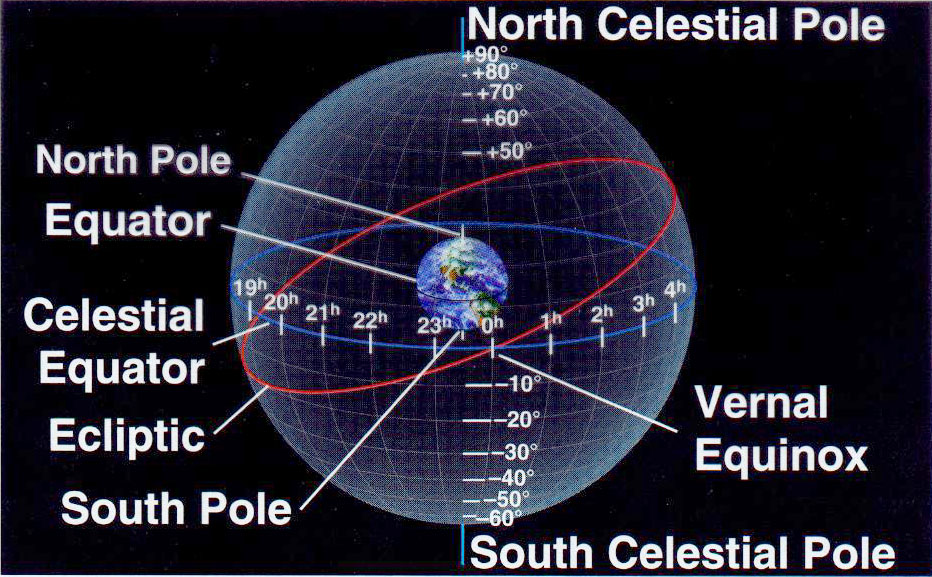
Answer: In fact it is both. As an astronomical event it marks the date on which when the Sun is at its maximum declination below the celestial equator (calculated to be at -23.5 degrees). The diagram below helps to show the relations, where we see the celestial sphere projected as a 3D lattice onto the sky from the Earth:
Image result
Thus, the north pole is projected to the North Celestial Pole, the equator is projected to the celestial equator, and all latitude lines are projected to become declination lines, while longitude lines become Right Ascension lines. Thus, just as every geographical location on Earth has a latitude and longitude so also every sky location has a declination and Right Ascension.   The "vernal equinox" position, for example, is at 0 degrees Declination and 0 hours RA.  (The vernal equinox marks the  first day of spring.) 

The red circle projected onto the celestial sphere defines the ecliptic or the projected (apparent) path of the Sun onto the celestial sphere through the year.  If we follow the red circle - the ecliptic - UP from the vernal equinox we come to the northernmost point at +23.5 degrees declination and 6h  RA. This coincides with the summer solstice - or when the Sun appears over that latitude on Earth. This marks the longest day of the year in the northern hemisphere.

If we go 180 degrees opposite, we come to -23.5 degrees declination for the Sun, which means it's now over Earth latitude of 23.5 deg. S.  This marks the shortest day of the year and is the winter solstice.

We can go to a different diagram for another perspective, this one showing the Earth in its orbit about the Sun over the year:
No photo description available.

At point A in the diagram, we have the commencement of summer in the northern hemisphere (summer solstice) because the Sun is directly over the Tropic of Cancer (lat. 23.5 N) and Earth's axis is tilted toward the Sun. Hence the N. hemisphere receives more direct sunlight, radiation. Also at point A, we have the longest day.

Summer lasts up to point B which marks the autumnal equinox,  but during this interval the length of day is continually growing shorter.  Again, the proportion of N. hemisphere area exposed to the Sun continually decreases which means from point A onwards the days continually grow shorter. The N. hemisphere observer notes the Sun's altitude in the sky is becoming lower and its path across the sky (diurnal circle) less.

This extends to point C, or the winter solstice, which marks both the shortest day (again for the N. hemisphere) and the beginning of winter. Note the Sun is now directly over the Tropic of Capricorn (lat. 23.5 S.) and the  tilt of the Earth's axis is away from the Sun, indicating less direct solar heat, radiation - while the S. hemisphere now receives more - hence it is now summer in the southern hemisphere.

The winter season extends from point C to point D, with the day lengths now increasing all the while, until the vernal equinox is reached around or about March 21, the first day of Spring. Spring then extends from March 21 to the summer solstice, with the length of days increasing further as the observer notes the  Sun now gains greater altitude in the sky, and thus longer diurnal circles (as it approaches the summer solstice (A).)

In summary then, the tilt of the Earth modulates the extent or the amount of sunlight-radiation (including heat) a hemisphere receives at a particular time, or over a given interval. Onset of winter and summer are defined respectively by the extreme axial tilts of  either "fully away" from the Sun, and "fully toward", while Fall, Spring are defined by neutral tilts - i.e.  neither away nor directly toward.

More technically, the specific points on the ecliptic  - for both solstices and equinoxes - are marked by the technical coincidence of the Sun's position with specific coordinates on the celestial sphere, as I showed earlier. 

The winter solstice then is just one of those specific points on the ecliptic but which now coincides with the specific celestial sphere coordinates of:   -23.5 decl. and 18h 00 m Right Ascension.

Wednesday, October 25, 2017

Select Questions-Answers From All Experts Astronomy Forum (3. Angles of the Sun at Sunrise in Winter etc.)

Question -
I live in a house with windows on two sides, South and East. When sitting
up in bed, on the longest day, the sun appears at about 4 am through one
window facing approximately due East. On the shortest day when sitting in
the same position the sun appears through a window approximately south to
south-east. The horizon between the two views is  at the same level to
within a few metres. the horizon is about 3-4 Kms away

My question is what is the relationship between the angle of the sun
rising on the longest/shortest day and my position on the globe -that is
my latitude (Salisbury UK)


Answer :

First, let's set out the reference frame for the angle- which we call
'azimuth'.

We can begin by noting the azimuth angle positions for the four cardinal
points of the compass:

North: A  =   0 degrees

East:  A  =  90 degrees

South:  A  = 180 degrees

West"  A =  270 degrees


Note that there may be some deviations for differing systems, but in every
astronomy course I've taught, this is how azimuth has been defined. Thus,
I call the angle more exactly "astronomical azimuth".

Now, for rising times at the equinoxes (approximately on March 21, and
Sept. 23) the rising angle will always be at 90 degrees. Thus, due east.

By the same token, the setting angle will be:

90 + 180  =  270 degrees or due west

Thus at those two dates only will you observe the Sun rise at *due east*
from your bedroom window.

Now, what about on the shortest and longest days of the year?

We can employ a simple trig relationship to obtain the azimuth angle on
these dates, and make appropriate conclusions.

That relationship is expressed:

 cos (A) = sin(d)/ cos (L)

where A is the azimuth of the Sun

d is the Sun's declination (which may be obtainable from a table - though
we know it right off from the equinox and solstice positions: +/- 23.5
degrees at solstices, 0 degrees at equinoxes).

L is the latitude for which I am using 51.5 degrees N, for London.
(Salisbury is only 10-12 miles further south on its own latitude line, so
the difference will be negligible for these purposes).

Now, for the December Solstice the Sun is over the Tropic of Capricorn
(lat. 23.5 S) so its declination is  -23.5 degrees.

We have for the Sun's azimuth at sunrise on Dec. 21 near your locale:

cos (A) = sin (-23.5)/ cos (51.5)

which gives approximately, 130 degrees./

Where is this on our observing circle reference?

We know that 180 degrees is due South so that this must be:

 40 degrees SOUTH of due East. (90 + 40 = 130)


Now, on the longest day of the year (~ June 21) the Sun is over the Tropic
of Cancer at 23.5 N latitude, so the Sun's declination is + 23.5 degrees.
Then the azimuth for that date is:

 cos (A) = sin (23.5)/ cos (51.5)

And A = 50 degrees,

This would put the Sun's rising position North of due East, specifically
40 degrees North of due East.

Based on the preceding results, between the shortest and longest day of
the year you should be seeing the Sun move from south of due east to north
of due east, by the amount of degrees difference indicated.

This also discloses that on the longest day  you cannot be observing
the Sun at true due East, but rather forty degrees North of that position
at rise time. On the shortest day, you'll be seeing the Sun 40 degrees
south of East, and you  correctly noted "approximately south to
south-east".

Re: the difference between the two views and being meters apart, and "the
horizon 3-4 km away", these linear measures are all meaningless in terms
of Sun positions. Mainly because they are subjective and variable,
dependent on the observer and his unique domain, landscape etc..

This is why angular (e.g. azimuth, hour angle) are the measures we use
since they dispense with the idiosyncrasies and peculiarities of different
linear distances. In other words, given the right instruments - e.g.
alt-azimuth measuring device- they apply to ALL observers irrespective of
particular location or house.


Sunday, March 8, 2015

Daylight Savings Time - Not Only Ridiculous But Deleterious

Last year at this time I sounded off on the foolishness of Daylight Savings Time, noting DST not only enables much more squandering of energy (as well as adding to the greenhouse effect by enhanced carbon deposition)  but also more obesity for kids- traced to losing sleep hours and eating to compensate. In the first case, the National Assoc. of Convenience Stores (main sellers of gasoline) estimate that one extra month of DST netted them an additional $1b.

So that stat alone makes a mockery of the lame claim that DST impels energy savings.

Now, a new Colorado study shows the effects of DST on our lives are actually deleterious.. Start out with the sleep problems - from losing the initial hour of sleep which tracks forward into the work and school week - to a 25 percent increase in heart attacks, to lower school test scores, and elevated ER visits and traffic accidents associated with the lost hour of time.

On the surface, one wouldn't think a measly hour could make such a profound difference, but it does.  According to National Jewish Health sleep expert Lisa Melzer:

"We have tons of evidence showing even small differences in sleep make a lot of difference in behavior."

Melzer added that "students who suffer even a small amount of sleep deprivation have trouble focusing on their work and research shows them testing below their well-rested grade level."

The worst aspect for students, according to Melzer, is that many Colorado schools tomorrow will begin testing grades three through high school on their mastery of content for state standards. At  the very least, she observed, any assessments ought to be made before the time change.

Another study published in 2012 in Sleep Medicine Reviews gave cause for further alarm. It noted that the presumed ease of adjustment in sleep patterns is wrong - even when we "fall back" in the fall and "gain an hour". The study cited an increased frequency of traffic accidents on account of the failure of sleep adjustment. Thus the sleep "debt" incurred is not magically or suddenly made up for as time goes on.

Meanwhile, heart attacks increased by 25 percent on the Monday following the time change, according to a recent study by University of Colorado cardiology fellow, Dr. Amneet Sandhu.

As I noted before, at least some of these deleterious effects might be tempered if we formally restricted DST to only being applicable between the equinoxes:  spring (Mar. 21) and fall(Sept. 22).  So, instead of having commenced DST today at 2 a.m. the powers-that -be would have waited until the nearest Sunday to the Spring equinox - which would have been March 22nd.  Similarly, DST would end at the Sunday nearest the Autumnal equinox.

This rational adjustment would also lessen the nonsensical early morning  burning of energy (because it's still dark outside), for workers and students, once the days get shorter - as they do for temperate climes near mid-October. 

The net effect of these changes would knock off almost two months of DST at a significant energy savings- as well as sparing the planet from more carbon load in the atmosphere.

Don't look for our lawmakers to go along with it, though. They are more invested in putting more moola in the pockets of businesses that can exploit DST for more wanton consumption.

Sunday, March 9, 2014

Daylight Saving Time: A Ridiculously Stupid and Wasteful Idea

I always felt DST or 'Daylight Saving Time' was a dumb notion. But since the U.S. labor sector and its corporate overseers generally demand a rigid work schedule, I could see at least some minimal benefit to family guys who couldn't get home from the office until nearly 6.30 or 7:00 p.m. and wanted some time to go out and play catch with the kids - or just take a walk.  This was generally an understandable and practical application. (At the same time, of course, workers will have to adjust to waking up an hour earlier for work by tomorrow - traced to increased frequency of heart attacks owing to the disruption of the circadian rhythm.)

But then a new meme struck which hailed the benefits of DST as an "energy saver" and my bull pockey  and PR radar instantly went off.  I smelled BS through and through and now, a new book, 'Spring Forward: The Annual Madness of  Daylight Saving Time'  ' (by Michael Downing) confirms my suspicion that there are no real energy savings and in fact more energy waste.

In a segment interview last night on the CBS News, the following hypothesis was offered by the news  anchor:

"The thinking is, with an extra hour of daylight, Americans will be outside more, in their homes left and therefore not using as much energy."

To which Downing responded:

"Well they got right the first half, that Daylight Saving pushes us out of our houses - but when Americans go the ball park or the Mall at the end of the day, we don't walk there.

Here's the dirty secret: Daylight Saving increases gasoline consumption and it's not a small matter. The National Association of Convenience Stores, who sell 80 percent of our gasoline, says that the one month of extra daylight we got recently in 2005 was worth one billion dollars to them".

That is a staggering amount of gasoline and oil consumed! Also a large amount of carbon (almost 0.2gT) added to the atmosphere, even as we are approaching a critical threshold (551gT) beyond which we will surpass the 2 deg. Celsius marker - leading to recurring violent weather, extended heat waves and droughts and new diseases entering temperate latitudes.

The anchor then asked: "Who benefits then?"

The author responded:

"Golfers benefit because of course, golf courses are too large to illuminate. So the golf industry days every extra month of daylight savings is worth about four hundred million dollars in greens fees and equipment sales. Similarly, the barbecue industry profits. Everybody associated with outdoor recreational sports loves daylight savings."

He then added that since DST extends days past Halloween, it means an extra hour for kids to graft for candies, which amounts to another fifty million or so in stores' profits.

So just terrific! DST not only enables much more squandering of energy,  as well as adding to the greenhouse effect by enhanced carbon deposition, but also more obesity for kids- i.e. probably scarfing up an extra two pounds of candy which will make them even fatter.

Another reason I believe the benefits  of DST are over-hyped, is because the nation has basically mutated from a more outdoorsy nation to an indoors one in the past twenty years or so.  Thus, unless an outdoor venue will support a WiFi connection, don't look for most of the Gen X or Y generations to partake. They want the social media connections, and while Twitter can provide a medium for some outdoor connections, it usually ends once the Twittering teen is accidentally clobbered by the first foul ball in his or her direction. (They were too busy twittering so didn't look up to see it coming).

I doubt we can end the unsupported yen for DST but a compromise ought to at least be possible. Indeed, I regard it as even more of a compromise from my end, because lots of gasoline will still be used up though not as much. The compromise is to limit the time applicable to DST between the equinoxes, spring (Mar. 21) and fall(Sept. 22).  So, instead of having commenced DST today at 2 a.m. the powers-that -be would have waited until the nearest Sunday to the Spring equinox - which would have been March 23rd.  Similarly, DST would end at the Sunday nearest the Autumnal equinox. 

It would also stop the nonsensical early morning  burning of energy (because it's still dark outside), for workers and students, once the days get shorter - as they do for temperate climes near mid-October. 

The net effect of these changes would knock off almost two months of DST at a significant energy savings- as well as sparing the planet from more carbon load in the atmosphere.

Don't look for our lawmakers to go along with it, though. They are more invested in putting more moola in the pockets of businesses that can exploit DST - including all the corporations that now see an opening to make their drones work even longer hours!

'Watcha wanna go home at six for! It's still light outside!"