Question: What exactly is the "winter solstice"? Is it a date or an astronomical event?
Answer: In fact it is both. As an astronomical event it marks the date on which when the Sun is at its maximum declination below the celestial equator (calculated to be at -23.5 degrees). The diagram below helps to show the relations, where we see the celestial sphere projected as a 3D lattice onto the sky from the Earth:
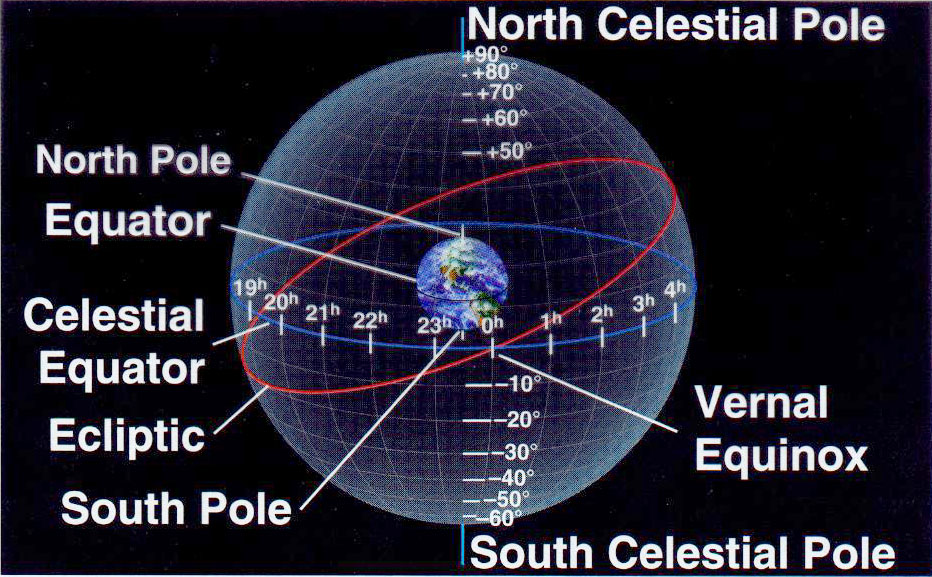
Thus, the north pole is projected to the North Celestial Pole, the equator is projected to the celestial equator, and all latitude lines are projected to become declination lines, while longitude lines become Right Ascension lines. Thus, just as every geographical location on Earth has a latitude and longitude so also every sky location has a declination and Right Ascension. The "vernal equinox" position, for example, is at 0 degrees Declination and 0 hours RA. (The vernal equinox marks the first day of spring.)
The red circle projected onto the celestial sphere defines the ecliptic or the projected (apparent) path of the Sun onto the celestial sphere through the year. If we follow the red circle - the ecliptic - UP from the vernal equinox we come to the northernmost point at +23.5 degrees declination and 6h RA. This coincides with the summer solstice - or when the Sun appears over that latitude on Earth. This marks the longest day of the year in the northern hemisphere.
If we go 180 degrees opposite, we come to -23.5 degrees declination for the Sun, which means it's now over Earth latitude of 23.5 deg. S. This marks the shortest day of the year and is the winter solstice.
We can go to a different diagram for another perspective, this one showing the Earth in its orbit about the Sun over the year:

At point A in the diagram, we have the commencement of summer in the northern hemisphere (summer solstice) because the Sun is directly over the Tropic of Cancer (lat. 23.5 N) and Earth's axis is tilted toward the Sun. Hence the N. hemisphere receives more direct sunlight, radiation. Also at point A, we have the longest day.
Summer lasts up to point B which marks the autumnal equinox, but during this interval the length of day is continually growing shorter. Again, the proportion of N. hemisphere area exposed to the Sun continually decreases which means from point A onwards the days continually grow shorter. The N. hemisphere observer notes the Sun's altitude in the sky is becoming lower and its path across the sky (diurnal circle) less.
This extends to point C, or the winter solstice, which marks both the shortest day (again for the N. hemisphere) and the beginning of winter. Note the Sun is now directly over the Tropic of Capricorn (lat. 23.5 S.) and the tilt of the Earth's axis is away from the Sun, indicating less direct solar heat, radiation - while the S. hemisphere now receives more - hence it is now summer in the southern hemisphere.
Summer lasts up to point B which marks the autumnal equinox, but during this interval the length of day is continually growing shorter. Again, the proportion of N. hemisphere area exposed to the Sun continually decreases which means from point A onwards the days continually grow shorter. The N. hemisphere observer notes the Sun's altitude in the sky is becoming lower and its path across the sky (diurnal circle) less.
This extends to point C, or the winter solstice, which marks both the shortest day (again for the N. hemisphere) and the beginning of winter. Note the Sun is now directly over the Tropic of Capricorn (lat. 23.5 S.) and the tilt of the Earth's axis is away from the Sun, indicating less direct solar heat, radiation - while the S. hemisphere now receives more - hence it is now summer in the southern hemisphere.
The winter season extends from point C to point D, with the day lengths now increasing all the while, until the vernal equinox is reached around or about March 21, the first day of Spring. Spring then extends from March 21 to the summer solstice, with the length of days increasing further as the observer notes the Sun now gains greater altitude in the sky, and thus longer diurnal circles (as it approaches the summer solstice (A).)
In summary then, the tilt of the Earth modulates the extent or the amount of sunlight-radiation (including heat) a hemisphere receives at a particular time, or over a given interval. Onset of winter and summer are defined respectively by the extreme axial tilts of either "fully away" from the Sun, and "fully toward", while Fall, Spring are defined by neutral tilts - i.e. neither away nor directly toward.
In summary then, the tilt of the Earth modulates the extent or the amount of sunlight-radiation (including heat) a hemisphere receives at a particular time, or over a given interval. Onset of winter and summer are defined respectively by the extreme axial tilts of either "fully away" from the Sun, and "fully toward", while Fall, Spring are defined by neutral tilts - i.e. neither away nor directly toward.
More technically, the specific points on the ecliptic - for both solstices and equinoxes - are marked by the technical coincidence of the Sun's position with specific coordinates on the celestial sphere, as I showed earlier.
The winter solstice then is just one of those specific points on the ecliptic but which now coincides with the specific celestial sphere coordinates of: -23.5 decl. and 18h 00 m Right Ascension.
