
Question -
We know the higher up a mountain you go the colder it is. We also know space is cold, so it must be the microwaves from the Sun that reach Earth, excite the atmosphere and hence make us warm. Please help to clarify, sir.Answer -
With a surface temperature of 6,000 C (11,000 F) and a core temperature of 15 million Celsius, it is nuclear fusion in the Sun's core which is the generator of the radiant energy responsible for warming the Earth - via the infrared radiation (not microwaves.)
Indeed the extremely high core temperatur is needed in order to achieve the fusion of hydrogen nuclei into helium. The primary fusion source is the proton -proton cycle i.e.
1H + 1H + e- ® 2 H + n + 1.44 MeV
2 D + 1H ® 3 He + g + 5.49 MeV
3 He + 3 He ® 4 He + 1H + 1H + 12.85 MeV
The top line shows two protons fusing to yield deuterium (heavy hydrogen) with a positron and neutrino (n) emitted, along with 1.44 MeV of energy. Empirical evidence of this reaction is obtained from gallium detectors, of the neutrinos given off, which are within 1-2% of what theoretical models predict.[1] In the second fusion reaction, the deuterium combines with a proton to give the isotope helium 3, along with a gamma ray (g) and 5.49 MeV energy. In the final fusion, two helium-3 nuclei combine to yield one helium-4 nucleus, along with two protons, and 12. 85 MeV energy. Note that the two ending product protons commence the cycle anew, so that the generation of nuclear energy is ongoing.
Regarding colder temperatures with altitude experienced here on Earth, this has everything to do with the density of oxygen, nitrogen (e.g. air) molecules decreasing. Hence, the higher one goes up a mountain the fewer molecules (matter) there are to absorb heat- or retain it.
What we call 'heat' (internal energy) is really energy associated with the motion
of molecules in a medium. The graphic shown below illustrates the relation of
heat energy to kinetic or motion energy in a gas contained within a cylinder. The
cylinder has a solid bottom at one end and a moveable piston at the other.

In this case the heat imparted by the Bunsen burner causes the molecules in the gas to move more rapidly - colliding with each other and causing the piston to move upward -expanding the gas volume. This changes the volume of the gas from V1 to V2 where V2 > V1.
Space is "cold" because there are so very few molecules of matter in it, being nearly a perfect vacuum. The presence of so few molecules means very few collisions and little available internal energy. Hence, even if you try to heat a volume of space there will be little detectable difference.
Regarding the Sun, it radiates at all wavelengths of the electromagnetic spectrum - not just microwaves.
If you study the diagram of the EM spectrum below you will see that microwaves form only a relatively small region:
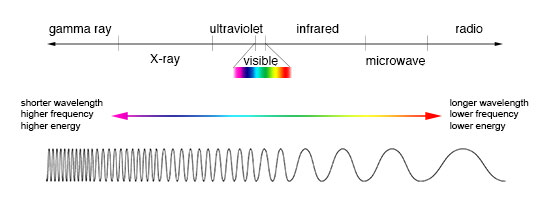
These are associated with longer wavelength EM radiation, as are radio waves. The shorter wavelengths (to the left) include what we call the "visible" band - as well as x-rays, UV (ultraviolet) and gamma rays.
The Sun actually shines with its maximum radiation emitted at about 5500 Angstroms (550 nm) - or in yellow light. It radiates at all wavelengths but has the maximum at that band. This is depicted below:

The fact is the Sun's radiant energy is being transferred to the Earth through space by the process known as radiation - which can occur even in a vacuum. But the fact the Sun's radiation (including as
heat, i.e. infrared radiation) can be transferred through space doesn't mean space itself will be hot - as I've explained.
Space is 'cold' not because it absolutely lacks heat but because its
density (of particles) is too low to have much quantity of heat, or
'thermal capacity'.
The thermal capacity, W, is defined by the amount:
W = mc
where m is the mass of the medium and c, the heat capacity. It is a measure of how difficult it is to increase the temperature of a medium by one degree (e.g. Kelvin). Obviously, since space is a near-vacuum, m is near 0, and c is near 0, so little or no thermal capacity exists. What this means is that energy from the Sun can be transferred through space, without appreciably heating space.
Back to Earth: If air is thin (low density), as it is at high altitude, i.e. the top of a mountain, there isn't enough mass present to enable or facilitate energy transfer to the medium. Hence, it feels 'cold' to the human observer. But this has nothing to do with the Sun being 'cold' because it exists in space. (As I noted earlier.) Conversely, the more one descends in altitude, the greater the number of particles encountered, and the greater the atmosphere's retention of heat. (thermal capacity)
The fundamental point here is that no heat energy transfer occurs from a cooler body to a hotter- ONLY from a hotter to cooler. Hence, it follows the Earth must be the cooler body compared to the Sun
One further point: One can have an enormous temperature - say for the Sun's corona- which is still not enough to burn anybody! In the case of the solar corona, we estimate a kinetic temperature of 2 million degrees K, yet if one could insert a finger into it, there'd be NO burn. Why is this?
Because the corona is essentially a vacuum containing very few particles (low thermal capacity). However, those few particles have very high velocities, so possess extremely high 'kinetic temperature' - which is most of what the '2 million Kelvin' magnitude is about.

No comments:
Post a Comment