Showing posts with label Sea level rise. Show all posts

Tuesday, August 27, 2019

Rapid Melting Of Greenland Ice Sheet : Will Our Favorite Barbados Beach Still Be There Next Time We Arrive?


It's been known for at least 38 years, that South Florida will be 'ground zero' when the rising seas from climate change begin to have their most serious impact. Indeed, the image of  projected sea reclamation by 2035  for Florida - in a U.S. Geological survey map -  was actually published first in a (World Book) Science Encyclopedia article from 1981.   

Meanwhile, sea rise prognostications had forecast a 20- 25 ft. increase by 2070 owing to the melting of Greenland' enormous ice sheet.  But frankly, that's all gone by the backboards as we now have direct evidence the melting of the Greenland ice sheet has accelerated and dramatically.  

How much are we talking about?  According to the latest reports (cf. The Denver Post, Aug. 25, p. 1A, 'Greater Mass Loss Going Forward'):

"By the end of the summer about 440 million tons of ice wil have melted or calved off Greenland's giant ice sheet. "

Adding:

"In the span of July 31 to August 3, more than 58 billion tons melted from the surface. This is more than 40 billion tons more than the average for this time of year."

Which elicits the question of what transpires if this rate of melt is sustained or even accelerates? It seems clear that in such a case the forecast that "Greenland alone would cause 3-4 feet of sea level rise" must be advanced, possibly to 2040 or even earlier.  Indeed, Greenland accelerated melting is  now evident given (ibid.):

"A NASA satellite found that Greenland's ice sheet lost about 255 billion metric tons of ice a year between 2003  and 2016, with the loss rate generally getting worse over that period."

Add that to the melting of the Arctic ice caps and Antarctic ice shelf as well and one can imagine a scenario for a 20-25 ' sea level rise by mid century.   We also now have to factor in the effects of the burning Amazon rain - forest - likely to add 2- 5 gigatons of carbon to the already CO2 sodden atmosphere.  This is no longer in the realm of science fiction such as portrayed in flicks like 'Waterworld'.  

Just look at the projected map of sea reclamation projected by the U.S. Geological survey for Florida by 2035. Now imagine a sea level rise instead of 3 m and five times the number of Florida residents affected. Yes, it is quite within the realm of plausibility now.  Hell, we've even seen how Miami itself is now subject to flooding.  The map below of the Miami area shows effect of elevation on rate of property price appreciation:

No photo description available.
Where the more contrast colored purple section refers to greater effect on rate of appreciation.  The incredible conclusion of Harvard real estate professor (and author of the paper) Jesse Keenan, is that ordinary home owners are already factoring future sea level rise into their calculations.

What about the island nation of Barbados, where I lived with wifey for 20 plus years?  It won't be any better for Bim's residents - unless they are living toward the higher elevations as indicated in the topographical  map below


Here the green coded area is greatest in elevation over sea level - from 194m to 338 m. To spare Bim's populace from the ravages of sea level rise on the same scale we expect for South Florida, they'd have to move to this area.  The most populated areas near the south coast (1- 3 m elevation) would be totally reclaimed by the ocean. Already as I posted previously, sea level rise has claimed large chunks of the beaches in and around Christchurch and St. Michael parishes.  On several visits to Bim over the past several years we've seen the encroachment of the sea first hand.

The future for Barbados and other island states does not look promising as an article in the UK Independent  notes:
"With a sea-level rise of one metre, which is now regarded as highly likely by the end of the century, the Caribbean would see "at least 149 multi-million dollar tourism resorts damaged or lost" and would also see loss or damage of 21 of the Caricom airports, and the inundation of land surrounding 35 of the region's 44 portsmage leapt upwards, as one metre of sea level.  

With a two-metre sea-level rise, by no means impossible, there would be "at least 233 multi-million dollar tourism resorts lost" plus damage or loss of nine power plants, 31 airports, and the loss of 710km of roads. However, when a more sophisticated analysis was done on the impacts of erosion caused by rising seas, it was found that the damage leapt upwards, as one metre of sea level rise on low-lying coasts gives between 50 and 100 metres of erosion. A one-metre rise with erosion factored in would result in "at least 307 multi-million dollar tourism resorts damaged or lost," the report says."

So we are talking calamitous economic and topographical changes here. Almost certainly permanent and indeed - with increased warming - the forecast can only get worse.  Indeed, we are speculating that at the current rapid Greenland ice sheet melt rate our favorite Bajan beach (below)  may no longer even exist by the time we next visit. 
Lastly, let's bear in mind that sea level rise is only one aspect of the ongoing climate catastrophe.  The other is the increased frequency of extraordinarily hot days -  spiking heat indices to unheard of levels (110 F and above) as lives and livelihoods are put at risk.

To fix ideas, the Union of Concerned Scientists 'Killer Heat' team recently compared historic averages over the period 1971- 2000 with projected heat indices for the middle to the end of this century. Their finding? 

"The team's projections bumped up against the limits of the NWS heat index formula, which is capable of calculating a value for 99 percent of summertime conditions. The analysis found that as climate change intensifies extreme heat, the numbers will often rise beyond the calculable range."

In other words, we are taking of conditions at the cusp of the runaway Greenhouse effect. Conditions so radically divergent from those today that current heat index models are unable to calculate the temperature (or thermature) limits.

One thing for certain, with the incineration of the Amazon rain forest  all our futures - especially for the younger generation - suddenly got much,  much worse.

See also:

https://www.independent.co.uk/environment/climate-change/rising-sea-level-threatens-hundreds-of-caribbean-resorts-says-un-report-2148034.html


And:

Friday, November 2, 2018

New IPCC Finding Shows More Rapid Ocean Warming - And Accelerated Path To Calamity

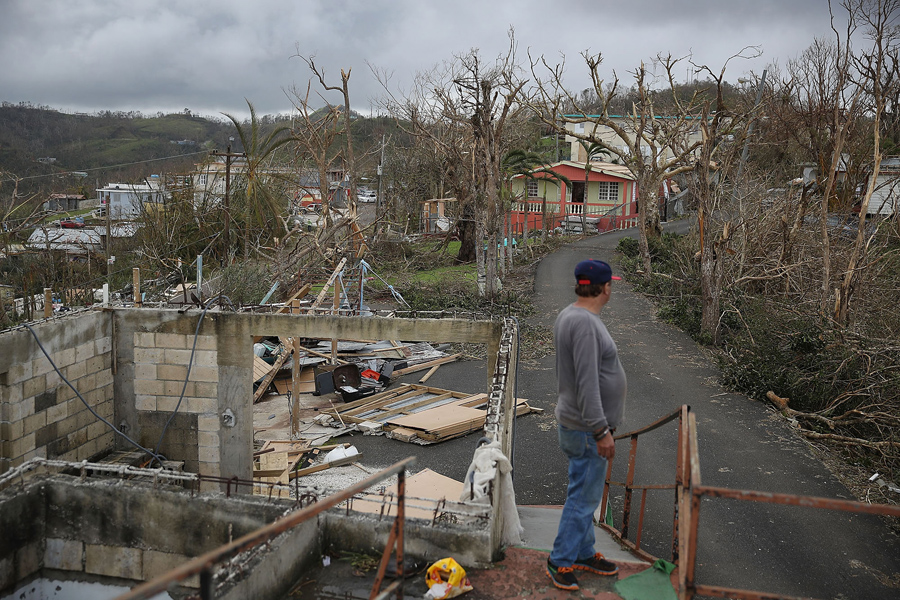
Image result for images of Puerto Rico damageDevastation in Puerto Rico following Hurricane Maria, which climate scientists agree was spawned by warmer ocean temperatures from global warming.

Even as we've learned of the world now projected in an ominous United Nations report — prepared by The Intergovernmental Panel for Climate Change, a new subsidiary report warns of warmer than ever oceans.  According to the last major assessment by the Intergovernmental Panel on Climate Change (IPCC), the world's oceans have taken up over 90% of the excess heat trapped by greenhouse gases.
This new study says that every year, for the past 25 years, we have put about 150 times the amount of energy used to generate electricity globally into the seas - 60% more than previous estimates.   This poses serious problems going forward, not the least of which is the threat to ocean life (such as corals) from warmer temperatures, e.g.
Image may contain: ocean, sky, plant, outdoor, nature and waterImage may contain: plant, sky, outdoor, nature and waterDying coral reef from warmer ocean temperatures (left and a healthy reef.
As well as rising sea levels, and more frequent Category 5 hurricanes (such as Maria, see top graphic) which feed off higher ocean temperatures.
 The IPCC team bases its predictions about how much the Earth is warming by adding up all the excess heat that is produced by the known amount of greenhouse gases that have been emitted by human activities. This new calculation shows that far more heat than we thought has been going into oceans. But it also means that far more heat than we thought has been generated by the warming gases we have emitted. 
All the extra heat being absorbed by the oceans means not only a much greater difficulty of containing increased warming - even to 2 C- but also many deleterious effects for ocean life itself.  According to  Laure Resplandy , a geoscientist at Princeton University who led the startling study published Wednesday in the journal Nature:
"If you look at the IPCC 1.5C, there are big challenges ahead to keep those targets, and our study suggests it's even harder because we close the window for those lower pathways.A warmer ocean will hold less oxygen, and that has implications for marine ecosystems.  There is also sea level, if you warm the ocean more you will have more thermal expansion and therefore more sea level rise."
The critical element is the fact that as waters get warmer they release more carbon dioxide and oxygen into the air.  As Dr. Resplandy made clear:
"When the ocean warms, the amount of these gases that the ocean is able to hold goes down,"  

Adding:
"So what we measured was the amount lost by the oceans, and then we can calculate how much warming we need to explain that change in gases."
The additional IPCC findings help resolve a long-running puzzle about the rate of ocean warming before 2007. when more reliable measurements from devices called “Argo floats” were put to use worldwide. Before that, differing types of temperature records — and an overall lack of them — contributed to uncertainty  about how quickly the oceans were heating up.
The higher-than-expected amount of heat in the oceans means more heat is being retained within Earth’s climate system each year, rather than escaping into space. In essence, more heat in the oceans signals that global warming is more advanced than scientists thought.
As Dr. Resplandy put it:
"We thought that we got away with not a lot of warming in both the ocean and the atmosphere for the amount of CO2 that we emitted.  But we were wrong. The planet warmed more than we thought. It was hidden from us just because we didn’t sample it right. But it was there. It was in the ocean already".
 Of course, this again puts the lie to climate change denier Holman Jenkins' recent bloviations, e.g. 'How Greens Humiliate Themselves', WSJ 

https://www.wsj.com/articles/how-greens-humiliate-themselves-1540939433
That there is oh so much uncertainty and climate scientists are just squandering time and money trying to nail down any real increase in global temperatures.   Of course, this is utter codswallop which merely says more about the deficiencies of the Journal's op -ed writers than anything else. 
Given ocean temperatures are rising more rapidly than previously calculated, that  leaves nations even less time to dramatically cut the world’s emissions of carbon dioxide. That is, assuming there is any hope in limiting global warming to the ambitious goal of 1.5 degrees Celsius (2.7 degrees Fahrenheit) above pre-industrial levels by the end of this century.  Many newer results show this is overly optimistic and neglecting other factors in play, e.g.

Climate report understates threat

Excerpt:

"So far, average temperatures have risen by one degree Celsius. Adding 50 percent more warming to reach 1.5 degrees won’t simply increase impacts by the same percentage—bad as that would be. Instead, it risks setting up feedbacks that could fall like dangerous dominos, fundamentally destabilizing the planet. This is analyzed in a recent study showing that the window to prevent runaway climate change and a “hot house” super-heated planet is closing much faster than previously understood."

Even as we've now been informed of the new ocean warming factor, we also have found out - more than than a year after the fact-  the U.S. Environmental Protection Agency took down information on climate change from its website for an “update”, it now seems uncertain whether it will ever reappear.

In April last year, the EPA replaced its online climate change section with a holding page that said the content was being updated to “reflect the agency’s new direction under President Donald Trump”.
Information previously found at epa.gov/climatechange made it clear that human activity was warming the planet, resulting in harm to Americans’ health as well as crucial ecosystems on which humans depend.
The “update” page has now given way to a page that simply states: “We want to help you find what you are looking for.” Below, one finds links to search other areas of the EPA website, as well as to an archived “snapshot” of the site from the day before Trump became president in January 2017. The switch was observed by the Environmental Data & Governance Initiative, which tracks changes in government websites

In the words of Juidth Enick, former EPA special administrator:.
“It’s an embarrassment. It is a ghost page.  It’s a bit like Amazon not allowing the public to order books via its website – it’s that fundamental. There’s no other issue at the EPA more important than climate change; it affects air, water, health and whether large parts of the world will survive.”
The likely culprit responsible? Scott Pruitt, the climate pseudo - skeptic who was Trump’s pick as EPA administrator until he resigned in July amid a long-running ethics scandal, repeatedly questioned basic scientific understanding of climate change while he headed the agency, such as whether carbon dioxide is a primary driver of planetary warming.

Tuesday provides a small chance to get it right. But if voters fail to follow through, or too many are bamboozled by the "threat" of a caravan of poor Honduran migrants, well they will have a real existential threat to fret over in a dozen years.

See also:

We Have 12 Years to Save—or Lose—Our Only Home

Thursday, May 31, 2018

"Sea Is Rising, But Not From Climate Change" - Fred Singer's WSJ Op-Ed Calls Into Question His Mental Acuity


Image may contain: 2 people, text that says 'Excuse Freddy, he maybe got da Alzheimer's!'
S. Fred Singer has been notorious in climate science circles for many years. Though ostensibly trained as an "atmospheric physicist" and even with some rocket science background, Singer has proven himself to be one of the most obdurate deniers of global warming.  More recently, as in a Mar. 18 WSJ op-ed ('The Sea Is Rising, but not from Climate Change') it appears he's devolved into full blown senility or maybe early onset Alzheimer's.   The touched -in- the- head simpleton writes:

"Of all known and imagined consequences of climate change, many people fear sea-level rise most. But efforts to determine what causes seas to rise are marred by poor data and disagreements about methodology. The noted oceanographer Walter Munk referred to sea-level rise as an “enigma”; it has also been called a riddle and a puzzle. 

It is generally thought that sea-level rise accelerates mainly by thermal expansion of sea water, the so-called steric component. But by studying a very short time interval, it is possible to sidestep most of the complications, like “isostatic adjustment” of the shoreline (as continents rise after the overlying ice has melted) and “subsidence” of the shoreline (as ground water and minerals are extracted). I chose to assess the sea-level trend from 1915-45, when a genuine, independently confirmed warming of approximately 0.5 degree Celsius occurred.

 I note particularly that sea-level rise is not affected by the warming; it continues at the same rate, 1.8 millimeters a year, according to a 1990 review by Andrew S. Trupin and John Wahr. I therefore conclude—contrary to the general wisdom—that the temperature of sea water has no direct effect on sea-level rise. That means neither does the atmospheric content of carbon dioxide. 

This conclusion is worth highlighting: It shows that sea-level rise does not depend on the use of fossil fuels. The evidence should allay fear that the release of additional CO2 will increase sea-level rise."

Of course, this is absolute nonsense, and the reaction- response of  (real) climate scientists to this offal was not long in coming.  Among the first to respond (WSJ letters, May 16) were Prof. Andrea L. Dutton of the University of Florida, and Prof. Michael Mann of Penn State.  They wrote, in deliberate sarcastic frame:

"Would the Journal run the op-ed 'Objects Are Falling, But Not  Because of Gravity'? That's pretty similar to climate contrarian Fred Singer saying The Sea Is Rising but not from Climate Change.

No, ice is not accumulating on Earth, it is melting. No, Antarctica isn't too cold for melting - warming oceans are eroding the ice from beneath, destabilizing the ice sheet. And no, legitimate scientific conclusions are not reached in op-ed pieces but through careful, peer-reviewed research".

Which begs the question of why Singer didn't get his major climate "find" published in a major journal. Well, most likely because after he sent it in - assuming he did - the referees were unable to stop laughing from hysterics.  That's because they'd know, as the authors write "research shows that sea levels are rising and human -caused climate change is the cause."

The best part is when they give Mr. "Rocket scientist" Singer a basic thermal physics lesson, this is after he writes "the cause of the trend is  puzzle":

"When water warms it expands. When ice warms it melts. To deny these facts is not just to deny climate change. It is deny basic physics."

Among the dumbest takes is seen at the end when Singer scribbles:

"Currently, sea level rise does not seem to depend on ocean temperatures and certainly not on CO2. We can expect the sea to continue rising at about the present rate for the foreseeable future."

To which letter writer Wendy Fleischer responds, citing NASA, via a Feb. 13 paper:

"Rising concentrations of greenhouse gases in Earth's atmosphere increase the temperature of air and water, which causes sea level to rise in two ways: first, warmer water expands, and this thermal expansion of the ocean has contributed about half of the 7 centimeters of global mean sea level rise over the last 25 years. Second, melting land ice flows into the ocean, also increasing sea level across the globe."


Which begs the 2nd question of whether we need to send Singer back to school for a remedial physcs lesson.

In a summary retort from climatefeedback.org we read:

This commentary published by The Wall Street Journal, written by Fred Singer, claims that warming (and therefore greenhouse gas emissions) has no effect on global sea level rise. Although Singer concedes the physical fact that water expands as its temperature increases, he claims that this process must be offset by growth of Antarctic ice sheets.

Scientists who reviewed this opinion piece explained that it is contradicted by a wealth of data and research. Singer bases his conclusion entirely on a cherry-picked comparison of sea level rise 1915-1945 and a single study published in 1990, claiming a lack of accelerating sea level rise despite continued warming. But in fact, modern research utilizing all available data clearly indicates that sea level rise has accelerated, and is unambiguously the result of human-caused global warming.

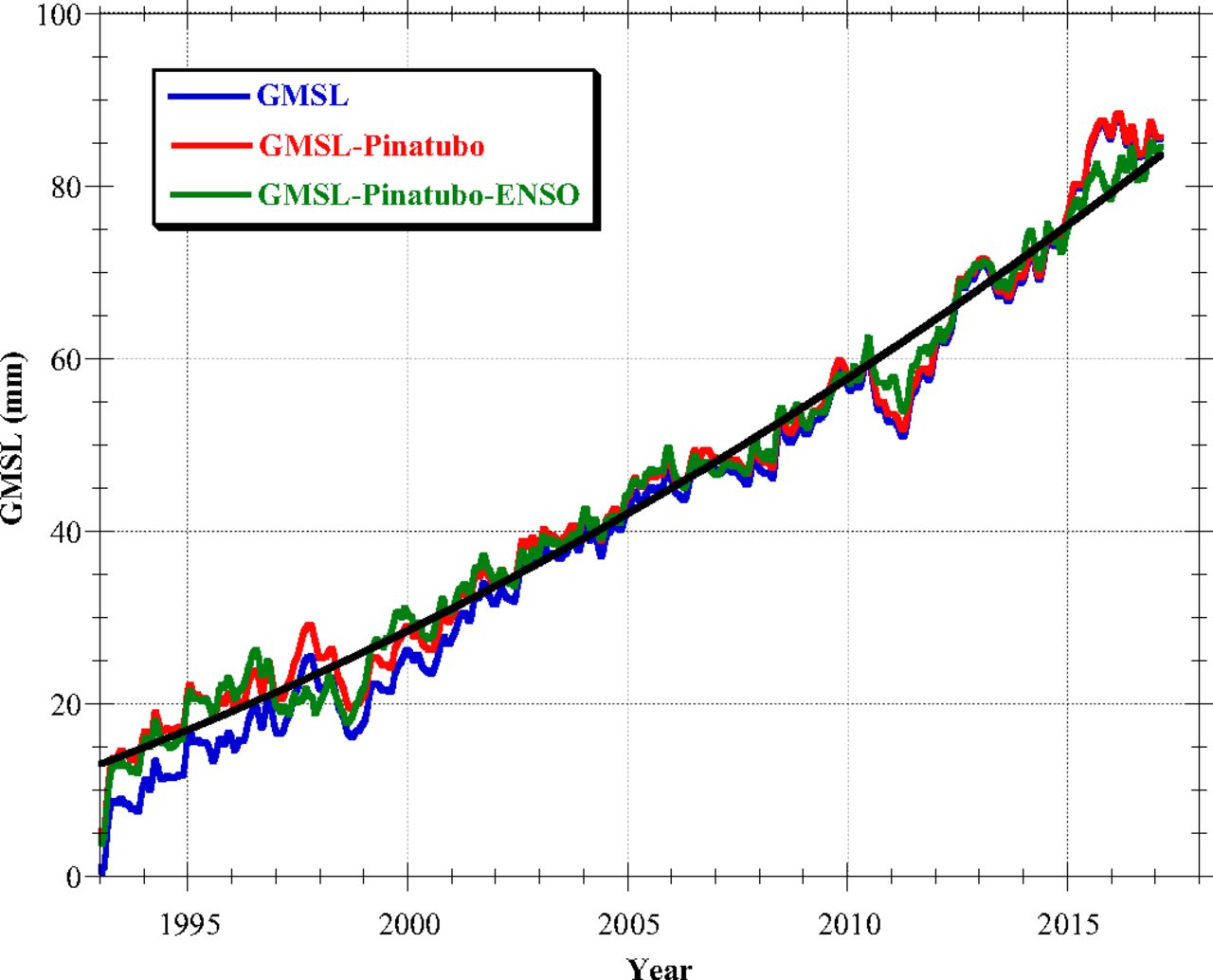
Since the 1990s for example, satellites have measured an acceleration in the rate of global sea level rise:

Global mean sea level (blue), after removing an estimate for the impacts of the eruption of Mount Pinatubo (red), and after also removing the influence of El Niño (green), fit with a quadratic (black). From Nerem et al. (2018)

REVIEWERS’ OVERALL FEEDBACK


These comments are the overall opinion of scientists on the article, they are substantiated by their knowledge in the field and by the content of the analysis in the annotations on the article.

Chris Roberts, Research Scientist, ECMWF/Met Office:

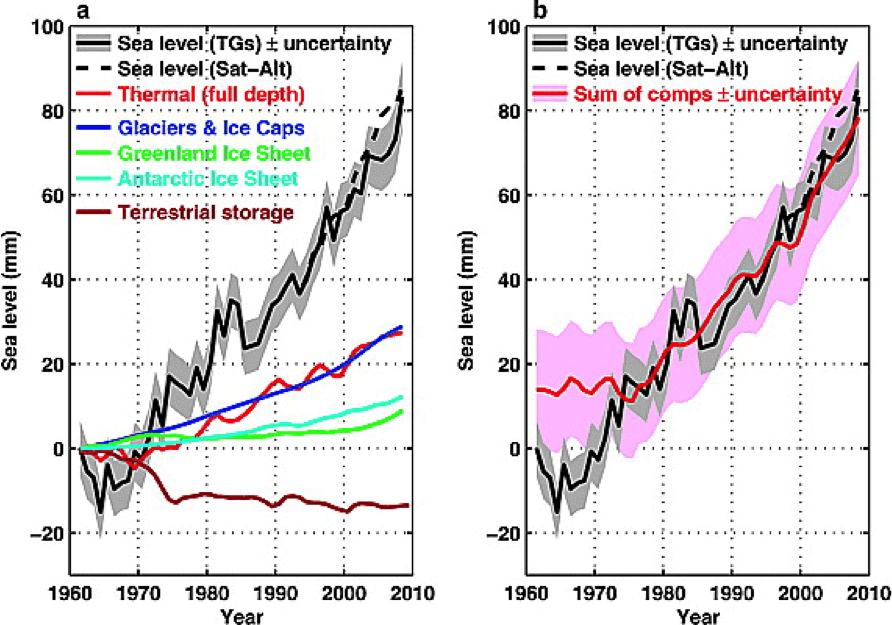
This article severely misrepresents the scientific understanding of the processes responsible for observed changes in global sea level. Understanding and attributing the causes of changes in global sea level is an area of active research and there are genuine uncertainties, but there is a clear consensus on the important roles for ocean thermal expansion and addition of mass to the oceans from melting glaciers and ice caps during recent decades. For example, the following paper by Church et al. (2008)* summarizes the independent lines of evidence for changes in sea level from satellite altimeter and tide gauge measurements and how these changes can be explained by a combination of thermal expansion and exchange of mass (either liquid water or ice) between the oceans and continents:

Figure – Global sea‐level budget from 1961 to 2008. (left) The observed sea level using coastal and island tide gauges (solid black line with grey shading indicating the estimated uncertainty) and using satellite altimeter data (dashed black line) with thermal expansion and glaciers melting components; terrestrial storage (e.g. dams) partially offsets other contributions to sea‐level rise. (right) The observed sea level and the sum of components.


Stefan Rahmstorf, Professor, Potsdam University:

The article has almost nothing to do with the modern state of sea-level science. The author tries to call into question that global warming causes sea-level rise, and does so by cherry-picking a short segment of data from 1915-1945, a time when data quality is poor and the warming signal small—a bizarre approach that could never pass scientific peer review and is apparently aimed at misleading a lay audience.

Keven Roy, Research Fellow, Nanyang Technological University:
This article is misleading, and presents inaccurate statements about global mean sea level rise.

Other criticisms:  On Singer's reliance on "outdated, cherry -picked data":

Benjamin Horton, Professor, Earth Observatory of Singapore:

This is a blatant case of cherry picking to confirm a Singer’s position while ignoring all other instrumental sea level data that may contradict that position. This fallacy is a major problem in public debate.
Stefan Rahmstorf, Professor, Potsdam University:

It is rather ironic that the author first complains about “poor data” and then goes on to cherry-pick a time of particularly poor data that includes the World War 2 period. Even the temperature data from this period are questionable; the sea surface temperature data show a strong warm peak at the end of WW2 (the basis of his claim of 0.5 °C warming) which is probably a data collection artefact, given that no such warming is seen in the data collected at the global network of weather stations on land. Also, in the peer-reviewed literature it has been shown that minor inaccuracies in sea-level data by just a few millimeters can lead to spurious fluctuations of sea level trends when too-short time intervals are considered*.

So the takeaway from all these climate specialists is that Fred Singer doesn't know what the hell he's writing about. But again, bear in mind it's an op-ed in the WSJ - which as one climate scientist put it "just tells its readers what they want to hear".

With this latest load of pseudoscientific twaddle, Singer has shown himself not only an incompetent agnotologist - from the Greek agnosis, or to sow doubt- but either suffering from premature senility or.....being gracious, now one of the Climate Denier Three Stooges. That would be right along with 'Moe' and 'Larry'......errrrr… Richard Lindzen and Willie Soon.

See also:

https://andthentheresphysics.wordpress.com/2018/05/17/sea-level-rise/

And:

http://brane-space.blogspot.com/2015/02/another-climate-scientist-fake-exposed.html

Tuesday, May 2, 2017

More on the Rift Associated With West Antarctic Ice Shelf

No automatic alt text available.Image of the rift in Pine Island Glacier ice shelf in West Antarctica photographed from the air during a NASA imaging operation in November, 2016.  This is the second rift to form in three years.


In this era of fake news and rampant pseudo-science, as well as science denial, climate scientists have been trying desperately to warn of the disastrous consequences if the West Antarctic ice sheet were to collapse.  For example, based on current computer projection models, such a collapse could lead to a sea level rise of nearly 3 meters (10 feet) which would be enough to inundate major U.S. cities such as New York, Miami and Jacksonville, while displacing 150 million people inhabiting coasts worldwide.

To set the scene: In 2015 a nearly 225 square mile iceberg broke off from Pine Island Glacier. However, it wasn't until climate scientists began testing new imaging processing software that something peculiar was notice in the Landsat 8 images.  That is, a rift was observed in the surfac3e of the ice shelf nearly 20 miles inland. The Landsat marked date was tracked to 2013. Overt 2 years the rift grew until it set the iceberg adrift in late July, early August, 2015.  During this interval a similar rift opened up 6 miles further inland from the first.

To be sure, such rifts usually form at the sides of an ice shelf where ice is thinner and also subject to shearing that rips it asunder. However, this particular rift (shown in the above image) originated at the center of the Pine Island Glacier's ice shelf then propagated to its margins. The implication is that some agent weakened the center of the ice shelf and the most plausible culprit appears to be a crevasse that melted out a bedrock level. This in turn was most likely driven by a warmer ocean.

The observed fact that the rift opened in the bottom of a 'valley' in the shelf  (where the ice had thinned) provides yet another clue the center of the ice shelf is weak. The 'valley' formation is also something the Antarctic researchers had long suspected given ocean water can intrude far inland and remain unseen. This is also associated with the fact the bottom of the West Antarctic ice sheet lies below sea level.

The rift's origin, interestingly, might have remained unseen if not for the fact the images were taken when the Sun was low in the sky. Thus, long shadows were created across the ice and white snow that provided visibility and drew the team's attention to the valley that had formed there.

It needs to be noted that such 'rifting' behavior provides a mechanism for rapid retreat of glaciers.  Indeed, similar subsurface rifting has been observed in the Greenland ice sheet (jokalhlaup) where ocean water has seeped inland along the bedrock and begun to melt the ice from underneath.  Now the Landsat images provide the first strong evidence that the large Antarctic ice shelves respond to changes at the ocean edge like the Greenland ice shelf.

For a more complete look at the relevant research go to:

https://doi.org/10.1002/2016GL071360


Tuesday, January 3, 2017

Climate Change Adaptation Will Be Limited And Require Competent Policy Changes


More (or less) serious proposals for adapting to climate change have been circulating for at least the past ten years.  Among the more trenchant have been those that actually claim to be techno-solutions to slow it down as proposed by the authors of the book, Super-Freakanomics: Global Cooling, Patriotic Prostitutes, and Why Suicide Bombers Should Buy Life Insurance.

One of their pet Rube Goldberg schemes (which obviously could only come from the brains of a pair of economists locked into hubris) is dispersing a fleet of fiberglass boats equipped with cloud-making machines over the oceans. They reason that the clouds would increase albedo and thence, decrease the tendency to trap incoming radiation. Hence, offset warming!

Nowhere did these two stalwarts factor in that a specific type of cloud has to be generated, not just any old cloud! For example, wispy high flying cirrus are semi-transparent to incoming sunlight but block infrared radiation emitted by the Earth, thus CONTRIBUTING to the Greenhouse Effect. Meanwhile, stratus clouds are gray, dense and low flying and have a net COOLING effect since their albedo is relatively high. So how will the authors ensure they generate the second type and not the first. And also, given an average of 3.5 billion cubic meters of cloud will be needed to offset the inputs of CO2 just from the oceans, where will they get the boats? Assuming each fiberglass boat can generate one million cubic meters of cloud (a BIG assumption) that means 35,000 such boats will be needed. One was left to wonder whether either of these geniuses bothered to calculate how much CO2 generating fossil fuel would be attendant on their manufacture. (Especially given they prize themselves as "cold, calculating economists" as opposed to - perhaps, touchy feely physicists?)

Another hare-brained plan entails sucking cold water from the depth of the sea to the surface. This fails because they have no remote idea how to locate such cold water, which emergence depends upon a downwelling wave (so-called because it lowers the thermocline, or temperature gradient). By example, typical downwellings during an El Nino prevent deeper cold water from mixing with warmer water near the surface. It would therefore make more sense to use these "tubes" at that time, since the segregation from warmer water is more assured. But HOW will they do it? They easily toss out these technological fixes, offering no practical means to achieve them, as if the mere spouting of the idea solves their greenhouse gas problem!

Perhaps their ultimate solution is based on the Mount Pinatubo volcano that erupted in the Phillippines in 1992. The volcano sent so much SO2 (sulphur dioxide) into the atmosphere that it resulted in cooler global air temperatures (by about 1.0 F) for about three years. So why not shoot enormous quantities (about four quadrillion tonnes a month) of sulphur dixoide into the atmosphere using an eighteen mile long hose?

First, the hose would have to be - in order for effect comparable to Pinatubo- about a half mile wide. Such a hose even if made of thinnest mylar with maximum ram pressure of the flowing gas -would not remain stable against gravity. Indeed, one can do calculations showing that by the time the mass of SO2 pumped attained a height of 2 miles the "hose" will collapse.

Even if the mechanical problems could be met, it would still be a god-awful idea. For one thing, SO2 in the presence of the catalyst NO2 forms sulphuric acid, H2 SO4, and this can then generate acid rain. Do we really want ten septillion tonnes of acid rain descending on what remaining agriculture growth areas, farms remain in a greenhouse world? Not to mention raining on humans, with concentrations of pH in the range of 2-3? Ever had H2SO4 spill onto your skin in a lab?

Beyond that, SO2 at the given altitude needed for effect can further erode the ozone layer. Beyond a certain threshold, this erosion of protective ozone leads to much higher influx of ultraviolet radiation - more skin cancers, more blindness, etc.

Then there is this: their idiotic SO2 pumping solution would only work IF fossil fuel production at the onset of pumping made no further increases, leading to further CO2 concentration. But this would require really draconian solutions, such as stopping all births (since human population is the base producer of greenhouse gas) and all industrial activity. To use the authors' own dubious words and turn them upon them:

"Wouldn't it be simpler just to control our carbon inputs?"

Interestingly, Raymond J. Perrehumbert - a real climatologist at the University of Chicago, actually sent these two climate bozos a letter some eight years ago. It read in part:

"The problem wasn't necessarily that you talked to the wrong experts or to too few of them. The problem is that you failed to do the most elementary thinking".

Ouch!

But all this elicits the question of what, if anything, can be done to adapt once the worst manifestations of global warming erupt. The hard fact is that any solutions may depend specifically on geographical locations. Consider rising sea level and how it will flood nearly one-third of Florida by 2035 (see graphic). The most relevant means of adaptation to such a future would be to start building massive dykes to prevent such flooding, using the technology already employed in places like Holland. These dykes would have to be constructed along the coast lines of all regions at sea level or even below (e.g. New Orleans).

Other adaptations may not be so simple. For example, how will communities adapt to constant power grid breakdowns arising from electricity overuse - say during 2 or 3 week long heat waves? The answer isn't clear apart from utility companies rationing the 'juice'. This may mean doing without electricity for extended periods each day, perhaps up to 12 hours or more. Can Americans adapt to such rationing? I am not sure.

Adapting to worm infestations may be the most straightforward process but require enormous supplies of anti-worm serums, meds such as Ketrax. I recall here my own worm infestation while in Peace Corps - noticed only after being awakened one night by intense itching of my skin, mainly on the inner thighs. As I switched the night light on and spotted definite wriggling movement of the skin, I grew concerned, had it checked out by a dermatologist. Sure enough, a common species of small worm ("beach worm" in the vernacular)  had laid eggs and its hatched offspring invaded me. The cure? Ketrax, prescribed by the spoonful three times a day. After a few bouts of vomiting the vermin out, all the worms had been eliminated. I don't know that people will even be properly diagnosed as multiple worm infestations spread on approaching the cusp of the runaway greenhouse.

Adapting to the soon to be spreading virulent diseases is another matter. How will we tolerate or adapt to much more  tropical diseases such as dengue fever, malaria, and even cholera? The assumption currently is there are no problems, but clearly those who believe that haven't read the frightening paper Global Climate and Infectious Disease:The Cholera Paradigm, in Science, Vol. 274, 20 December, 1996, p. 2025.)

How will a basically "captive" (i.e. no emigrating) population adapt to accelerated anti-biotic resistance and the spread of newer, more virulent bacterial infections as the heat ramps up? We don't know but with Trump and the Repukes ready to tear up Obamacare, any sane person ought to shudder at the prospect of millions without adequate health care.


Relevant to all the above is a recent workshop convened in Oslo, Norway by The Center for International Climate and Environmental Research,  which brought together representatives from across scientific disciplines to discuss the challenges of climate change adaptation. See, e.g.

http://bit.ly/CCAdaptation

A general consensus emerged that all groups, including environmental economists and statisticians, need distilled climate data to support decisions made by the public and private sector, especially at state and city levels.  In this light, one of the main challenges identified was open access to available data - namely economic and insurance data. For example, compelling results from one pilot study presented at the workshop showed how local insurance loss data obtained from the insurance industry can enable informed decision making which in turn may reduce vulnerability to climate-induced hazards.

This might have served many citizens here in the Springs, three -odd months ago after being pummeled by hail the size of softballs. We  had to have our entire roof repaired, with pits, holes that one roofer compared to as "meteorite craters" - an exaggeration but he got the point over to us. After the roof, we had one entire south siding replaced after it was literally ripped into multiple holes by the hail. According to the insurance company (Hartford) hundreds of homes were affected putting enormous pressure on roofers and others in the area, now forcing wait times of many weeks to complete repairs.

The matter of insurance data (such as acquired during the recent hail storms in CO) is urgent, given how these sort of freak occurrences will soon be regular events as climate change intensifies. Only the utmost fool - having experienced such an event and the size of the hail- would deny the reality of climate change or compare it idiotically to claims of "global cooling" back in the 70s. (Claims, as I noted, which were always subject to revision after global dimming was taken into account).

At the Oslo conference several recommendations emerged including that various data types be coupled to assess climate change effects and the costs of different adaptation options. Specifically, attendees called for new frameworks that can model  the uncertainty of climate risks to society. For example, what is the uncertainty in emergence of cholera in various locations, say compared to worm infestations of the brain?  Given the latter perspective, one can then determine the costs vs. benefits of different adaptation strategies. For example, given the benefits vs. costs, it may be better to establish preventive systems to contain cholera or dengue fever before implementing a widespread worm control template. (The cost benefit ratio for controlling worms is likely less than for controlling cholera or dengue fever.)


The attendees also pointed out that in conjunction with the above, decision support tools must be able to deal with basic uncertainty.  Participants thus discussed  tools that combine real options analysis with a portfolio approach. These sort of strategies are appealing because they allow decision makers to ponder combined adaptation strategies and basically invest in whatever schedule they choose- all while accounting for the uncertain effects of climate change.

Most interesting was the universal appeal to climate scientists to craft "stories" to get the attention of politicians. Storytelling, say setting a scene for a near climate future, could thereby help scientists convey information to policy makers without dozens of graphs and reams of data. It would be especially crucial to convey the near future to Trump and his minions. But what type of story would get their attention, and entice them to do the right thing?

Here's one: On entering the cusp of the runaway greenhouse effect nearly half the U.S. population will already be dealing with one antibiotic resistant disease (MRSA, c. diff.) or other, as well as multiple worm infestations of various organs- including the brain. Most power grids will no longer work 24/7 but have to be shut down because of the lack of capacity as millions try to stay cool -  overtaxing the system. Heat waves, rather than lasting a week or so, will now last months, and reach similar temperatures to Death Valley. Water resources will be at risk, and many communities will be without water, also because of power grid collapse. If you can't get electrical power you can't pump water to homes.

Will Trump and his buffoons process and appreciate that story? I doubt it, because his money making schemes probably mean more to him than the country which provided the opportunity.  It is doubtful in this light the Trumpsters would even do the minimum suggested at the Oslo meet: communicate the costs and benefits of climate change adaptations to the public.

Of course, by the time of the runaway greenhouse all adaptation strategies will be too little, too late anyway!