Showing posts with label the cholera paradigm. Show all posts

Saturday, December 30, 2017

Why Stephen Hawking's "Insane" Predictions From Last Year Are Still Valid (Part 1)


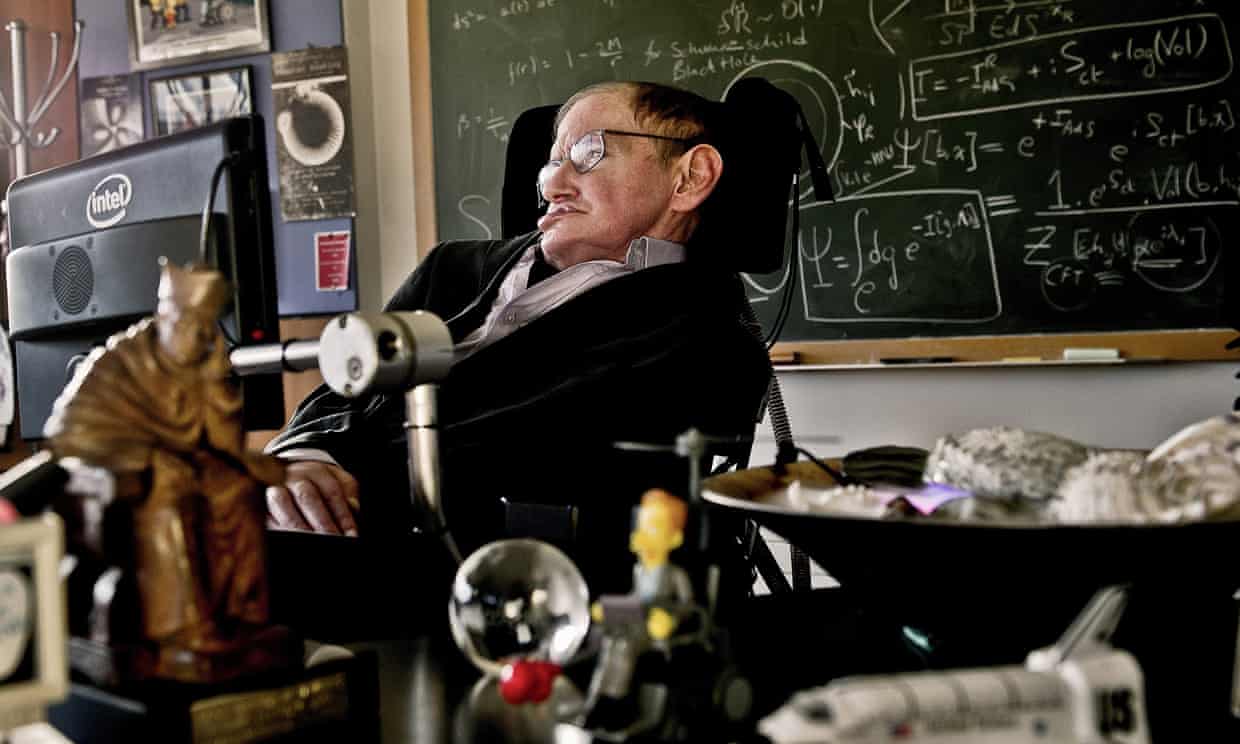
Professor Hawking’s insights shaped modern cosmology and inspired global audiences in the millions.
Almost everyone who's read 'A Brief History Of Time' - Stephen Hawking's seminal popular work on black holes and the universe, gets it that Hawking is a smart guy. This, despite the fact he's never won a Nobel Prize in physics. But his insights into cosmology, not to mention contributions (especially in the field of quantum black holes) to astrophysics have certainly illuminated many aspects of modern physics..

Less well known is that Hawking is also recognized  for his insightful predictions about the future of humanity and Earth.  Sadly, it appears in some enclaves of the mainstream media there is a running theme that Prof. Hawking is "losing it" with regard to his forecasts, or going round the bend, to use the vernacular.  But is he really? Or is this the usual media huff and puff snark penned by nattering nabobs who write too much and know too little?  

This year, for example, the Oxford physics professor was claimed to have "made some of the most insane predictions to date, some of which may put a slight damper on your New Year's festivities."   Really? What are they? I will examine in turn his entries in this post and the next, arguing they all (but one)  will have carryover effect into next year and beyond. First, I give Hawking's primary warning:

 Humans have only 100 years left to survive on Earth.


The media nabobs cheekily reported "this is nearly a lifetime", as if to say, how could this guy who professes to be so bright, predict an end to humanity within what will probably be our kids' lifetimes? An end of a species equal to the length of soon-to-be human lifetime? Get real.

Well, maybe, maybe not.  If one  watches Hawking's BBC series, Tomorrow's World, he names the primary threats that have the potential to end human life as we know it in a century. These include four prime culprits: climate change, Torino class 9 asteroid strike, nuclear war and an epidemic (which could also involve a weaponized virus) . He has also recently named AI systems as a real threat. 

Based on each of these he argues we need to leave the planetary nest within the net century. This has become the basis for a BBC documentary released earlier this year entitled "Stephen Hawking: Expedition New Earth".  Therein Hawking makes the case for leaving Earth and repopulating somewhere else in the cosmos.

This is a huge enterprise given our current space faring technology is limited to reaching only solar system planets - and even then that entails over a half year just to send a few astronauts to Mars. So it's difficult to see how we'd get the material  wherewithal to even reach Alpha Centauri in 100 years.  It's even more difficult to see how even a fraction of the current world population can be transported.  If there is any "insanity" lurking in Hawking's warning it is not in the threats to human existence per se, but in the fact he ought to know precious few humans can be saved from whatever dire fate awaits the species in 100 years.

That said
, let's look in turn at whether Hawking's predictions are viable before turning to means to effect a major repopulation project:

1-  Climate change extinction:

The danger here isn't so much that of a rapid cataclysm killing off human life, as environmental conditions becoming so unbearable it is nearly impossible for large populations (e.g. in cities) to survive.  We are talking about tiny increments of change - say in the pH of ocean water, or CO2 concentration in the atmosphere, setting us up for a slow rolling calamity.

In the worst case scenario that can be imagined, the ocean acidity (from absorption of CO2 by the oceans) becomes so great that the primary oxygen producers of the planet - phytoplankton - are killed off. Once they die, we perish too because there won't be adequate oxygen. Add in raging fires and other pollution likely present and the conditions for die off are magnified. You literally have billions of people suffocating.

It is possible that the phytoplankton might adapt over time to the changing conditions, so this extreme scenario doesn't happen. What other factors might emerge then to make human habitation intolerable?  I have listed the main ones below:

- Collapse of power grids

- Lack of potable water

- Spread of infectious diseases ("Cholera paradigm")

- Parasitic worm infestations

The first two pretty well occur together. The basic reason is that the power grids around the world - not just the U.S. - simply aren't designed to sustain the loads that will be imposed during extended heat events of the type we will face (E.g. 50 days or more with daytime highs of 115 F or more and night time lows of 90-95F)

Once the power grids go down then the water access is next. You need electric power to pump water and deliver to outlets in cities, suburbs etc   Take away power and water - as is currently the case in much of hurricane -ravaged Puerto Rico- and the spread of disease is next. 

This will entail everything from West Nile fever, to Zika, to dengue fever and cholera.  ((See, e.g. Global Climate and Infectious Disease:The Cholera Paradigm, in Science, Vol. 274, 20 December, 1996, p. 2025.)  Billions could easily perish, just from an uncontrolled cholera pandemic - spread because of the inability to provide power to even enable basic re-hydration of patients. Parasitic worm infestations almost certainly will accompany the lack of water, and this means foods will also spoil easily as well as providing an easy medium for worms - with the food then eaten to enable their invasion of the digestive tract, bowels and brain, e.g.


Worm infestations of the type shown will sap the energy from large populations already stressed by the heat and it is likely they will induce many suicides. 

The mere abundance of deformities of limbs, etc. from these parasites will be enough in most circumstances and locations to induce a sense of despair and hopelessness in the affected populations.

Lack of water to drink  in a future climate catastrophe  will sow misery orders of magnitude greater  than we are seeing in Puerto Rico with people so desperate they drink from polluted streams as well as from contaminated water at toxic waste sites. Expect then the further increase in severe water borne diseases (dysentery, diarrhea) as well as further worm infestations - say from schistosomiasis. 


2Torino class 9 asteroid strike:


This magnitude of asteroid strike defines your basic "planet killer". Such a calamity would most likely come from an Apollo object, especially a massive Earth orbit crossing object - perturbed out of the asteroid belt.   For example,   Gaspra (12.5 x 7 x 7.5 miles)  e.g.


This  monster asteroid's impact would obliterate all life on Earth - never to arise again. The crater and blast effects alone would eliminate most of the population on the continent it struck. An ocean strike, creating tidal waves upwards of 2 miles in height, would be even worse. The debris, for its part, would block out most solar radiation for years and probably usher in massive extinction of plants.  The size of object needed is >> 1 km, and an Explosive release: >> 100,000 megatons TNT equivalent.  It is no surprise that this kind of asteroid strike is the classic example used - as far back as Isaac Asimov in a 1976 lecture - for not putting all our "eggs in one planet".  As Asimov put in it that lecture, e.g.
"The dinosaurs were too dumb, too small-brained to avoid the asteroid catastrophe that wiped them out. But we humans can not only forecast such objects and their paths, but have developed rockets to perhaps knock them out. But these will be useless against a truly giant asteroid, so our best move is off this world."

To be continued next week...

Tuesday, January 3, 2017

Climate Change Adaptation Will Be Limited And Require Competent Policy Changes


More (or less) serious proposals for adapting to climate change have been circulating for at least the past ten years.  Among the more trenchant have been those that actually claim to be techno-solutions to slow it down as proposed by the authors of the book, Super-Freakanomics: Global Cooling, Patriotic Prostitutes, and Why Suicide Bombers Should Buy Life Insurance.

One of their pet Rube Goldberg schemes (which obviously could only come from the brains of a pair of economists locked into hubris) is dispersing a fleet of fiberglass boats equipped with cloud-making machines over the oceans. They reason that the clouds would increase albedo and thence, decrease the tendency to trap incoming radiation. Hence, offset warming!

Nowhere did these two stalwarts factor in that a specific type of cloud has to be generated, not just any old cloud! For example, wispy high flying cirrus are semi-transparent to incoming sunlight but block infrared radiation emitted by the Earth, thus CONTRIBUTING to the Greenhouse Effect. Meanwhile, stratus clouds are gray, dense and low flying and have a net COOLING effect since their albedo is relatively high. So how will the authors ensure they generate the second type and not the first. And also, given an average of 3.5 billion cubic meters of cloud will be needed to offset the inputs of CO2 just from the oceans, where will they get the boats? Assuming each fiberglass boat can generate one million cubic meters of cloud (a BIG assumption) that means 35,000 such boats will be needed. One was left to wonder whether either of these geniuses bothered to calculate how much CO2 generating fossil fuel would be attendant on their manufacture. (Especially given they prize themselves as "cold, calculating economists" as opposed to - perhaps, touchy feely physicists?)

Another hare-brained plan entails sucking cold water from the depth of the sea to the surface. This fails because they have no remote idea how to locate such cold water, which emergence depends upon a downwelling wave (so-called because it lowers the thermocline, or temperature gradient). By example, typical downwellings during an El Nino prevent deeper cold water from mixing with warmer water near the surface. It would therefore make more sense to use these "tubes" at that time, since the segregation from warmer water is more assured. But HOW will they do it? They easily toss out these technological fixes, offering no practical means to achieve them, as if the mere spouting of the idea solves their greenhouse gas problem!

Perhaps their ultimate solution is based on the Mount Pinatubo volcano that erupted in the Phillippines in 1992. The volcano sent so much SO2 (sulphur dioxide) into the atmosphere that it resulted in cooler global air temperatures (by about 1.0 F) for about three years. So why not shoot enormous quantities (about four quadrillion tonnes a month) of sulphur dixoide into the atmosphere using an eighteen mile long hose?

First, the hose would have to be - in order for effect comparable to Pinatubo- about a half mile wide. Such a hose even if made of thinnest mylar with maximum ram pressure of the flowing gas -would not remain stable against gravity. Indeed, one can do calculations showing that by the time the mass of SO2 pumped attained a height of 2 miles the "hose" will collapse.

Even if the mechanical problems could be met, it would still be a god-awful idea. For one thing, SO2 in the presence of the catalyst NO2 forms sulphuric acid, H2 SO4, and this can then generate acid rain. Do we really want ten septillion tonnes of acid rain descending on what remaining agriculture growth areas, farms remain in a greenhouse world? Not to mention raining on humans, with concentrations of pH in the range of 2-3? Ever had H2SO4 spill onto your skin in a lab?

Beyond that, SO2 at the given altitude needed for effect can further erode the ozone layer. Beyond a certain threshold, this erosion of protective ozone leads to much higher influx of ultraviolet radiation - more skin cancers, more blindness, etc.

Then there is this: their idiotic SO2 pumping solution would only work IF fossil fuel production at the onset of pumping made no further increases, leading to further CO2 concentration. But this would require really draconian solutions, such as stopping all births (since human population is the base producer of greenhouse gas) and all industrial activity. To use the authors' own dubious words and turn them upon them:

"Wouldn't it be simpler just to control our carbon inputs?"

Interestingly, Raymond J. Perrehumbert - a real climatologist at the University of Chicago, actually sent these two climate bozos a letter some eight years ago. It read in part:

"The problem wasn't necessarily that you talked to the wrong experts or to too few of them. The problem is that you failed to do the most elementary thinking".

Ouch!

But all this elicits the question of what, if anything, can be done to adapt once the worst manifestations of global warming erupt. The hard fact is that any solutions may depend specifically on geographical locations. Consider rising sea level and how it will flood nearly one-third of Florida by 2035 (see graphic). The most relevant means of adaptation to such a future would be to start building massive dykes to prevent such flooding, using the technology already employed in places like Holland. These dykes would have to be constructed along the coast lines of all regions at sea level or even below (e.g. New Orleans).

Other adaptations may not be so simple. For example, how will communities adapt to constant power grid breakdowns arising from electricity overuse - say during 2 or 3 week long heat waves? The answer isn't clear apart from utility companies rationing the 'juice'. This may mean doing without electricity for extended periods each day, perhaps up to 12 hours or more. Can Americans adapt to such rationing? I am not sure.

Adapting to worm infestations may be the most straightforward process but require enormous supplies of anti-worm serums, meds such as Ketrax. I recall here my own worm infestation while in Peace Corps - noticed only after being awakened one night by intense itching of my skin, mainly on the inner thighs. As I switched the night light on and spotted definite wriggling movement of the skin, I grew concerned, had it checked out by a dermatologist. Sure enough, a common species of small worm ("beach worm" in the vernacular)  had laid eggs and its hatched offspring invaded me. The cure? Ketrax, prescribed by the spoonful three times a day. After a few bouts of vomiting the vermin out, all the worms had been eliminated. I don't know that people will even be properly diagnosed as multiple worm infestations spread on approaching the cusp of the runaway greenhouse.

Adapting to the soon to be spreading virulent diseases is another matter. How will we tolerate or adapt to much more  tropical diseases such as dengue fever, malaria, and even cholera? The assumption currently is there are no problems, but clearly those who believe that haven't read the frightening paper Global Climate and Infectious Disease:The Cholera Paradigm, in Science, Vol. 274, 20 December, 1996, p. 2025.)

How will a basically "captive" (i.e. no emigrating) population adapt to accelerated anti-biotic resistance and the spread of newer, more virulent bacterial infections as the heat ramps up? We don't know but with Trump and the Repukes ready to tear up Obamacare, any sane person ought to shudder at the prospect of millions without adequate health care.


Relevant to all the above is a recent workshop convened in Oslo, Norway by The Center for International Climate and Environmental Research,  which brought together representatives from across scientific disciplines to discuss the challenges of climate change adaptation. See, e.g.

http://bit.ly/CCAdaptation

A general consensus emerged that all groups, including environmental economists and statisticians, need distilled climate data to support decisions made by the public and private sector, especially at state and city levels.  In this light, one of the main challenges identified was open access to available data - namely economic and insurance data. For example, compelling results from one pilot study presented at the workshop showed how local insurance loss data obtained from the insurance industry can enable informed decision making which in turn may reduce vulnerability to climate-induced hazards.

This might have served many citizens here in the Springs, three -odd months ago after being pummeled by hail the size of softballs. We  had to have our entire roof repaired, with pits, holes that one roofer compared to as "meteorite craters" - an exaggeration but he got the point over to us. After the roof, we had one entire south siding replaced after it was literally ripped into multiple holes by the hail. According to the insurance company (Hartford) hundreds of homes were affected putting enormous pressure on roofers and others in the area, now forcing wait times of many weeks to complete repairs.

The matter of insurance data (such as acquired during the recent hail storms in CO) is urgent, given how these sort of freak occurrences will soon be regular events as climate change intensifies. Only the utmost fool - having experienced such an event and the size of the hail- would deny the reality of climate change or compare it idiotically to claims of "global cooling" back in the 70s. (Claims, as I noted, which were always subject to revision after global dimming was taken into account).

At the Oslo conference several recommendations emerged including that various data types be coupled to assess climate change effects and the costs of different adaptation options. Specifically, attendees called for new frameworks that can model  the uncertainty of climate risks to society. For example, what is the uncertainty in emergence of cholera in various locations, say compared to worm infestations of the brain?  Given the latter perspective, one can then determine the costs vs. benefits of different adaptation strategies. For example, given the benefits vs. costs, it may be better to establish preventive systems to contain cholera or dengue fever before implementing a widespread worm control template. (The cost benefit ratio for controlling worms is likely less than for controlling cholera or dengue fever.)


The attendees also pointed out that in conjunction with the above, decision support tools must be able to deal with basic uncertainty.  Participants thus discussed  tools that combine real options analysis with a portfolio approach. These sort of strategies are appealing because they allow decision makers to ponder combined adaptation strategies and basically invest in whatever schedule they choose- all while accounting for the uncertain effects of climate change.

Most interesting was the universal appeal to climate scientists to craft "stories" to get the attention of politicians. Storytelling, say setting a scene for a near climate future, could thereby help scientists convey information to policy makers without dozens of graphs and reams of data. It would be especially crucial to convey the near future to Trump and his minions. But what type of story would get their attention, and entice them to do the right thing?

Here's one: On entering the cusp of the runaway greenhouse effect nearly half the U.S. population will already be dealing with one antibiotic resistant disease (MRSA, c. diff.) or other, as well as multiple worm infestations of various organs- including the brain. Most power grids will no longer work 24/7 but have to be shut down because of the lack of capacity as millions try to stay cool -  overtaxing the system. Heat waves, rather than lasting a week or so, will now last months, and reach similar temperatures to Death Valley. Water resources will be at risk, and many communities will be without water, also because of power grid collapse. If you can't get electrical power you can't pump water to homes.

Will Trump and his buffoons process and appreciate that story? I doubt it, because his money making schemes probably mean more to him than the country which provided the opportunity.  It is doubtful in this light the Trumpsters would even do the minimum suggested at the Oslo meet: communicate the costs and benefits of climate change adaptations to the public.

Of course, by the time of the runaway greenhouse all adaptation strategies will be too little, too late anyway!

Thursday, December 10, 2015

You Can't Fix Stupid: Rebutting The Climate Change Threat Belittlers


It was hard enough watching the spot on Chris Hayes' 'All In' three nights ago featuring a clip from Stuart Varney's show on FOX Business Channel. It featured a red-bearded Brit buffoon who fairly relished ridiculing Bernie Sanders' claim that climate change is the most serious threat faced by humanity. He said: "Oh, he's really brilliant that guy! El Baghdadi will be sawing  Bernie Sanders' head off and he'll be screaming: 'If only we had an emissions trading scheme"

Ha, ha and ha. Funny, but it really isn't funny. Nor will it be when this imbecile, his host Stuart Varney and Peggy Noonan (who spouted on a different show that "most people would see Sanders as slightly daffy"   have parasitic worms infesting their brains within ten years, along with amoebas bearing amoebic dysentery and also dengue fever. All this as the temperatures rise to new record levels in long lasting heat waves. Nor will they be laughing when five to six years earlier some ten million more migrants rush our borders because their own lands have become unlivable owing to global warming. What? Will Trump or whoever try to kill them all or build a wall as high as the Empire State Bldg.?  Get real!

The problem with morons like this is that they are basically unaware they are morons. They have no clue, nor do they know enough science to even be spouting off about CO2 levels, or climate change, or the Paris Climate Summit now going on.

As another example, we can take Denver Post columnist Ross Kaminsky who is the closest thing to a Neanderthal - in image- that one could imagine, e.g.

Not that I've anything against Neanderthals if they can write some sense, which Kaminsky clearly can't. A radio host on 850 KOA in Denver, Kaminsky had best keep his day job rather than churning out offal like his 'Climate Conference is Meaningless" dreck in last Sunday's paper.  He also, like the Fox buffoons, asks "How can it be that even a dozen people take Bernie Sanders Seriously?'

Well, because as Sanders noted in his on air response to the FOX Business clowns, the CIA and Pentagon are taking it seriously! See e.g.

http://brane-space.blogspot.com/2015/11/climate-deniers-still-dont-get-it-on.html

As noted therein:

In  The Proceedings of the National Academy of Sciences the authors compiled detailed statistics showing that water shortages in the Fertile Crescent in Syria, Iraq and Turkey, killed livestock, drove up food prices, sickened children and forced 1.5 million rural residents to the outskirts of Syria's jam-packed cities - just as the country was exploding with immigrants from the Iraq War. The stage was literally set for a human tinderbox.

And further:

on April 24 this year the 'Defense, National Security And Climate Change Symposium' was held in Washington, D.C.  At the Symposium Brigadier General Stephen Cheney stepped up to the podium to discuss 'Conflict and Climate Change'. Cheney, like some other speakers- zeroed in on climate-driven migration, asserting:

"We know for a fact that climate change is already driving internal and cross border migration"

Referencing here, for example, that in Bangladesh - the 'ground zero' of global warming- rising sea levels could displace 15 million by 2050. Oxford University's Norman Myers has projected there could be as many as 200 million climate refugees by mid-century.

Do Ross or any of his FOX nitwit pals have any remote idea what a human catastrophe such mass migrations would create?

Well, the defense and security establishments do which is why they are freaking terrified about the prospect and trying to get plans in place to cope with the floods. Not just water floods!

Ross then asks the most stupid question of all:

"How can it be that people fail to see a world boiling over with Islamofascism and say to themselves: 'We really need to focus our time and resources on climate change/"

Well, because ISIS are little irritating roaches compared to the magnitude of the peril we face in planet-wide climate change!  You can easily step on roaches but not rising seas inundating your cities, see e.g.


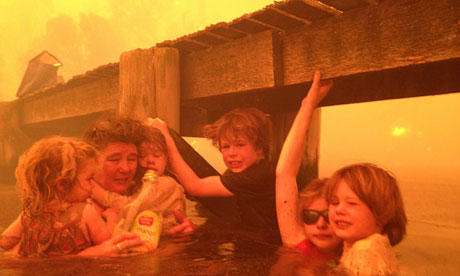
But that's not all! We can also expect raging fire storms from coast to coast similar to what struck Tasmania back in 2013, forcing people to flee for their lives, and escape to water areas to stay cool,  e.g.
Tim Holmes

And we already know that West Nile Fever and Dengue fever will spread to most of the nation by the first year of no seasons (ca. 2040), but other viral and parasitic infections will also abound, probably infesting most of the U.S. by 2025. (And already the "kissing bug" is devastating areas with Chagas disease. Google and learn more!)Two of these are illustrated below:


Thus, worm infestations, especially of the brain (above left) will proliferate as well as elephantiasis,  from  filariasis which will occur throughout the U.S. by 2040. Right now, there are in excess of 9 BILLION worm parasites inhabiting the vertebrates of our world, according to the author of Parasite REX. The human population alone may carry within it up to 2 billion worm parasites, including: hook worm, one of 5,000 forms of tape worm, round worm, trypanosomes, schistosomiasis-causing flukes and the protozoan that causes Toxoplasma (which over 1 billion may carry, mostly in their brains.).

With the stimulative effects of runaway cusp warming these numbers can expect to double or triple, especially amongst the human denizens of the planet. For an excellent insight into what we're in for and how bad it will be consult the paper: Global Climate and Infectious Disease:The Cholera Paradigm, in Science, Vol. 274, 20 December, 1996, p. 2025.

Imagine half a population sickened by cholera and dysentery and the other half by dengue fever, Chagas disease and parasitic worm infestations.

Now, if you still don't believe those are more serious to prevent happening than solely focusing on ISIS, well...no comment. But I believe you might be able to complete the thought!

Then we have the uber Moron Bret Stephens,


babbling away in another WSJ piece ('Liberalism's Imaginary Enemies')  in which he claims (presumably with a straight face) :

"I am not the first to have noticed the incongruity of this huge gathering of world leaders meeting to combat this notional enemy in the same place a real enemy just inflicted so much mortal damage."

Radical climate change a "notional" enemy? As in dreamt up by scientists on diets of MJ waffles and who have mere "notions"? What sort of nincompoop is this guy? As for defining a "real enemy" I defy this ignoramus to read again what is posted above - in terms of imminent climate threats if we don't get our acts together, and tell me these constitute a "notional" as opposed to REAL enemy. You would have to be either batshit crazy or with an IQ less than room temperature to do so.

Obviously, no one is disputing ISIS as a threat. But as I said in a post some two years ago, one must weight threats on a scale of consequential magnitude. It is true that the ISIS vermin may somehow in some way inflict a mini-holocaust on one of our cities if they get hold of something like sarin - say, as depicted in the current 'Homeland' TV series. That may indeed wipe out tens of thousands and that is truly horrific.

But rapid climate change is no duppy or ghost! It is also a real threat and we are talking about the death of millions not just tens of thousands. It is true this comprises a ghoulish calculus but one must make it to set the record straight on the greater threat to humanity worldwide. In this calculus we can include - by 2040:

- 5 million dead or dying from potable water shortages- resulting in amoebic dysentery, cholera etc..

- 4 million dead from famine as the last of the 'green revolution' expires and GMOs are found not to meet the needs, even as they sow cancers, Alzheimers.

- 3 million dead from MRSA, and other antibiotic -resistant bugs

- 6 million unproductive and more like walking dead because of parasitic worm infestations, especially of their brains.

Stephens, as per his wont, also writes other specious nonsense including of the "hysteria generated by an imperceptible temperature rise of 1.7 F since 1880."

Well, say one thing say the next, at least the simpleton isn't claiming a  "one hundredth of a degree" increase as he did on the Bill Maher Real Time show back in January. Some would say that's progress - even for an imp like Stephens.

But the new fact is that recent documents flatly declare that a 2˚C temperature rise is passé and that a 4˚C rise is already in the cards, moving towards a staggering 6˚C rise . That is an almost 11˚F temperature rise globally! and has always been the increment that Carl Sagan specified as the immediate trigger for the runaway greenhouse. Fortunately, this would not take hold until 2100, but it will take hold if we as a species continue to sit on our butts and do nothing.

In this regard, it is clear rational humanity's battle must be against ISIS and also allowing increased fossil fuel output to the atmosphere which would trigger the worst case scenario.

Unless we really fancy the image of parasitic worms crawling around inside our brains - wreaking havoc.

See also:

http://www.smirkingchimp.com/thread/dave-lindorff/65144/us-journalists-duck-the-big-climate-question-can-capitalism-and-mankind-both-survive

Monday, March 9, 2015

Life Changes At The Cusp Of The Runaway Greenhouse


Let us recognize that life at the cusp of the runaway greenhouse will not be "sweet bread" to use Bajan parlance. For those alive in 2035 and going forward, they will need every bit of resourcefulness and mettle to cope with the tidal wave of changes to descend on them. In this post I want to examine some of them with the underlying subtext: Are  we remotely ready to deal with them?

As shown in the accompanying graphic, some of the most profound changes will occur in sea level states such as Florida as projected sea level rise affects over 3 million in that state alone, as well as more than 560 million worldwide. Already Miami experiences severe flooding with heavy rains and pumps are often needed to eliminate the water. But this is batting on a 'losing wicket' that will only postpone the inevitable.

Island states like Barbados and Kiribati are particularly affected. A recent visit to Barbados (last May) reminded us of the extent to which the island is at risk of losing its precious beaches. With each passing year more coastal land is reclaimed due to the inexorably rising sea and now- unlike thirty years ago - you won't find one single climate change skeptic. As for Kiribati, see e.g.

http://www.huffingtonpost.com/2014/09/22/kiribati-president-buying-land_n_5860064.html


Unaddressed are also the following effects which will creep into the lives of those living near the first "year of no seasons" - the first signal of the imminent runaway:

- Hotter and hotter night time temperatures

Up until relatively recently, the bane of heat waves has been broken by the fact they usually don't last overly long, e.g. a week or ten days, and when they are finished night time temperatures get significantly cooler than day time  -providing needed relief. By the cusp of the runaway all that will change. Not only will heat waves be prolonged (lasting 2-3 months or longer) but will be severe, with highs in the 100-110F range. These conditions will be life - threatening for millions especially as the night time temperatures will scarcely be much lower.

Already, night time minimums have been rising more rapidly than daytime highs, even as the length of summer (and spring) stretches beyond their astronomical definitions.  The natural response in developed nations will be to amp up the a/c but this will clearly lead to more blackouts as power grids are strained beyond their capacity.

Extended heat waves, encroaching into what was spring and "winter" will also force school systems to install more air conditioning, at great expense. Will public school systems already scratching for money be able to afford it? They had better, or else they will have to cut the school year dramatically. (Or let kids mostly self-educate on their home computers, assuming electricity is available.)

- Water limits will see mass rationing for most communities

By which I mean water access, if at available at all, will be limited to specific intervals of the day. A major reason is that our water infrastructure was created for a 20th century climate. Indeed, many water systems originated in the 19th century especially in major cities like New York, Chicago. These systems will not be able to withstand the withering heat from prolonged heat waves and so an already dire water situation will become manifestly worse. In western states, water may not be available at all, as it's being delimited by prolonged drought but also by the fracking craze.  Some estimates indicate Colorado, for example, may run out of potable fresh water by the middle of the next decade if the fracking insanity isn't halted.

All this implies that if there is water, it will become immensely costly. We are talking of rates as high as $300 a month or more just for recycled toilet water. How will people, especially the poorest, be able to afford that if they can barely afford food now? It is clear any government at the time may have to provide water stamps as well as food stamps.

True, the planned expansion of the Gross Reservoir near Denver  makes sense. But even that will only provide a limited solution as the state's population continues to grow, and the frackers show no signs of relenting in their yearly plunder of hundreds of millions of gallons for frack wells.

- Fire potential will soar nationwide, worldwide:

While raging fires in the West have become commonplace, e.g.
A house is fully engulfed by the Black Forest Fire.

They will also be common throughout the nation at the cusp of the runaway greenhouse. The reasons for the coming "fire age" were clearly explained in a  Washington Post   article three years ago:

"Warmer weather, earlier snowmelt, drought and beetle infestations facilitated by warmer climates are all contributing to the rising number of fires linked to climate change. Across large swaths of the United States and Canada, bark beetles have killed many mature trees, making forests more flammable. And tropical rain forests that were not susceptible to forest fires in the past are likely to become drier as temperatures rise, growing more vulnerable."

This means that every state will need to have provisions ready for massive fire -fighting, and that means budgets to support it as much (in fact more) than they now support snow removal. (By the first estimated 'year of no seasons', 2040 (according to David Suzuki) there will, of course, be no more snow so all budgets will have to redirect to fire fighting.


- Heat Compromise of General Infrastructure :

While the effect on water delivery systems will be bad enough, the immense heat projected by 2035-37 will also wreak havoc on roads, bridges and even airports. Current road materials exhibit a limited range of heat tolerance and road buckling occurs with sustained temperatures above 90F - exactly the conditions that will emerge at the cusp of the runaway greenhouse.

Bridges are especially vulnerable to high temperatures, which stress bridge integrity. Already, thanks to lack of maintenance, nearly 70 percent of U.S. bridges are compromised in some way and it is these bridges most likely to be affected first as the temperatures ramp up. Like it or not, taxes may  have to be increased exponentially to pay for all this. (The American Society of Civil Engineers estimates a cost of $1.6 trillion just to achieve a moderate state of maintenance. Redesign for the "heat era" may require 2 or 3 times that.)

Airports will also be affected. DIA or Denver International Airport has the world's longest runway, but may need to extend it even further. The much higher temperatures at the cusp will make it much harder to attain lift (from the Bernoulli effect).  Thus, much warmer air will be less dense (when a gas is heated it expands so its density or mass/ volume decreases), reducing the mass of air flowing over the air foils (wings) to create lift. This will necessitate more runway length for takeoff. Already, in Colorado, the runways serving Aspen and Vail have been lengthened by 1,000 ft. to accommodate such changes during the summer months. We can expect similar modifications to be made nation wide as we approach the cusp of the runaway.

- Spread of Tropical Diseases:

We already know that West Nile Fever and Dengue fever will spread to most of the nation by the first year of no seasons, but other viral and parasitic infections will also abound. Two of these are illustrated below:


Thus, worm infestations, especially of the brain (above left) will proliferate as well as elephantiasis,  from  filariasis which will occur throughout the U.S. by 2040. Right now, there are in excess of 9 BILLION worm parasites inhabiting the vertebrates of our world, according to the author of Parasite REX. The human population alone may carry within it up to 2 billion worm parasites, including: hook worm, one of 5,000 forms of tape worm, round worm, trypanosomes, schistosomiasis-causing flukes and the protozoan that causes Toxoplasma (which over 1 billion may carry, mostly in their brains.).

With the stimulative effects of runaway cusp warming these numbers can expect to double or triple, especially amongst the human denizens of the planet. For an excellent insight into what we're in for and how bad it will be consult the paper: Global Climate and Infectious Disease:The Cholera Paradigm, in Science, Vol. 274, 20 December, 1996, p. 2025.

Do you really want to live to 100?

See also:

http://www.smirkingchimp.com/thread/william-rivers-pitt/61297/how-to-die-of-dumb

Saturday, October 12, 2013

Transition to "Hell World" - By 2047

Tim Holmes
A family huddles under a bridge in Tasmania to escape a firestorm in 2012. By 2047 a new report discloses such scenes may be commonplace.


Now we know what the world of 2047 will likely look like: A planetary hell. According to a new study published in Nature, climate-change will “lock” into place by the year 2047 (plus or minus 14 years, when the uncertainty is factored in). Once that happens, every year after 2047 will be hotter than even the current hottest year on record.  Go back to 2003, when 70,000 died across Europe from a heat wave - then expand the numbers by a factor of ten, as you expand the duration of the heat waves to months as opposed to weeks, and you have an idea what those alive in 34 years will be facing. Who will they be? Your kids? Your grandkids? Let them take a look at the photo shown to give them a heads up of what awaits.

This is no jive, by 2047, the study concludes, our current record temperatures will become the new normal temperatures.   Of course, since the planet has differing temperature regions, latitudes etc. the emergence of the new heat world will not be uniform. That means the arrival of "Hell year" will differ depending on location. The Nature study estimates that Singapore, for example, will reach its temperature point-of-no-return as soon as 2028. Cairo, they say, could start to see a “lock-in” of global warming in 2036, 11 years before the global “H-hour” of 2047.

According to Chris Field, one of the scientists who worked on the project, "One can think of this year [2047] as a kind of threshold into a hot new world from which one never goes back.”

The reason Field and his co-workers were able to make these specific calculations is quite simple: and scary: humans are expected to keep burning fossil fuels and pumping C02 into the atmosphere at a rapid rate well into the coming decades.

We are basically too damned lazy, unimaginative and cheap to invest in alternative energy or cut back our addiction to fossil fuels, so we will pay the price.

Living in Fairbanks, AK or Helsinki, Finland? Don't feel smug! Even you will be boiling by then, as temperatures regularize globally and the first 'year of no seasons" will have arrived  - likely 8- 15 years earlier. Recall in previous blog posts, I referenced David Suzuki's forecast in his book, 'It's A Matter of Survival', (Harvard Univ. Press, 1991)  co-authored with Anita Gordon, that 2040 is the first year of no seasons. However, if global warming is accelerating with much higher CO2 concentrations added each year, (translating to higher solar insolation by about 2 W/m^2 per year) then that date can arrive as early as 2025, if not sooner.

What it will mean is that an essential thermal equilibrium will be reached in our planetary  atmosphere.  So effectively, no more winters, summers or even intermediate (spring, fall) seasons anywhere. That will also mark the emergence of much higher mean global temperatures, probably as high as 60-65F. Locally, we can expect to see highs of 115F- 120F and covering much larger areas for much longer (heat 'waves' will be more like heat seasons, lasting months.)  Relatively cooler breaks, say with highs of 85-90, and lows of 80-85, will likely appear in what used to be northern winters.

With the much more consistent high temperatures, pests of all types will proliferate, so we can expect to see more worm -parasite infestations for example, as well as increased spread of the mountain pine beetle in the West, and  dengue fever throughout the nation-  rivaling what we have now with West Nile Fever. Cholera, c. diff. and amoebic dysentery will also not be unheard of as our water resources continue to be used up and polluted, i.e. by fracking.  Even salt water pools in marshlands will be infested, likely by brain-eating amoebas.  All in all, it will be a world that few will enjoy living in, other than the very rich - who, unlike the rest of us- will be able to afford their own off the grid power stations, so won't be rendered too uncomfortable when the main grids crash from over use.

If anyone thinks the planet is screwed up now, wait until you see  the “new normal” arrive in 2047. Savage storms, deadly droughts, cholera and dengue fever epidemics in the American South, torrential flooding – all of these disasters will both be more common and more powerful than they are right now. Millions of refugees will also have to flee from rising sea levels and governments around the world will have to find a way to both pay for their own displaced populations as well as the damage caused by an increasingly violent climate.

Meanwhile, the perpetually undisturbed zombies in our midst - many ensconced in the corporate media - continue to release the meme that humans are "adaptable" and they can adjust to the new normal. I don't know what brand of weed or new forms of 'E'  these nincompoops are ingesting, but their brains have definitely jumped the tracks. There is no way any human, unless he's mostly cyborg with synthetic organs, will survive very long in the new normal hot world. The runaway greenhouse which 2047 marks the onset of, defines the limits of human (or any organism's) adaptation. Think of trying to live on a planet - which merely 100 years later- will likely have ambient air temperatures of 170- 200F and bear in mind 212F is the boiling point of water.

Live until 100 or 120 like the pie-eyed longevity morons have postulated? You have got to be kidding! Fortunately, I won't be around to see 'hell world'.