Showing posts with label Chris Field. Show all posts

Wednesday, August 10, 2016

Energy Consumption Data Projects Threshold For Hothouse World Will Be Crossed By 2040


Graph above shows historical and projected global CO2-related emissions by 2040.

Projections for global energy consumption and CO2 emissions by 2040, as published in an Energy Information Administration paper in May,   e.g.   http://bit.ly/EIAreport-2016

sets the stage for what I call the permanent crossing of a critical threshold into a hothouse world. By "hothouse world"  I mean the immediate precursor to the runaway greenhouse world This is extrapolated from a study published in Nature in 2013 for which sometime in the 2040s  we transition to "a hot new world from which one never goes back.”  This, in the words of climate scientist  Chris Field, one of the scientists who worked on the (2013) project.

In the new project, based on the International Energy Outlook 2016, the world's energy consumption will increase 48 percent between 2012 and 2040. In effect, fossil fuels - rather than receding to the 50 percent proportion of all energy use envisaged by the Paris Summit dreamers- will instead account for nearly 75 percent of all world energy use by 2040.

This will translate into an increase of 34 percent in energy-related carbon emissions over that same interval. Thus, annual emissions will rise from 32 billion metric tons in 2012 to 43 billion metric tons in 2040.   Unfortunately, coal - among the most pernicious fossil fuels - will continue to generate the most energy-related CO2 emissions worldwide (despite its share of total energy declining from 43 % to 38%)

What all this means is we will come nowhere near close to staving off the highest incremental increase in global mean temperatures - which will now likely hit 4C by 2050 and 6C by 2100.

In retrospect it all ought to have been obvious and the current projections not too controversial  The reason Field and his co-workers were able to make their original  specific calculations in 2013 was quite simple: and scary: they just expected dumbo humans to keep burning fossil fuels and pumping C02 into the atmosphere at a rapid rate into the coming decades. Given the inability or unwillingness to change, the rest - as they say - was self-evident..

It will mean is that an essential thermal equilibrium will be reached in our planetary  atmosphere by 2040.  So effectively, no more winters, summers or even intermediate (spring, fall) seasons anywhere. That will also mark the emergence of much higher mean global temperatures, probably as high as 60-65F. Locally, we can expect to see highs of 115F- 120F and covering much larger areas for much longer (heat 'waves' will be more like heat seasons, lasting months, fire seasons nearly all year.)  Relatively cooler breaks, say with highs of 85-90, and lows of 80-85, will likely appear in what used to be northern winters.


That's your hothouse world.

If anyone thinks the planet is screwed up now with so many "hundred year events", wait until you see  the “new normal” arrive in 2040. Savage storms, deadly droughts, cholera and dengue fever epidemics in the American South, torrential flooding – all of these disasters will be more common and more powerful than they are currently. Millions of refugees will also have to flee from rising sea levels and governments around the world will have to find a way to both pay for their own displaced populations as well as the damage caused by an increasingly violent climate.

But wait. The actual projections for greenhouse gas increases could actually be much worse than portrayed in the current (EIA) report. According to Rachel Cletus, climate policy manager for the Union of Concerned Scientists, the forecast does not address the implications of rising methane emissions due to use of natural gas.

If the CH4 emission rate is as high as was reported 2 years ago in  The Denver Post, (May 8, 2014, 1A)  from a study of Colorado's front Range oil and gas production, at 19.3 tons an HOUR, then we are looking at a serious oversight indeed.

This is especially given earlier work from the Nov. 26, 2013  issue of the peer-reviewed journal Nature Geoscience, in which the authors warned that the Arctic Ocean is releasing methane at a rate more than twice what existing scientific models predicted.  Natalie Shakhova and Igor Semiletov at the University of Alaska- Fairbanks' International Arctic Research Center found this unexpected result  after a decade spent researching the Arctic's greenhouse gas emissions.

Shakhova, the lead author of the report, in an interview post-publication, warned the methane release rate was likely even greater than their paper describes..

All this portends a very uncomfortable entry point to a climate reality most people won't tolerate very well. By the time it is entrenched - likely by 2044 - today's climate deniers will genuinely wish they had been correct that all the AGW science was "rigged" and "fudged".

Alas, they will  now learn emphatically that was not the case and the climate events  manifest in 30 years will be unstoppable. To paraphrase Chris Field, we will have entered "a hot new world from which there is no going back.” 

If you're young, maybe a millennial, enjoy the world with seasons while you can, it won't last too much longer.

Saturday, January 11, 2014

2014: The Year Global Warming Deniers Will Wish They Were Right!


Two and a half years ago, in a blog post entitled 'If You Think It's Hot Now Just Wait a Few Years', I referenced climatologist S. George Philander who - 13 years earlier-  wrote a hot-button piece in Eos: Transactions of the American Geophysical Union (March 31, 1998) entitled:‘Who is El Nino?’

Philander argued that El Nino and its sister cycle 'La Nina' are not merely the yings and yangs of a meteorological cycle but  offshoots of climate change in terms of their expected future behavior. Thus, as more CO2 is pumped into the atmosphere (as indicated by the Keeling curve - which shows CO2 injection has exceeded the absorption capacity of the oceans), El Nino will ramp up leading to blistering hot and dry conditions, even as La Nina brings cooler spells and precip in alternate periods. However, unmentioned is the game changer of altered albedo.

Each El Nino cycle that over-warms, has pernicious and permanent effects on the Arctic, leading to ever more polar ice melting and large glaciers retreating, including much of the land mass of Greenland. The situation worsens as rising temperatures (from higher CO2 levels) lead to earlier and earlier melting, Prolonged Arctic melting- the mechanism of which is shown below:

exposes ever more surface area- thereby reducing the albedo or reflectivity of the surface - leading to increased absorption of solar radiation. Meanwhile, bare ice is much less reflective than snow, absorbing even more solar radiation and further speeding any melting. (In the diagram, the red arrows indicate incoming radiation and the blue arrows indicate radiation reflected back into space. Percentages give the amounts of reflected incoming solar radiation).
As anyone can see (even without a physics background)the above process over time results in ever diminished reflection of solar radiation back into space, a darker Earth surface - with more IR (infrared radiation)absorbed - which reinforces more melting, which in turn leads to more absorbed solar radiation and ever more melting - in a positive feedback loop that will become ever more consolidated.

Now, we learn that El Nino is about to ramp up again this year. This is bad news given that even in the absence of El Nino, 2013 was one of the hottest years on record. Readers may find this incredible given the bone chilling cold recently, but last month was the warmest December in 30 years. Now, with El Nino's next onset the stage is set for heat records to be broken like never before. In some quarters there are projections that this may be the hottest year ever recorded (TIME, 'El Nino Is On Its Way', Jan. 13, p.41)

As Philander and others have noted (op. cit.) El Nino conditions are incepted when the surface waters of the Southern Pacific become abnormally warm. This is critical given the Pacific covers some 30 percent of the planet's area.  With the solar insolation at some 1360 watts/m^2  this means the added energy will force an array of radical weather changes globally.  It can also trigger extremes of weather conditions such as we've seen the past few El Nino cycles, i.e. extreme rainfall in parts of the Western Hemisphere along with prolonged dry conditions in Asia.

Other dynamical changes triggered by El Nino can affect quality of life, even food availability. For example, because El Nino can reduce the upwelling of cold, nutrient rich sea water (i.e. that supports large fish populations in the Pacific) and destroy coral reefs - marine life can be decimated. Already there are shortages of certain fish, e.g. blue fin tuna, and these are going to get much worse over this year as El Nino unfolds.

Apart from that, there is the spread of more tropical diseases, including dengue fever, schistosomiasis, malaria, and West Nile fever - and likely others. (I look for an emergence of Rift Valley Fever in the U.S. along with dengue.)  It is estimated the strong 1997-98 El Nino cost the U.S. some $25b in health care costs and hours lost on the job. This marked the year when West Nile really began to spread, and it also marked the increased incidence of worm infestation of human brains, especially around the world, e.g.
 

The three warmest years on record were all El Nino Years: 1998, 2005 and 2010. This year will likely beat those if the Southern Pacific heats up enough (about 0.9F) in which case climate scientists can declare an 'El Nino Effect'.  In this case, 2014 will likely break all prior heat records with extended heat waves with high temperatures rising above 105-110F and never dipping below 80-85F at night.

Bear in mind also, the unusual warmth of last year (despite no El Nino) comports with the controversial 2008 Nature paper of  Noel Keenlyside et al, which looked at past and (forecast) future global average temperatures, with the particular graphic for reference labeled:

 "Hindcast/forecast decadal variations in global mean temperature, as compared with observations and standard climate model projections".

The termination of the running ten-year mean labeled as "flat warming" thus would have ended last year. Recall that a source of confusion in the paper leading deniers to circulate the myth that "warming had ceased from 1998"  is that each point on the graph represented a ten-year centered mean. That is, each point represented the average temperature of the decade starting 5 years before that point and ending 5 years after that point. Thus, the statistics for potential “cooling” could not possibly have been justifiably extrapolated beyond 1998 + 5 = 2003.

One key marker was the red line in the Nature publication, highlighting actual global temperature data from the U.K.'s Hadley Center for Climate Prediction and Research.  Another  marker was the black line in the same Figure, which was actually one of the IPCC scenario projections, labeled 'A1B.' It denoted a relatively high-CO2-growth model -- but actual carbon emissions since 2000 have wildly outpaced it. A further check by skeptics of the  additional solid green line - the "hindcast" of the authors – e.g. how well their model compared to actual data (and the A1B scenario) could also be done. It would have  been seen that, if extended (in dashes) through 2010 and finally to 2025, it JOINED up with A1B. In other words, a general trend of much higher warning.

The period 2013-14 marks the termination of the Keenlyside et al flat line trend and a general increase to higher and higher global surface temperatures on past 2025. This also comports with the most recent findings that much hotter climate change regimes are in store for us. According to a new study published in Nature, climate-change will “lock” into place by the year 2047 (plus or minus 14 years, when the uncertainty is factored in). Once that happens, every year after 2047 will be hotter than even the current hottest year on record.

By 2047, the study concludes, our current record temperatures will become the new normal temperatures.   Of course, since the planet has differing temperature regions, latitudes etc. the emergence of the new heat world will not be uniform.  The Nature study estimates that Singapore, for example, will reach its temperature point-of-no-return as soon as 2028. Cairo, they say, could start to see a “lock-in” of global warming in 2036, 11 years before the global X-year 2047.


According to Chris Field, one of the scientists who worked on the project, "One can think of this year [2047] as a kind of threshold into a hot new world from which one never goes back.”


People -adults living now, still alive in 2047, will remember 2014 as the year leading up to the new heat regime on Earth.  Instead of overly complaining about the cold, snow etc. Earthlings would do well to enjoy the next several weeks while they can. It may be the last "cool relief"  they see for some time! Spring with massive tornado outbreaks, heat and wildfires will be here soon enough. If the warming deniers are still babbling when this year concludes, well......all I can say is they are disconnected from the rest of the planet.  Disconnected to the extent of being certifiable for special insane asylum domiciling.

See also:

http://www.nytimes.com/2014/01/17/science/earth/un-says-lag-in-confronting-climate-woes-will-be-costly.html?hp&_r=0

Saturday, October 12, 2013

Transition to "Hell World" - By 2047

Tim Holmes
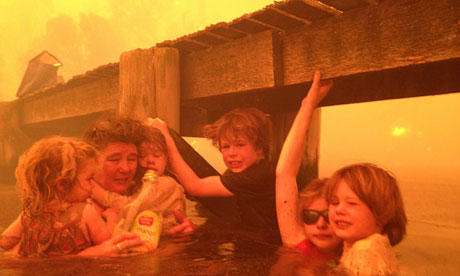
A family huddles under a bridge in Tasmania to escape a firestorm in 2012. By 2047 a new report discloses such scenes may be commonplace.


Now we know what the world of 2047 will likely look like: A planetary hell. According to a new study published in Nature, climate-change will “lock” into place by the year 2047 (plus or minus 14 years, when the uncertainty is factored in). Once that happens, every year after 2047 will be hotter than even the current hottest year on record.  Go back to 2003, when 70,000 died across Europe from a heat wave - then expand the numbers by a factor of ten, as you expand the duration of the heat waves to months as opposed to weeks, and you have an idea what those alive in 34 years will be facing. Who will they be? Your kids? Your grandkids? Let them take a look at the photo shown to give them a heads up of what awaits.

This is no jive, by 2047, the study concludes, our current record temperatures will become the new normal temperatures.   Of course, since the planet has differing temperature regions, latitudes etc. the emergence of the new heat world will not be uniform. That means the arrival of "Hell year" will differ depending on location. The Nature study estimates that Singapore, for example, will reach its temperature point-of-no-return as soon as 2028. Cairo, they say, could start to see a “lock-in” of global warming in 2036, 11 years before the global “H-hour” of 2047.

According to Chris Field, one of the scientists who worked on the project, "One can think of this year [2047] as a kind of threshold into a hot new world from which one never goes back.”

The reason Field and his co-workers were able to make these specific calculations is quite simple: and scary: humans are expected to keep burning fossil fuels and pumping C02 into the atmosphere at a rapid rate well into the coming decades.

We are basically too damned lazy, unimaginative and cheap to invest in alternative energy or cut back our addiction to fossil fuels, so we will pay the price.

Living in Fairbanks, AK or Helsinki, Finland? Don't feel smug! Even you will be boiling by then, as temperatures regularize globally and the first 'year of no seasons" will have arrived  - likely 8- 15 years earlier. Recall in previous blog posts, I referenced David Suzuki's forecast in his book, 'It's A Matter of Survival', (Harvard Univ. Press, 1991)  co-authored with Anita Gordon, that 2040 is the first year of no seasons. However, if global warming is accelerating with much higher CO2 concentrations added each year, (translating to higher solar insolation by about 2 W/m^2 per year) then that date can arrive as early as 2025, if not sooner.

What it will mean is that an essential thermal equilibrium will be reached in our planetary  atmosphere.  So effectively, no more winters, summers or even intermediate (spring, fall) seasons anywhere. That will also mark the emergence of much higher mean global temperatures, probably as high as 60-65F. Locally, we can expect to see highs of 115F- 120F and covering much larger areas for much longer (heat 'waves' will be more like heat seasons, lasting months.)  Relatively cooler breaks, say with highs of 85-90, and lows of 80-85, will likely appear in what used to be northern winters.

With the much more consistent high temperatures, pests of all types will proliferate, so we can expect to see more worm -parasite infestations for example, as well as increased spread of the mountain pine beetle in the West, and  dengue fever throughout the nation-  rivaling what we have now with West Nile Fever. Cholera, c. diff. and amoebic dysentery will also not be unheard of as our water resources continue to be used up and polluted, i.e. by fracking.  Even salt water pools in marshlands will be infested, likely by brain-eating amoebas.  All in all, it will be a world that few will enjoy living in, other than the very rich - who, unlike the rest of us- will be able to afford their own off the grid power stations, so won't be rendered too uncomfortable when the main grids crash from over use.

If anyone thinks the planet is screwed up now, wait until you see  the “new normal” arrive in 2047. Savage storms, deadly droughts, cholera and dengue fever epidemics in the American South, torrential flooding – all of these disasters will both be more common and more powerful than they are right now. Millions of refugees will also have to flee from rising sea levels and governments around the world will have to find a way to both pay for their own displaced populations as well as the damage caused by an increasingly violent climate.

Meanwhile, the perpetually undisturbed zombies in our midst - many ensconced in the corporate media - continue to release the meme that humans are "adaptable" and they can adjust to the new normal. I don't know what brand of weed or new forms of 'E'  these nincompoops are ingesting, but their brains have definitely jumped the tracks. There is no way any human, unless he's mostly cyborg with synthetic organs, will survive very long in the new normal hot world. The runaway greenhouse which 2047 marks the onset of, defines the limits of human (or any organism's) adaptation. Think of trying to live on a planet - which merely 100 years later- will likely have ambient air temperatures of 170- 200F and bear in mind 212F is the boiling point of water.

Live until 100 or 120 like the pie-eyed longevity morons have postulated? You have got to be kidding! Fortunately, I won't be around to see 'hell world'.