Showing posts with label David Suzuki. Show all posts

Wednesday, January 22, 2020

Donnie Dotard At Davos Claims Planting Trees Will Help Avoid Climate Catastrophe - He's An Idiot

Graph showing the rise in temperatures since 1900.
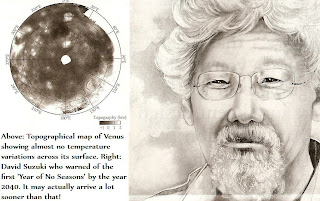
Image result for brane space, year of no seasonsImage may contain: 1 person, closeup


Even as Blowhard Dotard yesterday blustered to those gathered at Davos about ignoring the "perennial prophets of doom, the heirs of yesterday's foolish fortune tellers and their predictions of the apocalypse"   a veritable climate apocalypse was brewing across the planet.   And so  we beheld Greta Thunberg (Trump's intellectual superior) setting the record straight with a note of reality.  I.e. that “our house is still on fire” and that “naction is fueling the flames by the hour.”i

Incredibly even low IQ Dotard  at least knows that trees are beneficial. They give us oxygen, absorb CO2, provide nests for birds and habitats for wildlife, protect against flooding and even help to clean up air pollutants from traffic.  And so as the world’s forests  have come under increasing threat from fires, agriculture and logging, the World Economic Forum has launched an initiative to ensure 1 trillion trees are restored.  And Trump, to avoid his rep as a climate renegade,  jumped onto the  tree planting bandwagon.  But in relative terms it's akin to trying to save the Titanic with a bucket brigade. In other words, the tipping point is already upon us - with the record heat of the past five years proving it - and David Suzuki's first year of no seasons now imminent.
 So yeah, Trump is on board at least to the extent of a con.  Though like other climate deniers he did toss out the toxic memes that any form of genuine mitigation - like higher gas taxes, or cutting carbon emissions - amounts to 'loss of freedom' and socialism. But Greta Thunberg wasn't having any of that empty blather.  As  Thunberg responded to him at Davos: “Planting trees is very good of course, but is nowhere near enough and cannot replace real mitigation.” and said so, e.g.: 
Adding:

"Our house is still on fire, and your inaction is fueling the flames by the hour"

Recall Trump and his nitwit cult never got over Thunberg getting TIME's 2019  Person of the Year, and were so desperate they even reworked the TIME cover, e.g.
Image result for Trumpies put Trump image on TIME Person of Year cover
Photoshopping Trump's empty head on Thunberg's body.   The only word that comes to mind? Pathetic!

Thunberg's reinforced warning isn't apocalyptic doomsaying either.  We now know  that the year 2019 was the second hottest on record for the planet’s surface, according to latest research. The analyses reveal the scale of the climate crisis: both the past five years and the past decade are the hottest in 150 years.  All indications now are that climate author David Suzuki's forecast of the first "year of no seasons" will indeed occur by the year 2040 - if not before.

In his book It's A Matter of Survival (Harvard University Press, 1991) co-authored with Anita Gordon, Suzuki wrote in Chapter One, 'Beyond Your Worst Nightmare':

"A.D. 2040- If we were to give this year a name it would be Despair. This is the hopeless world we have left our children and grand children. Where once our lives were measured and enriched by the cycle of the seasons, there is now only searing heat and the certainty it will get hotter. Seasons exist only in the nostalgic longing of those of us old enough to remember the richness of life......

Daily, experts try to play God, desperate to determine what each new ecosystem will be, before it too is lost. This is the nightmare world of 2040 on this sad excuse for the planet we once called home."

On page 8 of the same chapter, the authors go on to link the total disappearance of the seasons worldwide to global mean temperatures being 5 C (9F) above what they were in 1991.  All signs  now are that we may equal or surpass that  - especially given there is absolutely no evidence that the planet's inhabitants are prepared to take the measures needed: significant taxes on gasoline, major emissions cuts back to 1990 levels, etc.  Hence we're living in a fools paradise.

Attesting to this we have the succession of records being broken year after year.   Described by one paleo climatologist as: “the drumbeat of the Anthropocene”.  That drumbeat   is bringing increasingly severe storms, floods, droughts and wildfires- including the recent ones smothering Australia and New Zealand in smoke.   The drumbeat is also bringing painful economic symptoms as WSJ columnist Greg Ip recently observed ('Economic Impact of Climate Change Is Here', Jnuary 17, p. A2), noting:

"McKinsey Global Institute estimated  that 'unusually hot summers' affected 15 percent of the Northern Hemisphere's land surface in 2015, up from 0.2 percent before 1980."

If you can do the math that is an increase of 75 times, or in other terms, 7500 %.

More ominous, McKinsey projects a "probability of a 10 % drop in wheat, corn, soybean and rice yields in any given year and which will rise from 6% now to 18 %  in 2050."

This is ominous because the current projections are that 2 billion more people will be added to the population by 2050.  How will they get sufficient food given the probable declines in grain yields?  Indeed, where will they all live, given vast land areas will become almost uninhabitable by then, thanks to  persistent, catastrophic drought or the prevalence of monster hurricanes, typhoons?

We also need to be more aware that we've been living on borrowed time thanks to the oceans absorbing the bulk of excess heat. An amount one specialist analogized to "five Hiroshima bombs being detonated every second."   This is serious given more than 90% of the heat trapped by human greenhouse gas emissions is absorbed by the oceans. On Monday last climate scientists revealed 2019 as the warmest yet recorded in the seas, calling it “dire news”.  It is indeed, given ocean life as in the food chain that supports thousands of  animals, is now at risk.  The krill population that feeds the Chinstrap Penguin alone has decreased by 25-30 %.  Other sea life - from the fish we consume, to crustaceans- are also at risk.  When Bill Maher informed his HBO audience two years ago that there may be no fish left at all in fifty years, no one believed it.  W(ell, it is more than likely there will still be Jellyfish)

As we can see from the attached (top) graph:  the average temperature in 2019 was about 1.1C above the average from 1850-1900, before large-scale fossil fuel burning began. The world’s scientists have warned that global heating beyond 1.5C will significantly worsen extreme weather and suffering for hundreds of millions of people.  The World Economic Forum’s global risk assessment for the next decade, also found the top five dangers were all environmental, including extreme weather, failure to prepare for climate change and the destruction of the natural world.  This is all supported by the WSJ's Greg Ip who writes (ibid.):

"Climate crises in the next 30 years might resemble financial crises in recent decades: potentially quite destructive, largely unpredictable, and - given the powerful underlying causes - inevitable."

What is important is the totality of evidence from multiple independent data sets that the Earth is warming, that human activity is driving it and the impacts are clearly being felt. These announcements might sound like a broken record, but what is being heard is the drumbeat of the Anthropocene.”

Added Michael Mann , a climate scientist at Penn State University:

It’s now official that we have just completed the warmest decade on record, a reminder that the planet continues to warm as we continue to burn fossil fuels,”

Let's also note that while instrumental temperature records stretch back to 1850, data from ice cores indicate that today’s temperatures were last seen at least 100,000 years ago. Furthermore, the level of carbon dioxide is the highest it has been for several million years, when the sea level was 15-20 meters  higher.By the early 1990s, climate scientists completed more precise studies of ice cores extracted from the Greenland ice sheet. Dust and oxygen isotopes encased in the cores provided a detailed climate record going back eons. It revealed that there had been 25 rapid climate change events like the Younger Dryas in the last glacial period.  The evidence in those ice cores  - many of them originally studied by Univ. of Alaska climate researcher Prof. Gunther Weller (at the Geophysical Institute) -

Prof.  Gunther Weller (1987) at Geophysical Institute - University of Alaska - Fairbanks.

Prof. Weller's  work and that of colleagues  has disclosed that over the past 800,000 years the CO2 concentration of  300 ppm was never crossed until after the advent of the Industrial Revolution and the burning of fossil fuels.  Prof. Weller's work was also critical in highlighting the phenomenon of "Arctic amplification".  In papers and seminars delivered at the GI over 1985-1990 he pointed out that a much warmer Arctic translated to a much more unstable polar region with more frequent intrusions ("waves")  of polar air

The four temperature datasets are compiled from many millions of surface temperature measurements taken across the globe, from all continents and all oceans. They are produced by the UK Met Office with the University of East Anglia (UEA), both Nasa and Noaa in the US, and Europe’s Copernicus Climate Change Service. Small differences between the analyses arise from how data-sparse polar regions are treated, but all agree that the past five years are the warmest five years since each global record began.

The Met Office’s forecast for global average temperature for 2020 suggests this year could well set another record and is very likely to be among the top three hottest. The UK government will host a critical UN climate summit in Glasgow in November. The UN secretary general, António Guterres, and many others are urging nations to increase dramatically their pledges to cut carbon emissions, which would lead to global temperatures rising by a disastrous 3-4C.

“It is obvious we are not succeeding in preventing dangerous anthropogenic interference with the climate system, which was the main goal of the original 1992 UN climate change convention,” said Bob Ward, of the Grantham Research Institute on Climate Change at the London School of Economics.

Even if we succeed in limiting warming to 1.5C, this would not be a ‘safe’ level of warming for the world,” he said. “Therefore we must focus on cutting global emissions to net zero as soon as possible. We know the transition to a net zero economy is the growth story of the 21st century.”

See also:

Climate report understates threat

And:


Thursday, February 23, 2017

70 Degree February Days As We Head Toward The First 'Year Of No Seasons'


David Suzuki - above- who predicted the first 'Year of No seasons' by 2040.

weather1
Scene in Chicago February 27, as temperature hits a record high of 75 F.

Let us admit that a 75 degree day in Tampa, Florida in February is not unusual, and in fact normal. Let us also admit a 75 degree high day in Chicago is not. When the high temperatures also hit 77 F here in Colorado Springs, I noted to Janice that this is a reminders that within 20-25 years such days will be the norm, not just in February. Imagine then 65-75 degree highs from December through February, for most of the nation, and 75 to 90 degree highs from March through May, then 95 to 105 degree days from June through October. Unreal? No, very real, and well on the way as humans continue to by and large disregard the harbingers of massive global warming, acting like nothing strange is going on.

Just imagine now, if you can, weird warm days in northern cities ALL the time, not just a few instances or one offs.  Picture in your mind no more autumns with brilliant leaf colors such as Vermonters currently enjoy, and no more adequate snow pack to accommodate skiers at Vail or any other place. Impossible? You wish.

Researcher and author David Suzuki, in his book It's A Matter of Survival (Harvard University Press, 1991) co-authored with Anita Gordon, believes we are well on our way there and will reach that stage by the year 2040. The first 'Year of No Seasons' (I happen to believe we will reach this stage a lot sooner, perhaps by 2020.) Bear in mind Suzuki based his projections on 1991 data and the hope we'd be able to keep the warming increment to less than 2C by 2100. According to data compiled from the National Climate Data Center, IPCC, the Hadley UK Center and other sources, all bets are off for achieving this based on their recent reports and the maximum increase now is projected to be from 3.6 C to 4.0 C.

Suzuki and Gordon wasted no time bitch-slapping the complacent reader from the first words of Chapter One: Beyond Your Worst Nightmare:

"A.D. 2040- If we were to give this year a name it would be Despair. This is the hopeless world we have left our children and grand children. Where once our lives were measured and enriched by the cycle of the seasons, there is now only searing heat and the certainty it will get hotter. Seasons exist only in the nostalgic longing of those of us old enough to remember the richness of life......

Daily, experts try to play God, desperate to determine what each new ecosystem will be, before it too is lost. This is the nightmare world of 2040 on this sad excuse for the planet we once called home."

On p. 8 of the same chapter, Suzuki and Gordon go on to link the total disappearance of the seasons worldwide to global mean temperatures 5 C (9F) above what they were in 1991. Given that Carl Sagan once forecast an increment of 6C as adequate to trigger the runaway Greenhouse, Suzuki's numbers would put us right on the cusp. Once that begins, and the methane is also released from melting permafrost and later CO2 is released from all the carbonate rocks in the world, we are for the high jump.

Of course, the cessation of seasonal changes is only one aspect of ongoing climate change. Already here in Colorado we are seeing a continued and relentless dying of the trees. One in 14 trees is now dead in Colorado forests and the number of gray-brown standing-dead trees has increased 30 percent since 2010 to 834 million, the state’s annual survey has found.    The dying trees are  largely the result of insect infestations —which  can lead to large intense wildfires, such as the Beaver Creek fire in 2016 that burned 38,000 acres northwest of Walden, This is according to  Colorado State Forest Service officials in a report released 2 weeks ago.
Standing-dead trees are shown on Wolf Creek Pass in Mineral County. One in 14 trees are dead in Colorado forests and over the past seven years, the number of gray-brown standing-dead trees increased 30 percent to about 834 million, according to the state's annual forest survey.
Still standing dead trees on Wolf Creek Pass in Colorado.

Recall the insect infestation is traced to the mountain pine beetle which population has exploded directly as a result of warming temperatures. Those readers interested in a detailed account of the trepidations spawned by this pest can get hold of the superb book: The Dying of the Trees.  You can read a shorter account here:

http://www.nytimes.com/2008/11/18/science/18trees.html?pagewanted=all

The point is the beetle is a major catalyst for all the ongoing and uncontained Colorado wild fires

With the release of the report, given we now know there are at least 800 million dead trees in the state, greater attention is being focused on conserving what we have left. State forest service director Mike Lester quoted in The Denver Post stated:

"When so many trees die and large wildfires follow, our forests quickly turn from a carbon sink into a carbon source. Beyond the implications for our atmosphere, forests in poor health have implications for our water supplies, public safety, wildlife and recreation opportunities.”

Other key findings:

• Colorado’s mountain pine beetle epidemic killed trees across 3.4 million acres
• The continuing spruce beetle epidemic has killed trees across 1.7 million acres
• About 80 percent of Colorado residents rely on forest watersheds for their municipal water supplies
• Climate models projecting statewide average temperature increases by 2.5 to 6.5 degrees before 2050 mean the risks of severe wildfires, insect infestations and droughts will worsen

More sobering yet, a University of Colorado -Boulder study is questioning whether burned forests on the Front Range in Colorado will ever return to normal. Given the predations of the mountain pine beetle in concert with the forest fires, it may be wishful thinking to believe so.

Note also the older trees that burned in fires were seedlings 50-100 years ago and we know the climate was different then.. The 2014 Climate Change in Colorado  report for the Colorado Water Conservation Board found that statewide temperatures have increased 2 F over the past 30 years.  This may sound insignificant but simulations of differing conditions on ponderosa pine and Douglas fir seedlings- in a 2015 published Canadian study (Canadian Journal of Forest Research) -  found that those growing in a post-burn areas had less chance of survival when subjected to even small increases in temperature. Or when subjected to less water.

One more takeaway: A recent study by scientists working as part of a group called World Weather Attribution, looked at the influence of climate change on the seasonal variation of temperatures, using models of the atmosphere as it exists and of a hypothetical atmosphere with no greenhouse gas emissions and thus no human-driven climate change. They found that a warm February like the one just experienced is now about four times more likely in the current climate than it would have been in 1900, before significant CO2 emissions began to change the climate.

How will all this play out as our own EPA, and indeed government, has been captured by climate change deniers and anti-science knuckle draggers? That will be the subject of an upcoming post.

Saturday, December 26, 2015

Warmest Xmas Ever In East: But Don't Celebrate!


Well, would you celebrate the birth of a three-headed infant? I don't think so! You'd understand instinctively it's unnatural. Humans do not have 3-headed babies, it's a simple statement of fact. Hence, something serious must be wrong with this picture. In like manner, people shouldn't be celebrating a 66F Christmas Day in New York, or a 70 F Christmas Eve. Because in meteorological terms such temperatures in December for eastern cities are just as unnatural as 3-headed babies. But to hear and see some people, it's a "gift".

Really?

In fact would you regard it as a gift when the next El Nino erupts and you have temperatures of 90- 95 F on Christmas Day? Don't believe it can happen? Think again! Also, that such high temperature conditions will one day become permanent through the entire year - not just the odd time or during a heat wave or a few summer months.

Many people - such as the guy on an NBC segment two days ago who exclaimed "This is nuts!" - want to believe this is just an aberration, an unusually warm but annoying few days in one warmish December. But I have news for them: it's just the beginning of ever escalating temperature aberrations including intense heat waves which will also see "cool" temperatures at night barely different from daytime highs. Get braced for an accelerated period of global warming! Welcome to the pre-runaway greenhouse effect phase!

Oh, for sure, the meteorologists  (like NBC's Al Roker, a global warming skeptic) will point to large high pressure domes over the nation's midsection or 'deformed' jet streams and expatiate on  how long they may last. The impression given here is of a transitory meteorological phenomenon which has little or no connection to climate science. So we just need to expect in coming years that the jet stream will float high over Canada making conditions unbearably hot by keeping the jet stream away and hot air flooding in from the south.

But these guys never touch on the whys and wherefores! Well, Geophysicist and climate scientist S. George Philander did more than 17 years ago in a small but hot-button piece in Eos: Transactions of the American Geophysical Union (March 31, 1998):Who is El Nino?’

Philander argued that El Nino and its sister cyclic counterpart 'La Nina' are not merely the yin and yangs of a meteorological cycle (La Nina from current forecasts is due to ramp up the end of next year) but actually offshoots of climate change in terms of their expected future behavior. Thus, as more CO2 is pumped into the atmosphere (as indicated by the Keeling curve - which shows CO2 injection has exceeded the absorption capacity of the oceans), El Nino will ramp up leading to blistering hot and dry conditions, even as La Nina continues her antics bringing cooler spells and precip. However, unmentioned is the game changer of altered albedo.

For reference, the heating effects are largely tied to increases in ocean temperatures for El Nino. For the past several months these temperatures have reached 3.6F higher than normal. In its early stages EL Nino had already spun off environmental havoc including "red tides" - from a certain species of algae, as well as rendering a species of crab inedible that usually thrives in the sea waters off southern California. This effect has been combined with unusual jet stream flows this December to effectively turn the nation schizoid - with we in the West having the usual normal cold temperature (it is 18F now as I write this) while those in the eastern U.S. bask in unusually warm temperatures with amped up warm, moist air entering from the Gulf.

To grasp this, try to think of what happens when you open the door of your fridge and allow it to defrost. Over a rather brief time interval all your ice melts (de-frosting) and the fridge (if left open)  will reach thermal equilibrium with the room temperature. At this point no ice remains at all, and meanwhile your electric bill will soar. In a similar way, the Arctic is defrosting (and to a lesser extent the Antarctic) and this is encapsulated in the lower diagram.

The defrosting of the Arctic arises from the melting of its polar ice and sea ice, as well as large glaciers and that includes much of the land mass of Greenland. The situation worsens as temperatures (from higher CO2 levels) lead to earlier and earlier melting, analogous to leaving the fridge door open longer and longer. Surface temperatures last summer ranged up to 3 Celsius higher than average and generated a much earlier melting.

When snow melts, grains tend to cluster in a process called 'constructive metamorphism. This reduces the albedo or reflectivity of the surface - leading to increased absorption of solar radiation. Meanwhile, bare ice is much less reflective than snow, absorbing even more solar radiation and further speeding any melting. (In the diagram, the red arrows indicate incoming radiation and the blue arrows indicate radiation reflected back into space. Percentages give the amounts of reflected incoming solar radiation).

All this - combined with an intense El Nino - paved the way for the abnormal temperatures we're seeing now in the eastern U.S.  The other aspect to bear in mind, as Philander noted, is that the El Ninos in the future -fed by global warming - will steadily increase in intensity. The EL Nino -La Nnia oscillation itself will keep going until the first 'year of no seasons' predicted by David Suzuki as long ago as 1991.  He estimated in his book, 'It's A Matter of Survival' (1991), that the first year of no season would occur in 2040. But given the pace of warming has ramped up to the point a 2C target threshold is now mostly regarded as a pipedream (given no serious carbon emissions cuts) we will likely see that first year of no seasons as early as 2030.

As a recent TIME report noted (Dec. 28, p. 18):

"A 3.5 C temperature rise would occur even if all (200) nations meet initial pledges to reduce carbon emissions.  This would still submerge coastal cities and drive over half of species to extinction."

It would also make life so horrific for humans, they will wish for extinction. Think of 6-8 month heat waves lasting even through supposed 'cold' months and temperatures hitting 95F- 100 F regularly - even in December. Think of it happening not just in the U.S. but globally.  And think of power grids mostly being down because they are unable to meet the vastly enhanced power demands, say for air conditioning.

The other factor that's enabled a more rapid heating from global warming, is the reduction of global dimming. The effect was first spotted by Gerry Stanhill, an English scientist working in Israel. Stanhill called the phenomenon 'global dimming', but his research, published in 2001, met with a skeptical response from other climate scientists. It wasn't until several years later that his conclusions were confirmed by Australian scientists using a completely different method to estimate solar radiation, that climate scientists at last woke up to the reality of global dimming.

Dimming appears to be caused by air pollution. This visible air pollution reflects sunlight back into space, preventing it reaching the surface. But the pollution also changes the optical properties of clouds. Because the particles seed the formation of water droplets, polluted clouds contain a larger number of droplets than unpolluted clouds. Recent research shows that this makes them more reflective than they would otherwise be, enhancing albedo and hence offsetting the lowered albedo from Arctic melting.

Stanhill and others estimated that global dimming masked up to one third of global warming for the past twenty -five years. Now that masking is at an end, and we are seeing mean global temperatures ramp up yearly.

We are headed for very "interesting" times indeed, mostly brought about because we paid too much attention to the climate change skeptics and their hacks in the media for too long. Now the planet inherited by our younger generations will likely not be worth living on. But perhaps they will be able to find a new one, based on a working interstellar drive.  If they settle such a world, hopefully they  won't end up trashing it for profit and expedience like their ancestors did to Earth.

One can always hope!

Saturday, October 12, 2013

Transition to "Hell World" - By 2047

Tim Holmes
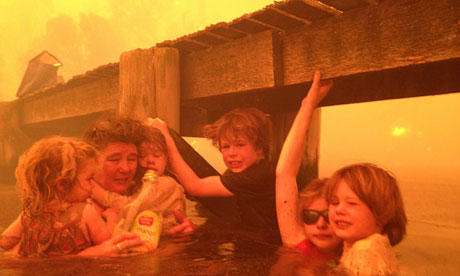
A family huddles under a bridge in Tasmania to escape a firestorm in 2012. By 2047 a new report discloses such scenes may be commonplace.


Now we know what the world of 2047 will likely look like: A planetary hell. According to a new study published in Nature, climate-change will “lock” into place by the year 2047 (plus or minus 14 years, when the uncertainty is factored in). Once that happens, every year after 2047 will be hotter than even the current hottest year on record.  Go back to 2003, when 70,000 died across Europe from a heat wave - then expand the numbers by a factor of ten, as you expand the duration of the heat waves to months as opposed to weeks, and you have an idea what those alive in 34 years will be facing. Who will they be? Your kids? Your grandkids? Let them take a look at the photo shown to give them a heads up of what awaits.

This is no jive, by 2047, the study concludes, our current record temperatures will become the new normal temperatures.   Of course, since the planet has differing temperature regions, latitudes etc. the emergence of the new heat world will not be uniform. That means the arrival of "Hell year" will differ depending on location. The Nature study estimates that Singapore, for example, will reach its temperature point-of-no-return as soon as 2028. Cairo, they say, could start to see a “lock-in” of global warming in 2036, 11 years before the global “H-hour” of 2047.

According to Chris Field, one of the scientists who worked on the project, "One can think of this year [2047] as a kind of threshold into a hot new world from which one never goes back.”

The reason Field and his co-workers were able to make these specific calculations is quite simple: and scary: humans are expected to keep burning fossil fuels and pumping C02 into the atmosphere at a rapid rate well into the coming decades.

We are basically too damned lazy, unimaginative and cheap to invest in alternative energy or cut back our addiction to fossil fuels, so we will pay the price.

Living in Fairbanks, AK or Helsinki, Finland? Don't feel smug! Even you will be boiling by then, as temperatures regularize globally and the first 'year of no seasons" will have arrived  - likely 8- 15 years earlier. Recall in previous blog posts, I referenced David Suzuki's forecast in his book, 'It's A Matter of Survival', (Harvard Univ. Press, 1991)  co-authored with Anita Gordon, that 2040 is the first year of no seasons. However, if global warming is accelerating with much higher CO2 concentrations added each year, (translating to higher solar insolation by about 2 W/m^2 per year) then that date can arrive as early as 2025, if not sooner.

What it will mean is that an essential thermal equilibrium will be reached in our planetary  atmosphere.  So effectively, no more winters, summers or even intermediate (spring, fall) seasons anywhere. That will also mark the emergence of much higher mean global temperatures, probably as high as 60-65F. Locally, we can expect to see highs of 115F- 120F and covering much larger areas for much longer (heat 'waves' will be more like heat seasons, lasting months.)  Relatively cooler breaks, say with highs of 85-90, and lows of 80-85, will likely appear in what used to be northern winters.

With the much more consistent high temperatures, pests of all types will proliferate, so we can expect to see more worm -parasite infestations for example, as well as increased spread of the mountain pine beetle in the West, and  dengue fever throughout the nation-  rivaling what we have now with West Nile Fever. Cholera, c. diff. and amoebic dysentery will also not be unheard of as our water resources continue to be used up and polluted, i.e. by fracking.  Even salt water pools in marshlands will be infested, likely by brain-eating amoebas.  All in all, it will be a world that few will enjoy living in, other than the very rich - who, unlike the rest of us- will be able to afford their own off the grid power stations, so won't be rendered too uncomfortable when the main grids crash from over use.

If anyone thinks the planet is screwed up now, wait until you see  the “new normal” arrive in 2047. Savage storms, deadly droughts, cholera and dengue fever epidemics in the American South, torrential flooding – all of these disasters will both be more common and more powerful than they are right now. Millions of refugees will also have to flee from rising sea levels and governments around the world will have to find a way to both pay for their own displaced populations as well as the damage caused by an increasingly violent climate.

Meanwhile, the perpetually undisturbed zombies in our midst - many ensconced in the corporate media - continue to release the meme that humans are "adaptable" and they can adjust to the new normal. I don't know what brand of weed or new forms of 'E'  these nincompoops are ingesting, but their brains have definitely jumped the tracks. There is no way any human, unless he's mostly cyborg with synthetic organs, will survive very long in the new normal hot world. The runaway greenhouse which 2047 marks the onset of, defines the limits of human (or any organism's) adaptation. Think of trying to live on a planet - which merely 100 years later- will likely have ambient air temperatures of 170- 200F and bear in mind 212F is the boiling point of water.

Live until 100 or 120 like the pie-eyed longevity morons have postulated? You have got to be kidding! Fortunately, I won't be around to see 'hell world'.

Wednesday, July 17, 2013

Boiling Under That "Heat Dome"? You Can Thank Global Warming!

Comparison images of Arctic (top) and Antarctic sea ice changes for summer minimum and wniter maximums. (From National Snow and Ice Data Center)

Tens of millions will be baking today with "thermatures" that approach 110 degrees F in some cities, such as Philadelphia. The official meteorological patter is that it's due to a "heat dome".  But most won't go the next step and track it to what it really is: global warming reaching a new dramatic level on this planet.  Why the hesitance? Who knows? But as physicist Michio Kaku noted this morning: "this could be part of a larger trend."

What do we know? As Kaku observed, one single heat dome event can't be pinned on global warming, but the trend or statistical average disclosing enhanced temperatures over larger regions, can. And the fact is that the statistical trend discloses many more such heat dome incidents, over larger and larger areas and lasting longer. As he pointed out this morning, this translates to longer and longer summers, hotter ones and more elderly likely dying because of heat waves - as well as increased strain on limited power supplies.

Now, let's get down to cases. As I noted in previous blogs, e.g. Oct. 21, 2012, Arctic sea ice is more important for Earth's energy balance because when it melts the albedo more rapidly decreases, exposing dark terrain which absorbs more solar radiation which is then trapped by the CO2 blanket. Meanwhile, the melting of Antarctic sea ice each summer largely leaves the energy balance unchanged. I also noted that there is a net loss of sea ice of some 74-75 gigatons per year.

Now,  let's move to the behavior of the Jet Stream in relation to Arctic thermal balance. Dr. Jennifer Francis of Rutgers University last year,  provided cogent scientific evidence that the erosion of Arctic sea ice and land snow resulted in less of the Arctic's cold air being trapped within the Arctic. This means there is less cold air available within the jet stream, at the same time more warm and moist air intrudes from the south. As a direct result of the temperature difference being reduced between the Arctic and mid-latitudes, the Jet Stream has formed large dips and bulges - many of them occurring during the summers and with the dips northward lasting longer - creating your "high pressure heat domes".

Again, no one heat dome points to global warming, but a succession of them over years, emerging as a higher temperature trend, does. Add to this that as the dips form and the affected air is repeatedly slowed, the Jet Stream has a greater tendency to become "stuck".  This sticking in place creates blocking patterns in which heat domes are likely to form with the inevitable heat waves occurring over extended periods of time.

To her credit, Dr. Francis has also pointed to an increased frequency of such blocking patterns, which also show how climate change is impacting our weather.  That such anomalous high pressure domes are increasing ought to therefore terrify every man, woman and child impacted each year. Because as Kaku observed, they will get worse - something first pointed out by David Suzuki in a 1991 book ('It's A Matter Of Survival')  on global warming.

Suzuki observed that extended heat periods would increase in frequency eventually leading to the first "year of no seasons" by which time there'd be no cooler respite at all. He estimated it as beginning from 2040, but the increasing length of summers, the increasing heat dome events and Arctic melting suggest if may arrive as early as 2020.

If people can barely handle it now, what will they do when actual temperatures hit 110F daily and only are down to 95-100F at night, even without humidity factored it? What will they do when so many want to keep cool at any cost that they drain the power grid to a crashing halt? What will happen when the water mains also break, as they have threatened to do in Prince William County,  Maryland (forcing a 5-day shutdown), because our people and politicos pay more attention to an artificial DOW than they do to their own water mains and other corroding infrastructure?

These are questions that remain to be answered.  The problem is we may not like the answers we will soon get!


Monday, March 11, 2013

Accelerated Warming is Indeed in Effect

In response to a question on my Mail Brane blog of Feb. 28, I replied that if global warming is accelerating - meaning much higher CO2 concentrations added each year-  there'd higher solar insolation (by about 2 W/m^2 per year) and the date of the first year of no seasons could arrive as early as 2025, if not sooner. Now a new report appears to validate that, and indeed the global temperatures are hotter now than they've been in 4,000 years.

This  research team just published their results in the journal Science, assembling  a record of global temperatures going back to the end of the last ice age — about 11,000 years ago — when mammoths and saber-tooth cats roamed the planet. The study confirms that what we're seeing now is unprecedented and we may well be past the time to do anything effective.

The Science researchers effectively peered into the past. They analyzed ice cores from polar regions that show what temperatures were like over hundreds of thousands of years. However, those only reveal changes only in specific regions; cores aren't so good at depicting what happened to the whole planet. Tree rings give a more global record of temperatures, but only back about 2,000 years.

According to Shaun Marcott, a geologist at Oregon State University:

 "Global temperatures are warmer than about 75 percent of anything we've seen over the last 11,000 years or so."

He adds that the other (optimistic)  way to look at is that  25 percent of the time (since the last ice age), it's been warmer than now.

Given such a relatively  lower proportion of higher temperatures since the previous Ice Age, many people might ask, 'Why worry?' After all, it's been colder for 75% of the time! But Marcott dismisses this given the record shows the alarming rate is unusual and we ought to be worried at this recent trend. As he puts it:

 "It's really the rates of change here that's amazing and atypical. Essentially, it's warming up superfast."

And in fact, my answer in the Mail Brane tried to draw emphasis to the RATE of warming. Indeed, in earlier blogs I also noted that this was critical since a threshold for the runaway Greenhouse Effect could be reached much sooner. This would mean maximum entropy globally, not a favorable prospect.   According to statistical mechanics, the entropy (σ ) is defined according to:

σ = log g

where g denotes the number of accessible states. As that number g increases, so does log g and hence the entropy. When g is maximized for a given system one will say it is in an equilibrium condition and has no further states which can be accessed. Such is the case with a planet  (e.g. Venus) uniformly at 450 C across its surface ....no climate to speak of, no 'cool nights', no variation in temperatures of any significance. The first year of no seasons for Earth would mark our strong trend toward that unsavory end.

Of course, the world will become unbearable long before that. The full horrors incepted, of which the loss of seasons is merely the most distinguishing, will include lack of sufficient water, lack of food - because of the inhospitable conditions to grow crops, and other hostile factors (catastrophic storms with hundreds of F5 tornadoes a year, monster hurricanes, rising sea levels inundating 30% of coastal lands in the U.S. alone).


Back to the Science journal paper, we can ask: What happened after the end of the ice age? What does the 11,000 year record disclose? Well, the planet got warmer, then, 5,000 years ago, it started to get cooler — but slowly. In all, it cooled 1.3 degrees Fahrenheit, up until the last century or so. Then it flipped again — global average temperature shot up. This coincides almost exactly with the kicking in of CO2 atmospheric absorption from the Industrial Revolution. This is verified by a previous 2000-year record of C14:C12 deviations compiled by P.E. Damon ('The Solar Output and Its Variation', The University of Colorado Press, Boulder, 1977)

As John Eddy observes concerning this output (Eddy, The New Solar Physics. p. 17):

The gradual fall from left to right (increasing C14/C12 ratio) is…probably not a solar effect but the result of the known, slow decrease in the strength of the Earth’s magnetic moment exposing the Earth to ever-increased cosmic ray fluxes and increased radiocarbon production.The sharp upward spike at the modern end of the curve, representing a marked drop in relative radiocarbon, is generally attributed to anthropogenic causes—the mark of increased population and the Industrial Age. "

Not surprisingly, the Science authors report:

"Temperatures now have gone from that cold period to the warm period in just 100 years,"

Hence,  it's taken just 100 years for the average temperature to change by 1.3 degrees, when it took 5,000 years to do that before.

The Science  research team tracked temperature by studying chemicals in the shells of tiny, fossilized sea creatures called foraminifera. Their temperature record matches other techniques that look back 2,000 years, which supports the validity of their much longer record.

Climate scientists predict that the current warming will continue, given the amount of greenhouse gases going up into the atmosphere. According to Gavin Schmidt, a climate reseachers at NASA's Goddard Institute for Space Studies:

"The climate changes to come are going to be larger than anything that human civilization and agriculture has seen in its entire existenc. And that is quite a sobering thought."

"Sobering" is perhaps an understatement to describe what's in store for us!