Showing posts with label runaway Greenhouse. Show all posts

Thursday, June 20, 2019

Greenland Ice Sheet Melt Accelerates- Are We On The Cusp Of The Runaway Greenhouse Effect?


Graphic showing the process by which the Greenland Ice Sheet is melting.

Image result for brane space, dog sledding
Dog- sledding near Chena Hot Springs, AK in March, 2005. We were unable to go as far as we would have liked because the much higher temperatures had melted the surface ice.


The news that last Wednesday saw record high temperatures in Greenland,  40 degrees above normal, and a record melt event  over the Greenland Ice Sheet triggered more cause for concern among climate scientists.  According to Zachary Labe, a climate researcher at the University of California -Irvine (quoted in The Washington Post):

"It's another series of extreme events  consistent with the long term trend of a warming, changing Arctic..

Meanwhile, Marco Tedesco - an ice researcher at Columbia University, quoted in the same article, noted it's "been extremely warm in east and central Greenland, adding:

"This has triggered widespread melting that has reached about 45 percent of the ice sheet"

In addition, Jennifer Francis  - a leading researcher studying the connections between Arctic change and mid-latitude weather - has noted the relation of Arctic changes to deformation in the jet stream.  She also was one of those who had indicated that such changes could well have played a role in the extreme jet stream patterns that in recent months have wreaked havoc.  That includes spawning tornado swarms and record flooding in the central U.S. during the last two weeks in May. The analogy here has been made to "a refrigerator door left open" - with intensified warming displacing the normally cold air that remains in the Arctic.

 In her words, referencing last week's record Greenland melt:

"The jet stream this week was one of the craziest I've ever seen!...We can't say yet that the Arctic warming is causing this particular pattern, but it is certainly consistent with that."

This is serious and has grave repercussions continued local (e.g. mid-latitude) weather disruptions as well as sea level rise.  The most critical connection is to the clear change in planetary albedo (the reflecting surface).

Here on Earth we are faced with a positive albedo feedback mechanism playing a major role - driving us toward the runaway. This concept was well explicated by Sagan in one of his essays, 'Ambush : The Warming of the World', in his book:  'Billions and Billions: Thoughts on Life and Death at the Beginning of the Millennium':
"Melting of ice caps (already occurring) results in diminished albedo (reflection of solar radiation back into space), and a darker Earth surface - with more infrared radiation absorbed - reinforcing the tendency while enhancing the melting effect, leading to further darkening of the surface, reduced albedo and more melting."
This mode of positive feedback is what we're faced with in the melting of the Arctic, see e.g.

Adding to the urgency of facing the issue, Harvard climate scientist (professor of atmospheric chemistry) James Anderson has warned in a recent FORBES interview that we may have only "five years left to save ourselves from climate change".    

This is given the CO2 concentration currently  in the atmosphere (415 ppm)  hasn't been seen in 12 million years. This condition  is rapidly pushing the climate back to its state in the Eocene Epoch, over 33 million years ago, when no ice existed on either pole. Prof. Anderson, best known for  establishing   chloroflourocarbons were damaging the Ozone layer noted pointedly: 
"We have exquisite information about what that state is, because we have a paleo record going back millions of years, when the earth had no ice at either pole. There was almost no temperature difference between the equator and the pole,"

Adding:
"The ocean was running almost 10ÂșC warmer all the way to the bottom than it is today, and the amount of water vapor in the atmosphere would have meant that storm systems would be violent in the extreme, because water vapor, which is an exponential function of water temperature, is the gasoline that fuels the frequency and intensity of storm systems."
Reinforcing that scenario Harvard's  Anderson acknowledges:
 "Can we lose 75-80 percent of permanent ice and recover? The answer is no." 
In other words, with that vast, reflecting ice surface gone, humans will have to figure out an alternative means of raising the albedo..  Basically, to avert such feedbacks would require perhaps the most monumental  engineering  effort  in the history of mankind -  dwarfing anything seen  hitherto. It would have to be mounted to reflect as much sunlight away from the Earth's poles as the melting ice sheets are now..   But here's the rub: short of launching into space twenty or so vast reflectors of 20 square kilometers surface each - likely at a cost of $2 trillion per reflector (conservative estimate) - that isn't going to happen.  
At the same time as intensifying warmth has accelerated melting in the Arctic and plausibly disrupted the jet stream leading to tornado swarms and flooding in the U.S. , heat waves have scorched India. (New Delhi recently topped 123 degrees F.)  But how many in the U. S. knew about India's travails at the same time flooding and tornadoes savaged the central U.S.?
One problem with educating the global citizenry on the existential crisis of greenhouse warming, is that information tends to be localized.   Hence, a  resident of New Delhi may have no clue of the tumultuous havoc wrought in the U.S. with massive flooding, hundreds of tornadoes and what not. Similarly, the typical U.S. resident may have no clue of the rising, infernal temperatures in Delhi lately, reaching a record 118.4 degrees on June 10   As one VOX media piece put it:  "Caucus voters in flood-ravaged Iowa, can see climate disruption simply by looking out the window."

This information disconnect means too many are unaware of global warming as a global phenomenon.  Even worse, the Trump cabal - "graduated" from climate change deniers to planet destroyers - is now determined to actively interfere in research by federal scientists.  As The New York Times reports , those scientists who prepared the National Climate Assessment will now be instructed not to include the worst-case scenarios of climate change in their reports, so the full extent of potential impacts will be hidden from readers. They will also be asked to project their model results through 2040 instead of the end of the century, masking some of the most dire effects of climate change.

Compounding that, the Trump criminal enterprise is reportedly setting up a “review panel” to publicly scrutinize the conclusions of the National Climate Assessment

Blogger John Atcheson-   much like Harvard's Anderson - put the current crisis in stark perspective when he observed:
"Most of the climate-related estimates you hear in the news and from the IPCC have built in assumptions that we humans will take necessary actions to mitigate the worst of the climate crisis. There’s no evidence that making such assumptions is a prudent thing to do. We’ve known about this unfolding tragedy for three decades now, yet we’ve been steadily increasing the amount of greenhouse gasses we release. In fact, in 2018 we set a record for the most CO2 ever emitted, and for the single largest increase in emissions year-to-year. Meanwhile, in May of this year, atmospheric CO2 levels reached 415 parts per million, a level higher than it’s been for more than 3 million years – literally before the dawn of human existence.

The second reason the climate crisis is likely far more dire than most people have been led to believe is that the IPCC, most of the scientific community, and the media present mid-range scenarios for temperature increases, not worst-case forecasts, and usually they don’t include potentially dangerous feedbacks.." 

Let's be clear all of the techno-baloney "solutions" advanced  thus far in order to dodge the necessary revolution in our economic system (based on radical consumption and waste), e.g..
http://brane-space.blogspot.com/2009/11/dont-trust-economists-with-climate.html

 - are essentially refined balderdash and baloney.

  Hence fixes like tinkering with the amount of sunlight that strikes the Earth by injecting sulphur dioxide into the upper atmosphere (to increase cloud cover)   is like trying to douse a kitchen fire with a cup of water. It simply can't work given the scale of the problem.   

The 'good'  news, despite the fact that warming conditions are likely being understated, e.g.

Climate report understates threat

Is that we are not yet at the cusp of the runaway Greenhouse effect.  The late Carl Sagan estimated this sub-threshold to occur near a CO2 concentration of 500 ppm.  We are currently at 415 ppm but the rate now seems to be increasing at 2.5 ppm/ yr compared to the previous 2.0 ppm/yr.   Doing the math this means we'd not arrive at the cusp concentration for another 30 years - assuming of course the rate of increasing concentration stays the same. Similarly, we'd reach the actual runaway (taken as 600 ppm) 40 years later, at around 2089-90.   That means our grandchildren will be the ones having to deal with what can only be regarded as catastrophic climatic conditions.

What about the accelerated melting of the Greenland ice sheet? We can perhaps take some mild comfort from the perspective of Mike MacFerrin - a glaciologist at the University of Colorado.  He has suggested in one recent tweet that it may be too early to panic and the observations of rapid melting thus far in 2019 have merely been "anomalous variations."  

Well, we have to hope he's correct.  Ultimately, when all is said and done, John Atcheson is correct and nations have blithely allowed CO2 emissions to increase over 3 or more decades taking us to the brink of climate apocalypse.  Much of this is a result of gov't retrenchment of regulations - say when administrations change in the U.S. (or elsewhere). And not too put too much of a fine point on it but the Trumpies now have rolled back coal plant rules. ('EPA Rescinds Obama Power Plant Rules', WSJ today, p. A4).  As another WSJ columnist (James Mackintosh) noted, nothing will change so long as it remains more profitable to extract oil, gas or coal and burn them.  
That leaves humans with a Hobson's choice decision: Enjoy more comfort today using more fossil fuels, e.g. for a/c, heating, plane trips, car trips etc. and toss the planet into the dustbin for future generations. OR shape up, cut back on consumption, allow carbon taxes and at least provide a chance (albeit slim) of leaving their progeny with a halfway livable world.

See also:


Saturday, May 25, 2019

How Will Humans Manage In A CO2 World That Hasn't Existed For 3 Million Years? Ans. They Won't


Exxon's own graph showing CO2 concentration increase with temperature as a function of time, from this Exxon paper


"The attack on science is underway throughout the government. In the most recent example, the White House-appointed director of the United States Geological Survey, James Reilly, a former astronaut and petroleum geologist, has ordered that scientific assessments produced by that office use only computer-generated climate models that project the impact of climate change through 2040, rather than through the end of the century, as had been done previously. Scientists say that would give a misleading picture because the biggest effects of current emissions will be felt after 2040."   - NY Times, May 27


The news this past week that the CO2 concentration has now reached 415 parts per million, which hasn't been the case for 3 million years, ought to alarm everyone with a pulse and brain wave.  We are basically talking about atmospheric conditions that characterized our planet before the species Homo Sapiens emerged.  A time when sea level was 50 feet higher as well.

Indeed, the CO2 concentration in the atmosphere has accelerated from 400 ppm in 2013 to 415 ppm now. That is an approximately 6 year interval for a per year change in concentration of :

(415 ppm - 400 ppm)  / 6 yr  =   15 ppm / 6 yr  =  2.5 ppm/  yr.

This is 25 % higher than the previous average rate of increase, i.e. 2.0 ppm/ yr. Given we know that every increase in CO2 concentration by 2 ppm increases the radiative heating effect by 2 W/ m2,  we also know that the associated radiative heating is now significantly higher.  This accounts for a major part of the increase of atmospheric temperature with CO2 concentration.

While it is true that  there is a yearly rise and fall   in CO2 concentration and May is usually the peak month for atmospheric CO2, we have also seen each yearly peak is inexorably higher than the last one.  This behavior has been noted for decades and hearkens back to the well -known Keeling curve, e.g.


In the wake of the findings, especially the graphs shown above, it is not at all beyond the realm of plausibility that the violent weather experienced in the past month: over 150 tornadoes in the plains, massive flooding, and triggering temperature extremes between eastern and western U.S., (we just had 6 inches of snow where we live in Colorado Springs three days ago, is tied to the higher CO2 concentration.

In the case of the above phenomena, start with repeated intrusions of destabilized polar air,  leading to frigid temperatures in the west - accompanied by massive snowstorms the past 3 weeks.  The frigid systems then moved to the east and met much warmer Gulf air, triggering violent circulation, thunderstorms, tornadoes and flooding of the Mississippi not seen in years.

And this is not novel at all.   The summer of 2018, for example, was truly apocalyptic, Across the Northern hemisphere railroad rails warped and pavement cracked. Nuclear plants cut power output when their water sources became too hot. Reideer sought relief inside Norwegian tunnels as as temperatures above the Arctic Circle approached 90 F.   Meanwhile, historic rain in Japan caused deadly floods and record breaking wildfires burned in California and Sweden.


On the Gulf coast of Florida, as my youngest brother Mike approached his end with terminal, stage IV liver cancer in May last year, he'd email me about the reeking dead marine life. Near the Gulf living in Port Charlotte, he was on the front lines  of a red tide invasion that generated more than 400 tons of manatee and fish carcasses.  The killer, as he informed me from the Port Charlotte papers?  A marine algae called Karenia brevis, which releases a potent class of neurotoxins called brevotoxins.  In high enough concentration it debilitates and kills manatees and other native marine species.

This climate -related havoc then spilled into the new year with polar vortex intrusions and super freezes, e.g.

Brane Space: Once Again: The Current "Super Freeze" Doesn't Mean ...


 No one could have foreseen at the time that the  intrusions would- by degree - become a repeated phenomena through the spring- as they have been. 

All this now as we've beheld (see middle graph)  daily atmospheric CO2  concentration cross above 415 ppm to 415.26 as measured at the Mauna Loa observatory in Hawaii.  To provide perspective,  this is the first time for this dubious milestone since humans walked the earth — perhaps since  our ape-like ancestor Australopithecus.  

Even more confounding, Exxon climate researchers  predicted the current CO 2 threat as far back as 1982.   When Exxon Corporation was studying climate change seriously, its scientists produced papers predicting atmospheric CO2 and global warming under a number of scenarios, including a "high case" scenario  (well elucidated by Bill McKibben of  350.org ) in which fossil fuel burning would increase and previously unavailable carbon resources, from shale for example, would become extractable.

Look at the last chart at the top of this post, which is a chart from one of those Exxon papers (pdf). It extrapolates and projects  from a 1980 baseline, ultimately arriving at almost 620 ppm by 2080.  That level of CO2 concentration has been the threshold for the runaway greenhouse effect, as often expressed by the late Carl Sagan, and former Geophysical Inst. climate specialist Gunther Weller. .  The near term Exxon prediction has been startlingly accurate, at least so far. It put atmospheric CO2 (upper line) just below 420 ppm in 2019 and global warming (lower line) above 1.2°C after we add in the amount of global warming, 0.4°C, that occurred between the pre-Industrial low and 1980 [Hansen, 2018].  But even now many climate physicists indicate these values are low-balled and the actual temperature rise is far higher. See e.g.


Climate report understates threat

Excerpt:

"So far, average temperatures have risen by one degree Celsius. Adding 50 percent more warming to reach 1.5 degrees won’t simply increase impacts by the same percentage—bad as that would be. Instead, it risks setting up feedbacks that could fall like dangerous dominoes, fundamentally destabilizing the planet. This is analyzed in a recent study showing that the window to prevent runaway climate change and a “hot house” super-heated planet is closing much faster than previously understood."

The question of whether Americans - or any nationality- can manage in a full out greenhouse world has been fairly well answered in the past week with its devastating tornadoes, flash floods and now - we are informed - a "death ridge" with triple digit temperatures ready to hatch over the southeast.  Now take all these calamities and multiply their intensity by two orders of magnitude to arrive at what life will be like in 2080 with the CO2 concentration at 620 ppm.

Such a projection is what awoke Greta Thunberg to the fact she and her young cohort may not have a future. It may even be gone before 2080.  As we read in the current TIME  (May 27, p. 38) on how she achieved climate wokeness:

"While Thunberg was studying climate change in school at he age of 11, she reacted in a surprisingly intense way: she suffered an episode of severe depression."

In her own words, quoted in the next paragraph:

"I felt everything was meaningless and there was no point going to school if there was no future."

Which catapulted her to become a climate activist, now addressing - and shaming - the rich and powerful everywhere she appears,  from the World Economic Forum in Davos, to the UN Climate Change Conference in Poland.  

Will Thunberg's activist push,  getting others of her generation on board halt or slow the hurtle toward climate catastrophe? Probably not, but at least she is making a last stand for her generation and shaming those energy-guzzlers who have squandered the planet for them.

Tuesday, December 18, 2018

Betting On Public Investors To Rescue Humans From The Ravages Of Climate Change? A Bad Bet

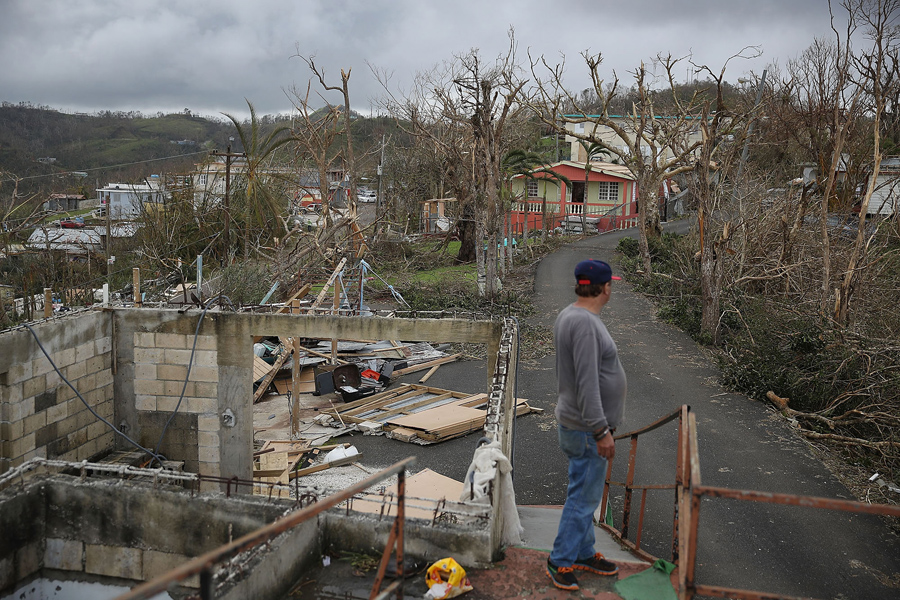
Image result for images of Puerto Rico damageTim Holmes

Truth be told, I didn't even need to read the WaPo account of the latest climate science conference at Katowice, Poland, to know it was abject failure. Oh, the mainstream media did as good a job as they could to 'gussie' up the PR but any non-Mensan could easily read between the lines, e.g. that "the agreement fell well short of the breakthrough that scientists say is needed to avoid the cataclysmic impacts of a warming world" (WaPo, Dec. 15). 

Or, from the WSJ (p. A8, yesterday) that the U.S. -Trump contingent essentially sabotaged the thrust of the talks and the extent of any worthwhile progress, i.e. "The U.S. hosted an event on the sidelines to promote fossil fuels including coal"  and "joined Saudi Arabia to weaken a motion to   introduce a UN report warning of irreversible changes in 12 years if warming isn't limited."

So now,  after 26 years of climate conferences, this is where we are at -  almost at the starting point with precious little to show for all the bloviation and bejabber.  Is it any wonder the hoi polloi in the streets aren't buying in given the extent to which the elites can't agree on which way to solve the  Venusian-style warming planet approaching?

Whether in fact the French discover the Russians are at the root of the recent mass "yellow vest" protests against higher fuel taxes (WSJ, Dec. 15-16, p. A6) , one fact remains:  It is going to be bloody near impossible to get the current crop of Earth's human inhabitants to do a damned thing to control greenhouse warming enough to avoid the oncoming runaway cataclysm.

Again, to reiterate, the worst rioting to hit Paris in years  - including the past fifth consecutive weekend-  was sparked by Emmanuel Macron's proposal to raise fuel taxes to reduce pollution as well as limit the CO2 inputs.  Even as Macron dropped his higher tax proposal in the face of furious public opposition,  see e.g.  Macron scraps fuel tax rise in face of gilets jaunes protests
plans are afoot to recruit public investors (sovereign wealth funds  and government  employee pension systems)  to pitch in with investor money and thereby remove the need for "trillions in new taxes"  across the OECD nations..  But can this really work?

The WSJ's Business & Investing guru James Mackintosh isn't convinced ('Betting on Climate  Change ',  p. B1, Dec. 14), writing in response to Emmanuel Jaclot's comment to the Milken Institute ("It's good for the planet and you end up with a stranded asset otherwise."). Mackintosh countering with:

"However,  surveys  (in western Europe)  showed strong public support for the violent  gilets jaunes protests against higher fuel taxes that brought the country to a halt, forcing the government to scrap the tax increase and raise wages for the low paid."

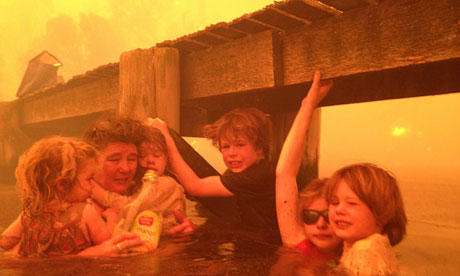
This unwillingness to offer any sacrifice is not just confined to France, but widespread in all the OECD countries.  This applies to the home front as well, where I already noted (Dec. 3rd post)  Janice's stout refusal to yield her independence (via our Buick Encore) one iota.  But obviously if every voter takes this attitude then the worst effects of climate change will soon be upon us, including the runaway greenhouse effect - accompanied by ferocious firestorms, as well as an invasion of tropical pests and diseases the likes of which have never before been seen - or imagined.

Worse, as Mr. Mackintosh notes:

"European voters are resisting changes that are relatively small compared with the wholesale economic transformation needed to avoid drastic climate change."

There is no reason at all to believe this can be changed via public green investment, i.e. using sovereign wealth funds or public pension funds to generate the trillions needed - which can't be raised in taxes.  The reason? ALL investment vehicles - even public green funds- rely on share holders getting something for their investments.  They are not going to plow money in and expect nada in return. Hence, Mackintosh's argument that there is no salvation with any public green funds. I agree totally.  We can't rely on shareholder capitalism but must count on the citizens of the planet to see that a shared sacrifice is required.  We either agree to share in the economic sacrifice or all go down in flames together.

The  resistance of voters to such (admittedly) wrenching economic change indicates to me they are unable to imagine the radical form of earthly Hell that awaits them and their children and grandchildren. This includes massive power grid collapse as millions try desperately to stay cool in weeks of 115-120F high thermature  (high temperature  + humidity) conditions, as well as lack of potable water (which requires power to pump) and disease pandemics - including of cholera and dengue fever.    Do they really want their offspring and grand kids to suffer in such hellish ways,  including parasites infesting their brains?


And Asian longhorned ticks bringing hemorrhagic fever....

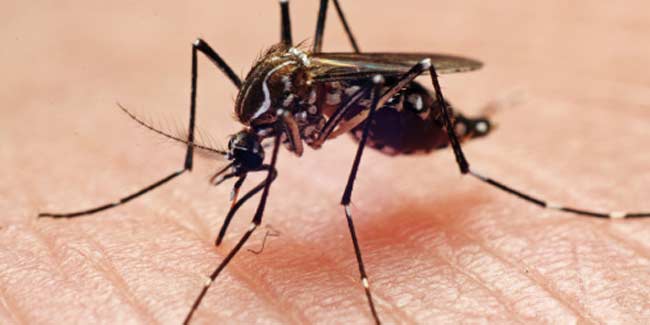
Causing victims to bleed to death via every orifice?  Then there is the dengue fever bearing mosquito,
Image result for bleeding from dengue fever, images

Which can spread dengue hemorrhagic fever, i.e.
Image result for bleeding from dengue fever, images

Do the  planet's adult, car- driving humans really want such atrocities visited upon their descendants? Maybe not. But the refusal to make any economic sacrifice now - even relatively minor as Mr. Mackintosh notes -  is not a sanguine indicator for the future.  Nor is it any indication of even minimal human rationality.  It is almost as if we won't get any positive response from Earth's denizens unless we are able to project images from the future of all their kids and grand kids in the throes of the climate apocalypse which is only barely hinted at thus far.

Ultimately then, one can only conclude that humans - the vast mass of them owning CO2- spewing  automobiles - are in a state of intransigent denial.  Also, there is no conscious connection whatsoever between this denial and the absolute calamity attendant upon it. It is as if the most egregious  CO2 outputs anywhere can be blithely accepted and there will be no payback from the planet.   This evoked the words of a letter writer to The  Sunday Denver Post (p. 3D):

"When an organism becomes sick with infection, its defense is to produce a fever to kill the invading organism. So, too, Earth's rising temperatures will destroy the organism which threatens it. "

Adding:

"Humanity has an uncanny ability to place short -term gain over the long term health of our planet."

I won't quibble over the writer's analogy of  a human body's response to microbial invaders with Earth's response to "invading" humans and their industrial activities. Whatever the flaws, he's nevertheless making as visceral a point as feasible that we continue our greedhead,  exploitative ways at our own peril.  It is clear therefore to me that the core problem in the reluctance to give up fossil fuel impacts, is that capitalism itself has failed to give us any viable alternatives.  There are no affordable solar autos, for example, that can get those French teachers and other workers to their jobs - without bankrupting them.

One can justifiably argue here that -  if at the time of the first (Rio) climate conference back in 1992-  shareholders had pushed companies away from fossil fuel -dependent SUVs and low mileage monstrosities we'd not be having to despair now.   But they didn't do that, so there's no reason to expect they will suddenly push now for "green cars" and new, massive solar energy development. Hell, they aren't even pushing for a nuclear alternative for energy generation - which at least is a step away from the continued fossil fuel generation, see e.g.

http://brane-space.blogspot.com/2016/05/top-climate-scientist-advocates-nuclear.html

Naomi Klein in her book   'This Changes Everything: Capitalism Vs. Climate Change' ,    also showed convincingly why we can't stake the planet's future on any form of capitalism, including the "green" shareholder variety. Basically, capitalism is unable to affect or alter  the course of climate change due to its dependence on fossil fuels and need for continuous growth. Also,  the time for marginal fixes has expired, thus forcing us to now make radical changes in how we live. We simply don't have the luxury of using all the carbon that lies in the Earth. Yet capitalism's never ending growth engine would demand we do so to support the expansion of new markets for exploitation - or what Klein calls "extractivism".  Grabbing every last remaining source of carbon to fuel ever greater growth.

Therein lies the conversion of the Earth as we know it, to another Venus.  And a recipe for the ultimate extinction of the human species with no chance of any "adaptation", e.g.
http://brane-space.blogspot.com/2017/01/climate-change-adaptation-will-be.html

See also:

Ben Ishibashi's picture
Article Tools E-mail | Print Comments (0)


And:


Sam Pizzigati's picture
Article Tools E-mail | Print Comments (0)