Showing posts with label Shaun Marcott. Show all posts

Friday, August 2, 2013

"Hell" is Coming- Can Humans Deal With It?

Tim Holmes
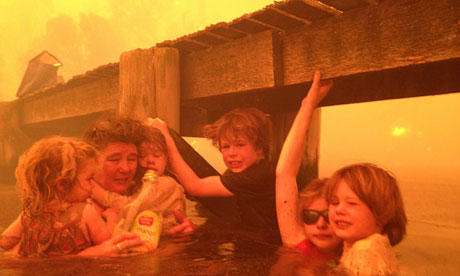
A vision of our future by 2065? Very likely - as well as mass murders, terrorism, wars and mayhem - all from hotter temperatures!


In my March 11 blog post I noted that according to Shaun Marcott, a geologist at Oregon State University:

 "Global temperatures are warmer than about 75 percent of anything we've seen over the last 11,000 years or so."

Now that’s changed, and we learn warming is outpacing anything we’ve seen for the past 65 million years. A report out of Stanford University and published in the journal Science shows the extent to which the rate of climate change is going to wreak havoc and catastrophe on our human world if the projections hold up. (And with fracking and massive release of methane gas on offer in the U.S., the pace of warming will pick up if anything!)


The Stanford  researchers in their paper state that the pace will accelerate to 50 or even 100 times faster than anything we’ve seen before. If this is so, it means we are well under way to experience the dreaded runaway Greenhouse effect.  Scientific American explains:

“They looked at climate events or major transitions that have happened on Earth since the extinction of the dinosaurs. Those include the period when the Earth emerged from an ice age. Temperatures then increased between 3 and 5 degrees Celsius, similar to the amount scientists say is possible with ongoing climate change. But that change happened over about 20,000 years, the scientists said, and not decades as is happening now.”


As if this wasn’t bad enough, another study, this one from the University of Texas and published in the journal Nature, has found that the Antarctic permafrost too is melting at a rate 10 times anything seen before; in the case, in the past 11,000 years. While they don’t attribute the change to increased temperatures (it’s rather “altered weather patterns”) that won’t be much satisfaction to the small islands in the Pacific and elsewhere affected by much higher sea levels on account of the added methane released from the permafrost melt, and the more rapid sea ice melting.


The Stanford team has far less optimism and for good reason: To keep up with current pace of global warming, according to study author Christopher Field, we will need to start adapting on a considerably faster schedule (i.e. maybe get used to no a/c during heat waves since at the pinnacle our power grid won't be able to handle it anyway!). The outlook for mitigating its effects now, in his estimation, is not so good. As he put it:


To hold the temperature increase to about 1.5 degrees, the globe would need to cut its greenhouse gas emissions to zero by 2050, and then have negative emissions, meaning the sum of all human activities is a net removal of CO2 from the atmosphere,”


The problem is that this is about as likely to transpire as our pusillanimous congress finding the balls to halt the NSA surveillance over reach. (Or  equivalently, advanced aliens from Tau Ceti landing to stop the NSA for the good of everyone on the planet.)


The other just exposed aspect to the problem, highlighted in today’s Denver Post, p. 1B, is the finding that as the planet gets warmer and affects humans more, people will get nastier, uglier, more violent. That necessarily means more wars, more terrorists, more insane blow ups and incidents of mass killings, mass murders, serial murders and genocides.  Not to mention more bar fights, more rage driving incidents, more rapes, and more assaults on hapless wives.
 
 
According to lead author Solomon Hsiang at the University of California, Berkeley:
 
When the weather gets bad we tend to be more willing to hurt other people.”
 
Hsiang and his team of researchers analyzed 60 studies on historic collapses of empires, recent wars, crime rates in the U.S. and lab simulations that tested police decisions on when to shoot.  They found that invariably extreme weather- meaning hot – translates to violence.
 
This means that in a world approaching greenhouse runaway we will be confronted with violence at almost every turn. Hsiang’s team actually arrived at a formula that predicts how much risk exists for various types of violence and how these risks should increase with extreme weather.
 
Thus, in war-torn parts of Africa, every added degree Fahrenheit increases the chance of conflict between groups- rebellion, war, civil unrest, by 14 percent. For the U.S. the formula says that for every increase of 5.4 F the likelihood of violent crime increases by 2-4 %.  This is worth noting, since as the Post article on the research notes:

 
“Temperatures in much of North America and Eurasia are likely to go up by 5.4 degrees by about 2065”.(According to a separate paper published Thursday in Science, this is the one from Stanford).

 
The same paper sees temperature increasing 3.6F in the next half-century implying 40-50% more African wars than would be expected without global warming.


Interestingly, the insurance companies and re-insurers – like Munich Re- are already making plans to cope with the upcoming disasters. Meanwhile, morons like Tom Coburn and other yokels continue to yap about “the biggest hoax ever” and bury their heads in the sand.


We can only hope saner, more intelligent heads prevail – but in this country – that’s not a given.


Monday, March 11, 2013

Accelerated Warming is Indeed in Effect

In response to a question on my Mail Brane blog of Feb. 28, I replied that if global warming is accelerating - meaning much higher CO2 concentrations added each year-  there'd higher solar insolation (by about 2 W/m^2 per year) and the date of the first year of no seasons could arrive as early as 2025, if not sooner. Now a new report appears to validate that, and indeed the global temperatures are hotter now than they've been in 4,000 years.

This  research team just published their results in the journal Science, assembling  a record of global temperatures going back to the end of the last ice age — about 11,000 years ago — when mammoths and saber-tooth cats roamed the planet. The study confirms that what we're seeing now is unprecedented and we may well be past the time to do anything effective.

The Science researchers effectively peered into the past. They analyzed ice cores from polar regions that show what temperatures were like over hundreds of thousands of years. However, those only reveal changes only in specific regions; cores aren't so good at depicting what happened to the whole planet. Tree rings give a more global record of temperatures, but only back about 2,000 years.

According to Shaun Marcott, a geologist at Oregon State University:

 "Global temperatures are warmer than about 75 percent of anything we've seen over the last 11,000 years or so."

He adds that the other (optimistic)  way to look at is that  25 percent of the time (since the last ice age), it's been warmer than now.

Given such a relatively  lower proportion of higher temperatures since the previous Ice Age, many people might ask, 'Why worry?' After all, it's been colder for 75% of the time! But Marcott dismisses this given the record shows the alarming rate is unusual and we ought to be worried at this recent trend. As he puts it:

 "It's really the rates of change here that's amazing and atypical. Essentially, it's warming up superfast."

And in fact, my answer in the Mail Brane tried to draw emphasis to the RATE of warming. Indeed, in earlier blogs I also noted that this was critical since a threshold for the runaway Greenhouse Effect could be reached much sooner. This would mean maximum entropy globally, not a favorable prospect.   According to statistical mechanics, the entropy (σ ) is defined according to:

σ = log g

where g denotes the number of accessible states. As that number g increases, so does log g and hence the entropy. When g is maximized for a given system one will say it is in an equilibrium condition and has no further states which can be accessed. Such is the case with a planet  (e.g. Venus) uniformly at 450 C across its surface ....no climate to speak of, no 'cool nights', no variation in temperatures of any significance. The first year of no seasons for Earth would mark our strong trend toward that unsavory end.

Of course, the world will become unbearable long before that. The full horrors incepted, of which the loss of seasons is merely the most distinguishing, will include lack of sufficient water, lack of food - because of the inhospitable conditions to grow crops, and other hostile factors (catastrophic storms with hundreds of F5 tornadoes a year, monster hurricanes, rising sea levels inundating 30% of coastal lands in the U.S. alone).


Back to the Science journal paper, we can ask: What happened after the end of the ice age? What does the 11,000 year record disclose? Well, the planet got warmer, then, 5,000 years ago, it started to get cooler — but slowly. In all, it cooled 1.3 degrees Fahrenheit, up until the last century or so. Then it flipped again — global average temperature shot up. This coincides almost exactly with the kicking in of CO2 atmospheric absorption from the Industrial Revolution. This is verified by a previous 2000-year record of C14:C12 deviations compiled by P.E. Damon ('The Solar Output and Its Variation', The University of Colorado Press, Boulder, 1977)

As John Eddy observes concerning this output (Eddy, The New Solar Physics. p. 17):

The gradual fall from left to right (increasing C14/C12 ratio) is…probably not a solar effect but the result of the known, slow decrease in the strength of the Earth’s magnetic moment exposing the Earth to ever-increased cosmic ray fluxes and increased radiocarbon production.The sharp upward spike at the modern end of the curve, representing a marked drop in relative radiocarbon, is generally attributed to anthropogenic causes—the mark of increased population and the Industrial Age. "

Not surprisingly, the Science authors report:

"Temperatures now have gone from that cold period to the warm period in just 100 years,"

Hence,  it's taken just 100 years for the average temperature to change by 1.3 degrees, when it took 5,000 years to do that before.

The Science  research team tracked temperature by studying chemicals in the shells of tiny, fossilized sea creatures called foraminifera. Their temperature record matches other techniques that look back 2,000 years, which supports the validity of their much longer record.

Climate scientists predict that the current warming will continue, given the amount of greenhouse gases going up into the atmosphere. According to Gavin Schmidt, a climate reseachers at NASA's Goddard Institute for Space Studies:

"The climate changes to come are going to be larger than anything that human civilization and agriculture has seen in its entire existenc. And that is quite a sobering thought."

"Sobering" is perhaps an understatement to describe what's in store for us!