Showing posts with label Natalie Shakhova. Show all posts

Tuesday, March 5, 2019

Can New Permafrost Models Shed Light On The Pace Of Global Warming?


Image may contain: possible text that says 'WebModeling Interface Interface Complex Advanced Geomorphology Visualization Intermediat Model Toolbox Simple Basic Applications Empirical Analy tical Numerica Permafrost Integrated Model Mo Model Model Model Modeling from IMT IMT Toolbox Models Simple Complex'
Figure 1: Component models - of varying complexity - in the "Permafrost Modeling Toolbox" (from EOS, Vol. 100, p. 33)


No photo description available.

Figure 2:  Computation of projected permafrost melting into the 2090s using  CMIP5  to calculate relative steepening of permafrost active layer thickness (from EOS, Vol. 100, p. 33)

When last in Alaska, in March 2005, my wife and I got to see many sights including massive wilderness regions near Mount McKinley ('Denali") as well as immense glaciers in the southern region just below Anchorage. In the latter case, we were shown just how much glaciers had receded in just the last two decades. 
Image result for brane space, dog sledding
On our dog sled trek near Chena Hot Springs, AK.  We had to choose a path where the ice hadn't melted as rapidly as it had in other places.
Image result for brane space, dog sledding
Janice on her snowmobile near the Trans--Alaska pipeline.  Melting permafrost had affected its stability - supports as well.

Meanwhile, during a visit to the Ice Art Exhibit in Fairbanks, several ice towers (including one 150' tall) collapsed due to melting permafrost beneath.  When we visited the Geophysical Institute two days later, we were informed by one atmospheric physicist that "this is just the beginning, wait until homes, downtown buildings are affected."

Eight and a half years later the Nov. 26, 2013  issue of the peer-reviewed journal Nature Geoscience, featured a ground breaking paper by Natalie Shakhova and Igor Semiletov of the University of Alaska- Fairbanks' International Arctic Research Center.  In the paper the authors warned that the Arctic Ocean is releasing methane at a rate more than twice what existing scientific models predicted. The two UAF researchers focused on the continental shelf off the northern coast of eastern Russia - the East Siberian Arctic Shelf. Underlying this region is sub -sea permafrost. When the permafrost melts, the methane (CH4 )  is  released.

In an update (2017)  of their earlier permafrost research,

Current rates and mechanisms of subsea permafrost degradation in ...


The authors actually showed the rate and mechanisms of subsea permafrost degradation and that it is a prerequisite to meaningful predictions of near-future methane (CH4 ) release in the Arctic.  

While the gradual warming of permafrost has been well documented in the Arctic, another  (2017) study published in  Nature Geoscience indicated that a brief period of unusual warmth can cause a rapid shift. Focusing on the polygon ice troughs associated with wedges of ice that thrust deeply into the ground, the study found the ice wedges are quickly melting, amplifying the loss of permafrost by altering the storage and movement of water.  The latter, of course, clearly shows the role of hydrology in permafrost dynamics.

It's an interesting kind of  paradox:  Climate change is currently thawing  vast expanses of Arctic permafrost, and the effect is to release methane - an even more potent greenhouse gas than CO2. The released CH4 then goes into the atmosphere to accelerate climate change, further thawing permafrost  and activating more methane release. 

This is all serious research given that permafrost is hundreds of meters deep in many places and has been frozen for millennia.  It covers approximately  24 percent of the Arctic and stores nearly 1,700 gigatons of organic carbon, far greater than the amount of carbon already in the atmosphere.

Ice-wedge degradation has been observed before, but this is the first study to determine that rapid melting of ground ice  (as opposed tp sub-sea permafrost) has become widespread throughout the Arctic. The research team predicts that the melting—already occurring at sub-decadal timescales—will expand and intensify across the region, and this could escalate global warming and create more feedbacks. 

 All of which strongly demonstrates the need for more powerful, and accurate models of permafrost thawing, especially which show the various ways it thaws. 

 Currently, the ways that permafrost thaws is being investigated on multiple fronts given it is is interwoven with hydrological and geomorphological processes and how carbon and toxic heavy metals spread throughout the thawing Arctic.  To be sure, we need more refined models and approaches given there remain are sweeping, yet unanswered, research questions..

For example, the thawing ground below creates unique geomorphic patterns: drooling solifluction lobes that form when wet soil oozes downhill, giraffe skin polygons formed by ice wedges filling the cracks in freeze-shrunken soil, thaw lakes and seasonal wetlands, and melting coastal bluffs.

Permafrost thaw contributes to the global hydrological and carbon cycles, but it also has a significant impact on roads, housing, and coastal infrastructure. This impact is predicted to create a multibillion-dollar infrastructure maintenance problem for Alaska over the span of the 21st century
To fix ideas first with basics, permafrost refers to ground that stays at or below 0°C for 2 or more years—can be found under 24% of the Northern Hemisphere’s land surface [Zhang et al., 1999]. The frozen subsurface profoundly influences the hydrological cycle of the Arctic region.

To address the issue of more refined models, climate scientists at the University of Colorado- Boulder   have developed online, easily accessible permafrost process models for use by scientists and educators.  This has been through the Community Surface Dynamics Modeling System (CSDMS) or the Permafrost Modeling Toolbox. (See Fig. 1)


The UC climate scientsts' "toolbox"  includes three permafrost models of increasing complexity, all driven by local climate forcing, to meet a variety of needs:


  • An empirical model, the Air Frost Number model [Nelson and Outcalt, 1987] predicts the likelihood of permafrost occurring at a given location.
  • An analytical-empirical model, the Kudryavtsev model [Anisimov et al., 1997] provides an exact solution to thermodynamic equations accounting for snow, vegetation, and soil to calculate active layer thickness, the average annual thaw depth.
  • A numerical heat flow model, the Geophysical Institute Permafrost Lab (GIPL) model [Jafarov et al., 2012] includes the latent heat effects in the active layer zone. This model divides a vertical profile into multiple layers of soil and substrate with different thermal properties, and it calculates temperature profiles with depth.

The first two models are developed as “components” that can be coupled to other CSDMS models. The GIPL model functions as a stand-alone code, and it will be fully embedded into the CSDMS model coupling framework at a later date. All three models are inherently one-dimensional; that is, they calculate the thermal state over time for a single vertical column, but they do not calculate heat exchange among columns. However, each model can run regional simulations or even be implemented for the entire Arctic region.
The current project pairs these models with preassembled data sets of input parameters. Casual model users can then quickly run experiments for selected time series and given regions. Data sets include long-term climatological and permafrost observations in coastal and interior Alaska (Barrow and Fairbanks, respectively), as measured at Circumpolar Active Layer Monitoring Network (CALM) and U.S. Geological Survey stations

Access to data and models together allows users to compare model output with in situ observations directly. Additionally, a regional climatological data set comprising observed monthly temperature and precipitation data for the 20th century is available to drive the models for Alaska. 

To explore future trends in permafrost, another data set comprises parameters of the Coupled Model Intercomparison Project Phase 5 (CMIP5) modeled climate data until 2100, specifically applied to the known permafrost zone.  (See Fig. 2)

Applications of the permafrost toolbox include calculating permafrost for real-world sites in the Arctic region, looking at warming trends over the past century, making maps of future permafrost, and comparing models with different complexities.

Figure 2 shows one such example: Calculations of the current and future active layer thickness over the entire Arctic region demonstrate a considerable deepening of this critical seasonal layer. This experiment is relatively straightforward to perform using the Web-based modeling tool.

Can such tools help us learn enough about  the physical processes of permafrost dynamics. Four hands-on modeling labs are already available for new users. This material is accessible for teaching use, and the online labs include instructions for classroom use and undergraduate lesson plans.  

Nevertheless, we need advances on multiple research fronts, in particular reconciling the different existing permafrost thawing models, i.e. between the UC-Boulder thawing model and the UAF model of Shakhova and Semiletov.  Special attention needs to be paid to the projections of permafrost thawing (Fig. 2) and the degree to which these vary model to model.  If in fact similar rapid permafrost melting is found to be consistent between differing models, we need to be much more concerned about accelerated global warming - and its consequences.

 In the meantime, the UC breakthrough (published in Eos, op. cit.) is a good, solid start.

Thursday, September 13, 2018

Trump's EPA Wants To Repeal Methane Release Rules To Allow More: Look For Cat 6 Hurricanes, Searing Heat And Choking Air Pollution


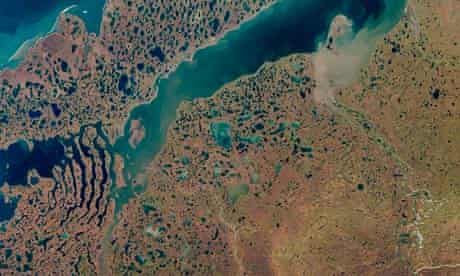
Arctic Permafrost melting in Liverpool Bay in Canada’s Northwest Territories
Two sides of the methane release problem: Left - Methane gas flaring from a pit in Bakken oil field. Right: Satellite image of melting permafrost near  Liverpool Bay, Canada.

Even as monster Hurricane Florence bears down on the Carolina coast and has millions fleeing inland, decisions by the Trumpie EPA could see even larger 'canes spawned by the end of the century. Are we talking category 5? Hell no! We are talking category 6.  Though there's still some debate on where the wind speed limit of hurricanes generated by warmer ocean waters lies, one specialist based at NASA's Goddard Institute for Space studies clearly leaves the door open for a higher category.

Timothy Hall, senior scientist at Goddard, quoted in a news release from July, said that top wind speeds of up to 230 miles per hour could well occur by the end of the century, if current global warming trends continue.  (For perspective, that would be equivalent to the strength of an F4 tornado but now spread across hundreds of square miles).

Let us put it this way: IF natural and human -spawned release of methane gas is in the offing, that calamitous trend to the Cat 6  'cane - not to mention the runaway greenhouse - will certainly continue.

Now, down to cases!

Recall in a  May 9, 2017 post I cited the Nov. 26, 2013  issue of the peer-reviewed journal Nature Geoscience, in which the authors warned of the Arctic Ocean's release of  methane at a rate more than twice what existing scientific models predicted.  Natalie Shakhova and Igor Semiletov at the University of Alaska- Fairbanks' International Arctic Research Center (IARC)  - after a decade spent researching the Arctic's greenhouse gas emissions- found this unexpected result.

Shakhova, the lead author of the report, in an interview post-publication with The Fairbanks News Miner, warned the methane release rate was likely even greater than their paper described.  She said:

" We decided to be as conservative as possible. We’re actually talking the top of the iceberg.” 


The two UAF researchers focused on the continental shelf off the northern coast of eastern Russia - the East Siberian Arctic Shelf. Underlying this region is sub -sea permafrost. When the permafrost melts, the methane is  released. For example, the submerged East Siberian Arctic Shelf contains much of the same stored carbon as the dry tundra to the south but also at least 17 teragrams of methane. (One teragram is equal to one million tons). 

As if the teragrams  of CH4 released from the melting permafrost aren't enough we're now faced with even higher release thanks to a process of deliberate methane burn off.    This is a result of the decision by the Trump cabal to allow flaring of methane associated with fossil fuel excavation.  (Methane, which is among the most powerful greenhouse gases, routinely leaks from oil and gas wells, and energy companies have long said that the rules requiring them to test for emissions were costly and burdensome.)

The Environmental Protection Agency, perhaps as soon as this week, plans to make public a proposal to weaken yet another an Obama-era requirement: one that mandates that companies monitor and repair methane leaks.. This was according to documents reviewed by The New York Times. In a related move, the Interior Department is also expected in coming days to release its final version of a draft rule, proposed in February, that essentially repeals a restriction on the intentional venting and “flaring,” or burning, of methane from drilling operations.

The new rules follow two regulatory rollbacks this year that, taken together, represent the foundation of the United States’ effort to rein in global warming. In July, the E.P.A. proposed weakening a rule on carbon dioxide pollution from vehicle tailpipes. And in August, the agency proposed replacing the rule on carbon dioxide pollution from coal-fired power plants with a weaker one that would allow far more global-warming emissions to flow unchecked from the nation’s smokestacks.

In the words of Janet McCabe, the E.P.A.’s top climate and clean-air regulator in the Obama administration.:

"They’re taking them down, one by one,” 

For the fossil fuelers, of course, jubilation reigns or something close to it. Kathleen Sgamma, president of the Western Energy Alliance, an association of independent oil and gas companies based in Denver, spun it thusly:  "The Obama-era E.P.A. methane rule was the definition of red tape. It was a record-keeping nightmare that was technically impossible to execute in the field.”

In actual fact, this is a disgusting dodge and also an admission of colossal inefficiency given the fossil fuel energy sector appears more open to wasting product than harnessing it.   As noted in a  recently published paper in the journal Science, methane emissions from domestic oil and gas operations reached 2.3 percent of total production last year. Not much you say?   Well, it's 60 percent higher than current estimates from the EPA and it translates into an estimated 13 million tons of natural gas lost - or enough to fuel 10 million homes.

Try to process that. And while you're at it, that all this lost methane instead went directly into the atmosphere to add to the already powerful CO2 driven greenhouse effect.  Let's quantify that for you: The EPA conceded with its proposal Tuesday that easing the rule for methane leaks would put as ,much as 380,000 additional tons of methane into the atmosphere from 2019 to 2025. This added amount would be equivalent to 30 million tons of  CO2 - given methane's much higher forcing factor.

The new Science study is based is the culmination of five years of research to determine the effects of methane leakage and its effect on climate. Leaks themselves can occur at many places along the natural gas supply chain, including poorly maintained pipes, seals and storage tanks - and even certain equipment that emits gas by design- including outmoded pneumatic devices.

To read more about the paper's findings go to:

Oil and Gas Facilities Leak More Methane Than ... - Scientific American

Does  Ms. Sgamma given a damn about such criminal waste? No. Instead she praised the Trump administration for turning the oil companies’ requests into policy, i.e. formalizing the gross inefficiency, while  noting that the Obama administration frequently turned proposals from environmental groups into policy.   She had the audacity to blab:

It all depends on who you trust.  That administration trusted environmentalists. This one trusts industry.”

Yeppers. Trust industry to continue wasting 13 million tons of methane ($2 b worth)  each year, enough to heat 10 million homes. Instead, shooting it into the atmosphere to hasten our global warming demise. Brilliant! But what would one expect from the Trumpite degenerates, who don't give two craps if your grandkids thirty years from now are choking on the polluted air - as they roast from the heat.(The paper's findings also showed air quality will plummet).

 The regulation of methane, while not as widely discussed as emissions from cars and coal plants, was nonetheless a major component of Mr. Obama’s efforts to combat climate change. Methane makes up only about nine percent of greenhouse gases, but it is around 25 times more effective than carbon dioxide in trapping heat in the atmosphere. About one-third of methane pollution is estimated to come from oil and gas operations.

The forthcoming proposals from the E.P.A. and Interior Department would allow far more methane to leak from oil and gas drilling operations, environmentalists say.   In the words of Matt Watson, a specialist in methane pollution:  “These leaks can pop up any time, anywhere, up and down the oil and gas supply chain,The longer you go in between inspections, the longer leaks will go undetected and unrepaired.”

The planned EPA regression on methane exemplifies Trump’s policy quest to roll back regulations on businesses, particularly oil, gas and coal companies. Translated that means rolling back protections for we the people regulations ARE protections. While some might cheer the sound of the word "deregulation" or mentally conjure up images of freedom and personal liberty, they are more brainwashed than accurate. As economist George Lakoff has pointed out, e.g.


Deregulation then, means the abolition or elimination of  citizen health protections to make way for higher corporate profits. In other words, embracing proposals and policies that enable tapeworm larvae to proliferate in our pork chops, salmonella and rat feces to contaminate  eggs, and allow bits of cockroach antennae and leg bristles to get into your milk - oh, while  your water is allowed to contain carcinogenic chemicals like atrazine and perchlorates.

Even more reasons we need to surgically remove the pestilence known as Trump from the nation's body and body politic!  In the meantime, recapturing House and Senate to prevent any further enabling of his planetary destruction agenda!

See also:

Trump Lights the Fuse on a Deadly Methane Bomb

Monday, March 13, 2017

More Rapid Permafrost Melting Triggers Emergency Climate Alarms

Arctic Permafrost melting in Liverpool Bay in Canada’s Northwest Territories
Satellite image of permafrost melting near Liverpool Bay, Canada

Recall two years ago (May 9) I referenced the much more rapid release of methane gas from the Arctic. I cited the Nov. 26, 2013  issue of the peer-reviewed journal Nature Geoscience, in which the authors warned of the Arctic Ocean's release of  methane at a rate more than twice what existing scientific models predicted.  Natalie Shakhova and Igor Semiletov at the University of Alaska- Fairbanks' International Arctic Research Center - after a decade spent researching the Arctic's greenhouse gas emissions- found this unexpected result.

Shakhova, the lead author of the report, in an interview post-publication with The Fairbanks News Miner, warned the methane release rate was likely even greater than their paper described.  She said:

" We decided to be as conservative as possible. We’re actually talking the top of the iceberg.” 


The two UAF researchers focused on the continental shelf off the northern coast of eastern Russia - the East Siberian Arctic Shelf. Underlying this region is sub -sea permafrost. When the permafrost melts, the methane is  released. For example, the submerged East Siberian Arctic Shelf contains much of the same stored carbon as the dry tundra to the south but also at least 17 teragrams of methane. (One teragram is equal to one million tons). 

The vast carbon stores in the Arctic are also protected by the layer of sub-sea permafrost, but the new research shows it's in danger of disappearing.   Core samples taken of the sub-sea permafrost by  Shakhova et al show now the temperatures are near the freezing mark (30-32F)  Meanwhile, both the top and lower levels of sediment have already thawed. (Some climate modelers had previously suggested this wouldn't happen for five to seven thousand years.)

Now, a new study of permafrost has found that the ice wedges forming the prevalent honeycomb pattern across the tundra appear to be melting rapidly across the Arctic, changing the hydrology of the region and accelerating the release of greenhouse gases with major implications for global warming. As I noted in previous posts, the main gas released in permafrost melting is methane, which traps 25 times more atmospheric heat than carbon dioxide does on a 100-year timescale. Hence, any significantly increased release of methane is serious cause for concern. Especially as one JPL scientist (quoted on a recent episode, #3, of HBO's 'VICE' ) asserted that in a worst case scenario (i.e. we can't slow the melting) the temperature could increase 8-10 F. Given  6 C (9.6F) is approaching the threshold for the runaway greenhouse, this is critical.

While the gradual warming of permafrost has been well documented in the Arctic, this most recent  study published in  Nature Geoscience indicates that a brief period of unusual warmth can cause a rapid shift. Focusing on the polygon ice troughs associated with wedges of ice that thrust deeply into the ground, the study found the ice wedges are quickly melting, amplifying the loss of permafrost by altering the storage and movement of water.   According to Cathy Wilson, a geomorphologist with Los Alamos National Laboratory (Earth and Environmental Sciences Division), who coauthored the paper:

The unique structure of ice wedge polygon landscapes promotes ponding of water and the accumulation of vast stores of soil carbon as wetland vegetation dies off seasonally and is buried and frozen over thousands of years, When ice wedges melt, the land surface collapses to form ‘thermokarsts’—lands dominated by irregular marshy hollows and small hummocks. These thermokarsts dramatically change hydrology by either creating a lot of new ponds, which absorb heat and increase thawing of the tundra, or draining and drying polygon ponds by connecting them into a continuous drainage network.”

Permafrost is hundreds of meters deep in many places and has been frozen for millennia.  It covers nearly 24 percent of the Arctic and stores nearly 1,700 gigatons of organic carbon, far greater than the amount of carbon already in the atmosphere. Permafrost has been thawing in recent decades and releasing greenhouse gases. Wilson and other Los Alamos scientists have been working to understand how changes in permafrost hydrology might alter the Arctic carbon cycle, including the possibility of a large-scale greenhouse gas release from thawing permafrost.

Ice-wedge degradation has been observed before, but this is the first study to determine that rapid melting of ground ice  (as opposed tp sub-sea permafrost) has become widespread throughout the Arctic. The research team predicts that the melting—already occurring at sub-decadal timescales—will expand and intensify across the region, and this could escalate global warming and create more feedbacks.

Wilson explains:

When permafrost thaws, microbes get active and start decomposing the carbon in the soil. This generates greenhouse gases. We want to know how much gas will be produced, how fast it will be released from the soil, and if it will be methane or carbon dioxide. Hydrology is critical, because more thermokarst ponds result in more methane, but more drained land results in more carbon dioxide.”

The international team combined observations about the types of ice wedge polygons and how they changed over time across the Arctic, where the team was already performing various permafrost studies. According to the paper, although these regions contain “cold permafrost,” with an overall average temperature of about minus-14 degrees Celsius, surface thawing still occurred at all of the 10 study sites across Alaska, Canada, and Russia. According to Anna Liljedahl, a researcher from the University of Alaska Fairbanks and the paper’s lead author:

It’s really the tipping point for the hydrology. Suddenly you’re draining the landscape and creating more runoff even if the amount of precipitation remains the same. Instead of being absorbed by the tundra, the snowmelt water will run off into lakes and larger rivers. It really is a dramatic hydrologic change across the tundra landscape.”

At the studied sites, ice wedge degradation occurred in less than a decade. In some cases, a single unusually warm summer was enough to cause over 10 centimeters of surface subsidence.
The team’s synthesis of field observations, remote sensing, and hydrologic modeling documents trough formation (from melt and subsequent water movement) across the Arctic continuous-permafrost domain.  As Wilson noted:

Change is happening so fast. I never thought I’d see thermokarst occur over the course of a few years at our field site. It’s pretty exciting, but scary too. Even though the goal of the Los Alamos research is to improve the representation of permafrost hydrology in coupled climate models, I hope these findings will immediately help the general public and policy makers understand just how vulnerable the Arctic is to climate change.”

It's crucial to point out that even the slow emission of a much smaller proportion of the vast quantities of methane locked up in the Arctic permafrost and offshore waters could trigger catastrophic climate change and "steep" economic losses, they say.  By "catastrophic" I mean ushering in the runaway greenhouse effect, which will arguably usher in the most devastating event since the Chicxulub  asteroid impact that eliminated the dinosaurs 65 million years ago,  In this case, humans stand to be eliminated in prolonged unbearable heat that will make most wish for death.

Back in September of 2012, I pointed out that Arctic sea ice largely melts and reforms each year, but is declining at an unprecedented rate. In 2012, it collapsed to under 3.5m sqkm by mid September, just 40% of its usual extent in the 1970s. Because the ice is also losing its thickness, some scientists expect the Arctic ocean to be largely free of summer ice by 2020.

The growing fear now is that as the ice retreats, the warming of the sea water will allow offshore permafrost to release ever greater quantities of methane. A giant reservoir of the greenhouse gas, in the form of gas hydrates on the East Siberian Arctic Shelf (ESAS), could be emitted, either slowly over 50 years or catastrophically fast over a shorter time frame, say the researchers.

The ramifications of vanishing ice will also be felt far from the poles, they say because the region is pivotal to the functioning of Earth systems, such as oceans and climate.   According to Prof Peter Wadhams, head of the Polar ocean physics group at Cambridge University and one of the authors of the paper published in the journal Nature.:

"The imminent disappearance of the summer sea ice in the Arctic will have enormous implications for both the acceleration of climate change, and the release of methane from off-shore waters which are now able to warm up in the summer,"

He added:

"This massive methane boost will have major implications for global economies and societies. Much of those costs would be borne by developing countries in the form of extreme weather, flooding and impacts on health and agricultural production,"

According to the authors, who calculated that 80% of the extra impacts by value will occur in the poorer economies of Africa, Asia and South America:

"Inundation of low-lying areas, extreme heat stress, droughts and storms are all magnified by the extra methane emissions,"

They argue that global economic organizations  (as well as national leaders, like Trump) have not taken into account the risks of rapid ice melt. These myopic interests believe that the only economic downside to the warming of the Arctic is the possible risk of oil spills.. On the risk scale of 1 to 10, that is like a 0.5 where effects of rapid permafrost melt is nearly a 10.   Enclaves of market fundamentalism, like the U.S. now under Trump, have no remote idea how they are putting their own and the global populace at grave risk. But why would they when the only fare Trump reads, for example, is comics.

As the authors point out:

"Neither the World Economic Forum nor the International Monetary Fund currently recognizes the economic danger of Arctic change."

Why not? Because, as Naomi Klein has eloquently put it in her book, This Changes Everything: Capitalism Vs. Climate Change. capitalism is unable to affect or alter  the course of climate change due to its dependence on fossil fuels and need for continuous growth. As de facto agents of global capitalism, the WEF and IMF would therefore have minimal interest in accepting the extreme dangers of rapid climate change.

 Instead of humping and hyping an Arctic "all year  transport route", they ought to be paying much more attention to the largely unseen time-bomb set to blow the planet into a permanent burn. The impacts of just one giant "pulse" of methane "approaches the $70-tn value of the world economy in 2012", said Prof Gail Whiteman, at the Rotterdam School of Management and another author.

The new reports come as Scott Pruitt and the Trumpies are implementing plans to keep the fossil fuels pouring out of land and sea, ensuring the CO2 concentrations will ramp up heating and release the methane from the melting permafrost.  It is absolutely the wrong time to drill any more petroleum in any form from the ground - and as the JPL specialist quoted on 'VICE' put it: "it will mainly be our grandchildren who suffer the most". 

See also:

http://www.salon.com/2017/03/15/carbon-dioxide-is-rising-at-record-rates_partner/