Showing posts with label methane. Show all posts

Tuesday, March 5, 2019

Can New Permafrost Models Shed Light On The Pace Of Global Warming?


Image may contain: possible text that says 'WebModeling Interface Interface Complex Advanced Geomorphology Visualization Intermediat Model Toolbox Simple Basic Applications Empirical Analy tical Numerica Permafrost Integrated Model Mo Model Model Model Modeling from IMT IMT Toolbox Models Simple Complex'
Figure 1: Component models - of varying complexity - in the "Permafrost Modeling Toolbox" (from EOS, Vol. 100, p. 33)


No photo description available.

Figure 2:  Computation of projected permafrost melting into the 2090s using  CMIP5  to calculate relative steepening of permafrost active layer thickness (from EOS, Vol. 100, p. 33)

When last in Alaska, in March 2005, my wife and I got to see many sights including massive wilderness regions near Mount McKinley ('Denali") as well as immense glaciers in the southern region just below Anchorage. In the latter case, we were shown just how much glaciers had receded in just the last two decades. 
Image result for brane space, dog sledding
On our dog sled trek near Chena Hot Springs, AK.  We had to choose a path where the ice hadn't melted as rapidly as it had in other places.
Image result for brane space, dog sledding
Janice on her snowmobile near the Trans--Alaska pipeline.  Melting permafrost had affected its stability - supports as well.

Meanwhile, during a visit to the Ice Art Exhibit in Fairbanks, several ice towers (including one 150' tall) collapsed due to melting permafrost beneath.  When we visited the Geophysical Institute two days later, we were informed by one atmospheric physicist that "this is just the beginning, wait until homes, downtown buildings are affected."

Eight and a half years later the Nov. 26, 2013  issue of the peer-reviewed journal Nature Geoscience, featured a ground breaking paper by Natalie Shakhova and Igor Semiletov of the University of Alaska- Fairbanks' International Arctic Research Center.  In the paper the authors warned that the Arctic Ocean is releasing methane at a rate more than twice what existing scientific models predicted. The two UAF researchers focused on the continental shelf off the northern coast of eastern Russia - the East Siberian Arctic Shelf. Underlying this region is sub -sea permafrost. When the permafrost melts, the methane (CH4 )  is  released.

In an update (2017)  of their earlier permafrost research,

Current rates and mechanisms of subsea permafrost degradation in ...


The authors actually showed the rate and mechanisms of subsea permafrost degradation and that it is a prerequisite to meaningful predictions of near-future methane (CH4 ) release in the Arctic.  

While the gradual warming of permafrost has been well documented in the Arctic, another  (2017) study published in  Nature Geoscience indicated that a brief period of unusual warmth can cause a rapid shift. Focusing on the polygon ice troughs associated with wedges of ice that thrust deeply into the ground, the study found the ice wedges are quickly melting, amplifying the loss of permafrost by altering the storage and movement of water.  The latter, of course, clearly shows the role of hydrology in permafrost dynamics.

It's an interesting kind of  paradox:  Climate change is currently thawing  vast expanses of Arctic permafrost, and the effect is to release methane - an even more potent greenhouse gas than CO2. The released CH4 then goes into the atmosphere to accelerate climate change, further thawing permafrost  and activating more methane release. 

This is all serious research given that permafrost is hundreds of meters deep in many places and has been frozen for millennia.  It covers approximately  24 percent of the Arctic and stores nearly 1,700 gigatons of organic carbon, far greater than the amount of carbon already in the atmosphere.

Ice-wedge degradation has been observed before, but this is the first study to determine that rapid melting of ground ice  (as opposed tp sub-sea permafrost) has become widespread throughout the Arctic. The research team predicts that the melting—already occurring at sub-decadal timescales—will expand and intensify across the region, and this could escalate global warming and create more feedbacks. 

 All of which strongly demonstrates the need for more powerful, and accurate models of permafrost thawing, especially which show the various ways it thaws. 

 Currently, the ways that permafrost thaws is being investigated on multiple fronts given it is is interwoven with hydrological and geomorphological processes and how carbon and toxic heavy metals spread throughout the thawing Arctic.  To be sure, we need more refined models and approaches given there remain are sweeping, yet unanswered, research questions..

For example, the thawing ground below creates unique geomorphic patterns: drooling solifluction lobes that form when wet soil oozes downhill, giraffe skin polygons formed by ice wedges filling the cracks in freeze-shrunken soil, thaw lakes and seasonal wetlands, and melting coastal bluffs.

Permafrost thaw contributes to the global hydrological and carbon cycles, but it also has a significant impact on roads, housing, and coastal infrastructure. This impact is predicted to create a multibillion-dollar infrastructure maintenance problem for Alaska over the span of the 21st century
To fix ideas first with basics, permafrost refers to ground that stays at or below 0°C for 2 or more years—can be found under 24% of the Northern Hemisphere’s land surface [Zhang et al., 1999]. The frozen subsurface profoundly influences the hydrological cycle of the Arctic region.

To address the issue of more refined models, climate scientists at the University of Colorado- Boulder   have developed online, easily accessible permafrost process models for use by scientists and educators.  This has been through the Community Surface Dynamics Modeling System (CSDMS) or the Permafrost Modeling Toolbox. (See Fig. 1)


The UC climate scientsts' "toolbox"  includes three permafrost models of increasing complexity, all driven by local climate forcing, to meet a variety of needs:


  • An empirical model, the Air Frost Number model [Nelson and Outcalt, 1987] predicts the likelihood of permafrost occurring at a given location.
  • An analytical-empirical model, the Kudryavtsev model [Anisimov et al., 1997] provides an exact solution to thermodynamic equations accounting for snow, vegetation, and soil to calculate active layer thickness, the average annual thaw depth.
  • A numerical heat flow model, the Geophysical Institute Permafrost Lab (GIPL) model [Jafarov et al., 2012] includes the latent heat effects in the active layer zone. This model divides a vertical profile into multiple layers of soil and substrate with different thermal properties, and it calculates temperature profiles with depth.

The first two models are developed as “components” that can be coupled to other CSDMS models. The GIPL model functions as a stand-alone code, and it will be fully embedded into the CSDMS model coupling framework at a later date. All three models are inherently one-dimensional; that is, they calculate the thermal state over time for a single vertical column, but they do not calculate heat exchange among columns. However, each model can run regional simulations or even be implemented for the entire Arctic region.
The current project pairs these models with preassembled data sets of input parameters. Casual model users can then quickly run experiments for selected time series and given regions. Data sets include long-term climatological and permafrost observations in coastal and interior Alaska (Barrow and Fairbanks, respectively), as measured at Circumpolar Active Layer Monitoring Network (CALM) and U.S. Geological Survey stations

Access to data and models together allows users to compare model output with in situ observations directly. Additionally, a regional climatological data set comprising observed monthly temperature and precipitation data for the 20th century is available to drive the models for Alaska. 

To explore future trends in permafrost, another data set comprises parameters of the Coupled Model Intercomparison Project Phase 5 (CMIP5) modeled climate data until 2100, specifically applied to the known permafrost zone.  (See Fig. 2)

Applications of the permafrost toolbox include calculating permafrost for real-world sites in the Arctic region, looking at warming trends over the past century, making maps of future permafrost, and comparing models with different complexities.

Figure 2 shows one such example: Calculations of the current and future active layer thickness over the entire Arctic region demonstrate a considerable deepening of this critical seasonal layer. This experiment is relatively straightforward to perform using the Web-based modeling tool.

Can such tools help us learn enough about  the physical processes of permafrost dynamics. Four hands-on modeling labs are already available for new users. This material is accessible for teaching use, and the online labs include instructions for classroom use and undergraduate lesson plans.  

Nevertheless, we need advances on multiple research fronts, in particular reconciling the different existing permafrost thawing models, i.e. between the UC-Boulder thawing model and the UAF model of Shakhova and Semiletov.  Special attention needs to be paid to the projections of permafrost thawing (Fig. 2) and the degree to which these vary model to model.  If in fact similar rapid permafrost melting is found to be consistent between differing models, we need to be much more concerned about accelerated global warming - and its consequences.

 In the meantime, the UC breakthrough (published in Eos, op. cit.) is a good, solid start.

Wednesday, January 2, 2019

2019 Forecasts: Climate Change Becomes Unstoppable; Trump Is Impeached, Indicted, Resigns


Forecasting future events is always a dicey proposition but I feel fairly confident regarding those predictions I make below for 2019.  Let me say only one thing here: those of us facing this new year had better buckle our safety belts as it will be even more tumultuous than 2018.   So, without further ado, let's proceed:

1) Climate Change Becomes Unstoppable.

One item that we need to get clear concerns the threshold for climate change becoming "unstoppable".  This is not, as many suppose, that the putative CO2 concentration limit is reached, estimated at 600 ppm by Prof. Gunter Weller, formerly of the Geophysical Institute in Fairbanks, AK.   The reason is that climate change acceleration is not based merely on release of CO2, but also  on another much more powerful greenhouse gas, methane.

For specific reference, a 2017  study of permafrost found that the ice wedges forming the prevalent honeycomb pattern across the tundra appear to be melting rapidly across the Arctic, changing the hydrology of the region and accelerating the release of  methane with major implications for global warming. As I noted in previous posts, the main gas released with melting  permafrost is methane, which traps 25 times more atmospheric heat than carbon dioxide does on a 100-year timescale. Hence, any significantly increased release of methane is serious cause for concern.

While the gradual warming of permafrost has been well documented in the Arctic, this  study published in  Nature Geoscience indicates that a brief period of unusual warmth can cause a rapid shift. Focusing on the polygon ice troughs associated with wedges of ice that thrust deeply into the ground, the study found the ice wedges are quickly melting, amplifying the loss of permafrost by altering the storage and movement of water.   According to Cathy Wilson, a geomorphologist with Los Alamos National Laboratory (Earth and Environmental Sciences Division), who coauthored the paper:

“The unique structure of ice wedge polygon landscapes promotes ponding of water and the accumulation of vast stores of soil carbon as wetland vegetation dies off seasonally and is buried and frozen over thousands of years, When ice wedges melt, the land surface collapses to form ‘thermokarsts’—lands dominated by irregular marshy hollows and small hummocks. These thermokarsts dramatically change hydrology by either creating a lot of new ponds, which absorb heat and increase thawing of the tundra, or draining and drying polygon ponds by connecting them into a continuous drainage network.”

Permafrost is hundreds of meters deep in many places and has been frozen for millennia.  It covers nearly 24 percent of the Arctic and stores nearly 1,700 gigatons of organic carbon, far greater than the amount of carbon already in the atmosphere. Permafrost has been thawing in recent decades and releasing greenhouse gases.


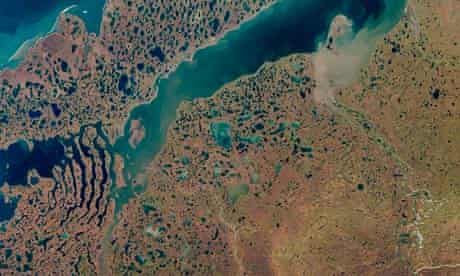
Arctic Permafrost melting in Liverpool Bay in Canada’s Northwest TerritoriesSatellite image of permafrost melting near Liverpool Bay, Canada


My forecast here is based on the more rapid release of permafrost, combined with the failure to take critical  CO2 feedback mechanisms into account,  as noted by The Bulletin of the Atomic Scientists,  e.g.

Climate report understates threat

Excerpt:

"So far, average temperatures have risen by one degree Celsius. Adding 50 percent more warming to reach 1.5 degrees won’t simply increase impacts by the same percentage—bad as that would be. Instead, it risks setting up feedbacks that could fall like dangerous dominoes, fundamentally destabilizing the planet. This is analyzed in a recent
study showing that the window to prevent runaway climate change and a “hot house” super-heated planet is closing much faster than previously understood."


 These in conjunction with Trump's EPA now punting on the climate change mission,   e.g.

http://brane-space.blogspot.com/2018/09/cat-6-hurricanes-searing-heat-and.html


leads me to believe time has run out. It will run out this year in terms of the latitude for options to stymie or slow climate change, making its onset unstoppable.  In effect, whatever few pathetic policies humans make will be too little and too late.  As if the teragrams of methane released by melting permafrost weren't enough, we will now also  have to contend with additional teragrams released by additional methane burn off - owing to a decision by Trump's EPA. 

In this context it is also important to process the limitations of trying to "adapt" as some popeyed purveyors of  Climate change Pollyannism have pushed. The reason - evident to anyone who's taken a college (or even high school) biology course - is that the human body can't tolerate excessive heat.  The biological and chemical processes that keep us alive are set to a narrow band of 96.8 to 98. 6F.   Beyond that, the human body's response to excess heat is to try to get rid of it. The problem is that as the warming of the planet reaches critical levels this will be all but impossible as cooling becomes impossible. Ask the people of Puerto Rico after Hurricane Maria took out their power grid.  Now, consider the demand on our continental U.S. grids reaching enormous proportions as we see heatwaves lasting weeks or months.  The sad fact, the available power supply will be too little to meet demand.

2) Trump Is Impeached, Indicted, Then Resigns

Readers here may wish to recall  that Michael Cohen's perjury didn't end with his lies and omissions to the SDNY.  Indeed,   Cohen previously pleaded guilty to lying to Congress about Trump’s plans to develop a building in Russia. He admitted the project continued well into Trump’s campaign for the presidency – contradicting Trump’s account – and that Cohen spoke with a Kremlin official about securing Russian government support.


In other words, we have direct evidence of a devious and nefarious synergy between Trump and the Russkies,  that permeated the Trump campaign.  Let's clear the air here and state emphatically that Trump is guilty of at least two felonies and hence two impeachable offenses.   This take is resoundingly confirmed by Neal Katyal former Acting Solicitor General in the Obama Justice Dept. see e.g.

https://www.msnbc.com/all-in/watch/neal-katyal-this-is-the-beginning-of-the-end-for-trump-1384324675700 


He noted even if the Dems don't want to look at impeachment they are going to have to, they  can't simply ignore it. Trump's transgressions are now a matter of "national security".  By the time of Mueller's probe conclusion the only out for Trump will be resignation, or face indictment - also noted by Katyal in a followup appearance on All In. 

As MSNBC's  Lawrence O'Donnell  made clear to soon-to-be  House Judiciary chair Jerry Nadler 3 weeks ago,  any failure to impeach Trump  - even if it doesn't lead to indictment (by the Senate) -means that Trump and any followers will believe he's above the law. (Jerry kept telling Lawrence the Dems "need at least twenty Republicans" - but that is only for indictment in the Senate, not impeachment.)   My take is the dominoes will fall rapidly once the details of Mueller's probe are known. (Though there is talk by some pundits that whoever the Trump appointed AG is, he will act to censor the release. But that remains to be seen, and personally if that cynical tactic is used the blowback will be serious.) 

  Meantime, little Holman Jenkins continues to pander to fellow FOX News followers with balderdash (WSJ today,  'Mueller's Report Will Be A Bore', p. A13) about Mueller "concocting a confection of guilt by innuendo based on the Russia related dealings of Mr. Trump and the people around him."    Well, don't stake your yellow journalist rep on that twaddle, sonny!

3) Polarization and Incivility Increase Owing to Split Media:

At the same time Trump is driven out of office, likely by October or November,  there will be major backlash and civic unrest as the Trumpie base goes insane because "Libruls' have repealed the 2016 election result."    This will be a direct result of these goofballs getting all their "news"  - actually conspiracy bollocks and misinformation - from FOX News. 

I  have posted on the bifurcation of news- information sources for some time, warning it creates two distinct national perspectives  and no nation can last for long if it contains two populations accepting widely divergent realities. I have also singled out FOX News as the biggest culprit in gutting the febrile and already gullible brains of a segment of the populace,  dividing our nation more with each passing month.   This division will reach its greatest chasm after Trump is forced to resign - or face prison time- and the reaction will lead to major unrest across the nation.   Let's put it this way:  The Trumpies will not take the ouster of their criminal leader and chief pussy grabber lightly! 

4) Recession By The End Of The Year.

As I noted in previous posts on the issue, the U.S. Treasury yield curve - the spread between 2- and 10-year Treasury bond yields- has flattened sharply this year,  e.g.
No automatic alt text available.
Yield curve behavior since 1977  (from T. Rowe Price December Investor Bulletin)

But has not yet "inverted" - which most investors take as a sign of a looming recession. Specifically, recessions tend to occur once the "flat" yield curve becomes "inverted" - with short term (e.g. 2 -year)  bond rates higher than long term (e.g. 10 year) rates. As a recent T. Rowe Price Investor Bulletin notes (p. 4) this condition has transpired before each of the past nine recessions dating back to 1955.  Hence, while it isn't a 100% absolute predictor, it is a significant historical marker.  But by November  (or possibly earlier - depending on how soon Trump is ousted)  the inversion will be well underway, and the fallout from the continued trade war with China and attacks on the Fed will have taken a massive toll.

The T. Rowe Price Investor Bulletin warning is clear (ibid.):

"Starting the historical average 16-month clock from the spring of 2019 would raise the specter of a major downturn by 2020." 

Interestingly, this take also conforms with the one 2 weeks ago by  Matt O'Brien writing in the WaPo ('Reasons There Really  Might Be A Recession In 2020').    O'Brien tags the "two big risks" today as: 1) the rising interest rates (which ought to also include the Fed cutting back on its QE policy, and 2) the difference between the government's 10-year and 2-year borrowing costs are beginning to flash yellow.  


My take and forecast - shared by 40 percent of financial experts - is that the end of this year will see a recession as all of Trump's terrible intrusions into the economy - including his stupid tax cut (for the wealthiest) wreak havoc.  As Paul Krugman observed in his most recent NY Times column:

"Since the tax cut isn’t paying for itself, it will eventually have to be paid for some other way – either by raising other taxes, or by cutting spending on programs people value. The cost of these hikes or cuts will be much less concentrated on the top 10 percent than the benefit of the original tax cut. So it’s a near-certainty that the vast majority of Americans will be worse off thanks to Trump’s only major legislative success."


Couple that with millions hit by the consequences of Trump's tariffs, as well as GOP states' stripping of the ACA to bare bones provisions (e.g. no coverage of preexisting conditions), and you have all the fuel needed for a major recession.  We will see. 
 
 See also:


And:


Alexa Beyer's picture


   And: