Showing posts with label Kiribati. Show all posts

Tuesday, July 5, 2016

Kiribati - Another 'Nail' In The B.S. Coffin Of Anthropogenic Climate Change Deniers


Kiribati boy tries to negotiate passage in deep waters which will soon inundate his island

A recent visit to Barbados (in April ) reminded us again  of the extent to which the island is at risk of losing its precious beaches, especially on the east and southeast coast.. With each passing year more coastal land is reclaimed due to the inexorably rising sea and now- unlike thirty years ago - you won't find one single climate change skeptic.

The degree of ocean reclamation of beach near the Atlantis Hotel had our heads spinning, as we were informed by the proprietor it had become much worse since our last buffet lunch there in 2010. He since had to move the pavilion and restaurant tables some twenty five feet further away from the beach which also reduced the total size of the area so more diners (who wished to dine outside) had to be  packed together.

Janice's older brother, a mechanical engineer, expressed the opinion of all of us in the party: "I just don't see how any of these climate change deniers have any credibility any more. It seems to me they all ought to be hooted out on a rail. "

Indeed. But Barbados isn't the only place enduring loss of beachfront land and even future inundation from rising seas. Look also at the island off Kiribati  - a collection of 23 coral islands and reef atolls in the South Pacific.  See e.g.  http://www.huffingtonpost.com/2014/09/22/kiribati-president-buying-land_n_5860064.html

In a recent Sunday New York Times article (p. A11) we learned how the future has now crashed into Kiribati and big time. Fortunately for them, no climate deniers like Kort Patterson were around to suffer like the islanders are. But as the piece informs us, for years climate scientists (real ones) has been predicting that much of the island of Kiribati proper would become uninhabitable - and within decades. This was directly because of an onslaught of problems linked directly to  climate change. 

But the islanders, much like the current climate deniers, paid little heed. They took all the advance warning with so many grains of salt and probably even believed they were coming from "alarmists", or rich white guys who merely wanted to drive them from their tropical island paradise. Now it appears a "tidal surge" last winter delivered a wake up call. Also known as a "king tide" the event shocked islanders much like the recent deluges in West Virginia, Texas and other U.S. locales have shocked residents there.  The Times quotes one pastor (of the Kiribati Uniting Church) who exclaimed "It shocked us. We realized, okay, maybe climate change is real."

To set the context, while the Pacific island nations are scattered and small, with tiny populations, they are sort of the 'canary in the coal mine' in terms of rising seas from climate change.  Indeed, these nations - in many ways like Barbados and other Caribbean island nations - are among the world's most vulnerable to the vicissitudes of climate change, especially in the economic and physical sphere. In Barbados, this has led to a general program to educate average citizens about the risks from climate change. Already, these risks have been visible in the recurring invasions of red algae and a certain species of knotty seaweed on southeast coastal beaches, such as Crane beach. The economic downside is obvious in driving tourists away.

It is a travesty of sorts that while world powers like the U.S. conduct summit meetings to negotiate carbon reduction, even if they aren't entirely successful like the Paris climate summit last December, nothing similar is being done for the micro nations like Barbados or Kiribati, the places where the most extreme climate consequences will strike first. 


This is extremely dismaying, and as we beheld in Bim, has the political establishment anxious given how the island is already suffering from credit downgrades.  Where does a tiny island state with a GDP roughly the same as Alex Gonzalez payroll on the NY Yankees go to get badly needed funds to reclaim beaches lost to the rising seas? To the IMF at 25%  interest? It simply isn't in the cards, not when there are so many other issues in play including how to ensure the island's water quality and protect it from possible sea water incursion.  

Meanwhile, in Kiribati, as in Barbados, climate scientists warn that rising seas are also likely to worsen erosion, trigger groundwater shortages and increase the intrusion of salt water into freshwater supplies.  Then there are the impacts from natural invasions that are accompaniments of climate change. In Barbados there are two: 1) ever more Sahara dust  clouding the skies and causing respiratory distress in residents - the dust arriving in greater concentrations due to droughts in Africa, and 2) the arrival of tropical pests including giant African land snails that consume vegetation as well as the Zika virus and dengue fever.  Again, as Janice's brother Anthony put it "Only an idiot or uneducated twit would believe climate change isn't real, or isn't human-engendered." 

What to do? Barbados top Minister for the Environment is already drawing up plans if the worse comes to the worst, including evacuations of affected citizens to other  (higher altitude) parts of the island. In the case of Kiribati we learn (ibid.)  it has actually been "drawing up plans for its demise".  In doing so, the government has "been promoting migration with dignity" and has been urging residents to acquire employable skills before they move abroad.  Already, the government has "bought up nearly 6,000 acres of land in Fiji" - an island nation more than one thousand miles distant. This is as a potential refuge given Fiji is at a higher elevation and has a more stable shoreline.

Yes, some people in the world, not so blessed as to inhabit rarefied ivory  towers of unaffected areas, don't have the luxury to pen codswallop about "climate alarmists". The threat to their very way of life is real and very personal, involving how they can live and where they can actually survive.   But one thing is true: eventually everyone on the planet will be affected, even the most hidebound, stubborn deniers - who might well be yelping "There is no climate change it's just a big conspiracy!"  even as they are carried away by rising seas.

Monday, March 9, 2015

Life Changes At The Cusp Of The Runaway Greenhouse


Let us recognize that life at the cusp of the runaway greenhouse will not be "sweet bread" to use Bajan parlance. For those alive in 2035 and going forward, they will need every bit of resourcefulness and mettle to cope with the tidal wave of changes to descend on them. In this post I want to examine some of them with the underlying subtext: Are  we remotely ready to deal with them?

As shown in the accompanying graphic, some of the most profound changes will occur in sea level states such as Florida as projected sea level rise affects over 3 million in that state alone, as well as more than 560 million worldwide. Already Miami experiences severe flooding with heavy rains and pumps are often needed to eliminate the water. But this is batting on a 'losing wicket' that will only postpone the inevitable.

Island states like Barbados and Kiribati are particularly affected. A recent visit to Barbados (last May) reminded us of the extent to which the island is at risk of losing its precious beaches. With each passing year more coastal land is reclaimed due to the inexorably rising sea and now- unlike thirty years ago - you won't find one single climate change skeptic. As for Kiribati, see e.g.

http://www.huffingtonpost.com/2014/09/22/kiribati-president-buying-land_n_5860064.html


Unaddressed are also the following effects which will creep into the lives of those living near the first "year of no seasons" - the first signal of the imminent runaway:

- Hotter and hotter night time temperatures

Up until relatively recently, the bane of heat waves has been broken by the fact they usually don't last overly long, e.g. a week or ten days, and when they are finished night time temperatures get significantly cooler than day time  -providing needed relief. By the cusp of the runaway all that will change. Not only will heat waves be prolonged (lasting 2-3 months or longer) but will be severe, with highs in the 100-110F range. These conditions will be life - threatening for millions especially as the night time temperatures will scarcely be much lower.

Already, night time minimums have been rising more rapidly than daytime highs, even as the length of summer (and spring) stretches beyond their astronomical definitions.  The natural response in developed nations will be to amp up the a/c but this will clearly lead to more blackouts as power grids are strained beyond their capacity.

Extended heat waves, encroaching into what was spring and "winter" will also force school systems to install more air conditioning, at great expense. Will public school systems already scratching for money be able to afford it? They had better, or else they will have to cut the school year dramatically. (Or let kids mostly self-educate on their home computers, assuming electricity is available.)

- Water limits will see mass rationing for most communities

By which I mean water access, if at available at all, will be limited to specific intervals of the day. A major reason is that our water infrastructure was created for a 20th century climate. Indeed, many water systems originated in the 19th century especially in major cities like New York, Chicago. These systems will not be able to withstand the withering heat from prolonged heat waves and so an already dire water situation will become manifestly worse. In western states, water may not be available at all, as it's being delimited by prolonged drought but also by the fracking craze.  Some estimates indicate Colorado, for example, may run out of potable fresh water by the middle of the next decade if the fracking insanity isn't halted.

All this implies that if there is water, it will become immensely costly. We are talking of rates as high as $300 a month or more just for recycled toilet water. How will people, especially the poorest, be able to afford that if they can barely afford food now? It is clear any government at the time may have to provide water stamps as well as food stamps.

True, the planned expansion of the Gross Reservoir near Denver  makes sense. But even that will only provide a limited solution as the state's population continues to grow, and the frackers show no signs of relenting in their yearly plunder of hundreds of millions of gallons for frack wells.

- Fire potential will soar nationwide, worldwide:

While raging fires in the West have become commonplace, e.g.
A house is fully engulfed by the Black Forest Fire.

They will also be common throughout the nation at the cusp of the runaway greenhouse. The reasons for the coming "fire age" were clearly explained in a  Washington Post   article three years ago:

"Warmer weather, earlier snowmelt, drought and beetle infestations facilitated by warmer climates are all contributing to the rising number of fires linked to climate change. Across large swaths of the United States and Canada, bark beetles have killed many mature trees, making forests more flammable. And tropical rain forests that were not susceptible to forest fires in the past are likely to become drier as temperatures rise, growing more vulnerable."

This means that every state will need to have provisions ready for massive fire -fighting, and that means budgets to support it as much (in fact more) than they now support snow removal. (By the first estimated 'year of no seasons', 2040 (according to David Suzuki) there will, of course, be no more snow so all budgets will have to redirect to fire fighting.


- Heat Compromise of General Infrastructure :

While the effect on water delivery systems will be bad enough, the immense heat projected by 2035-37 will also wreak havoc on roads, bridges and even airports. Current road materials exhibit a limited range of heat tolerance and road buckling occurs with sustained temperatures above 90F - exactly the conditions that will emerge at the cusp of the runaway greenhouse.

Bridges are especially vulnerable to high temperatures, which stress bridge integrity. Already, thanks to lack of maintenance, nearly 70 percent of U.S. bridges are compromised in some way and it is these bridges most likely to be affected first as the temperatures ramp up. Like it or not, taxes may  have to be increased exponentially to pay for all this. (The American Society of Civil Engineers estimates a cost of $1.6 trillion just to achieve a moderate state of maintenance. Redesign for the "heat era" may require 2 or 3 times that.)

Airports will also be affected. DIA or Denver International Airport has the world's longest runway, but may need to extend it even further. The much higher temperatures at the cusp will make it much harder to attain lift (from the Bernoulli effect).  Thus, much warmer air will be less dense (when a gas is heated it expands so its density or mass/ volume decreases), reducing the mass of air flowing over the air foils (wings) to create lift. This will necessitate more runway length for takeoff. Already, in Colorado, the runways serving Aspen and Vail have been lengthened by 1,000 ft. to accommodate such changes during the summer months. We can expect similar modifications to be made nation wide as we approach the cusp of the runaway.

- Spread of Tropical Diseases:

We already know that West Nile Fever and Dengue fever will spread to most of the nation by the first year of no seasons, but other viral and parasitic infections will also abound. Two of these are illustrated below:


Thus, worm infestations, especially of the brain (above left) will proliferate as well as elephantiasis,  from  filariasis which will occur throughout the U.S. by 2040. Right now, there are in excess of 9 BILLION worm parasites inhabiting the vertebrates of our world, according to the author of Parasite REX. The human population alone may carry within it up to 2 billion worm parasites, including: hook worm, one of 5,000 forms of tape worm, round worm, trypanosomes, schistosomiasis-causing flukes and the protozoan that causes Toxoplasma (which over 1 billion may carry, mostly in their brains.).

With the stimulative effects of runaway cusp warming these numbers can expect to double or triple, especially amongst the human denizens of the planet. For an excellent insight into what we're in for and how bad it will be consult the paper: Global Climate and Infectious Disease:The Cholera Paradigm, in Science, Vol. 274, 20 December, 1996, p. 2025.

Do you really want to live to 100?

See also:

http://www.smirkingchimp.com/thread/william-rivers-pitt/61297/how-to-die-of-dumb

Thursday, January 1, 2015

2015: Will The Pace of Climate Change Be Slowed? Unfortunately, No.


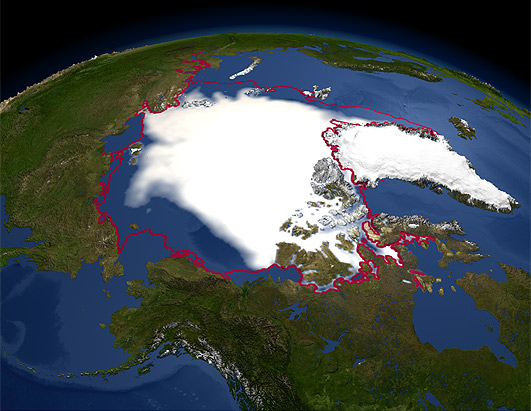
NASA imagery

After a tumultuous year of climate upheaval which saw mile-wide tornadoes strike Mississippi and Alabama, a tornado even outside of LA, monster typhoons striking the Philippines - one even so strong it dislodged the polar vortex, and a snow event of epic proportions striking Buffalo - not to mention continued extreme drought in many places, many want to know if 2015 will provide any relief.

Unfortunately, the projections -  based on quantifiable indicators, including the injection -deposition of carbon loads into the atmosphere, and the rate of melting of the Arctic Ice cap  - as well as reduction of Antarctic ice shelf - show this isn't likely to happen.

Germane to the issue of carbon deposition there are three numbers we had better keep close track of if we want to preserve even a semblance of a livable world ('Mystery of the Three Scary Numbers', UTNE Reader, Jan-Feb, 2014, p. 18):

 2 degrees Celsius or 3.6  degrees Fahrenheit

- 565 gigatons or 565 thousand million tons

- 2, 795 gigatons


The first number is the upper threshold for the global mean temperature to increase over this century without seeing the planet go into the crapper. According to climate scientist Bill McKibben, even a 2C increase is fraught with danger, with much longer -more sustained polar vortices, much more frequent and intense tropical cyclones (hurricanes, typhoons), more F5 tornadoes in the U.S., more persistent droughts, higher ocean acidification and dying coral reefs, and more wildfires in the American West. 

The second number represents the peak of humanity's carbon budget. It's the most carbon we can afford to pour into the atmosphere without triggering the 2 C temperature increase.  For reference, humans poured some 30.6 gigatons into the atmosphere in 2011 and it is projected that unless massive carbon cuts go into effect we will pass the 565 gigaton threshold in 16 years. That means we will likely trigger the 2 C increase in that time - with all the havoc that implies.

The third number is perhaps the most worrisome of all and the one that instills fear into most who know what the future portends if we don't stop our reckless foolishness -including the fracking craze. It represents the total stored reserves of carbon held by coal, gas and oil companies. It was first highlighted and brought to global attention by the Carbon Tracker Initiative - a group of London financial analysts and environmentalists.  It is what the fossil fuel industry plans to exploit in the future by its whole spectrum of methods, whether deep sea drilling, oil shale fracking or natural gas fracking.

It is, in other words, five times more carbon than will already blow a gasket in our world and send it toward runaway greenhouse perdition.

As the UTNE piece observes:

"Burning those fossil fuels we would enter a world of science fiction dystopia: a rise in sea levels not seen in human history, species extinction, droughts, super storms, heat waves from hell....and consequences you cannot imagine".

So what does 2015 portend in the way of climate crises, events? 

Polar vortex intrusions:

More are expected - both early this year and later. Again, recall the significance of the polar vortex: that is, it's the first sign of an ongoing Arctic instability associated with its extraordinary polar warming - again first revealed by Prof. Gunther Weller as early as 1986. As the melting ice proceeds faster the instability will become more and more pronounced leading to more such events in the years to come. Until the point is reached that the 'fridge' has totally defrosted leading to monumental climate upheaval and prolonged heat waves around the world - as well as the first "year of no seasons."


Violent tornado season:
Because of the several frigid dips expected of the polar vortex, there will be inevitable collisions with warm air flowing up from the Gulf.  The colder the air in the vortex, the more violent the result when warm air meets cold - setting off hundreds of tornadoes in the plains, southeast.  As years go by,  leading to the first 'year of no seasons'  ca. 2040,  this template will be repeated with ever increasing intensity.

Wildfires in the West, Southwest:

Again, the dry conditions in the region set the stage for raging wildfires in the spring.  Adding to the crisis is that the water tables from California to Colorado are dramatically low - leading to the proposal of extreme solutions to cope, such as recycling toilet water, e.g.

Fracking in the same arid states hasn't helped the situation given each frack well consumes up to 5 million gallons of fresh water. Not to put too fine a point on it, but it's the height of insanity as much as using corn to make ethanol.

Further loss of land to rising seas:
A recent visit to Barbados (last May) reminded us of the extent to which the island is at risk of losing its precious beaches. With each passing year more coastal land is reclaimed due to the inexorably rising sea and now- unlike thirty years ago - you won't find one single climate change skeptic. (Though there are the few oddballs who refuse to go the anthropogenic route).  

Barbados isn't alone in this phenomenon, but the problem is that unless you live there or you're on certain islands like Kiribati, see e.g.
http://www.huffingtonpost.com/2014/09/22/kiribati-president-buying-land_n_5860064.html

you will be oblivious to the threat.

Collapse of Greenland's Ice Sheet:

This is one of the 'feeding factors' leading to sea rise and will ramp up this year as the Jokulhlaup phenomenon reaches new intensity.  Recall, "jokulhlaups”or sudden glacial bursts of melting runoff from glaciers, first emerged with a landmark paper in 2008 ('Jokulhlaup Observed in Greenland ice sheet’, in Eos: Transactions of the American Geophysical Union , Vol. 89, No. 35, 26 Aug. 2008, p. 221). The cited paper specifically noted the separation of a “chunk of ice the size of Manhattan” (19 sq. miles)from Ellesmere Island in Canada’s northern Arctic. In the case of the increasing Greenland Jokulhlaup we are looking not just at one massive breakoff, but the loss of perhaps 45% of the entire Greenland ice sheet on account of the underground splintering effects producing ever larger cracks in the ice and the inability of it to support the overlying permafrost and other ice. Thus, onset will be sudden and perhaps more like a "terror attack" from nature.  Watch for this phenomenon to reach new heights this year.

What can you do to stay informed, apart from reading this blog?

I suggest every reader needs to obtain Naomi Klein's This Changes Everything: Capitalism Vs. Climate Change this year and study it cover to cover  - I'd say as a New Year's resolution.  Klein uses her trademark rigorous logic combined with scientific facts to prove capitalism is unable to affect or alter  the course of climate change due to its inherent dependence on cheap fossil fuels and need for continuous growth. Also,  the time for marginal fixes has expired, thus forcing us to now make radical changes in how we live. 

 We simply don't have the luxury of using all the carbon that lies inside the Earth. Yet capitalism's never ending growth engine would demand we do so to support the expansion of new markets for exploitation.