


In the last few weeks, and barely a year after RFK Jr. (as poseur who demolished all future mRNA vaccine
funding) we’ve learned airports across Asia have been put on high alert
after India confirmed
two cases of the deadly Nipah virus in the state of West Bengal over the past
month.
Thailand, Nepal and Vietnam are among the countries screening airport arrivals over fears of an wider outbreak of the virus, which can spread from animals to humans and has a high fatality rate. Nipah virus is primarily transmitted to humans from animals such as pigs and fruit bats, either by direct contact or through their secretions.
In the case of Covid 19, with a crude 2.7% mortality rate (compared to 40% or more for Nipah virus) the main source was found to be Laotian Bats, e.g.

In early 2022, scientists at the Chinese Center for Disease Control and Prevention carried out an analysis of the genetic traces of coronaviruses collected at the Huanan market in January 2020. Previous studies have shown that the viruses sampled from early cases of Covid belonged to two main evolutionary branches. The Huanan market samples included both branches.
These findings, in concert with the earlier (Oct. 2021) research by Marc Eloit, a virologist at the Pasteur Institute in Paris, put the lab leak bunkum to rest once and for all. The Eloit team captured hundreds of Laotian bats from caves and examined bat feces which turned out to harbor coronaviruses bearing molecular hooks - similar to that for SARS-Cov-2, e.g.
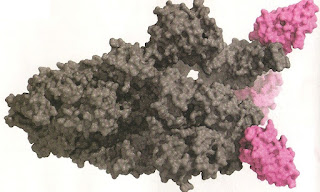
In a similar threat, fruit bat feces can harbor the Nipah virus. It can incubate in the body for a period of four to 14 days. The initial symptoms of the virus are often high fever, nausea, vomiting and respiratory problems, which can then develop into pneumonia. In severe cases it causes a dangerous swelling of the brain that can lead to neurological symptoms such as drowsiness and seizures.
It is highly contagious between humans and is seen by the World
Health Organization as a high risk for epidemics because there is no vaccine.
It has a high fatality rate of 40% to 75%, far deadlier than Covid-19. Thanks to the morons at the FDA and crass know nothings like RFK Jr. there is little chance now of getting a proper vaccine, for Nipah - if it should hit the U.S. (and recall Trump and his cabal pulled out of the WHO). Or Avian flu if it should strike sometime in the course of Dotard's remaining 3 years. (Recall Covid struck early in 2020 and Trump basically ignored it, waiting until the last minute to approve mRNA vaccines).
Recall RFK Jr. stated last August,
"We’re moving beyond the limitations of mRNA and investing in better solutions,”
Before announcing the termination of all mRNA projects.
In January, at the World Economic Forum in Davos, Switzerland,
Moderna’s chief executive, Stéphane Bancel, told Bloomberg
TV that
the company would stop investing in late-stage vaccine trials that are a
crucial part of the approval process.
“You cannot make a return on investment if you don’t have access to the U.S. market,” Bancel said.
This prompted alarmed comments from readers of the WAPO piece yesterday, i.e.
"This administration wants to kill people. If it's not
cutting funds, it's ICEstapo, or not approving a vaccine. This one is all Old
Leatherface Roadkill Boy Heroin Addict's doing. He's the polar opposite of his
father and the rest of his extended family, who believe in public service. Good
thing he wasn't in office to veto the COVID-19 vaccines or the death rate would
have been 10-20 times higher than it was."
"More incompetence from the Trump Administration and RFK, Jr.
How many Americans will die unnecessarily because of this stupid decision that
is not in any way based on science?"
The dreaded Nipah virus was first identified in 1998 among pig farmers in Malaysia, when it killed more than 100 people. It was named after the village where it was discovered.
Since then, outbreaks have been detected almost every year
across Asia in countries including India, the Philippines, Singapore and
Malaysia. It has routinely emerged in Bangladesh and
the first case in India was in 2001 in West Bengal, which borders Bangladesh.
It has been linked to the harvesting of raw date sap in
Bangladesh, as fruit bats often live in date palms.
In 2018, at least 17 people died from Nipah virus in the Indian state of Kerala, and two more died in 2023. The latest outbreak is significant as these are the first cases detected in West Bengal province in India since 2007.
The Indian health authorities said: “Enhanced surveillance,
laboratory testing, and field investigations were undertaken … which ensured
timely containment of the cases.”
Adding:
“The situation is under constant monitoring and all necessary public
health measures are in place,”
Alas, with Trump and DOGE's destruction of our disease early warning system - in USAID - there may be little prep time to get ready if Nipah does enter the U.S. Thankfully, other countries have stepped up precautionary
screening measures at airports and borders. Thailand, Vietnam and
Indonesia have introduced additional screening, including temperature checks
and health declarations of passengers arriving from India. Myanmar advised
against nonessential travel to West Bengal and China has strengthened disease
prevention measures in its border areas. Fruit bats of the family Pteropodidae –
particularly species belonging to the Pteropus genus – are the
natural hosts for Nipah virus. There is no apparent disease in fruit bats.
It is assumed that the geographic distribution of Henipaviruses overlaps
with that of Pteropus category. This hypothesis was reinforced
with the evidence of Henipavirus infection in Pteropus bats
from Australia, Bangladesh, Cambodia, China, India, Indonesia, Madagascar,
Malaysia, Papua New Guinea, Thailand and Timor-Leste.
African fruit bats of the genus Eidolon,
family Pteropodidae, were found positive for antibodies
against Nipah and Hendra viruses, indicating that these viruses might be
present within the geographic distribution of Pteropodidae bats
in Africa.
Alas, the U.S. is at high risk with the Trumper baboons having destroyed USAID in Musk's 'woodchipper', hollowed out our own medical research facilities and abandoned the World Health Organization, as well as having scuttled (early in 2025) any chance to develop an mRNA vaccine similar to that used against Covid.
In medical researcher Laurie Garrett's sober take, i.e. in her book The Coming Plague (p. 169);
"An individual microbe's world is limited only by the organism's mobility and its ability to tolerate various ranges of temperature, sunlight, oxygen, acidity or alkalinity. Wherever there may be an ideal soup for a microbe, it will eagerly take hold, immediately joining to the local microbial ecosystem of pushing and shoving struggle for survival."
See Also:
And:
FDA won’t review Moderna’s application for first mRNA-based flu vaccine - The Washington Post
The decision, which shocked company officials, comes as the FDA says it will take a stricter approach to federal vaccine approvals.
Excerpt:
Moderna conducted two late-stage, “Phase 3” trials (one of the
final steps before seeking drug approval) designed to test the safety and
effectiveness of its mRNA flu vaccine, enrolling more than 43,000 adults age 50
or older. In one trial, more
than 40,000 participants received either a dose of the experimental mRNA flu
vaccine or a standard dose of an existing flu shot. In another,
participants received a dose of the mRNA vaccine, a standard shot or a
high-dose influenza shot recommended for adults 65 and older.
Moderna said the FDA notified the company of its decision on
Feb. 3 in a “refusal to file” letter stating that the company’s application
was, “on its face, inadequate for review.”
Companies conduct clinical trials with the oversight of the
FDA, which offers feedback on the design of the trials. Moderna indicated that
in April 2024, the FDA provided feedback saying the agency agreed its trial
design was “acceptable,” though it recommended that the
investigational drug be compared against a higher-dose flu shot for those 65
and older.
Refuse-to-file letters are infrequently used by U.S.
regulators, according to a study published in JAMA Internal Medicine. Over a
decade, that study found, only 4 percent of nearly 2,500 applications received
such letters.

No comments:
Post a Comment