Showing posts with label Michael Brown. Show all posts

Monday, July 29, 2019

After Last Week We Can Truly Say The Asteroid Peril Isn't just Science Fiction


Image of the Chelyabinsk asteroid's exploded trail  over Chelyabinsk, Russia,  in 2013.

An interesting article by Gordon L. Dillow ('The Asteroid Peril Isn't Science Fiction', WSJ, p. C4, July 6-7) appeared barely two weeks before a real asteroid scare, which few humans may know about. This near hit concerned the asteroid 2019 OK  which was definitely not "ok" in terms of its near collision with Earth.  This is also given  no one picked it up until it had already passed.

Alan Duffy  - lead astronomer at the Royal Institution of Australia-   was  particularly confused in the aftermath.  This was given  a couple of forecasts had already predicted a couple asteroids were to pass close to the Earth  last week.   So, in Duffy's mind, everyone was getting hysterical over something already known to be coming, but evidently not. Because most did not know as 2019 OK whizzed past Earth.
That led Duffy to say:
“I was stunned.  This was a true shock.”

Indeed.

So what happened and why wasn't it on more astronomers 'radars' so to speak?  According to Michael Brown - a Melbourne-based observational astronomer- this particular beast wasn't one that astronomers had been tracking. And it "seemingly appeared from out of nowhere". 

Let's back up here. By 'out of nowhere' he means from the direction of the Sun which of course will obscure any relatively small rock headed for us. In this case, we're talking of an object weighing in at nearly  6 x 10 14  kg and wider than an NFL football field. The trouble is, as Gordon Dellow's article makes clear, there are "hundreds of thousands of other near Earth asteroids both large and small which up to now haven't been identified." If they haven't been identified that means we don't have their orbital elements and hence can't predict what tracks they will take, including how close to Earth in the future.   The other not so sanguine news?  The funding allocated for asteroid defense this year is barely 1 percent of NASA's total budget of $21.5 billion.

Certainly, before planing expeditions back to the Moon and Mars we ought to be shoring up our defenses against oncoming asteroids that could wipe out whole cities - or islands - no?

Our previous asteroid wake up call occurred with the  Chelyabinsk object (est. 66 feet in diameter)  that blew up over that Russian city in 2013.  That event was energetic enough to injure over  1,000 people by flying debris as the shock wave from the explosion swept across the Russian city, shattering windows and leaving a trail of damage.  The explosion was estimated to have had a force greater than 30 Hiroshima atomic bombs, according to NASA scientists.  

By contrast, the object that just missed us would have been in the 1- 2 megaton energy range and had it struck a city like New York or Philly, would have incinerated it, reduced it to ashes. If it had struck Barbados, as I pointed out to Janice, it would have flatted that little 21 by 14 miles island. 

According to data from NASA, the craggy rock was large, an estimated 57 to 130 meters wide (187 to 427 feet), and moving fast along a path that brought it within about 73,000 kilometers (45,000 miles) of Earth. That’s less than one-fifth of the distance to the moon and what Duffy considers “uncomfortably close.”
“It snuck up on us pretty quickly,” said Brown, an associate professor in with Monash University’s School of Physics and Astronomy. He later noted, “People are only sort of realizing what happened pretty much after it’s already flung past us.”
Not good enough my Astro friends!   The asteroid’s presence was discovered only earlier this past week by separate astronomy teams in Brazil and the United States. Information about its size and path was announced just hours before it shot past Earth, Prof. Brown said.  He added:

“It shook me out my morning complacency. It’s probably the largest asteroid to pass this close to Earth in quite a number of years.”

So how did the event almost go unnoticed?  “Nothing this size is easy to detect,” Duffy said of Asteroid 2019 OK. ″You’re really relying on reflected sunlight, and even at closest approach it was barely visible with a pair of binoculars.”

Brown said the asteroid’s “eccentric orbit” and speed were also likely factors in what made spotting it ahead of time challenging. Its “very elliptical orbit” takes it “from beyond Mars to within the orbit of Venus,” which means the amount of time it spends near Earth where it is detectable isn’t long, he said. As it approached Earth, the asteroid was traveling at about 24 kilometers per second, he said, or nearly 54,000 mph. By contrast, other recent asteroids that flew by Earth clocked in between 4 and 19 kilometers per second (8,900 to 42,500 mph).

Regarding the elusive 2019 OK object, Prof. Brown went on to say:

“It’s faint for a long time.  With a week or two to go, it’s getting bright enough to detect, but someone needs to look in the right spot. Once it’s finally recognized, then things happen quickly, but this thing’s approaching quickly so we only sort of knew about it very soon before the flyby.”
Basically summarizing why we desperately need thousands, hell, millions, more asteroid detection volunteers with basic astronomy principles guiding them and the telescopes needed for the job.  Such an instrument would be along the lines of the Celestron-14 shown below:

Ironically in May, barely two months before the close pass of 2019 OK, a hypothetical  asteroid impact exercise had been conducted.   This was as part of the International Academy of Astronautics Sixth Planetary Defense Conference held in College Park, MD.

As described by Dellows (ibid.) the exercise began when astronomers in Hawaii detected an 800 foot wide asteroid they dubbed 2019 PDC.  In other words, roughly twice the maximum estimated diameter (427' )  of the actual 2019 OK that just brushed past us.   The decision of the team was then to try to "reduce its speed by a tiny fraction" using missile "kinetic impactors".   Then:  "By the time it reaches its predicted rendezvous point with Earth, our planet will have already moved in its orbit."  All well and good, right?  Not really, as Dellows continues:

"Three of the impactor ships smashed into the asteroid.  The main body was destroyed and would miss Earth.  Denver (the original target) was saved. Unfortunately, one of the kinetic impacts inadvertently broke off a 200-foot wide chunk of the asteroid - and that hurtling fragment was now on track to hit New York City,"

Let's pause here to point out the size of the fragment was smaller (by up to a factor 2)  than the estimated size of 2019 OK that just missed Earth.  Anyway, as we read on (ibid.):
"The only hope was to destroy the fragment with a nuclear device.  But existing ground -launched nuclear missiles were not designed to take on an asteroid.in space and there wasn't time to launch a nuclear armed device to intercept the asteroid chunk.  New York would just have to take the hit."

So what was done in the exercise?

"Millions of people were evacuated.  The asteroid exploded in a fireball over Central Park.- and Manhattan was wiped off the map."

Two takeaways:  First, at least the exercise saw a partial success in that the population of Manhattan was evacuated in time, though they had nothing to return to but ashes. Second, The much larger REAL asteroid that appeared last week, and would have REALLY destroyed Manhattan (or Barbados) missed us by an astronomical hair's breadth.

The consolation? "The chances of a civilization- destroying asteroid are exceedingly small".  Well, true, but they are not zero.  After one hit in 2013 and another near collision this month, I suspect it's time we get a real plan in place especially for these smaller, city-killer asteroids that emerge at the last minute.    As Dellows ends his piece:
"It isn't a question of whether humankind will have to confront the prospect of a destructive asteroid hurtling our way; it is only a question of when."

Let's hope that 'when' is still a long, long time away.

See also:

Friday, February 2, 2018

If Pluto Has Clouds Can It Still Be A "Dwarf Planet"?

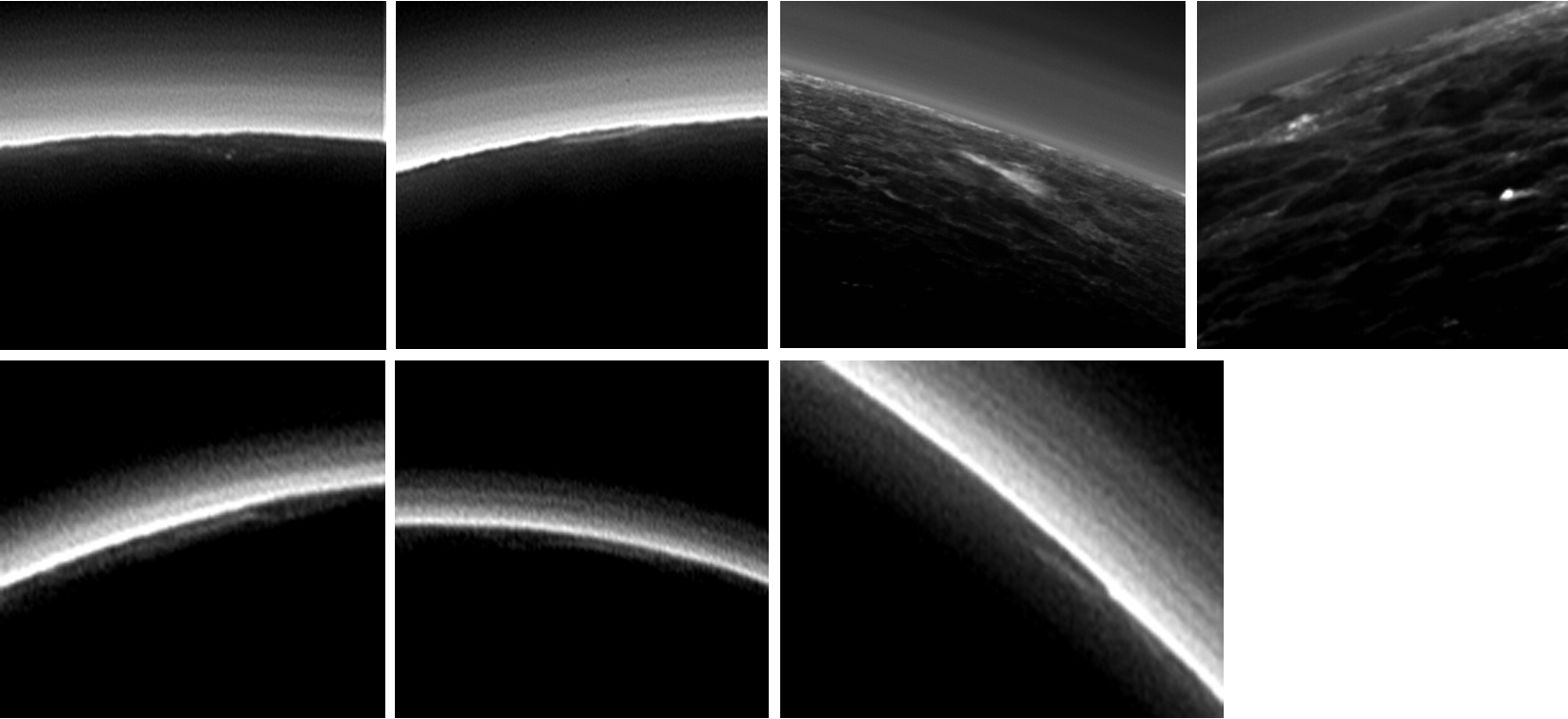
Pluto-clouds
A sequence of images taken by the Long Range Reconnaissance Imager and Multispectral Visible Imaging Camera from the New Horizons spacecraft Pluto flyby  in July, 2015. The images show possible evidence for clouds on Pluto but altitude data are needed to confirm this.

Alan Stern, New Horizons principal investigator,  gave a terrific analogy to the demotion of Pluto to a 'dwarf planet' in the NOVA special  'Chasing Pluto'.  He compared the ridiculous IAU vote (to decide Pluto was a "dwarf" as opposed to "real" planet)  to a similar vote by canine specialists to vote all small dogs, i.e. pugs, Chihuahuas etc. to 'dwarf dogs' while all larger dogs are 'real dogs'.   

Stern has been consistent in his position that Pluto is emphatically a genuine planet , never mind the contrived definition offered by some (e.g. Michael Brown).  Stern maintains Pluto is a planet simply because it is massive enough that gravity has forced it into a spherical shape.

Now it appears there is even further physical evidence -  from the New Horizons mission - that this dwarf planet nonsense might finally be put to rest. And who might we thank other than the same Alan Stern who has described several lines of evidence that Pluto may exhibit partly cloudy skies.  Can such clouds be an attribute of a dwarf planet? I doubt it, for the same reason that it is unlikely a genuine dwarf world would have adequate gravity to force it into a spherical shape.  Bottom line:  a dwarf world wouldn't have the gravity to retain any kind of atmosphere, it would be outgassed.  We can use:

v =  Ö( (3 k T/m)

where k is Boltzmann's constant (1.38 x 10 -23   J/K), T is the absolute temperature applicable in degrees K, and m is the mass of the most prominent, constituent single gas  molecule . We then compare this value to the escape velocity of the object.

Anyway, Stern's new findings were presented on October 18 last year to a joint meeting of the American Astronomical Society Division for Planetary Sciences and European Planetary Sciences Congress.  This took place in Pasadena, California and interested readers can find more details at:   

http://bit.ly/aas-dps

Let's note that previous observations have shown that Pluto does have a hazy atmosphere. This arises as a result of a process involving sunlight (even at that great distance) and hydrocarbons present. In particular, when sunlight strikes the planet it triggers formation of the haze composed of hydrocarbons like acetylene and ethane.  These chemicals then coagulate into small particles that scatter sunlight - visible as a blue mist captured in the images captured by the instruments aboard the New Horizon.

This haze, to be sure, is extremely thin whereas the particles of vapor that meteorologists would classify as clouds must be discrete, optically thick objects that block the surface.. So again, we have to deal with some scientific semantics here.

How to reconcile the Earth meteorologists' definition with what Stern's New Horizons team found? Well, the latter actually spotted - using the instruments cited- several bright smudges at apparently low altitudes that blocked Pluto's surface. (Refer to the last two images on the right of the top panel). These appeared at Pluto's dawn and dusk when lower temperatures would allow condensed clouds to form.

Moreover, the Stern team spotted these features at low altitudes which totally conforms with what a planetary atmospheric model of cloud formation would expect to yield.

The bugbear or the primary obstacle preventing a definite confirmation?  Because the Stern team lacks altitude data they can't yet confirm whether the features detected optically hang above Pluto's surface  or lie atop it. Once we get that resolved then a more unambiguous conclusion is possible.

For my part - and Stern's (who's articulated this before) we don't need the cloud confirmation to ascertain Pluto is definitely a planet - and not a mere "dwarf" planet.

In Stern's Wall Street Journal interview (July 18-19, 2015 p. A9) he addressed the admission of one IAU voter to vote for Pluto being a dwarf planet. To wit,  "We're not so keen to have Pluto and all his friends in the club because it gets crowded. By the end of the decade we would have had 100 planets.."

Hmmm...can't have too many planets, eh?, Otherwise they'd all have to be named and the poor little school kids wouldn't be able to remember them all.  Stern's response (ibid.):

"That's a very 20th century view. Our technology used to be very limited, so we could only see a few planets, and we could memorize the list because we thought we knew them all. Arbitrarily limiting the number of planets to a familiar few is like deciding to name only seven mountains on Earth,"

Of course, one response of the pro-dwarfers would be that gazillions of people are more interested in space and the planets rather than all the terrestrial mountains. But in fact that planet -space prejudice is immaterial to Stern's basic point. In another parallel universe, many more might be interested in mountains... but planets -  not so much.


Another type of objector who might brainlessly ask: "Why does it matter if we call Pluto a planet?  Only a bean counter might care"

However, we do care because scientific terminology has consequences. It's not a mere casual parlor game of semantics. It matters because scientific methods and processes are important, not because "a name by any other name" means anything....to anyone.  If people (laymen) perceive that planetary status (which ought to be an OBJECTIVE finding) is accomplished by subjective vote, then you really can't blame them for buying into the agnotology message- i.e. hat consensus, i.e. in the anthropogenic warming setting, means science is decided by popularity.

And more importantly, if scientific words and terms meaning nothing and are all relative, that opens the door to direct exploitation by ideology and  authoritarians who'd like to play upon the fake news idiom. This we cannot afford.   As one blog commenter Laurel  Kornfield put it:

"Clearly, more than "a few bean counters" care about what we call Pluto, and this is a good thing. It means they are paying attention to astronomy and have the discretion to distinguish a poor definition from a good one. "


Would it be nice and seal the deal to learn Pluto has a bona fide atmosphere? Sure, but in the end it is not necessary for regarding Pluto as a bona fide planet - as opposed to a dwarf planet.

See also Laurel's blog at:

http://laurele.livejournal.com


Wednesday, November 8, 2017

Selected Questions- Answers From All Experts Astronomy Forum ( Planet Nibiru: Science Fact Or Fable)

Question: I am very interested in the mystery planet called Nibiru, which some have dismissed as a fantasy or fable. If it is real, then how did it originate, how we can locate it.?  I also understand it may collide with Earth. Can you elaborate?


Answer:  The idea of an alleged planet Nibiru (and a future catastrophic encounter with Earth)  originated with Nancy Lieder, a Wisconsin woman who claimed that as a girl she was contacted by gray extraterrestrials called Zetas, who implanted a communications device in her brain.  This claim  alone would give pause to any rational person - even if not scientifically trained - that the whole Nibiru story is so much balderdash.

There is no such astronomical entity as Nibiru or "Planet X" as it's also been called, nor any potential for future collision with Earth.  It really is all an elaborate fable that has been circulated among assorted gullible groups - who've also made empty collision claims.

The multiple collision forecasts are important because to actually know that would require knowing the alleged object's orbital elements. In  fact there have never been any orbital elements computed for Nibiru which indicates it's merely a creation of overactive imaginations.

Let's grasp then that orbital elements ultimately determine whether a proposed (or hypothetical)  planetary object is fact or fiction. These include a set of parameters used to define the properties of the orbit: a (semi-major axis), e (eccentricity), M, the mean  anomaly,  W  the longitude of the ascending node, i, the inclination of the planet''s orbit, to the ecliptic  and w  the argument of the perihelion.

A typical diagram that may be used is shown  below: 


  The diagram shows assorted orbital elements for a planet of mass m2 (the Sun is m1) and this can be used as a basis for orbital energy analysis and also to predict future positions. Energy constants in celestial mechanics are very useful for quickly coming to terms with specific properties of an orbit such as shown in the accompanying sketch- designating a generic orbit in x-y-z space .

The critical or key parameter here is h, the angular momentum vector for the orbiting system.

The fact none of these have ever been computed for Nibiru shows more than anything that it doesn't really exist.  The relevance of orbital elements is because the "Niburians" keep making forecasts of collisions with Earth leading to calamity. One such impact was designated for May, 2003.  According to a Wikipedia entry:  "One week before the supposed arrival of Planet X in May 2003, Lieder appeared on KROQ-FM radio in Los Angeles, and advised listeners to euthanize their pets in anticipation of the event as she had done"

So she must have known the orbital elements to make such a forecast and even kill her pet, right? Nope!  Never happened.  Not to be denied,  the Nibuirans made yet another doomsday forecast for Dec. 21, 2012, the supposed date for the "end of the world" by the Mayan calendar - which I'd already skewered, e.g.

https://brane-space.blogspot.com/2012/12/no-therell-be-no-mayan-apocalypse.html


If people were intelligent enough and genuinely curious they'd be more invested in a real "Planet X" which is actually Planet Nine for our solar system. "Planet Nine" is the name given to the newest potential member of our solar system by astronomers at Caltech. But don't call it "Planet X", because they are averse to having it conflated with the Nibiru baloney.


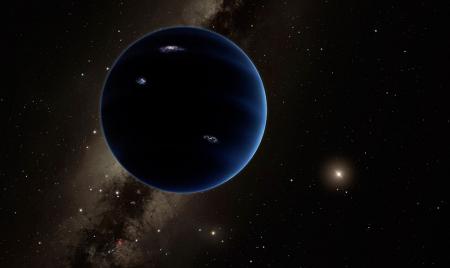
Artist's conception of 'Planet Nine' - predicted by Caltech astronomers

To be sure, Planet Nine has not technically been "discovered", as in actually training the Palomar telescope on it. No, its existence has been inferred from the marvelous science of celestial mechanics, based on the gravitational effects detected on smaller objects in the Kuiper Belt - and from mathematical modeling techniques and computer simulations.
  
According to the Caltech site, the two scientists - Konstantin Batygin and Michael Brown  describe their work in an issue of the Astronomical Journal.  They show how Planet Nine helps explain a number of mysterious features of the field of icy objects and debris beyond Neptune known as the Kuiper Belt. Those who wish to access the actual paper can get the .pdf here:

http://iopscience.iop.org/article/10.3847/0004-6256/151/2/22/pdf

Planet Nine is about 1 million times more probable than any Niburu, but sadly too many lack the curiosity to explore that because it entails mastering - learning actual scientific  principles.  By contrast, Niburu's existence has merely been based on recycled babble, phony forecasts (that have never materialized), and false claims of "experts"  (unnamed astronomers and seismologists)  who supposedly support this bunkum but haven't yet published anything in serious journals or even come to public light.  Thus, as far as science can inform us - Nibiru simply does not exist. It is a figment of the imagination of millions of gullible folks who have probably never taken a science course in their lives.

This confirms again that the tragedy of humanity is that it's too  often fascinated with mythical objects or catastrophes and not engaged or intelligent enough to deal with the real entities.  OR real catastrophes,  like global climate change. 


Friday, January 22, 2016

Parsing "Planet Nine" - It's Not Like Earth


Artist's conception of 'Planet Nine' - predicted by Caltech astronomers

"Planet Nine" is the name given to the newest potential member of our solar system by astronomers at Caltech. Don't call it "Planet X", because to these guys - like Michael Brown (former 'slayer' of Pluto) it reeks of aliens and sci-fi.   Planet Nine then simply designates the recognition of the ninth actual planet belonging to the Sun's family - after Pluto was summarily ejected some 8 years ago for being a "dwarf".

Let's also get it into our heads Planet Nine has not been "discovered", as in actually training the Palomar telescope on a portion of the sky and seeing it. No, its existence has been inferred from the marvelous science of celestial mechanics, based on the gravitational effects detected on smaller objects in the Kuiper Belt - and from mathematical modeling techniques and computer simulations.

According to the Caltech site, the two scientists - Konstantin Batygin and Brown  describe their work in the current issue of the Astronomical Journal and show how Planet Nine helps explain a number of mysterious features of the field of icy objects and debris beyond Neptune known as the Kuiper Belt. Those who wish to access the actual paper can get the .pdf here:

http://iopscience.iop.org/article/10.3847/0004-6256/151/2/22/pdf

To say the paper is a work of stupendous scientific inference and deduction is an understatement. In fact, the current work didn't launch until after two earlier researchers (one a postdoc of Brown) noted that 13 of the most distant objects in the Kuiper Belt are similar with respect to an obscure orbital feature. To explain that similarity, they suggested the possible presence of a small planet. Brown's interest was piqued and he enlisted the help of Batygin - whereupon the two commenced a year and a half long collaboration.

The pair quickly found that the six most distant objects from the original collection of 13  all followed elliptical orbits that pointed in the same direction in physical space. That was particularly surprising because the outermost points of their orbits moved around the solar system, and they traveled at different rates.  According to Brown:

"It's almost like having six hands on a clock all moving at different rates, and when you happen to look up, they're all in exactly the same place,"

 The odds of that happening were something like 1 in 100, but on top of that, the orbits of the six objects were also all tilted in the same way—pointing about 30 degrees downward in the same direction relative to the plane of the eight known planets. The probability of that happening is about 0.007 percent. "Basically", Brown said, "it shouldn't be happening randomly. So we decided to look for something else shaping the orbits."

After a number of trials they noticed almost by accident that if they ran their simulations with a massive planet and an anti-aligned orbit (i.e. the orbit's perihelion is 180 degrees opposite the perihelions of all the other objects and planets) then the 6 distant Kuiper Belt objects assumed the alignment actually observed.

In other words, a massive planet (10 times Earth's mass) was needed in order to have alignments observed jibe with the data. It was somewhat like finding the piece to a puzzle which finally fits with the rest of the pieces.

Brown and Batygin estimate the planet takes from 10,000 to 20,000 years to make one orbit around the Sun. Using Kepler's harmonic law, e.g.
http://brane-space.blogspot.com/2011/09/tackling-intermediate-astronomy_10.html

 One can then work out the range for the semi-major axis. With a 10,000 year period it turns out to be 434 AU (astronomical units) and at 20,000 years it's 736 AU. Since Neptune is at about 40 AU, that makes Planet Nine up to almost 20 times more distant. From the nearer distance the Sun would appear in the sky as barely a 2nd magnitude star in brightness (about like Polaris). Needless to say the temperatures would be unthinkably frigid - think close to absolute zero Kelvin, or -273 C. With an order of magnitude greater mass than Earth a 200 lb. Earth astronaut would weigh in at nearly 290 lbs. there.

Now, it remains for someone to actually observe the planet (estimated at about +6.5 absolute magnitude) and maybe even lay claim to naming it. Once that actual observation occurs we will be able to finally say the planet has been "discovered". I'd try myself, but my eyesight simply isn't that great and my remaining telescope is only a 2.4" Tasco refractor - mainly used  to observe the occasional unusual astronomical event - like five of the planets (Mercury, Venus, Mars, Jupiter and Saturn) lined up in the morning sky right now.

Wednesday, July 22, 2015

Alan Stern On Why Pluto Is Still A Bona Fide Planet

Pluto

View Of Pluto from the Long Range Reconnaissance Imager  Aboard New Horizons spacecraft then half way to its minimum distance of 7700 miles.

Alan Stern, New Horizons principal investigator,  gave a terrific analogy to the demotion of Pluto to a 'dwarf planet' in the NOVA special  'Chasing Pluto'.  He compared the ridiculous IAU vote to a similar vote by canine specialists to vote all small dogs, i.e. pugs, Chihuahuas etc. to 'dwarf dogs' while all larger dogs are 'real dogs'.

Of course, to make the analogy much better,  one would postulate a scenario in which people go crazy about breeding and owning small dogs which soon outnumber large breeds by 10:1 or more. Worrying about a proliferation of small dogs, the specialist canine community makes the decision to vote on redefining them as 'dwarf dogs' to try to discourage ownership and breeding.

In Stern's Wall Street Journal interview (July 18-19, p. A9) he is even more specific, after referencing what led to the IAU vote, i.e. when scientists began finding worlds even  farther away and one (Eris) nearly the same size as Pluto. This led certain investigators (e.g. Michael Brown) to propose a special class for the proliferating small planets, calling them all 'dwarf planets'.

So rather than have public confusion about hundreds of planets, it made sense to them to separate eight regular planets from the multitude of dwarf planets.

As one IAU voter put it (ibid.):

"We're not so keen to have Pluto and all his friends in the club because it gets crowded. By the end of the decade we would have had 100 planets.."

But Stern objected:

"That's a very 20th century view. Our technology used to be very limited, so we could only see a few planets, and we could memorize the list because we thought we knew them all. Arbitrarily limiting the number of planets to a familiar few is like deciding to name only seven mountains on Earth,"

Of course, the response of the pro-dwarfers would be that gazillions more people are interested in space and the planets rather than all the terrestrial mountains. But in fact that planet prejudice is immaterial to Stern's basic point. In another parallel universe, many more might be interested in mountains... but planets -  not so much.

Stern also dissents on more technical grounds given the IAU insists a bone fide planet must have gravitationally swept its neighborhood clear of other objects which Pluto hasn't done. But as Stern observes, a body big enough to clear a small orbit and qualify as a planet might fail to make the cut for a larger orbit (as Pluto has).

In other words, when is a planet not a planet? Well, when it is somewhere else!

Stern goes on to maintain Pluto is a planet simply because it is massive enough that gravity has forced it into a spherical shape. (A sphere - for technical reasons - is the maximum volume shape arrived at from g-forces) By this definition, Ceres also qualifies as a planet.

In one of the most incisive points, Stern acknowledges that planetary scientists regularly define objects this way. Which is why it was wrong to bring the planetary definitional vote before the entire International Astronomical Union - because you're mixing planetary astronomers, with stellar astrophysicists, solar physicists, cosmologists, space physicists, astro-geologists, astro-biologists, astrometry specialists (astrometrists), celestial mehanicians and so forth.

As Stern aptly puts it:

"I know the public thinks we're all the same because we study things in space. So my analogy is doctors. Would you let a podiatrist do brain surgery on you. Wrong specialty! So don't let an astrometrist classify planets."

A point well taken which is why many of us ignore the  supercilious IAU vote and continue to regard Pluto as a planet.

See also:

http://www.smirkingchimp.com/thread/ed-tant/63181/new-horizons-provides-up-close-look-at-faraway-pluto

Saturday, May 2, 2015

Conservative Twitterati Try to Go After Marilyn Mosby - End Up Looking Like Damned Fools


Twitter conservatives can't wrap their heads around Marilyn Mosby -- so they attack her instead
How dumb is dumb? Well, when ignorant, dumbo conservatives can't handle the truth, and especially can't wrap their febrile minds around a person with a fearless sense of justice and impeccable integrity seeking it. That this person - Marilyn Mosby - is the product of five generations of police officers would seem to indicate more support than attacks - but not for the conservo Twitterati, most of them brainwashed by Hannity, O'Reilly and "Fox n' Friends".

When I saw Prosecutor Mosby's announcement yesterday, I told my wife: "Make no mistake she will be attacked by the racist knuckledraggers". They hide behind the veneer of politics  and pseudo-justice but as the Southern Poverty Law Center's recent "Intelligence Report" noted - it is all about racism since Obama's 2008 election.  While the numbers have somewhat diminished, a residue of hardcore hate groups remain. See e.g.

http://www.splcenter.org/get-informed/intelligence-report/browse-all-issues/2015/spring

 So no one can tell those of us involved in deep politics that the nasty flood of backlash that's followed the Eric Garner, Michael Brown, Walter Scott and now Freddie Gray incidents - deaths is merely ordinary expression of  "un- PC" pinions. Oh no! Not now, not ever. Each vile backlash which cast the murdered victim as bringing on his own death and in addition referring to them  as "apes" or "gorillas" discloses the comments are not value -neutral regarding race. They are imbued with the same sickening racism that cast Obama as a "skunk" on a Facebook page - creating the incident that led me to break off any family relations with a brother in OK.

The latest example erupted from the right wing noise machine on Twitter yesterday - with some of the tweets given below with the Twitter addresses of the sorry senders:

Ben Shapiro:

This is a textbook case for recusal for Marilyn Mosby, by the way. Here's her husband blowing off looting

--
Here,  as one salon.com writer put it: "to Ben Shapiro,  Breitbart’s Editor-at-Large, the conservative calculus is clear: five generations of police officers — including, at a minimum, at least five members of her immediate family — don’t even remotely equal one husband. Her husband essentially functions like a zero, so no matter how many other family members you multiply against him"

Of course, Shapiro's other inexcusable transgression is conflating Ms. Mosby with her husband - a Baltimore councilman - intimating their interests must be the same.

Other idiotic tweets from the conservo backwaters:

Adam@keepitrealist:

Wow, Marilyn Mosby is married to Nick Mosby, the riot and looter apologist. Can you say conflict of interest?

Mythos@victorsteve:

marilyn mosby:"I have a racist narrative that matches my ideological bias & corrupted brain. all cops are murderers until further notice"

mike matheson @mikematheson5

@FoxNews WRONG cops r innocent! mosby let being BLACK LIB KKKrat influence Being BLACK lib kkkrat comes 1st 2 them This decsn is RACIST

Richard Colon @porthosposrtosp
The prosecutor is a rookie, racist and political and working with the mayor, al shapton and the White House in this case

This is just a sampling but the rest aren't any better: all drenched in blatant racism and/or unfathomable ignorance.  The typical trash racist, of course, will always seek to re-interpret the views of her husband and impute them to her, or seek to conflate the two separate people as one. The fallacy of "re-composition".

The dreck from the likes of "Mythos" discloses a foolish twit incapable of even processing the special prosecutor's words when - after her charging statement- she noted that the Baltimore Police Department deserved high praise and could not be sullied based on the actions of a few. She re-asserted that in her interview last night, telling Chris Hayes: "I understand and respect that most police officers are risking their lives day in and day out. They're on the streets of every urban city, not just Baltimore, and risking their lives for the betterment of their communities."

And again, let's bear in mind she comes from five generations of police officers and both her parents were cops.

The other congenital morons who bring up  Ms. Mosby's "conflict of interest" are also averse to the facts at hand, including that there can be no such "conflict" between a prosecutor and councilman. One "makes the laws" the other enforces them. As she also told Chris Hayes in her interview:

"There is no conflict of interest! My husband represents the district in which I live. I am the Baltimore city state attorney. I represent his district and thirteen other districts throughout the city. I prosecute crimes there. I don't have to turn on the news or open a newspaper to see the impact of crime there. All I need to do is open up the door. So there is no conflict of interest."

As for the claim by Richard Colon (funny how his surname describes the human large intestines), that the "prosecutor is a rookie" - this is an out and out red herring. As Mosby pointed out in her Hayes' interview: "The people of Baltimore elected me to exercise my discretion to apply justice fairly and equally with or without a badge."

Colon also errs by imputing that experience trumps integrity in such a case, when - given that one is properly qualified for the position,  it is always integrity that is of highest import. Something that LBJ and his "Warren Commission" might have contemplated and invoked  - but then it was never LBJ's intent to do that, but rather to cover up his own role in the JFK assassination.

She also pointed out that any alleged "independent prosecutor" would in fact be a political  appointee, not elected.:

"Where's the accountability? Someone political is going to appoint someone else."

Hence, the political nature of the appointment would likely undermine any pursuit of justice in the case.

The tweet by Mike Matheson, meanwhile, is classic racist. Anyone who would scrawl such keyboard feces as:

mosby let being BLACK LIB KKKrat influence Being BLACK lib kkkrat comes 1st 2 them This decsn is RACIST

Is projecting his own blatant racism - in this case against all blacks - onto the person. He, in fact, is likely a "KKK" or at least a KKK sympathizer, who probably gets off when they burn crosses on the lawns of black people. He also probably calls Obama a "monkey" or represents him as a skunk as my now disowned Okie brother did once upon a time.

As for the claim of a "rush to judgment" as asserted by the head of the Baltimore Police Union, this canard was also easily dispatched by Ms. Mosby who informed Chris that:

"From the time we learned of this tragic event, we started canvassing the area, speaking to witnesses, reviewed hours and hours of video surveillance, reviewed hours and hours of statements in the case, and medical records. This wasn't something that was quick, fast or in a hurry or a rush to judgment. This was a thorough investigation that we were conducting in parallel with the police department. So the information that was provided to us yesterday by the police department is information we already knew. ....This was a thorough investigation, we applied the facts to the law and we pursued this case fairly and appropriately."

Make no mistake that the backlash by racist conservatives against Marilyn Mosby is not about to end soon, not by a  long shot. There is way too much racist hatred in this country to keep it stoked - as the SPLC Intelligence Report notes. But she should know those of us who are sane and sensible back her up to the fullest!

The racist knuckledraggers may try all they want to slander her as an "out of control ape" or "racist tramp" but such reckless invective is all they have in their disgusting corner. We see her as the epitome of fearlessness and adherence to the rule of law - not merely dismissing charges because the crimes were committed by those wearing badges.

Kudos also to the ex-Baltimore cop whistleblower, Pete Castle, who exposed the crimes of  two of his mates (beating shackled prisoners),  highlighted last night on 'All In'. He was abandoned by fellow cops as a 'snitch' - disclosing their ethics as no better than those felons who try to hide their crimes while in the 'can'.

See also:

http://www.salon.com/2015/05/02/america_is_back_to_lynching_baltimore_freddie_gray_and_the_noxious_legacy_of_white_supremacy/


And:

http://www.salon.com/2015/05/02/bill_maher_compares_baltimore_police_to_the_catholic_church_the_institution_covered_for_pedophiles/