Showing posts with label New Horizons mission. Show all posts

Friday, February 2, 2018

If Pluto Has Clouds Can It Still Be A "Dwarf Planet"?

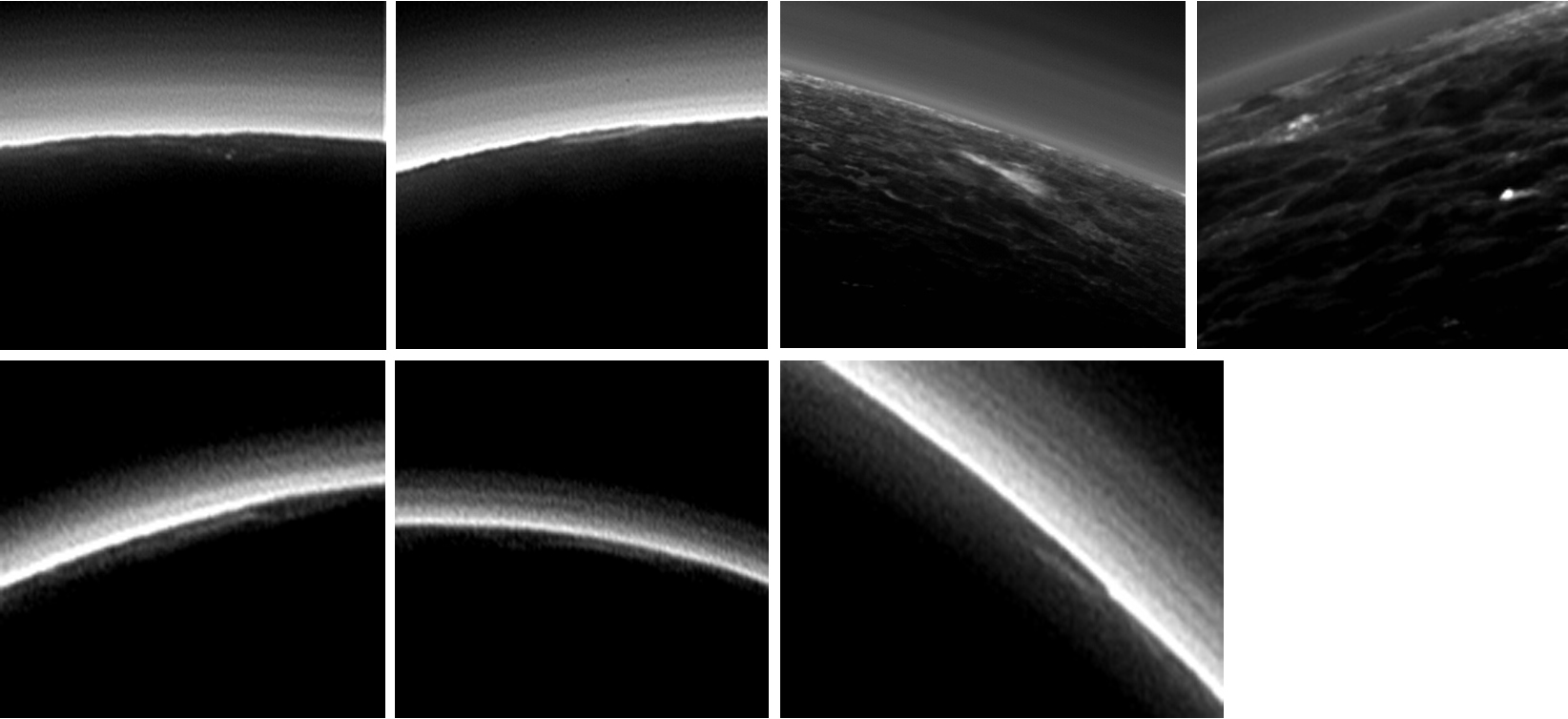
Pluto-clouds
A sequence of images taken by the Long Range Reconnaissance Imager and Multispectral Visible Imaging Camera from the New Horizons spacecraft Pluto flyby  in July, 2015. The images show possible evidence for clouds on Pluto but altitude data are needed to confirm this.

Alan Stern, New Horizons principal investigator,  gave a terrific analogy to the demotion of Pluto to a 'dwarf planet' in the NOVA special  'Chasing Pluto'.  He compared the ridiculous IAU vote (to decide Pluto was a "dwarf" as opposed to "real" planet)  to a similar vote by canine specialists to vote all small dogs, i.e. pugs, Chihuahuas etc. to 'dwarf dogs' while all larger dogs are 'real dogs'.   

Stern has been consistent in his position that Pluto is emphatically a genuine planet , never mind the contrived definition offered by some (e.g. Michael Brown).  Stern maintains Pluto is a planet simply because it is massive enough that gravity has forced it into a spherical shape.

Now it appears there is even further physical evidence -  from the New Horizons mission - that this dwarf planet nonsense might finally be put to rest. And who might we thank other than the same Alan Stern who has described several lines of evidence that Pluto may exhibit partly cloudy skies.  Can such clouds be an attribute of a dwarf planet? I doubt it, for the same reason that it is unlikely a genuine dwarf world would have adequate gravity to force it into a spherical shape.  Bottom line:  a dwarf world wouldn't have the gravity to retain any kind of atmosphere, it would be outgassed.  We can use:

v =  Ö( (3 k T/m)

where k is Boltzmann's constant (1.38 x 10 -23   J/K), T is the absolute temperature applicable in degrees K, and m is the mass of the most prominent, constituent single gas  molecule . We then compare this value to the escape velocity of the object.

Anyway, Stern's new findings were presented on October 18 last year to a joint meeting of the American Astronomical Society Division for Planetary Sciences and European Planetary Sciences Congress.  This took place in Pasadena, California and interested readers can find more details at:   

http://bit.ly/aas-dps

Let's note that previous observations have shown that Pluto does have a hazy atmosphere. This arises as a result of a process involving sunlight (even at that great distance) and hydrocarbons present. In particular, when sunlight strikes the planet it triggers formation of the haze composed of hydrocarbons like acetylene and ethane.  These chemicals then coagulate into small particles that scatter sunlight - visible as a blue mist captured in the images captured by the instruments aboard the New Horizon.

This haze, to be sure, is extremely thin whereas the particles of vapor that meteorologists would classify as clouds must be discrete, optically thick objects that block the surface.. So again, we have to deal with some scientific semantics here.

How to reconcile the Earth meteorologists' definition with what Stern's New Horizons team found? Well, the latter actually spotted - using the instruments cited- several bright smudges at apparently low altitudes that blocked Pluto's surface. (Refer to the last two images on the right of the top panel). These appeared at Pluto's dawn and dusk when lower temperatures would allow condensed clouds to form.

Moreover, the Stern team spotted these features at low altitudes which totally conforms with what a planetary atmospheric model of cloud formation would expect to yield.

The bugbear or the primary obstacle preventing a definite confirmation?  Because the Stern team lacks altitude data they can't yet confirm whether the features detected optically hang above Pluto's surface  or lie atop it. Once we get that resolved then a more unambiguous conclusion is possible.

For my part - and Stern's (who's articulated this before) we don't need the cloud confirmation to ascertain Pluto is definitely a planet - and not a mere "dwarf" planet.

In Stern's Wall Street Journal interview (July 18-19, 2015 p. A9) he addressed the admission of one IAU voter to vote for Pluto being a dwarf planet. To wit,  "We're not so keen to have Pluto and all his friends in the club because it gets crowded. By the end of the decade we would have had 100 planets.."

Hmmm...can't have too many planets, eh?, Otherwise they'd all have to be named and the poor little school kids wouldn't be able to remember them all.  Stern's response (ibid.):

"That's a very 20th century view. Our technology used to be very limited, so we could only see a few planets, and we could memorize the list because we thought we knew them all. Arbitrarily limiting the number of planets to a familiar few is like deciding to name only seven mountains on Earth,"

Of course, one response of the pro-dwarfers would be that gazillions of people are more interested in space and the planets rather than all the terrestrial mountains. But in fact that planet -space prejudice is immaterial to Stern's basic point. In another parallel universe, many more might be interested in mountains... but planets -  not so much.


Another type of objector who might brainlessly ask: "Why does it matter if we call Pluto a planet?  Only a bean counter might care"

However, we do care because scientific terminology has consequences. It's not a mere casual parlor game of semantics. It matters because scientific methods and processes are important, not because "a name by any other name" means anything....to anyone.  If people (laymen) perceive that planetary status (which ought to be an OBJECTIVE finding) is accomplished by subjective vote, then you really can't blame them for buying into the agnotology message- i.e. hat consensus, i.e. in the anthropogenic warming setting, means science is decided by popularity.

And more importantly, if scientific words and terms meaning nothing and are all relative, that opens the door to direct exploitation by ideology and  authoritarians who'd like to play upon the fake news idiom. This we cannot afford.   As one blog commenter Laurel  Kornfield put it:

"Clearly, more than "a few bean counters" care about what we call Pluto, and this is a good thing. It means they are paying attention to astronomy and have the discretion to distinguish a poor definition from a good one. "


Would it be nice and seal the deal to learn Pluto has a bona fide atmosphere? Sure, but in the end it is not necessary for regarding Pluto as a bona fide planet - as opposed to a dwarf planet.

See also Laurel's blog at:

http://laurele.livejournal.com


Monday, December 28, 2015

What's With Pluto's Smaller, Rapidly Spinning Moons?


Image showing simulation of Pluto and its relatively large moon Charon near the center  of the Pluto system, along with other Pluto satellites.

There is a problem, a big one, with Pluto's outer moons. Like disobedient children these four small moons are apparently rotating at inexplicably high rates defying the gravitational influence expected from their mother planet, and its larger moon companion, Charon.

These four moons, Styx, Nix, Kerberos and Hydra (in order of proximity to Pluto) all spin much faster than the 20 to 38 Earth days the moons take to orbit the Pluto-Charon system, as planetary astronomers recently reported. Kerberos spins the slowest, once every 5.33 Earth days, whereas Hydra rotates once every 10 hours and 19 minutes.

Make no mistake these are fast rotations for moons, which usually keep one face pointed at their central planet (synchronous rotation), rotating just once per orbit of that planet. Earth's Moon, for example, rotates once every 27 days 8 hours, the time it takes to orbit our planet once. Charon also plays by the rules, rotating once per Plutonian orbit. But the four small moons are renegades by comparison.

According to Mark Showalter of the NASA New Horizons mission put it this way (Eos Earth & Space Science News, Dec. 15, p. 3):

"These Pluto moons are essentially spinning tops and that radically changes the way we understand how they operate. This is unlike anything we've seen elsewhere in the solar system. No one has ever seen a moon, like Hydra, that rotates 89 times during a single orbit."

Recall last July, the New Horizons mission carried out the first flyby of Pluto. The analysis of images recorded by the spacecraft in the weeks leading up to the flyby led to the discovery of the moons surprising rotation rates.  This was unveiled November 9th at the annual meeting of the American Astronomical Society's Division of Planetary Sciences.

Showalter said these fast spin rates are so surprising because even if the moons originated as rapid rotators, the push and pull of the gravitational tides of Pluto and Charon ought to have slowed down that motion. So the question becomes: Why didn't they?

As Showalter put it (ibid):

"It's as if the moons just picked some random rate of rotation and Pluto and Charon have no part in any of that."

One explanation offered is that the gravitational tides of Pluto and Charon worked against each other, thus leaving the moons to maintain a high spin.

Among the category of so-called "regular moons", i.e. those that form as a result of collision between a planet and another body  - say large asteroid - Hydra ranks as the ninth fastest rotator.

Because all the moons in question are tiny - ranging from ten to a few tens of kilometers across, any collision with a large impactor could easily have imparted a lot of angular momentum to the objects.

Interestingly prior to the flyby and analysis of the moons, the leading theory was that they rotated chaotically, varying their spin rate and tumbling as they orbited Pluto and Charon. This work was published by Showalter and Douglas Hamilton of the University of Maryland in the June 4 issue of Nature.  Interested readers can read more about that study here:

http://bit.ly/moon-chaos

The theory - perhaps more a hypothesis - held up fairly well until last July when New Horizon detected brightness variations showing clear signs of periodicity. These revealed the four small moons were not so much tumbling as spinning in a regular fashion - just much faster than anyone expected. The images also revealed that Nix is rotating backward compared to the rest of the Pluto system - and also on its side.

More interesting findings from this system are sure to come.

To see the model animation from which the graphic displayed at the top came, go to:

http://bit.ly/four-tops


Thursday, July 12, 2012

Return Pluto to the Pantheon Of Planets!

The recent discovery (made via the Hubble Space Telescope) that Pluto has not one, not two but five moons to call its own, reminds me of the words of  former Hayden Planetarium Director Kenneth Franklin - when he visited Barbados nearly 40 years ago. He warned (in a guest lecture) that Pluto - based on its relatively small size - might at some time in the future be demoted from full planetary status. However, he warned that if Pluto had any moons, this would amount to a serious error of judgment and perhaps be a result more of subjective preference than scientific determination. 

I have come to believe that as well, despite ridiculous books such as Mike Brown's 'How I Killed Pluto and Why It had It Coming'. The fact is "it" didn't "have it coming" - it was entirely the result of a subjective vote taken at a meeting of the International Astronomical Union (IAU).  So while one might sympathize with author Brown over the "hate mail from school children" at his role in Pluto's demise, the fact is it was likely spurred as much by the irrational basis for the election to downgrade Pluto to "dwarf planet" status.

By contrast, the modern consensus on evolution was achieved by a body of empirical evidence, including from the fossil record, microbiology and genetics. For example, one of the most powerful lines of evidence has shown that the human chromosome designated '2' was the result of the telomeric fusion of the two ape chromosomes, 2p and 2q. The effect also saw the reduction from 24 chromosome pairs in apes, to 23 pairs in humans. (Source: Yunis and Prakash, 1982, Science, Vol. 215, p. 1525, 'The Origin of Man: A Chromosomal Pictorial Legacy')

Mathematical precision also consolidates scientific discovery in quantitative fields, making them less likely to be overturned. Particle physics is one such example, wherein the original three sub-atomic particles (proton, neutron, electron) have become a veritable “zoo” numbering in the hundreds – including up, down, top and bottom quarks, W and Z bosons, electron, mu and tau neutrinos and many others too numerous to mention. This panoply of particles didn’t just manifest because the respective particle physicists intended to be “mean” to school children or regular mortals. It emerged out of more refined and detailed experiments that exposed each of the particles. (The same set of parameter confirmations and empirical cross-checks will have applied if the Higgs boson is confirmed.)

The same applies to the current consensus on global warming, only arrived at after years of computer analysis of ice cores, changing CO2 concentrations therein, satellite imagery disclosing retreat of polar ice and data from over 1300 temperature sensing bouys in the oceans. Not to mention data we now possess that the glaciers in Greenland are melting 32 times faster than they were 10 years ago. No one took a vote to attain the consensus on anthropogenic warming, it was the culmination of over 1500 papers published over 20 years in peer-reviewed climate journals. Doesn't Pluto's demotion warrant at least half as much effort?

In the end, the error of the  IAU planetary astronomers was to cave in to public pressure to avoid “complexity”, e.g. in adding numerous additional planets like Charon, Xena, Ceres etc. This, despite the fact the original IAU definition was perfectly rational in its criteria for a planet.

Alan Stern, executive director of the Space Science & Engineering Division of the Southwest Research Institute – and Principal Investigator for NASA’s New Horizons mission to Pluto- observed that the new planet definition was “sadly flawed, particularly due to the vagueness of the third condition”, e.g. clearing the neighborhood around its orbit – which might also disqualify Earth!)

He added: “A lot of people are going to ignore the (new) definition because it doesn’t make sense.” (Source: Eos, Vol. 87, 29 August, p. 350)

The tragedy of the Pluto vote is that it has not only set back planetary astronomy – showing the preponderance of ego over scientific inquiry – but also eroded public confidence in science, which extrapolates to areas like anthropogenic global warming. (Which polls disclose only 46% of Americans now accept as arising from human-engendered greenhouse gases, as opposed to 59% in 2000.)

Anyway, the newfound fifth moon, designated P5, is estimated to be between 6 and 15 miles across. Pluto's largest Moon, Charon - at 650 miles across, was discovered in 1978 - three years after Prof. Franklin's lecture and warning about a possible Pluto downgrade.

Right now, I imagine Dr. Franklin turning over in his grave about how his forecast was ignored and the demotion of Pluto overall.  And.....I suspect he'd have some words to share with Brown, Neil Degrasse Tyson and others of the 'Anti-Pluto as full Planet' ilk.