Showing posts with label Konstantin Batygin. Show all posts

Wednesday, November 8, 2017

Selected Questions- Answers From All Experts Astronomy Forum ( Planet Nibiru: Science Fact Or Fable)

Question: I am very interested in the mystery planet called Nibiru, which some have dismissed as a fantasy or fable. If it is real, then how did it originate, how we can locate it.?  I also understand it may collide with Earth. Can you elaborate?


Answer:  The idea of an alleged planet Nibiru (and a future catastrophic encounter with Earth)  originated with Nancy Lieder, a Wisconsin woman who claimed that as a girl she was contacted by gray extraterrestrials called Zetas, who implanted a communications device in her brain.  This claim  alone would give pause to any rational person - even if not scientifically trained - that the whole Nibiru story is so much balderdash.

There is no such astronomical entity as Nibiru or "Planet X" as it's also been called, nor any potential for future collision with Earth.  It really is all an elaborate fable that has been circulated among assorted gullible groups - who've also made empty collision claims.

The multiple collision forecasts are important because to actually know that would require knowing the alleged object's orbital elements. In  fact there have never been any orbital elements computed for Nibiru which indicates it's merely a creation of overactive imaginations.

Let's grasp then that orbital elements ultimately determine whether a proposed (or hypothetical)  planetary object is fact or fiction. These include a set of parameters used to define the properties of the orbit: a (semi-major axis), e (eccentricity), M, the mean  anomaly,  W  the longitude of the ascending node, i, the inclination of the planet''s orbit, to the ecliptic  and the argument of the perihelion.

A typical diagram that may be used is shown  below: 


  The diagram shows assorted orbital elements for a planet of mass m2 (the Sun is m1) and this can be used as a basis for orbital energy analysis and also to predict future positions. Energy constants in celestial mechanics are very useful for quickly coming to terms with specific properties of an orbit such as shown in the accompanying sketch- designating a generic orbit in x-y-z space .

The critical or key parameter here is h, the angular momentum vector for the orbiting system.

The fact none of these have ever been computed for Nibiru shows more than anything that it doesn't really exist.  The relevance of orbital elements is because the "Niburians" keep making forecasts of collisions with Earth leading to calamity. One such impact was designated for May, 2003.  According to a Wikipedia entry:  "One week before the supposed arrival of Planet X in May 2003, Lieder appeared on KROQ-FM radio in Los Angeles, and advised listeners to euthanize their pets in anticipation of the event as she had done"

So she must have known the orbital elements to make such a forecast and even kill her pet, right? Nope!  Never happened.  Not to be denied,  the Nibuirans made yet another doomsday forecast for Dec. 21, 2012, the supposed date for the "end of the world" by the Mayan calendar - which I'd already skewered, e.g.

https://brane-space.blogspot.com/2012/12/no-therell-be-no-mayan-apocalypse.html


If people were intelligent enough and genuinely curious they'd be more invested in a real "Planet X" which is actually Planet Nine for our solar system. "Planet Nine" is the name given to the newest potential member of our solar system by astronomers at Caltech. But don't call it "Planet X", because they are averse to having it conflated with the Nibiru baloney.
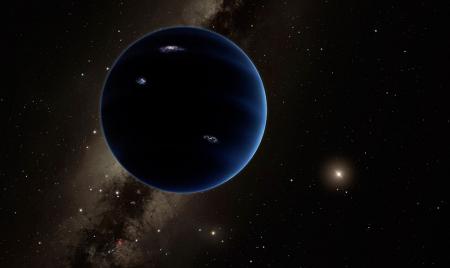

Artist's conception of 'Planet Nine' - predicted by Caltech astronomers

To be sure, Planet Nine has not technically been "discovered", as in actually training the Palomar telescope on it. No, its existence has been inferred from the marvelous science of celestial mechanics, based on the gravitational effects detected on smaller objects in the Kuiper Belt - and from mathematical modeling techniques and computer simulations.
  
According to the Caltech site, the two scientists - Konstantin Batygin and Michael Brown  describe their work in an issue of the Astronomical Journal.  They show how Planet Nine helps explain a number of mysterious features of the field of icy objects and debris beyond Neptune known as the Kuiper Belt. Those who wish to access the actual paper can get the .pdf here:

http://iopscience.iop.org/article/10.3847/0004-6256/151/2/22/pdf

Planet Nine is about 1 million times more probable than any Niburu, but sadly too many lack the curiosity to explore that because it entails mastering - learning actual scientific  principles.  By contrast, Niburu's existence has merely been based on recycled babble, phony forecasts (that have never materialized), and false claims of "experts"  (unnamed astronomers and seismologists)  who supposedly support this bunkum but haven't yet published anything in serious journals or even come to public light.  Thus, as far as science can inform us - Nibiru simply does not exist. It is a figment of the imagination of millions of gullible folks who have probably never taken a science course in their lives.

This confirms again that the tragedy of humanity is that it's too  often fascinated with mythical objects or catastrophes and not engaged or intelligent enough to deal with the real entities.  OR real catastrophes,  like global climate change. 


Monday, April 11, 2016

Planet Nine Hype Dies Down - And Some Astronomers Cool To The Notion


Two and a half months ago the discovery of "Planet Nine"  was heralded as a kind of milestone for the solar system, thanks to a pair of Caltech planetary astronomers, Konstantin Batygin and Miichael Brown.  Those who wish to read more details of the find can go here:

http://iopscience.iop.org/article/10.3847/0004-6256/151/2/22/pdf


Now, in the wake, it appears more yawns have been forthcoming than anything else

Two and a half months ago could as well have been a lifetime. Let's face it, that was before thousands had the chance to dig into the paper to unravel the study's hitherto  hidden flaws.  But that is the risk scientists take when they advance a new find, new model or theory and also one reason climate deniers have had to set up their own journals to get any respect. They simply couldn't get any from the actual professional climate journals - for which highly trained referees could too easily pick out the stumbles and unjustified extrapolations, claims, conclusions.

In the Planet Nine case, and recall the find hinged not on any direct detection but on indirect parameters associated with orbital features of 13 of the most distant objects in the Kuiper Belt, criticism was almost a given. This despite a blog entry from Brown, see:

http://bit.ly/Search-4-P9


Wherein he wrote:

"From some very simple calculations we can show that the probability of these alignments happening due to chance is only about 0.007%. You could also say that there is a 99.993% chance the alignments we are seeing in the outer solar system are real, and that we are not simply being fooled into seeing a pattern where none exists".

Maybe, but some aren't buying it any more than the climate deniers' claim that Michael Mann's 'hockey stick' (for anthropogenic warming) isn't real and we're all just being fooled by a cartoon. Not quite, since the Keeling curve also substantiates it.

For example, astronomer Brett Gladman of the University of British Columbia, reacted cooly to the Planet Nine claim. In his words (EOS: Earth & Space Science News, p. 5):

"The paper presents some interesting arguments but I think the claims are being made more strongly than the evidence merits."

Meanwhile, David Latham of the Harvard-Smithsonian Center for Astrophysics, remarked (ibid.):

"The arguments that Konstantin and Mike have presented are carefully worked out, but it's not a slam dunk."

My own take is even more basic: I look with skepticism on the find until the authors can come up with a full set of orbital elements, including:  inclination angle, i, longitude of the acending node, eccentricity e,, semimajor axis a, argument of perihelion and period P.

In fact, the firm support of demanding the orbital elements as part of the discovery claim was fortified not long after the Brown-Batygin paper appeared. This occurred with an alternative hypothesis published in The Monthly Notices Letters of the Royal Astronomical Society, e.g.

 http://bit.ly/RAS-paper


The paper, by Ann -Marie Madigan of the University of California-Berkeley, and Michael McCourt of the Harvard -Smithsonian Center for Astrophysics, suggested that gravitational interactions among the myriad, small icy objects in the outer solar system could suffice on their own to cause the orbital alignment of the six telltale objects in the Kuiper Belt that inspired the Planet Nine claim.

Their simulations showed that gravitational interactions among objects located from 100- 10,000 AU from the Sun would drive some of them to form a cone-shaped distribution, inclined to the Kuiper Belt.  This, in turn, would give rise to the alignments Brown and Batygin inferred and lead (falsely) to the planet hypothesis.

As Madigan put it during a Jan. 26 lecture at the SETI Institute (see: http://bit.ly/SETI-talk):

"This spontaneous behavior is just something the disk does on its own. We don't need to invoke an external reason such as a ninth planet for it."

All of which shows again that the process of science is supreme in getting to objective truth, and that falsifiability and testability are part of this dynamic.


Friday, January 22, 2016

Parsing "Planet Nine" - It's Not Like Earth


Artist's conception of 'Planet Nine' - predicted by Caltech astronomers

"Planet Nine" is the name given to the newest potential member of our solar system by astronomers at Caltech. Don't call it "Planet X", because to these guys - like Michael Brown (former 'slayer' of Pluto) it reeks of aliens and sci-fi.   Planet Nine then simply designates the recognition of the ninth actual planet belonging to the Sun's family - after Pluto was summarily ejected some 8 years ago for being a "dwarf".

Let's also get it into our heads Planet Nine has not been "discovered", as in actually training the Palomar telescope on a portion of the sky and seeing it. No, its existence has been inferred from the marvelous science of celestial mechanics, based on the gravitational effects detected on smaller objects in the Kuiper Belt - and from mathematical modeling techniques and computer simulations.

According to the Caltech site, the two scientists - Konstantin Batygin and Brown  describe their work in the current issue of the Astronomical Journal and show how Planet Nine helps explain a number of mysterious features of the field of icy objects and debris beyond Neptune known as the Kuiper Belt. Those who wish to access the actual paper can get the .pdf here:

http://iopscience.iop.org/article/10.3847/0004-6256/151/2/22/pdf

To say the paper is a work of stupendous scientific inference and deduction is an understatement. In fact, the current work didn't launch until after two earlier researchers (one a postdoc of Brown) noted that 13 of the most distant objects in the Kuiper Belt are similar with respect to an obscure orbital feature. To explain that similarity, they suggested the possible presence of a small planet. Brown's interest was piqued and he enlisted the help of Batygin - whereupon the two commenced a year and a half long collaboration.

The pair quickly found that the six most distant objects from the original collection of 13  all followed elliptical orbits that pointed in the same direction in physical space. That was particularly surprising because the outermost points of their orbits moved around the solar system, and they traveled at different rates.  According to Brown:

"It's almost like having six hands on a clock all moving at different rates, and when you happen to look up, they're all in exactly the same place,"

 The odds of that happening were something like 1 in 100, but on top of that, the orbits of the six objects were also all tilted in the same way—pointing about 30 degrees downward in the same direction relative to the plane of the eight known planets. The probability of that happening is about 0.007 percent. "Basically", Brown said, "it shouldn't be happening randomly. So we decided to look for something else shaping the orbits."

After a number of trials they noticed almost by accident that if they ran their simulations with a massive planet and an anti-aligned orbit (i.e. the orbit's perihelion is 180 degrees opposite the perihelions of all the other objects and planets) then the 6 distant Kuiper Belt objects assumed the alignment actually observed.

In other words, a massive planet (10 times Earth's mass) was needed in order to have alignments observed jibe with the data. It was somewhat like finding the piece to a puzzle which finally fits with the rest of the pieces.

Brown and Batygin estimate the planet takes from 10,000 to 20,000 years to make one orbit around the Sun. Using Kepler's harmonic law, e.g.
http://brane-space.blogspot.com/2011/09/tackling-intermediate-astronomy_10.html

 One can then work out the range for the semi-major axis. With a 10,000 year period it turns out to be 434 AU (astronomical units) and at 20,000 years it's 736 AU. Since Neptune is at about 40 AU, that makes Planet Nine up to almost 20 times more distant. From the nearer distance the Sun would appear in the sky as barely a 2nd magnitude star in brightness (about like Polaris). Needless to say the temperatures would be unthinkably frigid - think close to absolute zero Kelvin, or -273 C. With an order of magnitude greater mass than Earth a 200 lb. Earth astronaut would weigh in at nearly 290 lbs. there.

Now, it remains for someone to actually observe the planet (estimated at about +6.5 absolute magnitude) and maybe even lay claim to naming it. Once that actual observation occurs we will be able to finally say the planet has been "discovered". I'd try myself, but my eyesight simply isn't that great and my remaining telescope is only a 2.4" Tasco refractor - mainly used  to observe the occasional unusual astronomical event - like five of the planets (Mercury, Venus, Mars, Jupiter and Saturn) lined up in the morning sky right now.