Showing posts with label astrodynamics. Show all posts

Tuesday, November 27, 2018

Why Is It So Difficult To Send A Spacecraft To Mars?


Artist's conception of InSight space craft landing on Mars yesterday,

Image may contain: text
Analysis diagram for the trajectory of a spacecraft with respect to the Sun and arrival point at planet (say Mars), with arrival velocity U A , hyperbolic excess  velocity v A  and final velocity vector V A  .  The quantities with subscript 'D' refer to departure values, i.e. from Earth  (at which VD   denotes the initial velocity vector)
Image may contain: text

Simplified trajectory for spacecraft to get to Mars.  The '300 million mile' distance cited for Insight refers to the total distance of the curved path.


Contrary to what we've read in some recent media pieces (e.g. Denver Post, Sunday, p. 13 A)  Mars is not "relatively easy to get to". It remains damned difficult, and if a team hasn't got its wits about it, all i's  dotted and  t's crossed, the trip can end up in a scientific dumpster. Say like the time two teams diverged on the units for critical parameters for the Mars Climate Orbiter,  e.g.

http://www.cnn.com/TECH/space/9909/30/mars.metric.02/

Things went very wrong, very fast. In the case cited,  NASA lost a $125 million orbiter because a Lockheed Martin engineering team used English units of measurement while the space agency's team used the more standard (and internationally accepted)  metric system for a key spacecraft operation.  This mismatch in units wrecked the 286 -day mission though assorted space heads declared that QA ought to have caught the problem in advance. Well maybe, but maybe not.

The stat which escapes too many, however, is that only about 40 percent of Earth- launched spacecraft have successfully landed on Mars.  The problems begin with one of the most difficult problems in astrodynamics, the restricted  three body problem. That is, the launching of a relatively small space craft (say like the Mars InSight) from one planet (Earth) to a destination planet (Mars). 

The interplanetary trajectory shown - under the artists' conception of the InSight landing -  conveys the basic details, but in radically simplified form.  Thus, we consider that given a specific a date of departure (T D )  from planet D (Earth) and the date of arrival (T A ) at planet A (Mars) we can compute a conic trajectory between planet D and planet A - provided we assume the two planets to be massless. (There is the great simplification!  The actual working using mass values  is obviously much more difficult!) 

The "conic solution" (see diagram)  aspect is one I've discussed in previous posts, e.g. from Feb. 16, 2017:


Brane Space: Analytic Geometry Conclusion: G

eneralizing 2nd …


The ephemerides of each planet (i.e. their orbital parameters at specific times) are given as a function of date so we can obtain the position vectors ( R D   and   R A ) and the  respective velocities with respect to the Sun ( U D   and   U A  ) of the two planets at the dates.    The next step would be to compute the position vectors and the flight time, D  t , i.e. between the dates  T D  and  T A .  The applicable solution then yields the initial and final velocities, V D   and   V A in a heliocentric (Sun-centered) coordinate system.  Then the velocity vectors with respect to the departure and arrival planets can be obtained:

i)  v D   =  V D     -    U D

ii) v A   =  V A     -    U A


The subjects of each of the above equations are known as the v-infinity or 'hyperbolic excess velocity vectors'. The value v A  is critical as the craft approaches the arrival.  Alas, here is where the oft quoted "seven minutes of terror" comes in- about which the media (correctly) makes so much ado. The reason?  There is a perturbation owing to the planet's (Mars') mass which causes an instantaneous velocity change.   How is this critical? Well, given the InSight craft needed to brake from 12,500 mph to 5 mph one can understand why.

The braking alone, never mind reaching velocity  v A    near Mars,  means the heat shield must survive the entry into Mars' atmosphere, and a supersonic parachute must properly deploy to get help  the landing velocity to 5 mph.  Hundreds of things can go awry in the transit, make no mistake.  (The deceleration to landing speed is also helped by a dozen rocket thrusters and shock-absorbing landing gear.    The landing sequence is also done on automatic pilot because command signals from Earth would take too long.)

For precision work, just to get to the velocity v A   one must solve the problem using one or other perturbation methods. (One method entails using a planetary gravitational potential function with Legendre polynomials, e.g.

http://brane-space.blogspot.com/2010/07/another-special-function-legendre.html


Given all the mathematical hurdles which had to be conquered (for which I've barely touched the surface)it's little wonder cheers erupted  at the Jet Propulsion Laboratory in Pasadena, , which operates the spacecraft.  This transpired  when InSight sent back an electronic acknowledgment of its safe arrival on Mars. As the press accounts portrayed, "that was the end of a journey of more than six months and 300 million miles."

Jim Bridenstine, the NASA administrator, was in the control room listening as each milestone of the landing process was called out, each followed by a round of clapping, expressed the view of most of the engineers on NASA TV:

 “It was intense, and you could feel the emotion.”

In the months ahead, InSight will begin its study of the Martian underworld, with the aim of helping scientists understand how the planet formed, lessons that could help also shed light on Earth’s origins. It will listen for tremors — "marsquakes" — and collect data that will be pieced together in a map of the interior of the planet.  Ultimately, astronomers hope that by studying the deep interior of Mars insight will be forged into the processes that shaped the other inner planets of the solar system - including Mercury, Venus and Earth - more than 4 billion years ago.

InSight landed at Elysium Planitia, near the Martian Equator in the northern hemisphere. Mission scientists have described the region as resembling a parking lot or “Kansas without the corn.” Within minutes, the first photograph from InSight appeared on the screen, eliciting another round of cheers.


See also:

https://www.theguardian.com/science/2018/nov/26/nasas-mars-insight-probe-touches-down-on-mars

And:

https://www.youtube.com/watch?v=05eLnSQCNVg

Wednesday, October 5, 2016

Rocketry: The Gateway To Understanding Space Technology


Few people living today are aware the Space Age began on October 4, 1957 with the launch of the Russian Sputnik satellite. (See newspaper clipping). Sputnik was a resounding event, and had the impact of a train collision on the American educational system and citizens'  consciousness. As the attached graphic shows, Sputnik was a 184 lb. satellite that orbited the Earth every 96 minutes at an altitude of about 900 km (600 miles).

I was 11 at the time, and had much more interest earlier on that particular day (a Friday) in how my Milwaukee Braves would fare in Game 3 (the next day, Saturday) of the World Series against the New York Yankees - than in any space exploits.

Some days later, we heard the first radio 'beeps' from Sputnik. The signal had been picked up by an RCA receiving station at Riverhead, New York and relayed to the NBC studios in Manhattan, when most of us alive then in the U.S. heard it over the Huntley-Brinkley Report.

How did the nation, including  politicos, react? (This was during the Eisenhower administration which alas, for most of the population today constitutes ancient history!) According to Paul Dickson, author of Sputnik: The Shock of the Century, p. 23:

"Polls taken within days of the launch showed that Americans were concerned - so concerned that almost every person surveyed was willing to see the national debt limit raised and forgo a proposed tax cut in order to get the United States moving in space"

The Sputnik moment triggered a space competition that would ultimately see the United States reaching the Moon before the Russians. It disclosed a collective willingness to sacrifice financially, via raising the debt limit,  and rescinding a proposed tax cut to achieve it.  And with very good reasons. By the time of Sputnik's launch in October, 1957, the Russians were producing some 66,000 engineers a year compared to the United States' 22,000. In addition, the key subjects of higher math and physics were almost nowhere to be found in the U.S. secondary school curriculum - nor were there the teachers to teach them. All this had to be factored into the coming expense to get the U.S. on a competitive par with the Soviets. Teacher education and training alone came to over $1 billion by the time of the Apollo 11 lunar landing.

By the early 1960s, physics, astronomy, math as well as the hobby of model rocketry had become a part of many students' lives. Those who might have been mildly interested in psychology or medicine turned instead to mathematics, physics, and rocket engineering. And the memory of Sputnik became the driving impetus leading many of us to want to build our own rockets - with their own payloads.
Space phenomena such as auroras, asteroids, cosmic rays and solar flares - while important -  also often provoke the desire to learn more about space technology. After all, getting a space telescope in orbit above Earth is the optimum way to observe celestial objects, only surpassed by  sending space probes to actually land on asteroids to take samples, e.g.

http://www.esa.int/Our_Activities/Space_Engineering_Technology/Asteroid_Impact_Mission/The_art_of_landing_on_an_asteroid

Thus the study of space often itself begins for many with the study of space vehicles and also construction of rockets. If one then begins by building and launching simple rockets - he or she goes a long way to becoming informed about the physics of space flight overall, as well as energized to learn more about advanced space propulsion systems.

My own rocketry exploits ran in parallel to my astronomy devotion. At the same time I was building my own refracting telescopes to observe celestial phenomena from M13 (globular cluster)  in Hercules to M 8 (Lagoon Nebula) in Sagittarius, I was also constructing my own model rockets to launch publicly - e.g. at Mgsr. Edward Pace High (where the entire school would be let out to watch a launch).  Below is shown a typical 2- stage design I'd use, with dimensions.


My single stage rockets were up to 16-18" in length and generally contained a payload section with parachute, within which a lizard, frog or cricket was often placed - on a comfortable wad of cotton to withstand the g-forces. A tiny side panel was cut out with plastic glued over it to allow a kind of small window.

Rocketeering, of course, also required a thorough study of the related physics principles. What is it that causes that single stage rocket to be thrust upwards? And can one compute the altitude from certain basic parameters? The first question can be answered with respect to the diagram below, and a model rocket launched by Colorado high school rocketeers::


As indicated in the diagram, the rocket’s motion changes when a fraction of its mass (D m) is released in the form of ejected gases. Since the gases acquired their own momentum, the rocket receives a compensating momentum in the opposite direction.  Therefore, the rocket is accelerated as a result of a push from the gases. In free space, or a vacuum, the entire system works independent of the presence of any opposing medium.

Assume at some time t, the momentum of the rocket plus fuel is: (M + D m)v, then at some later time: (t + D t), the rocket ejects some fraction of mass D m, so the rocket’s velocity must increase to (v + D v). By appealing to Newton’s 3rd law via an application of conservation of momentum,  we may write:


Total initial momentum of the rocket system = Total final momentum of the system

Then we get:

(M + D m)v = M(v + D v) + D m(v – v’)


Where v’ is the velocity with which the fuel is ejected relative to the rocket. The equation can then be simplified to yield:  Mdv = v dm, which may be integrated, viz.:

M òv1v2  dv = v òm1m2  dm

Or, letting m2 = M f, m1 = M i and v2 = v f, v1 = vi:

v f – vi:   = v’ ln [M i / M f]

Where the left side shows the difference between the final and initial velocities, M i refers to the initial rocket mass (fuel plus rocket proper) and M f refers to the final rocket mass with fuel expended.  (In general, for most rockets,    M i  >> M f ).

To see how this works, say a model rocket is launched by an amateur group in central Colorado (see image  at top)  of initial  total mass 1.0 kg. They used a Zn S (zinc sulfide) solid fuel engine for which the exhaust gases attained a velocity of 100 ms -1 relative to the rocket for 3 seconds.  After this interval, the rocket mass decreased to 0.05 kg.   We can then find the rocket’s acceleration and estimate the altitude assuming zero air drag and a near –vertical launch angle.

We have: M i = 1.0 kg, M f  = 0.05 kg

 Therefore, the difference between initial and final velocities is:
v f – vi:    =  v’ ln [M i  / M f]

v f – vi:     = (100 m/s) ln [1.0 kg/ 0.05kg]

v f – vi:    = (100 m/s) ln(20) = (100 m/s) (3) = 300 m/s

The altitude can be estimated by using the kinematic eqn.

s = ½ at2

where s is the vertical displacement for an acceleration a, over time t.

s = ½ (300 ms-2) (3)2  

s = 450 m  or  1 485 ft.

For the rocket itself, the key parameter is usually the thrust, on which the rocket's velocity will depend. The graphic below gives an idea how the average thrust of a given rocket engine is obtained:


Total Impulse, as indicated above, is extremely critical and a property of the solid rocket engine one uses - each of which has a specified value in model rocketry with units in Newton-seconds or pound -seconds. The 16 0z. in the factor on the extreme right is because this is generally regarded as the upper limit for the model rocket. Above this and there is too high a danger of instability - mainly that the design will not allow the center of gravity to be ahead of the center of pressure as it needs to
be.

Let's say the model rocketeer wishes to compute the velocity v2 from the equation above, using the units (feet-pounds) as indicated.  Let the total impulse of the engine be 10 pound-seconds, and the burn time of the engine be 2 seconds. Then the force F or thrust is:

(10 lb-sec)/ 2 sec  x (16 oz/ 1 lb) = 80 oz.

Then the velocity v2 = (80 oz/ 10 oz   - 1)  32 ft/ sec/sec (2 sec)

Assuming the average weight of the rocket at lift off is 10 oz.

v2 = (8 - 1) (64 ft/ sec)  =  7( 64 ft/ sec)=  448 ft/ sec or about 135 m/sec

Which is a reasonable value.

Many model rocket enthusiasts  of course, go on to full amateur rocketry which entails the construction of large metallic tube rockets capable of going thousands of feet in altitude. Different safety rules apply to these "full fledged" rockets, and their design and construction is also much more complex because now instead of buying a ready -made engine as in the case of the model rocket, you are designing your own. This means you need to get the design of the rocket engine nozzle very precise.  A typical design layout is shown below:

The computation for the effective thrust coefficient CF shown at the bottom is related to the physical specs including the atmospheric pressure,  Pa    , the chamber pressure,  Pe  , the ratio of specific heats (Cp /Cv )  for combustion products k .

The combustion chamber cross-sectional area (Ae / A t)  is the ratio of nozzle exhaust area to throat area) given by:


(Ae / A t)   =  (M t / M c)  [(1 + M c
2 (k -1 )/2/ 1 + M t 2 (k -1 )/2] k+1/2(k+1) 


Where M t is the Mach number of the gases in the throat, and M c is the Mach number at the end of the cylindrical section.

Generally, the diameter of the nozzle throat needs to be about one third the diameter of the combustion chamber, while the angle of the converging section of the nozzle needs to be approximately 30 degrees, and the angle for the diverging section 15 degrees. The failure to properly design the nozzle is probably responsible for most amateur rocket misfires.


Of course, those of us doing any rocketry back in the early 60s didn't have access to computers or even scientific calculators like the spoiled students today. Nope, we used the one reliable instrument we had, the slide rule. For me, the good ol' Mannheim type as shown below:


Today, most of these instruments are relegated to mathematical displays in certain museums, but I still have mine and even check it out every now and then, computing a tangent, cube root or ...a rocket's thrust, velocity.

In more than a few ways, today's space exploits and technological developments - including many citizens' continued interest in space- was incepted by the launch of Sputnik - and more critically, the proactive response to it.

For those who'd like to learn a lot more, I provide the link to MIT's Astrodynamics course below:

https://ocw.mit.edu/courses/aeronautics-and-astronautics/16-346-astrodynamics-fall-2008/

Enjoy!


Thursday, November 13, 2014

The Top Space Feat of the Past 45 Years: Landing on a Comet

Rosetta: The comet chaser
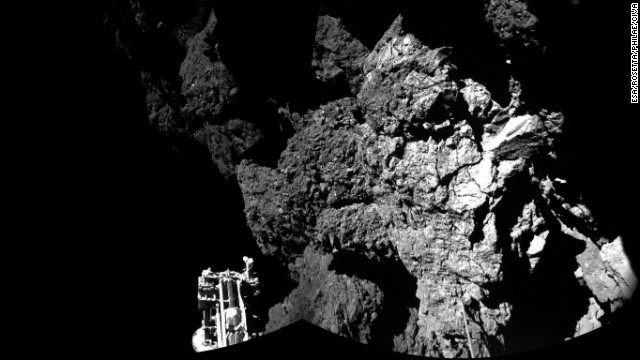
By now most every reader has seen the spectacular scenes of the Philae landing craft setting down on the surface of a comet: identified as Comet 67P/Churyumov with the approach described by the European Space Agency (which designed the craft and planned the mission) as "seven hours of terror" - as contrasted with the "seven minutes of terror" for the Curiosity touchdown on Mars.

Housing the landing craft was the "mother ship", nicknamed 'Rosetta'- which  was launched on March 2,  2004 and traveled 6.4 billion kilometres through the Solar System before arriving at the comet on 6 August 2014.  To say this feat, tracking a comet for 10 freaking years before catching up to it and landing is "astounding",  is nothing less than understatement.


To the layman, unversed in the fine points of astrodynamics or the 3-body problem of celestial mechanics, the wonder may be what all the hoopla is about.

The diagram shown depicts the nature of the extended three body problem faced by the ESA team, long after launch and in the final approach phase. (The original conditions would have matched what we call a "four body problem" involving: Sun, Earth, spacecraft and comet.) In either case the mathematics for plotting an exact trajectory to the destination is formidable. (During my years pursuing an astronomy major it sent many students rushing to the registrar to change  majors - from astronomy to maybe chemistry.)

Thus, at this phase Earth is now at m1, the Rosetta spacecraft at m2 and the comet at m3. For the stage indicated, the m2-m3 separation distance D may be about one million km and closing as the angle S changes with it. (The angle S separates the r and r3 radius vectors and Legendre polynomials figure into the detailed computations).  The actual distance D of the comet from Earth was at 300 million miles.

While landing on Mars is formidable in itself, landing on a comet moving at 84,000 miles/hour over a 4 billion mile transit is vastly more so. Not so much because of the speed per se, which can be matched by the spacecraft using a "slingshot" effect (thanks to solar gravitation), but the time delay between successive command and control signals. In addition, it's because the comet's surface is volatile and vastly more uneven than Mars. The dynamical aspect has been compared to launching a tennis ball in New York and sending it around the world 160,000 times and landing it precisely in a relative's hand in Los Angeles. Think about that!

 According to John Grunsfeld, Associate Administrator of NASA's Science Mission Directorate,  interviewed this morning on CBS:

"This is the first time we've ever landed on a comet, and the first time we've been up close and personal. People have cared about comets as long as there have been people. Ancient Chinese writings contain references to 'guest stars' portending bright futures, or wars or crop failures. 

In recent years we've realized that comets are the building blocks of our solar system. They may be our only Rosetta stone, of what we are made of. The organics in comets could be the source of the water on Earth."

Heady stuff indeed! When asked what we hope to learn, Grunsfeld answered:

"We hope to learn about the structure of the comet, the composition and also we want to learn about the water content. Specifically, do the actual atomic components of the water look like Earth's water, i.e. is it hydrogen and oxygen or deuterium and oxygen?"

We have to wait and see how ultimately successful the mission is, which would be at least lasting 64 hours to make enough measurements. Up to now, we know the 'harpoons' to anchor the craft failed, so that its continued hold on the 2 1/2 mile wide object may be precarious to say the least.

If the mission fully succeeds, of which I am confident, we may finally see the extent to which comets had a role in contributing to our planet's formation.