Showing posts with label Mars Curiosity Rover. Show all posts

Saturday, March 25, 2017

How Do We Find The Best Landing Location On Mars?


Potential Martian landing sites for 'Mars 2020' Curiosity Rover will need to 27 terabytes of data including high resolution images gained from orbiters.

Much excitement is building toward the Mars 2020 mission for the Mars Curiosity Rover which seeks to build on the discoveries of previous Rovers (Spirit, Opportunity, Curiosity).  The primary focus will be expanding our potential for past or present life beyond Earth.  Mars is a natural first suspect for other life given geological evidence for  once expansive oceans and a thick sheaf of atmospheric gases.

While the 2012 Curiosity Rover has already done yeoman service - advancing our Martian understanding from geochemistry to paleoclimate- the 2020 Rover will study the rocks and soil of the latest landing site allowing further insight into the planet's geological and astrobiological history. In addition, the 2020 mission will collect and store sets of rock and soil samples that conceivably can be sent back to Earth by a future mission. All of which elicits the question of how exactly one ascertains an optimum landing site, given the scarcity of resources available and that a wrong site could find those resources wasted.

Deciding how and where to land a Rover is no small enterprise. It generally requires a collaborative effort of the best and brightest scientists and engineers. For the 2020 mission, teams are now tasked with plowing through 27 terabytes of data, including high resolution digital images (from orbiters), then considering a multitude of different scenarios for the locations identified.  The most difficult part is determining which location scenario best fits the available data.

In the case of the Mars 2020 craft, the options for potential landing sites will also be expanded in real time based on what is called "terrain relative navigation". This is a technology that enables a craft to precisely identify where it is above the landing site.

Further insights can be obtained by going to the following links:

http://bit.ly/Meyer-webpage


Referencing the work of Michael Meyer, whose primary research focus is micro-organisms living in extreme environments. He's also one of Mars 2020's leaders and architects

And:

http://bit.ly/Ehlmann-Caltech


This refers to Beth Ehlmann whose specialties include environmental change, weathering processes on Mars, and assaying the compositional surface. She also served as a student collaborator for the Spirit and Opportunity missions.

The recent NatGeo series 'Mars' showed just how critical selection of a landing site on the Red Planet can be, especially for human colonists. However, landing site selection is also critical for any craft with astrobiology as a primary objective.. Hence, the supreme effort going into the 2020 mission.

Stay tuned!

Monday, August 10, 2015

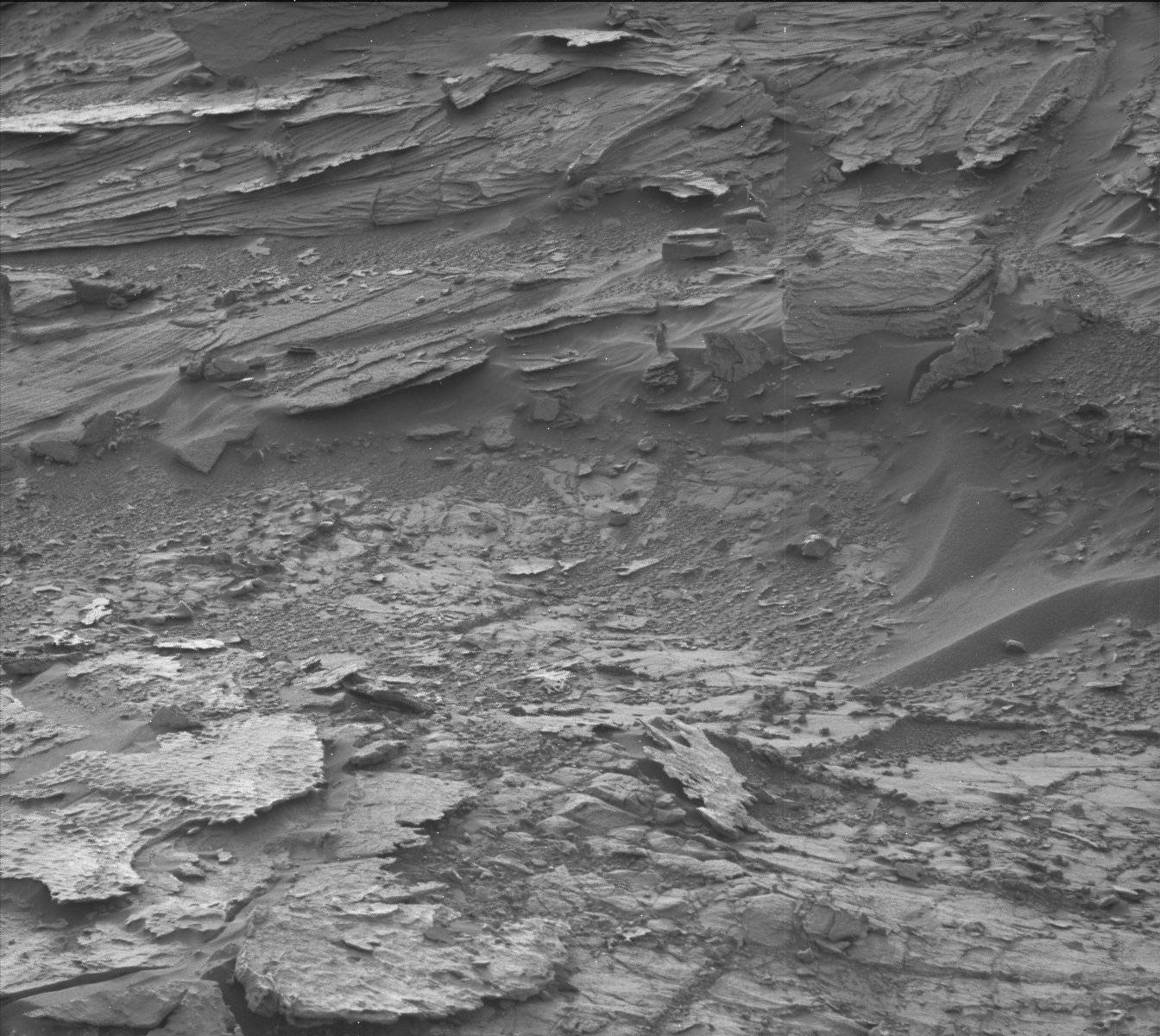
Errr...No, That's Not A Real Woman Photographed By Curiosity on Mars


Image as released by NASA

ama
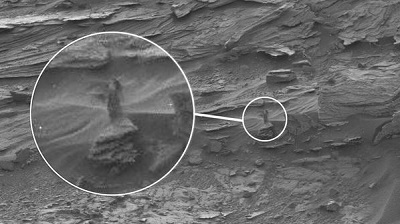
Close up image - with  Mars "woman" circled.

It appears some crannies of social media and the internet have recently erupted with images purported to be of a human (or "alien") female, standing on a flat rock on the Martian surface  - as captured by the Mars Curiosity Rover, e.g.

http://brane-space.blogspot.com/2012/08/can-mars-curiosity-rover-get-it-done.html

The skinny is that the image shows a real living entity. But here is where skepticism must come to the fore, because first, no actual living being is going to be able to survive on Mars without space suits for more than a second. There is no breathable atmosphere - mostly CO2- plus the temperatures are absolutely frigid from minus fifty to minus 100 F.  Then there is the scale of the image. Is that really a being only a few inches high? Well, if so I guess you're going to tell me fairies and Leprechauns exist on our planet too.

Look, the human brain has the remarkable propensity to see patterns and objects where none really exist. Look at how the ancients put together all manner of creatures from the constellations. Here's a large bear (Ursa Major), then a small bear (Ursa Minor), there's a hunter (Orion) and even a scorpion (Scorpio).

The point is these creatures and objects didn't really exist in the sky, the brains of the ancients "filled in the gaps" between stars to connect them.  Indeed, in many cases the stars weren't even close to each other and only seemed so in the line of sight. In some cases the "connecting" star was hundreds of light years farther away.

One sees the same brain tendency when people observe clouds. Stare at them long enough and all kinds of cloud patterns become visible - you can see butterflies, giant fish, pitchers of beer or basically whatever you want to see. That's how your brain is made. Blame your 'creator' if you like, I blame evolution. (See the book, “Faces in the Clouds” for how humans project imagery because of a basic brain wiring defect in the frontal cortex) )

Mars' images have caused consternation before as with the 'face on Mars' that was observed in the region called Cydonia decades ago e.g.
Image result for face on mars wiki
Years later (1998) the Mars Global Surveyor went over the area and actually got detailed photographs using laser altimetry - and Voila!  With much higher resolution for a 3km x 3km area, No more "face", e.g.


Simply a geological formation whose shadows  and tricks of sunlight on it  earlier fooled people into seeing a "face" - when it was viewed with far less optical resolution by the Mars Viking probe.

The moral of the story in all things to do with space, is don't always believe your eyes  - or brain - they can and will play tricks on you!


See also:

http://www.forbes.com/sites/matthewfrancis/2015/08/10/no-thats-not-a-woman-on-mars/

Friday, January 9, 2015

New "Goldilocks" Planets Found: But Do They Harbor Life?

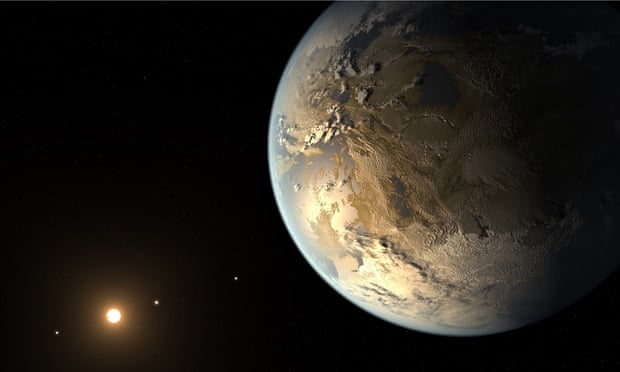
This artist's concept released April 17,
At the 225th meeting of the American Astronomical Society (AAS) in Seattle some fabulous discoveries have already been made in the area of planetary science. These concern the identification of two planets deemed "Goldilocks" candidates - which meet the same conditions for life support as here on Earth (which lies precisely within a habitable zone at the right distance from our star, the Sun).

The new data, as before, comes compliments of the Kepler Space Telescope. Now, with the announcement on Tuesday (at the AAS meeting) of 554 new planetary candidates discovered, Kepler's grand total comes to 4, 175. However, of those thousands only eight are within the "Goldilocks zone" where the host star is not too hot or too cold - hence just at the right distance to keep water in the liquid state.

While the latest findings essentially double the number of planets in the habitable zone, astronomers are especially excited about two of the candidates:

1) Kepler - 438b  - which is only 12 percent larger than the Earth in diameter or

(0.12) (8,000 mi.) =   960 miles greater

This means a larger density than would be expected from a gas planet, hence likely a rocky planet (astro-geologists assign about a 70 percent chance of being rocky).

2) Kepler - 442 b is a bit larger - about 33 percent enhanced over Earth's diameter or:

(8,000 mi.) / 3 =  2667 miles greater or 10, 667 mi.

This means a larger surface gravity (g) and at least a 60 percent chance of being rocky. Interestingly also, both planets orbit a red dwarf star  (late K or M spectral type) - not a G2 spectral type like our Sun. The red dwarf stars being at much lower  surface  temperature (4,000 F vs. 11,000 F for Sun)  would require any planets to be much closer to arrive within the habitable zone and this is what has been found.  By way of comparison here: 438 b receives 40 percent more light from its red dwarf star than Earth from its Sun, while Kepler 442 b receives 66 percent of the light (or 33 percent less).  From this it is reckoned that the latter candidate has a 97 % chance of being in the habitable zone and the former a 70 % chance.

For perspective here, it's relevant to consider what is most important. According to SETI institute astronomer Douglas Caldwell, who presented the findings to the AAS gathering, we are now that much closer to finding actual twins of Earth - and thereby possibly answering the question: 'Are we alone?'

In the words of Guillermo Torres, an astronomers at the Harvard-Smithsonian Center for Astrophysics:

"These planets do exist. We didn't know that before. What we're really looking for eventually is signs of life. We're not there yet. It will take many years."

Indeed! Which begs the question: 'Can any kind of life on these exo-planets really be determined from a distance?'

I don't believe this is in any way possible. One might find "suggestions" or "hints" that life could exist on them *, say by examining the light variations of their atmospheres (when the planets pass in between their suns and Kepler's observational line of sight and certain differences in the photometry are detected) but this is only identifying a pre-condition for life. Not life itself.

Really, technically speaking, to ascertain life is on these worlds means landing actual space craft there to do organic investigations, such as we have done with Mars robot landing craft, like the Viking and more recently, Curiosity.

But this is beyond any conceivable technology for now. Kepler 438 b, for example, is 475 light years distant, meaning that even if we could develop a spacecraft to travel at light speed (300,000 miles per second) it would take 475 years to get there. Humans might not still be around by the time it arrived  -having gone to perdition because of the runaway greenhouse effect.

Alas, the most we may be left with is the intriguing possibility of life existing on these worlds, without actually knowing it does.

--------
*  The ELT (“Extremely Large Telescope”) planned by European astronomers will offer the combination of light-gathering power and sharpness of imaging to draw such inferences about those planets orbiting nearby,

Thursday, March 14, 2013

Mars Curiosity Detects 'Building Blocks' of Life – But These Still Aren’t Life!

MSL RoverThe just reported finding that the Mars Curiosity Rover used its laser-induced breakdown spectrometer to detect the key elements needed for life (nitrogen, oxygen, carbon, sulfur and phosphorus) was encouraging to be sure and has been described as “a major coup for the Mars Science Laboratory Mission”. This has been operated out of the Jet Propulsion Laboratory in Pasadena.
But let’s be sure we don’t confuse life’s building blocks (we are assuming carbon based life) with the precursors of life.These precursors, in the form of complex carbon compounds (the basis for what we call Organic chemistry) have yet to be revealed or detected. JPL researchers do say that a key priority is to search for locations where “organics” might be preserved.

Interestingly, previous missions, e.g. Viking, have disclosed that Mars could have supported microbes billions of years ago, when water was perhaps more available – as opposed to being in frozen form now.

How would such primitive microbes have come to be?  The famous  Miller and Urey experiment provides a clue. They basically applied an electrical discharge to a chemical brew resembling the Earth’s primitive reducing atmosphere. This brew included ammonia and methane, as well as hydrogen and water vapor. The effect of the discharge transformed the mix into a diverse yield of organic compounds. These included amino acids, as well as substances such as formic acid and urea that normally occur in living organisms.

The very fact so many organic compounds could arise is remarkable in itself, given the vast number of possible compounds that might have emerged. And while it is true that the discharge didn’t produce actual living cells, there is no reason – given enough time, that a primitive pre-biotic cell in the distant past could not have emerged given the building blocks left behind.


The consensus of current research is already fairly clear about the nature or form of the first primitive organisms. They were prokaryotic autotrophs . More specifically, they were suspended colloidal micro-spheres capable of exchanging energy with their surroundings. To get energy, these self-sustaining coacervate droplets could use one or two basic reactions involving adenosine triphosphate (ATP) and adenosine diphosphate:

L*M + R + ADP + P -> R + L + M + ATP

ATP + X + Y + X*Y -> ADP + X*Y + X*Y + P


In the above, L*M is some large, indeterminate, energy-rich compound that could serve as ‘food’. Whatever the specific form, it’s conceived here to have two major parts capable of being broken to liberate energy. Compound R is perhaps a protenoid, but in any case able to act on L*M to decompose it. Concurrent with the first reaction is the possibility of a second, entailing autocatalytic molecules X*Y. These molecules could accelerate their own formation, using ATP.


On the basis of the chemical reactions, the hypothetical coacervate would consist of the combination: X*Y + R. Now, what properties ought we expect for any such primitive life form? These include: simple organization, ability to increase in size, and ability to maintain itself over extended intervals. Does the coacervate meet these conditions?

Well, it has a simple organization, consisting of the molecules X*Y and R. It can increase its size by synthesizing more of X*Y, growing until hydrodynamically unstable. Finally, it can maintain itself over indefinite intervals, so long as it can extract the chemical components it needs. What about replication? We expect that this is feasible when it splits into ‘daughters’ after growing too large. Then, so long as each has some of the protenoid R there is the capacity for replication.


From all the evidence thus far uncovered, it does appear that ancient Martian organisms in the form of coacervates roamed that planet billions of years ago. How or why Mars changed so radically we may never know - but perhaps Curiosity can also help us to find clues. Among the reigning theories is that Mars suffered a collision with a giant asteroid billions of years ago which caused it to catastrophically lose its atmosphere. With the atmosphere gone, temperatures became too extreme to support liquid water, or life. Another theory is that in the distant past Mars lost it protective magnetic field (in a primitive magnetosphere) perhaps owing to a monster solar flare or coronal mass ejection. With the loss of magnetosphere the planet would have been blasted by high frequency radiation that no life could have surivived. This, even if it did have a residual atmosphere.

Meanwhile, in basic astronomy courses, students learn that Mars never really had a chance to keep an atmosphere because of its low surface gravity. In this case typical atmospheric molecules, say like oxygen (O2) would easily have reached escape velocity. Readers can learn more about such factors here:
http://en.wikipedia.org/wiki/Atmospheric_escape