Question: I used to read James White's marvellous Galactic Space Hospital series, all
about numerous sentient alien species living in chlorine/hydrogen/oxygen/H20
etc. atmospheres, or in gravities of less than 1g or far more than 1g, and so
on. Are current scientists right in thinking that all alien life will have to be
within Earth-norms of some sort as in a form of parallel evolution? Or was James
White correct in thinking that alien, extraterrestrial life would truly be
alien by nature? And why is it so hard to find planets around non-dwarf stars?
Thanks, Geoff.
Answer:
I am not sure you're aware, but the number of "habitable" planets found thus far
is exceedingly small. Based on recent papers delivered at the 225th meeting of
the American Astronomical Society (AAS) in Seattle, two new planets (deemed
"Goldilocks" candidates) have been found. These are so defined because they
meet the same conditions for life support as here on Earth (which lies precisely
within a habitable zone at the right distance from our star, the
Sun).
The two new habitable planet candidates reported at the AAS meeting
are:
1) Kepler - 438b - which is only 12 percent larger than the Earth
in diameter or
(0.12) (8,000 mi.) = 960 miles greater
This means
a larger density than would be expected from a gas planet, hence likely a rocky
planet (astro-geologists assign about a 70 percent chance of being
rocky).
2) Kepler - 442 b is a bit larger - about 33 percent enhanced
over Earth's diameter or:
(8,000 mi.) / 3 = 2667 miles greater or 10,
667 mi.
This means a larger surface gravity (g) and at least a 60 percent
chance of being rocky. Interestingly also, both planets orbit a red dwarf star
(late K or M spectral type) - not a G2 spectral type like our Sun. The red dwarf
stars being at much lower surface temperature (4,000 F vs. 11,000 F for Sun)
would require any planets to be much closer to arrive within the habitable zone
and this is what has been found.
As noted at the AAS meeting last year, where
554 new planetary candidates were announced, the grand total now comes to 4,
175.
However, of those thousands only eight are within the "Goldilocks"
(habitable) zone of their host stars, including the two new ones identified
above.
I am not sure where you got your information on orange and red
dwarfs but let me clarify that red dwarfs (late K, M types) can be as long
-lived as orange (G0-G4) types. So can support the long time needed for
evolution. It all depends on where the planet is in relation to the star and how
stable the orbit is within the habitable zone.
Also, I don't know where you got
the information that a planet must be in some synchronous orbit about the host
star. In fact, we have no information as yet on any of the orbital revolution
periods so cannot assume such rotation. So one face does not have to
"permanently" face the red dwarf star while the other half is away from it.
(Which would be a catastrophic condition for life to evolve).
As to
your question 'why it's so hard to find planets around non-dwarf stars?' (red or
orange) the answer is because higher spectral types mean much shorter lifetimes
on the main sequence so less time to evolve life. Also, for whatever reason, the
masses of the planets found so far on those stars seem to be far too large to
support life (too high a g-value would make it difficult to evolve life like
ours) or else are gas giants like Jupiter.
Regarding James White's alien
life conjectures, while it's certainly possible (I never like to say
'impossible' ) that such exotic life might exist, most exo-biologists adhere to
a conservative or orthodox view that any actual extraterrestrial life is more
probably carbon -based. Thus, it would more plausibly follow along evolutionary
lines as life forms have on Earth - which means beginning on a planet within a
habitable zone as a necessary condition.
Showing posts with label red dwarf stars. Show all posts
Showing posts with label red dwarf stars. Show all posts
Friday, October 19, 2018

Friday, January 9, 2015
New "Goldilocks" Planets Found: But Do They Harbor Life?
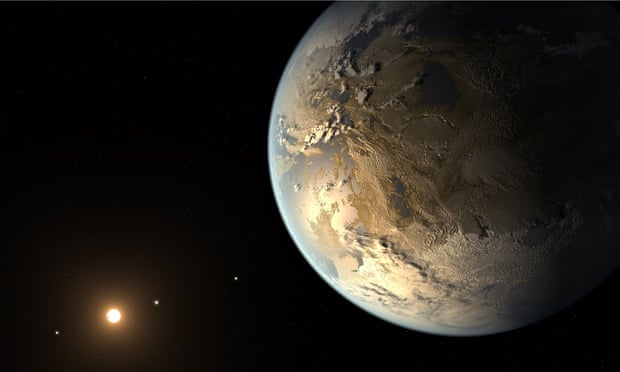
At the 225th meeting of the American Astronomical Society (AAS) in Seattle some fabulous discoveries have already been made in the area of planetary science. These concern the identification of two planets deemed "Goldilocks" candidates - which meet the same conditions for life support as here on Earth (which lies precisely within a habitable zone at the right distance from our star, the Sun).
The new data, as before, comes compliments of the Kepler Space Telescope. Now, with the announcement on Tuesday (at the AAS meeting) of 554 new planetary candidates discovered, Kepler's grand total comes to 4, 175. However, of those thousands only eight are within the "Goldilocks zone" where the host star is not too hot or too cold - hence just at the right distance to keep water in the liquid state.
While the latest findings essentially double the number of planets in the habitable zone, astronomers are especially excited about two of the candidates:
1) Kepler - 438b - which is only 12 percent larger than the Earth in diameter or
(0.12) (8,000 mi.) = 960 miles greater
This means a larger density than would be expected from a gas planet, hence likely a rocky planet (astro-geologists assign about a 70 percent chance of being rocky).
2) Kepler - 442 b is a bit larger - about 33 percent enhanced over Earth's diameter or:
(8,000 mi.) / 3 = 2667 miles greater or 10, 667 mi.
This means a larger surface gravity (g) and at least a 60 percent chance of being rocky. Interestingly also, both planets orbit a red dwarf star (late K or M spectral type) - not a G2 spectral type like our Sun. The red dwarf stars being at much lower surface temperature (4,000 F vs. 11,000 F for Sun) would require any planets to be much closer to arrive within the habitable zone and this is what has been found. By way of comparison here: 438 b receives 40 percent more light from its red dwarf star than Earth from its Sun, while Kepler 442 b receives 66 percent of the light (or 33 percent less). From this it is reckoned that the latter candidate has a 97 % chance of being in the habitable zone and the former a 70 % chance.
For perspective here, it's relevant to consider what is most important. According to SETI institute astronomer Douglas Caldwell, who presented the findings to the AAS gathering, we are now that much closer to finding actual twins of Earth - and thereby possibly answering the question: 'Are we alone?'
In the words of Guillermo Torres, an astronomers at the Harvard-Smithsonian Center for Astrophysics:
"These planets do exist. We didn't know that before. What we're really looking for eventually is signs of life. We're not there yet. It will take many years."
Indeed! Which begs the question: 'Can any kind of life on these exo-planets really be determined from a distance?'
I don't believe this is in any way possible. One might find "suggestions" or "hints" that life could exist on them *, say by examining the light variations of their atmospheres (when the planets pass in between their suns and Kepler's observational line of sight and certain differences in the photometry are detected) but this is only identifying a pre-condition for life. Not life itself.
Really, technically speaking, to ascertain life is on these worlds means landing actual space craft there to do organic investigations, such as we have done with Mars robot landing craft, like the Viking and more recently, Curiosity.
But this is beyond any conceivable technology for now. Kepler 438 b, for example, is 475 light years distant, meaning that even if we could develop a spacecraft to travel at light speed (300,000 miles per second) it would take 475 years to get there. Humans might not still be around by the time it arrived -having gone to perdition because of the runaway greenhouse effect.
Alas, the most we may be left with is the intriguing possibility of life existing on these worlds, without actually knowing it does.
--------
* The ELT (“Extremely Large Telescope”) planned by European astronomers will offer the combination of light-gathering power and sharpness of imaging to draw such inferences about those planets orbiting nearby,
Subscribe to:
Posts (Atom)