Showing posts with label Hubble Space Telescope. Show all posts

Wednesday, November 22, 2017

Discovering "Hot Jupiter" Exoplanets Using CUTE (Colorado Ultraviolet Transit Experiment )

Hot Jupiter illustration
Artist's depiction of vaporization of a Jupiter-sized exoplanet


In our solar system, there are no "hot Jupiters". The only Jupiter we know is a frigid (-161 C) gas giant:
Jupiter and its shrunken Great Red Spot.jpg
It is some 86,000 miles in (mean) diameter, and at a distance of 5.2 AU (778 million km) from the Sun.   Given that semi-major axis distance then by Kepler's 3rd law of planetary motion, the orbital period would be 11. 86 years.

But now consider another, distant solar system which features a "hot Jupiter" as an exoplanet.  A hot Jupiter is a giant gaseous planet that orbits close to its parent star.  Unlike Jupiter this planet  takes only a couple of days to complete a trip compared to the 88 days it takes Mercury to orbit the Sun.  How close would a planet have to be to its Sun to complete an orbit in 2 days? By  Kepler's 3rd law:

a 3 = P 2

Where P = 0.006 yr.  So:  a = [P 2] 1/3   =   0.033 AU

Or, just over 3 million miles distant, which is approximately 12 times closer to its Sun than Mercury is in our own solar system.  At this close distance the parent star would dump 400 times more radiation into the nearby planet, superheating it. This would then cause the planet's atmospheric gas and particles to move ever faster until they exceed the escape velocity, shooting out of the large planet’s gravitational pull.  This would have the general appearance of a large comet - hence is  represented by the depiction shown in the graphic.

Now introduce the Colorado Ultraviolet Transit Experiment or CUTE, a shoebox-sized satellite equipped with a telescope that will launch in 2020. Its objective will be to study 12 to 20 exoplanets:  gigantic gaseous planets called “hot Jupiters, which have evaporating atmospheres trailing behind them akin to a comet.

In February, NASA allocated $3.3 million of funding for four years to the CUTE project. CUTE will leave the lab at University of Colorado-Boulder where it is being built in 2020 to hitch a ride to space along with another NASA mission. It will still be operated from the CU campus — with the help of students — as it remains in low orbit around Earth for a year, studying these “hot Jupiters.”

If all goes well, the CUTE team will ask NASA for approval to continue the research.  The candidates sought as hot Jupiters will have certain signatures for sure. In particular, the CUTE team will seek evidence for a planet which becomes "big and puffy" and  continues trucking around its star as stellar wind drags the atmosphere into a tail.

Hot Jupiters aren’t found in our solar system because no gas giants are found any nearer our Sun than Jupiter at 5.2 AU..  Our space neighborhood doesn’t even have the most common planet in the Milky Way: a "Super-Earth", or a sub-Neptune as some call it. This is a planet that’s a little bit larger by volume,  and a bit more massive than Earth.

The hot Jupiter phenomenon was first discovered with the Hubble Space Telescope.  But no such entity has ever  actually been photographed. The discovery is made by the indirect light curve method, e.g.
Image may contain: text
 Thus, any planet that passes in front of its Sun blocks most of the light. But scientists have (in this caae0 noticed times when a planet had already passed its star but the light continued to be partially blocked, as though something was trailing it. This tipped researchers off to the planets’ tails.

The CUTE team includes Kevin France - the project leader and assistant professor at the CU Laboratory for Atmospheric and Space Physics and other LASP researchers. The latter include professional research assistant Rick Kohnert, engineers and several graduate students. CU’s Astrophysical and Planetary Sciences research professor Brian Fleming is also part of the team.

Outside of CU, the CUTE team includes researchers from the University of Arizona, the Space Research Institute of the American Academy of Science in Graz, Austria, Trinity College in Dublin, Ireland, the University of Toulouse, France, and the University of Amsterdam in the Netherlands.
When asked if the CUTE acronym was intentional, one team leader (France)  let out an extended “yeah” and then started to laugh.


When casual observers ask 'what's it all for'?  France and his team deliver a solid, coherent responose - as articulated by Kevin France himself:

"All of exoplanetary science is about understanding our place in the universe. It ties into all of those big picture questions. Are we alone? Is Earth unique? Are there other solar systems like ours?"

The CUTE project will go a long way toward answering many of those questions, and the UC team should be proud of its role.

Tuesday, September 19, 2017

Particle Beams Over Jupiter's Poles Incite Questions

Image result for brane space, Jupiter aurora
Infrared image of auroral oval above Jupiter's southern polar regions.

In earlier posts, I examined some of  the research into the appearance of aurorae on Jupiter. For example, on Nov. 21, 2015 I cited some of the earliest research done, by two astronomers  (Ray S. Clary and James H. Hunter Jr.)  from the University of South Florida, e.g.
No photo description available.
Their paper, Hydrogen Alpha Auroral Activity on Jupiter', appeared in The Astrophysical Journal (Vol. 199, p. 517) and dealt with the attempted detection of auroral activity on the largest planet.  They carried out their observations from April through November, 1972 "usually with Jupiter 2 hours or less  from the meridian". This would have ensured the optimal seeing conditions since Jupiter's altitude would be displaced enough from the horizon to avoid atmospheric effects, and enable the greatest clarity.

The pair ended up making a total of 100 hours of observation yielding some 2,000 photographs of Jupiter, most of them prior to the planet's opposition on June 24 of that year. Still "observations were often interrupted by clouds or haze"  Alas, the results themselves were ambiguous. Examining their prime plates published in their paper (4 pages in all) I could detect nothing remarkable or any features that stood out - even in the polar areas.

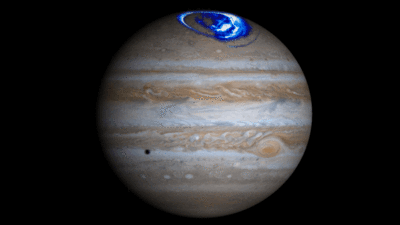
Contrast this limited observational condition with one of the highly enhanced images of Jupiter's aurorae (at N. and S. poles)  visible in the Hubble Space Telescope photograph below e.g.

Image result for brane space, Jupiter aurora
A major difference is that unlike Earth's auroras, those on Jupiter are nearly continuous - driven by the planet's rapid rotation and its volcanic moon (Io),  which spews out sulfur and oxygen ions as well as electrons into space, The latter speed along the planet's magnetic field lines and - if powerful enough - slam into the atmosphere causing its particles to glow.

Tao et al (Journal of Geophysical Research -Space Physics, Oct. 2015, p. 1002), using the Japanese Hisaki Space Telescope, measured variations in the brightness of the Jovian aurorae. They reported observing two kinds of auroral pulses. In one, the aurora brightened for up to several days at a time, and the authors attributed this to the solar wind. Thus, as it 'washes over' the planet, the charged particles are buffeted and compress Jupiter's magnetic field. This is very similar to what happens on Earth.

The team also observed much more rapid variations, with pulses typically lasting less than ten hours. By comparing the Hisaki images with images taken simultaneously by the Hubble Space Telescope, Tao et al could see these variations arose from the aurora brightening at lower altitudes, at the bottom of the auroral arc and as reported by Kimura at al (op. cit.)

Another mystery that emerged was the fact that the ultraviolet (UV) radiation intensity appeared much brighter than the UV from the Sun.  How can this be? A planet's UV radiation intensity greater than a star's?

Last August, NASA’s Juno spacecraft deepened that mystery: In a close flyby of Jupiter’s poles, it found powerful angular beams of electrons above the aurora, extending in energy to greater than 1 million electron volts. These beams shoot upward over the polar caps and over the main aurora, even where a weaker downward component contains sufficient energy flux to generate the powerful emissions from the main aurora.

Now, as a contribution to a special Geophysical Research Letters section on Juno’s first encounter with Jupiter, Mauk et al. provide the most detailed analysis of this phenomenon yet. Although they don’t know the causes, they suggest it may be the key to understanding Jupiter’s intense auroras.

Juno’s close encounter came on 27 August 2016, just a couple months after it arrived at Jupiter to study the planet, its moons, and its enormous magnetic field. The spacecraft’s pass over the northern and southern poles took it above dancing ovals of aurora, allowing it to peek into the polar regions within.  Mauk et al analyzed data from the Jupiter Energetic Particle Detector Instrument, which measured the trajectories and energies of the charged particles whizzing past. As the craft approached the auroral oval from the more equatorward regions, it saw typical signatures of trapped electrons with up-down differences reminiscent of those generating faint diffuse auroras at Earth.

When the spacecraft passed directly over the bright main auroral oval, it detected two highly directional angular beams—for both downward and upward traveling electrons. When Juno fully crossed inside the oval, deep within the polar caps, the downward beams virtually disappeared, leaving only the upward beams, varying in intensity but always present. This is very unlike what happens at Earth, where spacecraft passing over the most intense auroras find electrons accelerated downward only into what are called energy beams.

The Jovian bidirectional angle beams indicate that Jupiter’s aurora are generated by a totally different process than on Earth—a much more random one where collisions and turbulence propel particles both down and up along magnetic field lines. The team hypothesizes that this may have been happening most strongly in the region below Juno’s position, which could explain why Juno saw the large up-down differences in the beams over the main auroral oval.

It's tempting to conjecture that the monodirectional electron angular beams emerging from the “polar cap,” can be modeled using something analogous to:
Image may contain: text
The diagram shows the orbital plane of the (25–800 keV) electron's motion, as well as the orientations of the local magnetic induction (B) - out of the plane (toward the reader), and the radiated E-field which is polarized parallel to the orbital plane.  The authors' abstract (Geophysical Research Letters, https://doi.org/10.1002/2016GL072286, 2017)  notes the energy spectra of all beams being monotonic and hard (i.e. not structured in energy), showing power law-like distributions often extending beyond ~800 keV.   They also make reference to "variable downward energy fluxes (below 1 RJ altitudes within the loss cone".


Note that the loss cones is an important device in space physics. One uses the sine of the loss cone angle to obtain the mirror ratio relating the magnetic inductions at the presumptive loop ends:

sin (q L ) = ± Ö (Bmin / B max )

If one finds that there are particles within the “mirrors” for which the “pitch angle” (a) has:

sin (a )  >  Ö (Bmin / B max )

then these will be reflected within the tube, On the other hand, those particles for which the “less than” condition applies will be lost, i.e. on transmission out of the mirror configuration.

For the Juno observations, the equation used (see paper at link below) was:

(B source / B Juno )  =   sin 2 (a source ) /  sin 2 (a Juno )

=   B Juno  /  sin 2 (a Juno )


where αsource = 90°, BJuno and αJuno are the magnetic field strength and the beam angle at Juno, respectively, we find that Bsource ≈ 8.1 G in the north and Bsource ≈ 7.2 G in the south

See also:

http://onlinelibrary.wiley.com/doi/10.1002/2017GL073180/full

Saturday, December 3, 2016

Europa's Plumes: What's Their Significance?


Image of Europa from the Hubble Telescope. Note the plumes clearly visible at lower left.

The wispy, towering (200 km high) plumes of water vapor, rising above the icy surface of Jupiter's moon Europa, are readily visible in the lower and left periphery of the image.  For some time there's been a question of whether these really exist, or are more a mirage like the once popular Martian canals. Now, new images from the Hubble Space Telescope at least strengthens prior evidence for existence, ongoing since the Galileo mission discovered the moon's subsurface ocean in 1996.

One excited researcher is Louise Prockter, director of the Lunar and Planetary Institute in Houston. Quoted in EOS Earth & Space Center News  (15 November, p. 11):

"It's potentially great if the images do sow plumes from Europa ...because that means Europa's subsurface is coming at us. We could sample the material without digging through ice."

In fact, as the most recent issue of ASTRONOMY notes (Janaury, 2017, p. 11):

"If Europa has geysers, it opens new possibilities to test if the moon has the right conditions for life. As with Enceladus, space agencies may be able to fly a spacecraft through the plumes and test test the chemical signatures without having to drill into the surface. Additionally, such an encounter could identity areas where the ice shell is weaker and thinner."


In the case of the latest Hubble study, it was led by William Sparks, a researcher at the Space Telescope Science Institute in Baltimore who used a novel method to independently corroborate the plumes which is statistically significant.   The plumes, or "geysers", were originally discovered by Lorenz Roth et al in 2012 on surveying a silhouette of Europa against the background of space for spectral lines of hydrogen and oxygen (indirect indicators of water).  To read some more on this work, go to:

http://bit.ly/2012-plumes

By contrast, Sparks and co-workers made their observations as Europa passed in front of Jupiter. More of their work, which appeared in the Sept. 29 issue of The Astrophysical Journal, e.g.

http://bit.ly/ApJ-29Sept

can also be found here:

http://www.nature.com/news/europa-s-peek-a-boo-plumes-confirmed-1.20685

Interestingly, exoplanet researchers have commonly used this same technique - called transit photometry- to find their object against the background of the star it orbits. I had actually looked at the basic method in a previous post, e.g.

http://brane-space.blogspot.com/2016/07/carrying-out-yur-own-exoplanet-and.html

Once again, the basic principle is simple: when an object moves in front of a light source it blocks out part of that light. The amount of occlusion and the time duration gives an indication of the size of the exoplanet.  Sparks and his team actually went beyond this template, in that Jupiter's glow provided a sufficiently smooth background against which potential plumes could be viewed.

The actual images were made in 2014 during Europa's transit of Jupiter, but processing them to achieve adequate resolution took many months. By using a method distinct from the one (by Roth et al) for the original plume discovery, the Sparks team supplied credibility to the hypothesis that the plumes exist. Still, Sparks urged caution, advising the result "was not one hundred percent verifiable" given that Hubble had operated at its technological limits in making the images.

One optimistic note is provided by recent history in respect of the Saturnian moon Enceladus, which had its own plumes confirmed a decade ago. This suggests similar confirmation may follow with Europa's plumes, but require actual spacecraft observations, since they seem to occur only under certain conditions.

Alas, we won't really know until years after 2022 when the European Space Agency (ESA) launches its Jupiter Icy Moons Explorer Mission. NASA is also building a Europa-focused mission (Europa Multiple Flyby Mission)  scheduled to launch between 2020 and 2024. That is, unless Trump and the Republicans cut the NASA budget.


Sunday, January 10, 2016

Jupiter's Pulsing Aurora

Image showing bright patches glowing associated with Jupiter's ultraviolet aurora - observed by the Hubble Space Telescope.

In an earlier post (Nov. 21, 2015) I noted the work of two University of South Florida astronomers (Ray S. Clary and James H. Hunter Jr.), on the attempted detection of auroral activity on Jupiter ('Hydrogen Alpha Auroral Activity on Jupiter') and published  in The Astrophysical Journal (Vol. 199, p. 517).  They noted correctly that given the correlation between Jupiter's radio emissions and solar outbursts nonthermal, visible emissions from the planet ought to have been detected. Most importantly, they pointed out that:

"At least the polar areas should be visible since aurorae should be most likely there"

They carried out their observations from April through November, 1972 "usually with Jupiter 2 hours or less  from the meridian".

However, their results were mixed, e.g. in  'Results and Conclusions' the authors wrote:

"Most of the pictures (> 90 percent) taken in H-alpha during the experiment showed no significant detail on the 'surface' of Jupiter."

They added that:

"Equatorial features should have been resolved if they were visible. Haze and /or clouds reduced the resolution and brightness of images and it was frequently necessary to discontinue an observing run."
One of their interpretations was:

"Apparent variations in Jupiter's emissions were observed but the effects must be deemed spurious doe to conditions at the observing site"

Decades later, and using appropriate space telescopes, those variations in emission don't seem to be spurious at all. Only recently Tao et al (Journal of Geophysical Research -Space Physics, Oct. 2015, p. 1002), using the Japanese Hisaki Space Telescope, measured variations in the brightness of the Jovian aurorae. They reported observing two kinds of auroral pulses. In one, the aurora brightened for up to several days at a time, and the authors attributed this to the solar wind. Thus, as it 'washes over' the planet, the charged particles are buffeted and compress Jupiter's magnetic field. This is very similar to what happens on Earth.

A major difference is that unlike Earth's auroras, those on Jupiter are nearly continuous - driven by the planet's rapid rotation and its volcanic moon (Io),  which spews out sulfur and oxygen ions as well as electrons into space, The latter speed along the planet's magnetic field lines and - if powerful enough - slam into the atmosphere causing its particles to glow.

The team also observed much more rapid variations, with pulses typically lasting less than ten hours. By comparing the Hisaki images with images taken simultaneously by the Hubble Space Telescope, Tao et al could see these variations arose from the aurora brightening at lower altitudes, at the bottom of the auroral arc and as reported by Kimura at al (op. cit.)

Using Hisaki's onboard spectrometer, the Tao team was also able to estimate how fast the electrons were traveling on the basis of how deep in the atmosphere the light originated. They found that when the aurora flares up it's not because faster, more energetic electrons are penetrating deeper into the atmosphere. It is instead due to the overall increase in the number of electrons.

All of this indicates that Jupiter's most intense auroras occur when plasma is suddenly injected into its magnetic field, most likely from Io.

We have to await further work to confirm these pulses and also more in-depth research into their causes.

Saturday, November 21, 2015

Detecting Auroral Activity on Jupiter - New Energy Insights


In 1975, two University of South Florida astronomers (Ray S. Clary and James H. Hunter Jr.), published their paper ('Hydrogen Alpha Auroral Activity on Jupiter')  on the attempted detection of auroral activity on Jupiter in The Astrophysical Journal (Vol. 199, p. 517).  They noted correctly that given the correlation between Jupiter's radio emissions and solar outbursts nonthermal, visible emissions from the planet ought to have been detected.

They then documented a brief history of such efforts by reference to the narrow passband H-alpha filters used and noted that "intense auroral activity should have increased the narrow passband channel's output". However, in most of these efforts the aperture of the telescopes used were not adequate to detect substantial localized activity,

When the 84 -inch Kitt Peak telescope was finally used by Dulk and Eddy (Astronomical Journal, Vol. 71, p. 160, 1966), paired with a coude spectrograph of 0.1 A resolution," no evidence for activity greater than 1.2 kilorayleighs was found". In a different observation, a possible H-alpha feature was found but the author (Schwitters, Icarus, 1968, Vol. 9, 570) )admitted it may have arisen from a plate defect.

With this history, the USF astronomers then attempted their own H-alpha detection using the university's 26-inch Schmidt -Cassegrain telescope. Most importantly, they noted that:

"At least the polar areas should be visible since aurorae should be most likely there"

They carried out their observations from April through November, 1972 "usually with Jupiter 2 hours or less  from the meridian". This would have ensured the optimal seeing conditions since Jupiter's altitude would be displaced enough from the horizon to avoid atmospheric effects, and enable the greatest clarity.

The pair ended up making a total of 100 hours of observation yielding some 2,000 photographs of Jupiter, most of them prior to the planet's opposition on June 24 of that year. Still "observations were often interrupted by clouds or haze"

Alas, the results themselves were ambiguous. Examining their prime plates published in their paper (4 pages in all) I could detect nothing remarkable or any features that stood out - even in the polar areas- and which could have been identified with auroral activity. In their own stated words, for 'Results and Conclusions' the authors wrote:

"Most of the pictures (> 90 percent) taken in H-alpha during the experiment showed no significant detail on the 'surface' of Jupiter."

They added that:

"Equatorial features should have been resolved if they were visible. Haze and /or clouds reduced the resolution and brightness of images and it was frequently necessary to discontinue an observing run."

Their results, such as they were, had been attributed to one of two interpretations:

1) Apparent variations in Jupiter's emissions were observed but the effects must be deemed spurious doe to conditions at the observing site, and

2) A general, nonlocalized, H-alpha airglow was observed that was sufficiently intense to prevent observation of familiar Jovian features given the airglow strength was 3-5 kilorayleighs.

In other words, (2) meant the airglow emission strength likely wiped out any residual auroral signal.

While Clary's and Hunter's observational effort represented a determined 'experiment'  to detect H-alpha emissions, it also showed the limitation of ground -based observations for a delicate optical feature presumed to exist on a distant planet. No surprise then that the actual detection of Jovian aurorae had to await the observations of the Hubble Space Telescope launched some 30 years later.  One such image from the HST is shown below:


Image of Jupiter aurorae using Hubble Space Telescope

Interesting, and unknown to the USF astronomers at the time, Jupiter's aurora occurs mostly in the ultraviolet (UV) part of the spectrum. Still, analogous to Earth's aurorae, Jupiter's are caused by showers of energetic particles, e.g. from the solar wind, raining down on the upper atmosphere, exciting atoms and causing them to glow.

Recent research by Gerard et al (Journal of Geophysical Research - Space Physics, 2014) goes one step further and also shows  how energetic these incoming particles (mostly electrons) are using one of the Hubble's spectrographs.  They found the most energetic incoming electrons penetrate the deepest into Jupiter's atmosphere producing a UV emission closer to the surface.

To map these more energetic electrons (as shown above) the Gerard team panned Hubble's 'eye' across the disk of Jupiter at a constant rate and used a special mode of the spectrograph that tags every bit of light detected with a time stamp. In this way they could later reconstruct which emission came from which part of the planet.

These maps could very well provide insight into one of the planet's most enduring mysteries: why its upper atmosphere is so hot. Decades of measurements show that Jupiter's atmosphere contains much more heat than would be expected if its only source was incoming solar radiation. The energy deposition maps show that the aurorae may play a role in this extra heating given the amount of energy the electrons deposit in the upper atmosphere is enormous - on the order of 10 terawatts, the equivalent of about 10,000 nuclear reactors. This is vastly greater than the energy Jupiter absorbs from the Sun.

A pity that my former USF colleagues didn't have available then what the Gerard team and others have had since Hubble achieved orbit.