Showing posts with label Abelian groups. Show all posts

Wednesday, April 19, 2017

Math Revisited: Permutation Groups

Among the most interesting entities in abstract algebra is the permutation group. To fix ideas, consider the following example:

Let S = {1, 2, 3} and define the group G = {The set of all permutations on S}

a) Write out all the members of G

b) Show that G obeys group properties and determine whether or not it is Abelian

Solution::

We may first determine how many members G has using the fact the number of elements will be n = 3!

= 3 x 2 x 1 = 6.

The components to the elements can then be found:

(1,2, 3), (1, 3, 2), (3, 2, 1), (3, 1, 2), (2, 1, 3) and (2, 3, 1)


These are not the elements themselves, which must be written as (2 x 3) matrices. For example, the identity element will be: e =

[1 2 3]

[1 2 3]

The other elements we can write:

s1 =

 [1 2 3]

[2 3 1]


s2 =

[1 2 3]

[3 1 2]


t1 =

[1 2 3]

[1 3 2]


t2 =

 [1 2 3]

[3 2 1]


t3 =

 [1 2 3]

[2 1 3]


We can now prepare a group table to show the operation is binary and G meets the Group definition. We have for G = {The set of all permutations on S}:


        e---- s1--- s2--- t1 ---  t2 ---  t3
--------------------------------------------------
e  --   e  ---s1--- s2 --- t1 --- t2---  t3

s1  --s1--- s2--- e ----t2 ----t3 ----t1

 s2  --s2----e  ---s1---  t3---   t1----  t2

 t1  ---  t1-  t3-  t2 ---  e ---  s2 -----s1

t2  ----t2--- t1-- t3- - s1--- e------ s2

t3 -----t3 ---t2 ---t1 ---- s2 --- s1---- e
------------------------------------------


The shaded highlights shown are intended to emphasize the symmetries in the table (which can also be found for the s  elements).

Is G Abelian? If we check any two elements and find they don’t meet the commutative property (4) then the answer is no. By inspection:

t1 • t2s1 =

[1 2 3]

[2 3 1]


but t • t21s2     =

 [1 2 3]

[3 1 2]


So, the commutative property is not met, and G is not Abelian.

Other examples: Groups of permutations related to 1:1 mappings (functions).

Let A be a set and let s  and t be permutations of A so that s and t are both one-to-one functions mapping A onto A. Then the composite function is s t   and will be a permutation if it is one-to-one and onto A.

Definitional illustrations:

A)If  a1(s t) = a2(s t), then (a1s t = (a2 st and (a1s) = (a1s ) (since t  is 1:1) and a1 = a2.

Hence (s t) is 1:1.

B) Let a  Î A , then since t is onto A, $ a’ Î such that a’t = a. Since s is onto A, $ a" Î such that a’ = a” s. Then, a = a’t = (a” st = a” (s t).

Example: Let A = {1, 2, 3, 4, 5} and

s =

[1 2 3 4 5]
[4 2 5 3 1]

In this case: 1s = 4, 2s = 2, 3s = 5, 4s = 3, and 5s = 1

Now, let:

t =

[1 2 3 4 5]
[3 5 4 2 1]

Then: 1t = 3, 2t = 5, 3t = 4, 4t = 2, and 5t = 1

Then we can find  st  by matrix multiplication (for details of matrix multiplication, see http://brane-space.blogspot.com/2010/05/looking-at-matrix-groups.html ).


The result will be:

[1 2 3 4 5]
[2 5 1 4 3]

(Which the reader should be able to verify!)

Practice Exercise:

Let A = {1, 2, 3, 4, 5} and be the result above (st)  

Find: 1 t, 2t , 3t , 4t, and 5t

Tuesday, April 18, 2017

Math Revisited: Abstract Algebra - Groups

1. Definitions:

A GROUP is a set G with one binary operation defined on it , and G satisfies the axioms:

(a) Associative law: a· (b · c) = (a· b) · c

(b) Identity element (e): there exists an element e  Î  G such that: e · a = a for all a Î G and a · e = a

(c) Inverse element: For any a Î G there exists an element a - 1  Î G such that:
a · a - 1 = a - 1 · a = e

d) Commutativity[1]: Only if there exist elements a, b Î G such that (a · b) = (b · a), then G is said to be an Abelian Group.

2. Generating Simple Groups:

A) Clock Groups:

These are amongst the simplest of all, and easiest to generate – they also represent a nice introduction to modular arithmetic, the Euclidean Algorithm etc.

Let a clock group representation be denoted as shown in the diagram of Figure 1.

We seek to construct a group from the above, which is closed under addition. As we can see there are four members, 0, 1, 2, and 3. The process of addition is defined by adding elements – starting with 0- in a clockwise sense. Doing this we should be able to find a complete closed set of addition operations for all the elements. For example, we find 0 + 1 =1, and 0 + 2 = 2 and so forth. Similarly, we find 1 + 1 = 2, 1 + 3 = 0, 2 + 3 = 1 and so on. Each result obtained by adding the portion of the cycle from the starting element. From here, we may set out the group under addition (+) (Fig. 1- right top)

The reader should easily be able to check each of these and demonstrate for himself that the table is valid. Is G+⊕ (4) a group? Yes, because it obeys all the properties for a group.

Problem: For the same group, develop a table to show it is closed under multiplication (x). Hint: Simply extend the principle of addition to the case of multiples, and start all multiple entries counting clockwise from 0. For example, 2 + 2 + 2 amounts to three two’s counted from 0. (Three sets of two). One such counting set leads to 2, and two leads to 0 and three leads to…? Obviously, 2.

Thus: 4 + 4 = 0 and 4 + 4 + 4 = 0 so that 3 x 4 = 0

What about: 3 + 3 + 3?

By inspection and using the clock graphic we obtain: 3 + 3 + 3 = 1 so that 3 x 3 = 1

We thereby arrive at the (x) table for the group G+⊕ (4) (Bottom right in Fig. 1)

Is this group commutative? Some checks of the operation using pairs of elements will confirm that it is (E.g. 2 x 3 = 3 x 2). Hence, we can aver it is an Abelian group.

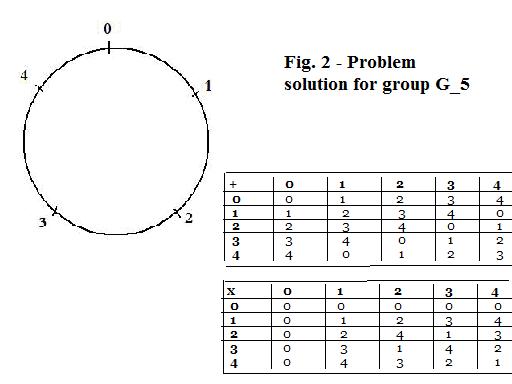
Problem: Set out a clock group with five elements (G+⊕ (5)), and prepare tables to show the group is closed under (+) and (x).

Solution:

The correct diagram is shown in Fig. 2, along with the tables for multiplication and addition.


B) Cyclic Groups and Sub-groups

A more advanced variation on the simple clock group is what's called a "cyclic group" which we will see can also be a sub-group. To clarify definitions here - let G denote a group, and let H be a subset of G then H is a subgroup of G if: H is closed under the same operation as G, for each element x there exists the inverse element, x - 1, and these are related to an identity element I such that: (x)(x - 1) = I.


A relevant theorem- Lagrange's Theorem:

Let G be a group of finite order n, then let a be any element of G. Then the order of the element divides the order of G.

Proof:

Let H be the set of all powers of a:

H = {a, a2 , a3 , a4...........a n}

But, H must have a finite number of distinct elements.

Then: a n = a m (for some m)

a n(a m- 1 = a n - m   a m (a m- 1 = a n - m *I

Is the cyclic group closed under (x)? Check by consideration of C 4, the cyclic group of order 4. To see an example of C 4 simply take the diagram for the clock group, G+⊕ (4), and re-assign it elements as follows:

0 -> 1

1 -> a 1 = a

2 -> a 2

3 -> a 3


Now, what will the multiplication table look like?

Solution: the result is shown in Fig. 3.  Note especially how the table differs from the (x) table for the clock group, G+⊕ (4).


Practice exercise:

Using the diagram for the clock group G+⊕ (5) in Fig. 2 as a template, work out the elements for the cyclic group C 5. Prepare a table for (x) applicable to its elements. Is  C 4  a sub-group of  C 5? Why or why not?

--------------------

[1] This is not a critical, or indispensable group property. If it does apply, we say the group is Abelian

Saturday, December 10, 2016

The Peculiarities Of Elliptic Curves And Their Rational Points


Example 1 of an elliptic curve under study for rational points


Example 2 of an elliptic curve. Can you identify its rational points


In an earlier post from 2010 , e.g.

http://brane-space.blogspot.com/2010/04/looking-at-groups.html


I noted the definition for an Abelian group, in respect of the commutative property i.e. Only if there exist elements a, b Î G such that (a · b) = (b · a), then G is said to be an Abelian Group.   
According to Mordell ('On the rational solutions of the indeterminate equation of the third and fourth degrees', Proceedings of the Cambridge Philosophical society, Vol. 21 (1922), 179),

The set E(Q) of rational points of an elliptic curve E defined over Q (the set of rational numbers) forms a finitely generated Abelian group such that:

E(Q) = Zr  ⊕ E(Q)tor


for some non-negative integer r and finite Abelian group E(Q)tor.  Where  'tor' denotes the torsion subgroup.

In general,  elliptic curves can be considered in long or short Weierstrass form. For the former, we know an elliptic curve over Q is isomorphic to the projective closure of the zero locus of the equation:

y2  + a1 xy  + a3y =  x3      + a2 x2   +  a4 x + a6

But when defining a nonsingular curve the preceding can be transformed over Q to the short form:

y2  =   x3    +  Ax   +  B


for A, B   Î Q   with non-zero discriminant   D = -16 (4 A3  +   27 B2 )

N.B. The non-vanishing of the discriminant ensures the curve is nonsingular.

And we say the elliptic curve given by the short form has height coordinate maximum:

h (E) =   max (4 |A|3 ,   27 B2)

Consider now two examples of elliptic equations with graphs for subsets of the real points shown above.  These are:

1) y2  =   x3     –       x  

And:

2) y2  =   x3     –     x  +  1


For each curve we can apply the short form for the Weierstrass equation. Thus, for (1) we have:    A = -1  and B = 0

Then the discriminant :   D = -16 (4 A3   +  27 B2 ) =   -16( 4 (-1)3    + 0) = 64

The height is:  h (E) =   max (4 |A|3 ,   27 B2) =  4 |(-1)|3 , 0   = 4, 0

For (2) we have: A = -1  and B = 1

Then the discriminant :   D = -16 [4 A3   +  27 (1)2]  =   -16[ 4 (-1)3    + 27]

=   [64 +   27(-16)]  =  [ 64 +   (-432)]  = -368

The height coordinates maximum is:   h (E) =   max (4 |A|3 ,   27 B2) =  4 |(-1)|3     = 4, 27

One peculiarity of such elliptic curves as noted by Ho (Bull. American Math Soc., Jan., 2014, p. 27) is that the elliptic curves occur in two separate domains: the complex points of an elliptic curve make up a one-holed torus, or "genus 1" curve, i.e. like a donut or torus given the genus specifies the number of "holes" or handles. Meanwhile, the real points are smooth curves in R2  with one or two components (compare the graphs shown above)

The "group law" applies, as Ho notes (ibid.) such that the set of solutions in a given field forms a group.

Ho goes on to say that "the group structure on the points of an elliptic curve uses the point 0 at infinity as the identity element and is most easily described geometrically."  Ho gives an example of this which I leave for the energized reader to actually work out using the curve shown in (2). His prescription, which the reader may use as a guide is:

"Construct the line L through any two points P1 and P2 such that they intersect a third point P3, by direct calculation or using Bezout's theorem, e.g. 

https://en.wikipedia.org/wiki/B%C3%A9zout's_theorem


The vertical line through P3 then intersects another point on the elliptic curve which is the composition P1 + P2 of P1 and P2"

Further elaborating (ibid.):

"In other words the three intersection points P1, P2, and P3 of any line L with the elliptic curve sum to the identity in the group law.(The identity point 0 may be one of these points,  e.g. a vertical line intersects 0, a point P and its negative. Moreover, if P1 and P2 are rational points then the line L has rational slope, so P1 + P2 is also a rational point."

To get the interested math reader started, you may use as point P1 the vertex of the curve shown in (2)

Suggested Problems:

1) Sketch more of the elliptic curve (2) such that the section is shown for x = 4, y = ?

2) Use the short Weierstrass form to generate another elliptic curve and graph it. Then obtain the discriminant and ensure it is non-vanishing. Thence obtain h(E).


Monday, November 26, 2012

Looking Again At Groups: Sub-Groups & Problems

Back in April of 2010 when I first did a blog on the mathematical entities called groups, I noted that I'd first taught them while in the Peace Corps to a class of 2nd form students (about the equivalent of U.S. 8th graders).  I discovered that the kids loved investigating these mathematical curiosities and the more they got into it the more they wanted to do.

My introduction of group theory to them mainly originated with the simple groups known as 'clock groups'.  Let a clock group representation be denoted as shown in the diagram of Figure 1.


We seek to construct a group from the above, which is closed under addition (which means no extraneous values enter that aren't already members of the given group). As we can see there are four members, 0, 1, 2, and 3. The process of addition is defined by adding elements – starting with 0- in a clockwise sense. Doing this we should be able to find a complete closed set of addition operations for all the elements. For example, we find 0 + 1 =1, and 0 + 2 = 2 and so forth. Similarly, we find 1 + 1 = 2, 1 + 3 = 0, 2 + 3 = 1 and so on. Each result obtained by adding the portion of the cycle from the starting element. From here, we may set out the group under addition (+) (Fig. 1- right top)

The reader should easily be able to check each of these and demonstrate for himself that the table is valid. Is G+⊕ (4) a group? Yes, because it obeys all the properties for a group.

Problem: For the same group, develop a table to show it is closed under multiplication (x). Hint: Simply extend the principle of addition to the case of multiples, and start all multiple entries counting clockwise from 0. For example, 2 + 2 + 2 amounts to three two’s counted from 0. (Three sets of two). One such counting set leads to 2, and two leads to 0 and three leads to…? Obviously, 2.

Thus: 4 + 4 = 0 and 4 + 4 + 4 = 0 so that 3 x 4 = 0

By inspection and using the clock graphic we obtain: 3 + 3 + 3 = 1 so that 3 x 3 = 1


We thereby arrive at the (x) table for the group G+⊕ (4) (Bottom right in Fig. 1)

Is this group commutative? (i.e. there exist elements a, b { G such that (a · b) = (b · a), ) Some checks of the operation using pairs of elements will confirm that it is (E.g. 2 x 3 = 3 x 2). Hence, we can aver it is an Abelian group.

Problem: Set out a clock group with five elements (G+⊕ (5)), and prepare tables to show the group is closed under (+) and (x).

Solution:

The correct diagram is shown in Fig. 2, along with the tables for multiplication and addition.

A more advanced variation on the simple clock group is what's called a "cyclic group" which we will see can also be a sub-group. To clarify definitions here - let G denote a group, and let H be a subset of G (H ( G) - then H is a sub-group of G if: H is closed under the same operation as G, for each element x there exists the inverse element, x^-1, and these are related to an identity element I such that: (x)(x^-1)= I.


A relevant theorem- Lagrange's Theorem:

Let G be a group of finite order n, then let a be any element of G. Then the order of the element divides the order of G.

Proof:


Let H be the set of all powers of a:

H = {a, a^2, a^3, a^4...........a^n}

But, H must have a finite number of distinct elements.

Then: a^n = a^m (for some m), therefore:

a^n(a^m)^-1 = a^(n-m)* a^m(a^m)^-1 = a^(n-m) *I

where I is the identity element.

Is the cyclic group closed under (x)? Check by consideration of C_4, the cyclic group of order 4. To see an example of C_4 simply take the diagram for the clock group, G+⊕ (4), and re-assign it elements as follows:


0 -> 1

1 -> a^1 = a

2 -> a^2

3 -> a^3


Now, what will the multiplication table look like? (Note especially how the table differs from the (x) table for the clock group, G+⊕ (4).)  Hint: set out the top of the table with elements: 1, a, a^2, a^3. The set out the left side of the table with elements (from top to bottom): 1, a, a^2, a^3. Your result will be a 4 x 4 array such that each side member multiplied by the corresponding top table member will yield the correct group member, e.g. 1·1 = 1, 1·a·= a, a·a= a^2 etc.

Practice exercise 2:


Using the diagram for the clock group G+⊕ (5) in Fig. 2 as a template, work out the elements for the cyclic group C_5. Prepare a table for (x) applicable to its elements.

SUB-GROUPS:

Basic definition: Let G be a group (G, •) . Let H be some subset of G. The H is a subgroup of G IF:


i) H is closed under the operation (•) on G.

ii) (H, •) satisfies the group axioms

The groups axioms are:

a) Associativity: a· (b · c) = (a· b) · c


(b) Identity element (e): there exists an element e { G such that: e · a = a for all a { G and a · e = a

(c) Inverse element: For any a { G there exists an element a^-1 {G such that: a · a^-1 = a^-1 · a = e

d) Commutativity: Only if there exist elements a, b { G such that (a · b) = (b · a), then G is said to be an Abelian Group.

We now want to test this definition for previous examples.


1. What are the proper subgroups of G+⊕ (5)?

First, a proper subgroup is not a member of itself, so that G+⊕ (5) Ë G+⊕ (5)! (Where  Ë  denotes 'does not belong)Second, one cannot assume any combination of a subset of elements will comprise a subgroup. For example, consider the table for the operation of (+) on Z+ (4) (e.g. the top part of the table in Fig. 2)

We perceive a number of potential subgroups at the outset:


{0, 1}, {0, 2}, {0, 3}, {0, 1, 2}, {0, 1, 3} and {0, 2, 3}

Any combination of elements that includes 4 can automatically be excluded since a group is never a proper subgroup of itself. Let’s take the extreme set first, starting with {2,3}.

A quick check of the additive-operation table discloses 2 + 2 = 4, so the set isn’t closed on {0, 2, 3}. Similar arguments can be applied to exclude {0, 1, 2} and {0, 1, 3}. For example, in the latter case, 1 + 3 = 4, so (+) is not closed for the proposed subgroup.

What about {0, 2}? Does it qualify?  Again 2 + 2 = 4, so the set isn’t closed.   What about {0, 1}? Does it qualify?  The problem here is that 1 + 1 = 2, so the set isn’t closed, since the result (2)  lies outside the group’s elements. Evidently then, there are no proper subgroups for the example. Compare this with the integer 4-element group Z4, for which the addition table is: the same as depicted in the upper portion of Fig. 1.

Are there any proper subgroups? What about {0. 3}?  The problem here is, from the table: 3 + 3 = 2 and 2 Ë  {0, 3}.  However, if we set out the sub-table for the set of elements {0. 2} we find:

+/ ---0 -----2

--------------
0---- 0----- 2

2---- 2----- 0

By inspection, all elements are in the subgroup, so it is closed on (+).


2.: Explain why Z4(+)  contains a proper subgroup within it, but not G+⊕ (5) which has one more element.

Ans.  The clock group G+ (5)  terminates at highest element 4. The clock addition (2 + 2) = 4,  so the set {0, 2} is not closed under the operation, as 4 Ë  {0, 2}.  By the same token, {0, 3} doesn’t work because 3 + 3 = 1 and 1 Ë  {0, 3}. If one now includes element 1 so that {0, 1, 3} that doesn’t work either because  3 + 1 = 4 and 4 Ë  {0, 1, 3}.

Thus, Z4(+) has enough elements to allow for a small subgroup, but not so many elements that all subgroups are prohibited, as for G+ (5). However, when one inspects the group table G+ (4), one finds it is the same as for Z4(+).

Problems for the Math Maven:

1. Show that {1,a^2} is a proper subgroup of C4, the cyclic group of order 4.


2. Sketch the cyclic graphic associated with the cyclic group C8, the cyclic group of order 8. Prepare the table for this group with all elements indicated, and thence or otherwise identify the subgroups by order and indicate which are proper, which improper and list the respective elements of each.

3. Show that the largest order subgroup in C9 is a proper subgroup of C9,.