Showing posts with label zenith distance. Show all posts

Thursday, August 15, 2019

Spherical Astronomy Problem Solution

The problem again:

The altitude of a star as it transits your meridian is found to be 45o along a vertical circle at azimuth 180o, the south point.  Find the declination of the star.

Solution:

From the celestial pole geometry (e.g. in Fig. 3 of post from Aug. 12):


90o = z +  max    

Where  max    is the altitude at meridian transit (hence a maximum)


But if:   z =   max   = 45o

Then:   90o -   z    =     90o -     max    =  f (latitude) 

For which your latitude is inserted.

But    d (decl.) =    z + φ


For example, take Barbados' latitude of 13 deg north.

Then:

d (decl.) = z +   f = (- 45o)   + 13o    = - 32o


Since the zenith distance z  plus altitude (max) must equal 90 degrees and we know CE (celestial equator) defines 0 degrees declination, then in this case (Barbados' location) the  star’s altitude of  max = 45 deg shows it to be SOUTH of CE. How much? 90 deg - 45 deg = 45 deg.   (The (-ve) sign implies direction below (south) of CE.)

The diagram below shows the geometry of the situation:
Image may contain: text

At the zenith the declination is + 13o     on the basis of projection.  Also, the north celestial pole (NCP)  must be 13 degrees  above the northern horizon. The star S is   45o    above the observer's southern horizon. We know the celestial equator (CE) is 0 o  declination.  Then the position of the star S must be 32 degrees south of it, or as shown in the computation,  d  =  - 32o, which would be its declination.

As we can infer:  Z  CE =  13o

CE   S  =   32 o

The altitude max    =   45o     as shown

The zenith distance z =  Z CE +  CE S =   13   +  32 o  =   45 o

Thus,  90o =   z +  max  

Monday, August 12, 2019

Spherical Astronomy Revisited (1)

Spherical astronomy entails the mastery of the basic relations for spherical trigonometry. This is merely an extension of plane trig, but to the sort of angles (many > 90 degrees) one finds in astronomical applications, since distances, angles are of spherical measure (derived from spherical triangles.)        A simple illustration of spherical geometry is shown in Fig. 1. In the diagram, the angle Θ denotes the longitude measured from some defined meridian on the sphere, while the angle φ denotes a zenith distance, or the measured angle from an object to the zenith. 


Fig. 2 shows a spherical right triangle from which a host of different angle relationships can be obtained, which can then be used to find astronomical measurements, etc. 


Fig.3 shows a diagram of the celestial sphere, such as used in many practical astronomy applications, and some of the key angles with reference to a particular object (star) referenced within a given coordinate system:


In some applications, the coordinate system may not need to be changed, but in others it must - for example, when going from the coordinate system applied to sky objects (Right Ascension, Declination) to the observer's own coordinates (altitude, azimuth). In this way, coordinate transformations will also enter and are straightforward to perform, for example via use of matrices.

We consider first a simple angle relation in Fig. 1, say to find the altitude, a. Then if we have the basic geometrical relationship: a + φ = 90 degrees, then a = (90 - φ).

    Let's now examine Fig. 2 and see what spherical trig relationships we can infer.

 Two of the key ones embody the law of sines and law of cosines for spherical triangles, which are the analogs of the law of sines and cosines in plane trig.

We have for the law of sines:

Sin A/ sin a = sin B/ sin b = sin C/ sin c

where A, B, C denote ANGLES and a,b,c denote measured arcs. (Note: we could also have written these by flipping the numerators and denominators).

We have for the law of cosines:

cos a = cos b cos c + sin b sin c cos A 

Where a, b, c have the same meanings, and of course, we could write the same relationship out for any included angle.

   Now, we use Fig. 3, for a celestial sphere application, in which we use the spherical trig relations to obtain an astronomical measurement.

Using the angles shown in Fig. 3 each of the angles for the law of cosines (given above) can be found. They are as follows:

cos a = cos (90o -
d)

where
d = declination

cos b = cos (90 o - Lat)

where 'Lat' denotes the latitude. (Recall from Fig. 1 if φ is polar distance (which can also be zenith distance) then φ = (90 - Lat))

cos c = cos z

where z here is the zenith distance.

sin b = sin (90 deg - Lat)

sin c = sin z

and finally,

cos A = cos A

Where A is the azimuth.


Example Problem:

Let's say we want to find the declination of the star if the observer's latitude is 45 o N, the azimuth of the star is measured to be 60 o, and its zenith distance z = 30 o. Then one would solve for cos a:

cos a = cos (90 o -
d)=

cos (90 o - Lat) cos z + sin (90 o - Lat) sin z cos (A)

cos (90 o -
d) =  cos (90 o - 45 o) cos 30 o

+ sin (90 o - 45 o) sin 30 o cos 60 o

And:

cos (90 o -
d) = cos (45 o) cos 30 o

+ sin (45 o) sin 30 o cos 60 o

We know, or can use tables or calculator to find:

cos 45 o =
Ö2 / 2

cos 30 o =
Ö3/ 2

sin 45 o =
Ö2/ 2

sin 30 o = ½

cos 60 o = ½

Then: 

cos (90 - d)= {(Ö2/ 2 )( Ö3/ 2)} + {Ö2/ 2} Ö (½) }

cos (90 -
d)= Ö6/ 4 + Ö2/ 8 = {2Ö6 + Ö2}/ 8

cos (90 -
d) = 0.789

arc cos (90 -
d)= 37.o

Then:

d = 90 o - 37. o 9  = 52. o 1

Or, in more technical terms:

d (star) = + 52.1 degrees

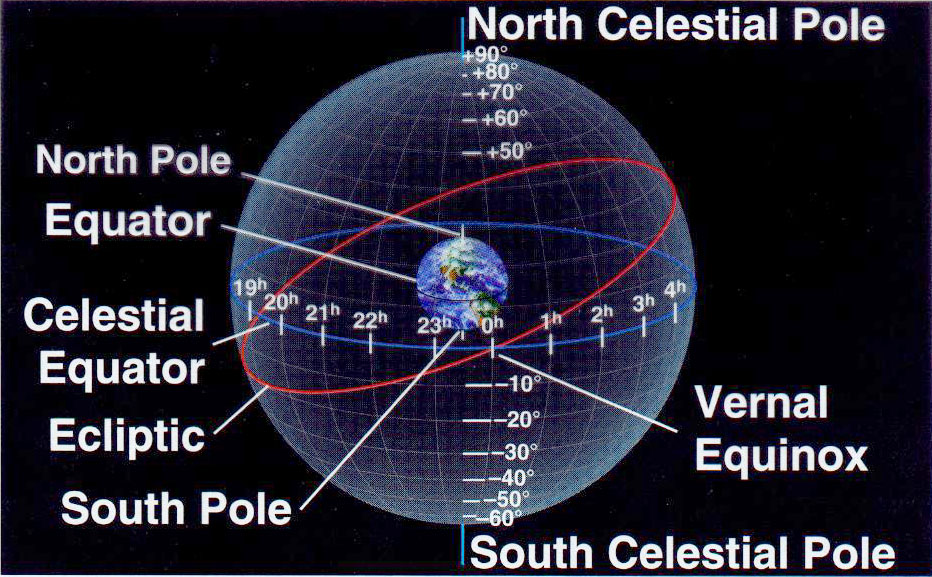
A more detailed image of the celestial sphere appears below with key aspects not found in the simpler version (Fig. 3):
Image result

In this detailed version we see the Earth's north pole is projected to the North Celestial Pole, the equator is projected to the celestial equator, and all latitude lines are projected to become declination lines, while longitude lines become Right Ascension lines. Thus, just as every geographical location on Earth has a latitude and longitude so also every sky location has a declination and Right Ascension.   The "vernal equinox" position, for example, is at 0 degrees Declination and 0 hours RA.  (The vernal equinox marks the  first day of spring.) 

The oblique red circle projected onto the celestial sphere defines the ecliptic or the projected (apparent) path of the Sun onto the celestial sphere through the year.  If we follow the red circle - the ecliptic - UP from the vernal equinox we come to the northernmost point at +23.5 degrees declination and 6h  RA. This coincides with the summer solstice - or when the Sun appears over that latitude on Earth. This marks the longest day of the year in the northern hemisphere

We are led then to consider how to compute star positions on this sphere (which had the designated coordinates of R.A. and declination) and also how to transform between coordinate systems, say between the horizon system and the celestial sphere  (equatorial) system.    

For example, the coordinate system depicted  in the color graphic above - the equatorial system - is based on the projections of the Earth's own equator and N. and S. poles onto the sky sphere.  The poles then become the North and South Celestial poles, and the equator becomes the celestial equator. If these poles are defined respectively at +90 degrees (NCP) and -90 degrees (SCP) and the celestial equator at 0 degrees, then a system of celestial latitude can be constructed.

 Once the vernal equinox position is fixed at 0 hours R.A. then the celestial longitude emerges and spans 24 hours across the same celestial sphere.  (Refer again to color graphic for direction of celestial longitude circles.) These can be used in conjunction with celestial latitude (declination)  to locate any celestial object. It is then possible to make computations translating one system's coordinates to those of others (horizon, ecliptic etc.) 

Example: φ = 51.5 degrees N, for London. Now, for the December (winter) Solstice the Sun is directly over the Tropic of Capricorn (φ  = 23.5 S) therefore we do know its declination is - 23.o5. We have then for the Sun's azimuth at sunrise in London on Dec. 21:

cos (A) = sin (-23.o 5)/ cos (51.o 5)

which gives approximately, 130 o.


  Where is this on our directional reference circle for azimuth? We know that 180 degrees is due South so that this must be: 

40 degrees SOUTH of due East. (90 o + 40 o = 130 o)

Now, on the longest day of the year (say June 21), the Sun is over the Tropic of Cancer at 23.5 N latitude, so the Sun's declination is + 23. o 5 . Then the azimuth for that date is:

cos (A) = sin (23. o 5)/ cos (51. o5)

And A = 50 o

This puts the Sun's rising position North of due E. or specifically 40 degrees North of due East.    


Problem:


The altitude of a star as it transits your meridian is found to be 45o along a vertical circle at azimuth 180o, the south point.  Find the declination of the star.

Thursday, March 15, 2018

Selected Questions -Answers From All Experts Astronomy Forum (Astronomical Coordinates)

Question: I am interested in how astronomical coordinates and angles are computed and the geometry involved. Also can you show an example of how one can calculate a star's declination, say, using known angles?

Answer:

The sub-discipline to which you refer, computing astronomical coordinates, including in differing coordinate systems, is called "practical astronomy".  The term implies little or no theorization just straight out, bare knuckle observations and mathematical computations.  Practical astronomy entails learning about the mechanics of the sky: how to measure angles and reference coordinates, then how to use these to find astronomical objects in terms of their positions, including altitude for the observer, as well as azimuth.

But before one can do all those things, one has to become au fait with the basic sky coordinate systems and geometry, ultimately working in the basic relations for spherical trigonometry. This is merely an extension of plane trig, but to the sort of angles (many > 90 degrees) one finds in spherical or astronomical applications.

A simple illustration of a spherical geometry is shown in Fig. 1. In the diagram, the angle Θ denotes the longitude measured from some defined meridian on the sphere, while the angle φ denotes a zenith distance, or the measured angle from an object to the zenith.


Fig. 2 shows a spherical right triangle from which a host of different angle relationships can be obtained, which can then be used to find astronomical measurements, etc.


Fig.3 shows an actual example of a celestial sphere, such as used in many practical astronomy applications, and some of the key angles with reference to a particular object (star) referenced within a given coordinate system. In some applications, the coordinate system may not need to be changed, but in others it must - for example, when going from the coordinate system applied to sky objects (Right Ascension, Declination) to the observer's own coordinates (altitude, azimuth). In this way, coordinate transformations will also enter and we'll get to those in time.


For now, let's just consider a simply angle relation in Fig. 1, to find the altitude, a. Then if we have the basic geometrical relationship: a + φ = 90 degrees, clearly then a = (90 - φ ).

Let's now examine Fig. 2 and see what spherical trig relationships we can infer.

Two of the key ones embody the law of sines and law of cosines for spherical triangles, which are the analogs of the law of sines and cosines in plane trig.

We have for the law of sines:

Sin A/ sin a = sin B/ sin b = sin C/ sin c

where A, B, C denote ANGLES and a,b,c denote measured arcs. (Note: we could also have written these by flipping the numerators and denominators).

We have for the law of cosines:

cos a = cos b cos c + sin b sin c cos A


Where a, b, c have the same meanings, and of course, we could write the same relationship out for any included angle.

Now, we use Fig. 3, for a celestial sphere application, in which we use the spherical trig relations to obtain an astronomical measurement.

Using the angles shown in Fig. 3 each of the angles for the law of cosines (given above) can be found. They are as follows:

cos a = cos (90 deg - decl.)

where decl. = declination

cos b = cos (90 deg - Lat)

where 'Lat' denotes the latitude. (Recall from Fig. 1 if φ is polar distance (which can also be zenith distance) then φ = (90 - Lat))

cos c = cos z

where z here is the zenith distance.

sin b = sin (90 deg - Lat)

sin c = sin z


Let's say we want to find the declination of the star if the observer's latitude is 45 degrees N, the azimuth of the star is measured to be 60 degrees, and its zenith distance z = 30 degrees. Then one would solve for cos a:

cos a = = cos (90 deg - decl.)=

cos (90 deg - Lat) cos z + sin (90 deg - Lat) sin z cos (A)

cos (90 deg - decl.)=

cos (90 - 45) cos 30 + sin (90 - 45) sin 30 cos 60

And:

cos (90 deg - decl.)= cos (45) cos 30 + sin (45) sin 30 cos 60

We know, or can use tables or calculator to find:

cos 45 =  Ö2/ 2

cos 30 = Ö3/ 2

sin 45 = Ö2/ 2

sin 30 = ½

cos 60 = ½

Then:

cos (90 deg - decl.)= {(Ö2/ 2 )(Ö3/ 2)} + {Ö2/ 2} (½) (½)

cos (90 deg - decl.)= Ö6/ 4 + Ö2/ 8

= {2 Ö6 +  Ö2/ 8)

cos (90 deg - decl.)= 0.789


arc cos (90 deg - decl.)= 37.9 deg

Then:

decl. = 90 deg - 37.9 deg = 52.1 deg

Or, in more technical terms:

decl. (star) = + 52.1 degrees

As can be seen with this example, once the basic geometry of the sky is grasped, relatively straightforward calculations can be used to obtain various astronomical angular measures as well as coordinates.

Friday, November 4, 2016

Measuring Angular Distances In Astronomy


On giving the first ever technical workshop at the Harry Bayley Observatory in 1978, one of the first tasks  of attendees was to build an effective cross staff to measure angles in the sky. This ancient instrument was probably first used as long ago as 400 B.C. by the Chaldeans to make basic angular observations and computations.  One such measurement was to get the zenith distance (φ)  of the pole star, and thereby to obtain latitude. Thus, if  φ = (90 - Lat) then:  Lat =  90 - φ.


The device is relatively simple to construct, as indicated in the link below for any who might be interested:

http://www.phy6.org/stargaze/Scrostaf.htm


But before one can use it one must become familiar with the system of angular measure. Say that one wishes to get the distance between the Moon and Saturn such as depicted in the star map (from my planetarium program) below:


It is useless to use a linear measure such as meters, feet or inches because these have no meaning when referred to the sky, or celestial objects in it and distances between them. So we use degrees. But given degrees are only one unit, and many objects (e.g. double stars) are much nearer, say fractions of a degree, one must be able to use smaller measures too.

As for the cross staff shown in the image above, that is mainly used to measure degrees.  For  a basic cross staff one can generally measure from 15 degrees to 60 degrees with a fair amount of accuracy.  For angular measures up to 15 degrees, and as low as one degree angular measure, one's extended hand - in addition to the stars in the Big Dipper  - provide a useful basis, e.g.


Thus, your pinky finger extended at arm's length equals a 1 degree span. Half of that yields the angular diameter of the full Moon or 1/2 degree. Three fingers extended at arm's length yields a span of 5 degrees, which is also the angular separation between the two stars at the front end of the Big Dipper's 'bowl'.  A fist extended at arm's length yields 10 degrees. (Of course, there will be some  variations, generally + 1 degree due to natural disparity in the size of hands. For a small woman, then, the angular degrees measured as shown will be smaller.)

Let's return to the angular width of the full Moon, and seek out smaller angular units based upon it. An arcminute is 1/30 the width of the full Moon. Hence, we conclude that 1 deg = 60 arcmin.  The arcminute is further divided into 60 arcseconds, which is typically used to measure the distance between components of a binary star, e.g.


Where the separation is in seconds of arc or arcsec. Conveniently, astronomers have learned that if  the semi-major axis of the true relative orbit (e.g. the one displayed if the system is seen face-on) has an angular distance of a" (seconds of arc) and if the system is at a distance d parsecs, then the semi-major axis in astronomical units is:

a = (a" x d)

It should come as no surprise that planetary widths - given they are tiny - would also be registered in arcseconds or ". Thus, the giant planet Jupiter can be seen up to 50" in diameter. Mars will reach 24" in 2018 at a close opposition. Neptune is 2" and Uranus is 4".  (Pluto's angular width is barely 0.1").  To fix ideas, to magnify Pluto's disk to one arcminute width (i.e. 1/30 of the full Moon's diameter) would require a magnification of:

1 arcmin/  0.1 arcsec  =  60 arcsec/ 0.1 arcsec =  600 x

For completeness another angular measure used is the radian.

For example the Sun has an angular radius of a = 959.63 "

But this must be in radians before one can compute the solar constant, for example.

One radian (1 rd) can first be converted into arcsec as follows, given there are 3600 arcsec per degree.:

1 rd = 57.3 degrees = 57.3 deg/rad x (3600"/ deg)= 206 280 "

Then: a  (rd) = 959.63"/ 206 280"/ rad = 0.00465 rad


Problems for the budding astronomer:


1) Two observers using cross staffs obtain zenith distances from their respective locations of   φ = 45 degrees, and  φ =  35 degrees. How far apart in latitude are their locations?

2) Consider the system Epsilon Ursae Majoris which semi-major axis subtends an angle of  2½" and for which the parallax of the system is 0."127. Find the  semi-major axis in astronomical units. (Hint: p"  = 1/d)

3)  What telescope magnification would be required to observe the planet Uranus as a disk 2 arcminutes in diameter?


4) Find the Moon's angular diameter in radians.


Project:

Construct your own cross staff using the directions in the above link, then use it to measure the altitude of the star Deneb in the constellation Cygnus.   Hint: see the star map at:

http://www.space.com/22915-deneb.html